
Comox Valley bus strike puts broader transportation issues into focus
The regional district says it’s working on solutions to help people get around by bus, on a bike or on foot.

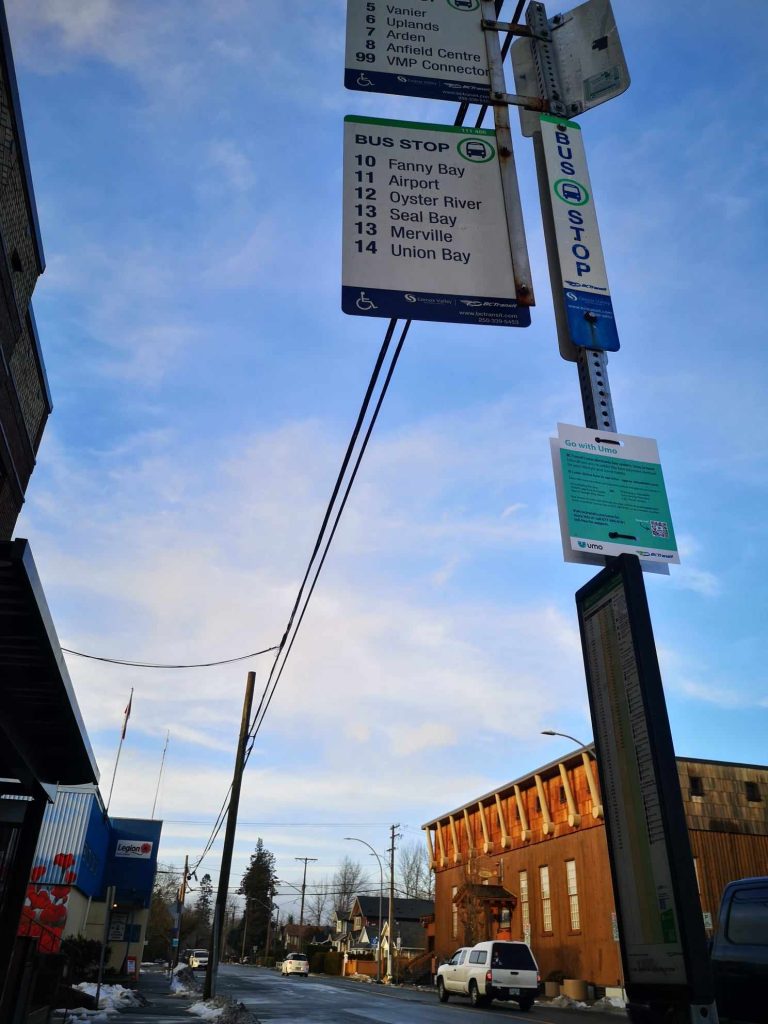
Many Comox Valley residents are still stranded after a transit worker strike brought Comox Valley bus service to a halt.
The strike has been ongoing since Dec. 15, 2023. The striking workers are employed by PWTransit Canada, which holds the BC Transit contract for bus operations in the Comox Valley and Campbell River.
Courtenay resident Emily Macham has needed to adjust to the half-hour walk to her job at Too Good To Be Threw, the thrift store run by Comox Valley Transition Society.
Macham said that although the lack of bus service is frustrating, she understands why workers are striking.
“I support them for what they have to deal with,” she said, adding that she understands the importance of work-life balance for bus drivers, who have people’s safety in their hands.
The transit workers, represented by Unifor Local 114, say they want wages that are on par with other B.C. communities, and that BC Transit has failed to implement a fair compensation system for transit drivers across its network.
The strike is impacting many who rely on public transit, such as students, seniors, people with mobility challenges, and people who don’t drive or cannot afford to drive.
HandyDART bus service, which serves people who cannot access conventional public transit without assistance, is available only for transportation to medical appointments.
This prolonged strike is shining a light on broader transportation issues in the region. Reducing dependency on cars is critical to combating climate change and is associated with other societal benefits, but most Comox Valley households are still heavily reliant on private vehicles to get around. A 2023 study identified significant gaps in the availability and accessibility of transportation on Vancouver Island, particularly for travel between communities.
Mediation could bring an end to the transit strike
In a statement sent to The Discourse, Gavin Davies, National Representative for Unifor, said that Unifor and PWTransit are meeting with a mediator on Jan. 24 and 25 for continued contract negotiations.
Davies said that the mediator will “develop recommendations for each party to take back to the respective sides for ratification. These recommendations are non-binding however, do carry quite a bit of weight.”
PWTransit told The Discourse that they do not have an update on their end of the situation at this time.
Macham is looking forward to the return of transit service. “I am an avid bus user, and I want to continue being an avid bus user.” But the Comox Valley transit system needed improvement long before the strike, she said.
She used to live in Comox, and it took 45 minutes to get into downtown Courtenay by bus — a trip that typically takes 10 minutes by car. She said that buses are also frequently late and occasionally fail to show up.
She does not drive and hopes to continue to be able to use the system moving forward.
“I think there needs to be more bus stops in general, [and] the rides need to be longer to get to more people,” Macham said.
She said she hopes that the system becomes more robust and accessible for the future of the community, adding that she thinks the system has not adjusted for the boom in population the valley has seen in recent years.
CVRD eyes improved transportation networks
In an interview with Discourse on Tuesday, Michael Zbarsky, manager of transit and facilities at Comox Valley Regional District, said that transit in the Comox Valley Regional District (CVRD) is much more robust than the system riders were used to 15 years ago.
He said that the Comox Valley has made improvements in the last few decades, such as increasing bus frequency and extending hours from 6:30 a.m. to 11 p.m.
Zbarsky said that right now the CVRD is focusing on increasing the frequency of buses, but also looking at improving transportation as a whole, including pedestrian and bike paths.
The CVRD completed its active transportation network plan implementation strategy on July 21, 2023. The plan aims to increase the accessibility of active transportation, which is any self-propelled mode of transportation, such as cycling or walking.
“Some people will never ride a bus, but they’ll take a bike out if you provide them with good infrastructure,” Zbarsky said.
Macham said that improving the local transit network would be a great way to cut down on traffic congestion in the Comox Valley, and specifically in Courtenay.
“If you’re able to stretch the transit system to make it more accessible to people, more and more people will use it,” she said.
What did you think of this story?
Your feedback after we publish a story helps ensure we're always improving our reporting to better serve you
Author

Related Articles

Courtenay mayoral candidates on water conservation strategies amid worsening drought conditions
For the second time this year, Courtenay residents see Level 3 water restrictions, days before the Oct. 17 municipal election.
Comox Valley local candidates on housing affordability
Candidates in Courtenay, Comox and Cumberland share how they’d support housing affordability and increase the supply of affordable housing.

Comox Valley candidates on supportive housing, second-stage housing and warming centres
Candidates in Courtenay, Comox and Cumberland share how they’d support adding supportive housing beds, second-stage housing and warming centres.