
Comox Valley commute to ease soon as sewer conveyance project wraps up on schedule
‘New pipe is 98 per cent in the ground,’ according to regional district
This story is the first in a series about Comox Valley’s sewage. Do you have any thoughts you want to share about sewage management? Issues you’re concerned about? Something you’d like us to dig into? Email madeline@thediscourse.ca to share.
It has been four years since the Comox Valley Sewage Commission approved the Sewer Conveyance Project.
The large-scale construction project involves upgrading pump stations and replacing the pipe that transports raw sewage to a treatment plant in Comox. But for locals, the project also means getting from Courtenay to Comox has been a little more complicated, and involves a lot more zipper merging.
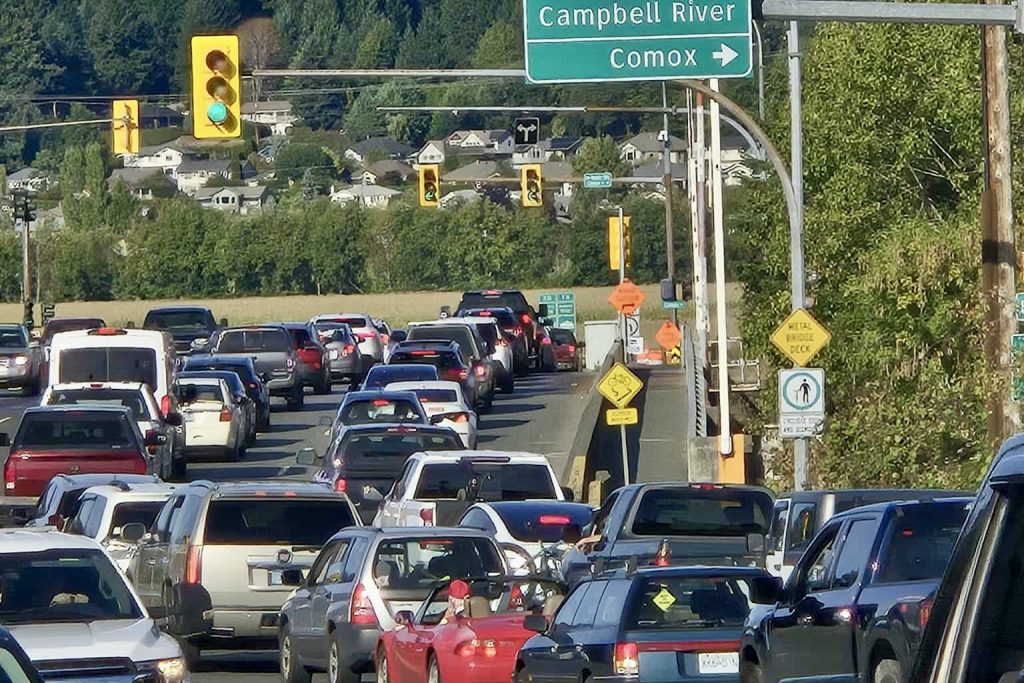
The biggest interruption for most residents has been the one-way closure of Comox Road — known to most locals as the dyke road — leading to gridlock traffic for those who want to get from downtown Courtenay to East Courtenay or Comox, on the east side of the 17th Street Bridge.
The project also led to more than 100 news releases from the Comox Valley Regional District (CVRD) detailing construction updates and traffic information since July 2021, as well as a few satirical news stories from the Comox Valley’s satire news Facebook page, the Puntledge News.
But Comox Valley residents can look forward to a calmer commute as road work related to the Sewer Conveyance Project is set to be completed on schedule this fall. The CVRD also told The Discourse that most residents have been understanding of the environmental importance of the project.

Current pipe poses environmental risk to surrounding waters
Every day, 14,000 cubic meters of raw sewage is transported through a pipe to a sewage treatment plant in Comox. The pipe that transports wastewater from the communities of Courtenay, Comox and K’ómoks First Nation to the Comox Valley Water Pollution Control Centre was getting old and was flagged for having capacity issues and exposure risk.
According to the CVRD website, wastewater flows daily through that pipe which is located along the Willemar Bluffs, an exposed section of beach that is vulnerable to waves, rocks and logs.
Charlie Gore, senior manager of capital project delivery for the Comox Valley Regional District told The Discourse the old pipe along the bluffs poses an environmental risk to all of Baynes Sound, the nearest narrow channel of water that lies south of the K’ómoks Estuary. The sewer system upgrades, Gore explained, will decommission the old sewer pipe and move the new one out of the foreshore both at Willemar Bluffs and the K’ómoks Estuary.
Gore said the pipe is similar in age and structure to one that exploded in Calgary last summer, when a state of emergency was declared after a pipe that supplies most of Calgary’s drinking water ruptured. The pipe in Calgary was built in 1975, whereas the sewer pipe being decommissioned in the Comox Valley was built in 1982.
“Engineers have known for a long time that the pipe poses a risk,” Gore said.
He said the Calgary water line is not the only one that has had recent issues. In 2024, a water pipe of the same materials as the pipe being decommissioned in the Comox Valley — concrete and steel — burst in Montreal.
“Worst case scenario would be for that pipe to rupture,” Gore said about the one in the Comox Valley. “We don’t want to put Baynes Sound at risk because of this pipe. So this is a preventative measure in terms of environmental risk and an upgrade that is required to manage the wastewater flows of our growing community.”
Gore was clear that there is no indication the current pipe has ever leaked into Baynes Sound, and this project is a precautionary measure. He added that sewage is continuing to flow through the old pipe until the new pipe is commissioned, then the old pipe will be decommissioned.
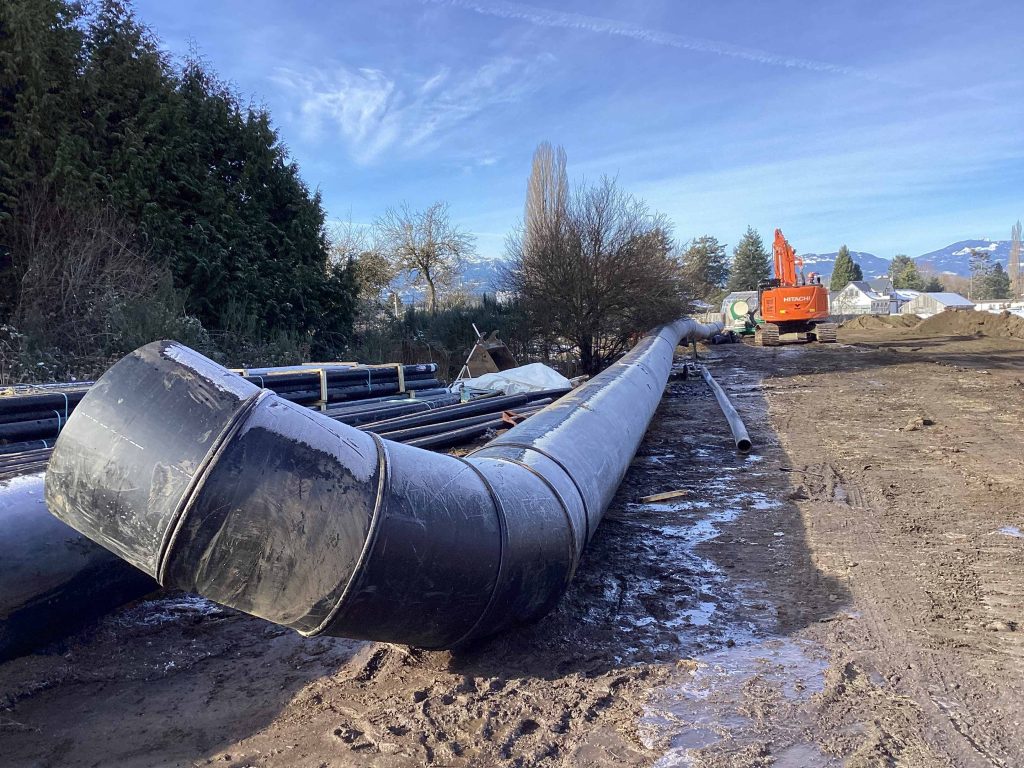
The new pipe is made of a material called high density polyethylene, which is a hard plastic that does not corrode and is very abrasion resistant, Gore said.
With the old pipe, Gore said corrosion can happen in small areas, eating through the concrete and getting to the steel inside the concrete. He explained that the pipe is made of a layer of concrete, then steel, then another layer of concrete.
“Once the steel is compromised, it loses its strength very quickly,” he said.
The new pipe, he explained, is “completely homogenous, there’s no different layers in it … so there are no joints or weak spots.”
Project finishing on schedule
Now, after months of traffic issues and years of work on the project, the installation of the new pipe is set to be completed on schedule, with traffic getting back to normal soon as well.
Gore said the new pipe is already 98 per cent in the ground.
“We’re on schedule,” Gore said, adding that the CVRD had initially forecasted major road interruptions lasting into Fall 2025.
Gore said major interruptions on Comox Road were supposed to begin in January this year, but were able to be avoided until March. The roundabout work on Comox Avenue, which is being built by the CVRD on top of the new sewer conveyance pipe, is also ahead of schedule which means major road construction is expected to finish this fall instead of having more disruptions in 2026..
He emphasized that this prediction is weather-dependent.
There will, however, still be some construction next year at the pump stations in Comox and Courtenay.
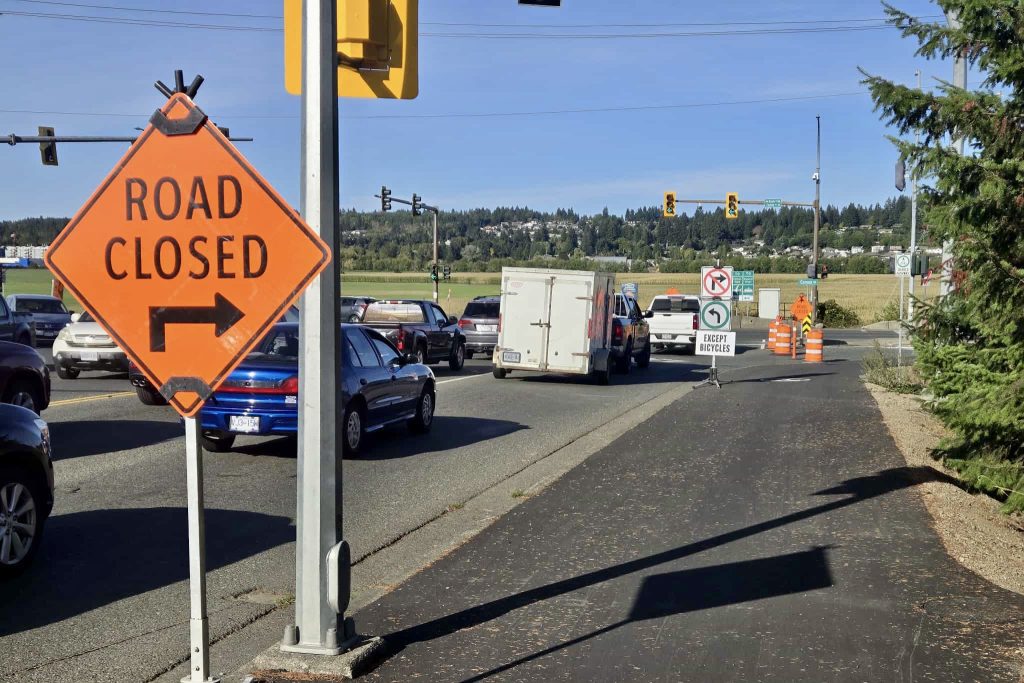
Gore said he understands the road work has been challenging for many commuters.
“A lot of people live and work or have kids activities on either side of this construction zone and have just been in this traffic jam for eight months,” he said, adding that he empathizes with that frustration.
“We’ve done everything we can to minimize that pain, but it’s been painful.”
Despite the construction woes, Gore said the community has been “extremely patient, kind and understanding. They’ve shown a lot of grace and appreciation to our crew out there.”
“I think people understand why we’re doing it,” Gore said. “People don’t want an environmental disaster.”
What did you think of this story?
Your feedback after we publish a story helps ensure we're always improving our reporting to better serve you
Author

Related Articles
Voting in the 2026 Comox Valley local elections? Here’s what you need to know
Where, when and how to cast your ballot in the Comox Valley for the 2026 local elections.
How will Comox Valley local candidates balance growth and environment?
Candidates in Courtenay, Comox and Cumberland share how they’d balance infrastructure, transportation and housing needs with environmental protection.

Comox Valley local election candidates on walking, cycling and active transportation
Candidates in Courtenay, Comox and Cumberland share how they’d support the continued build-out of active transportation.