
To boost local food production, this Comox Valley nonprofit restores salmon habitat
LUSH Valley takes ‘a food systems approach’ to nurture a resilient future for farms in the Comox Valley.
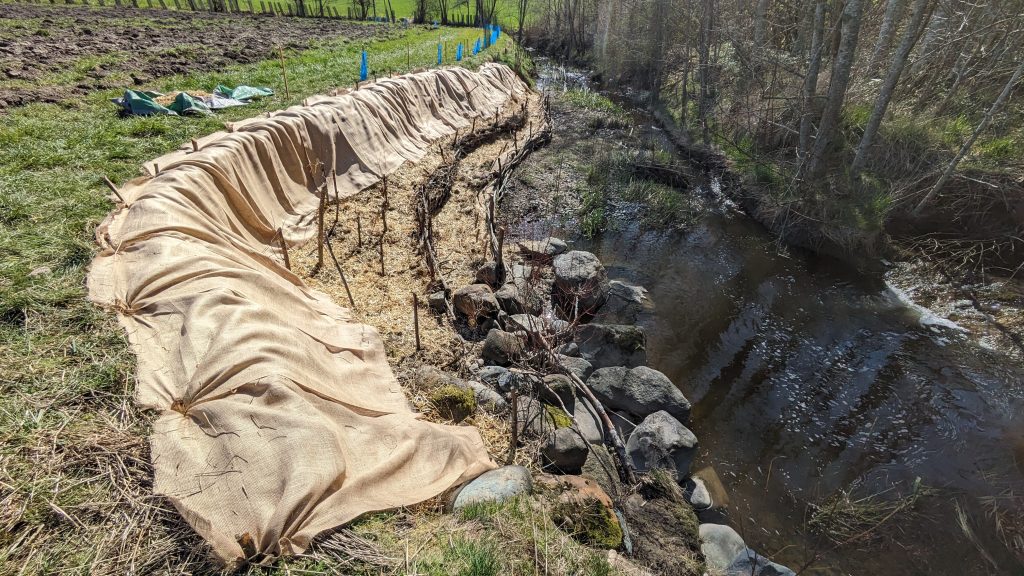
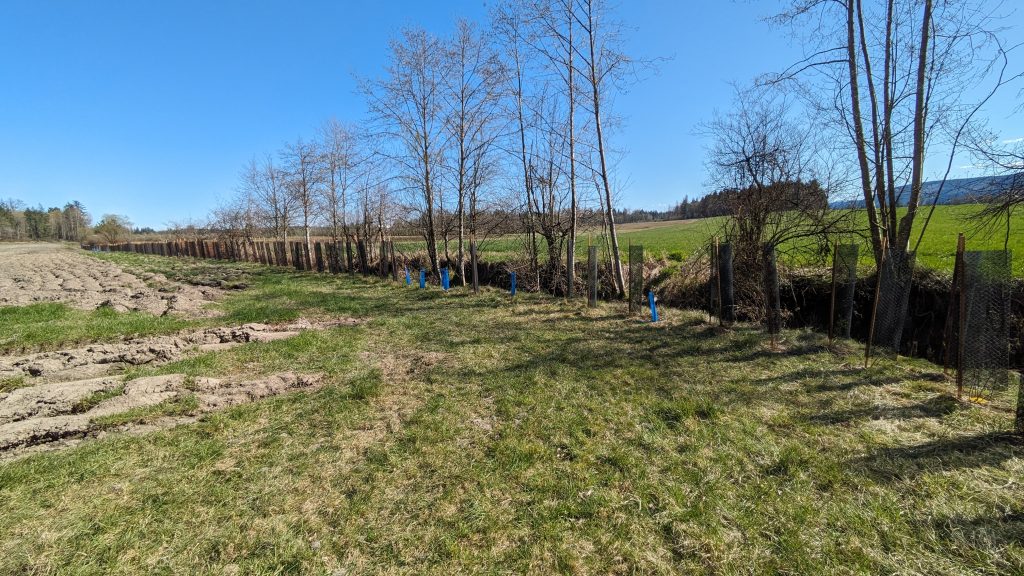
In Comox, Brooklyn Creek winds through century-old cow pastures at Birkdale Farm. And in one stretch, a three-meter-wide tangle of invasive Himalayan blackberry lines the creek. With no opportunity for native plants to thrive and establish, the creek has become unwelcoming to juvenile salmon, as well as drier in hotter months.
Over time, the adjacent farmland was losing its key asset: a healthy stream to support the soil through summer droughts.
It was exactly the kind of challenge local nonprofit LUSH Valley knew it could work to solve.
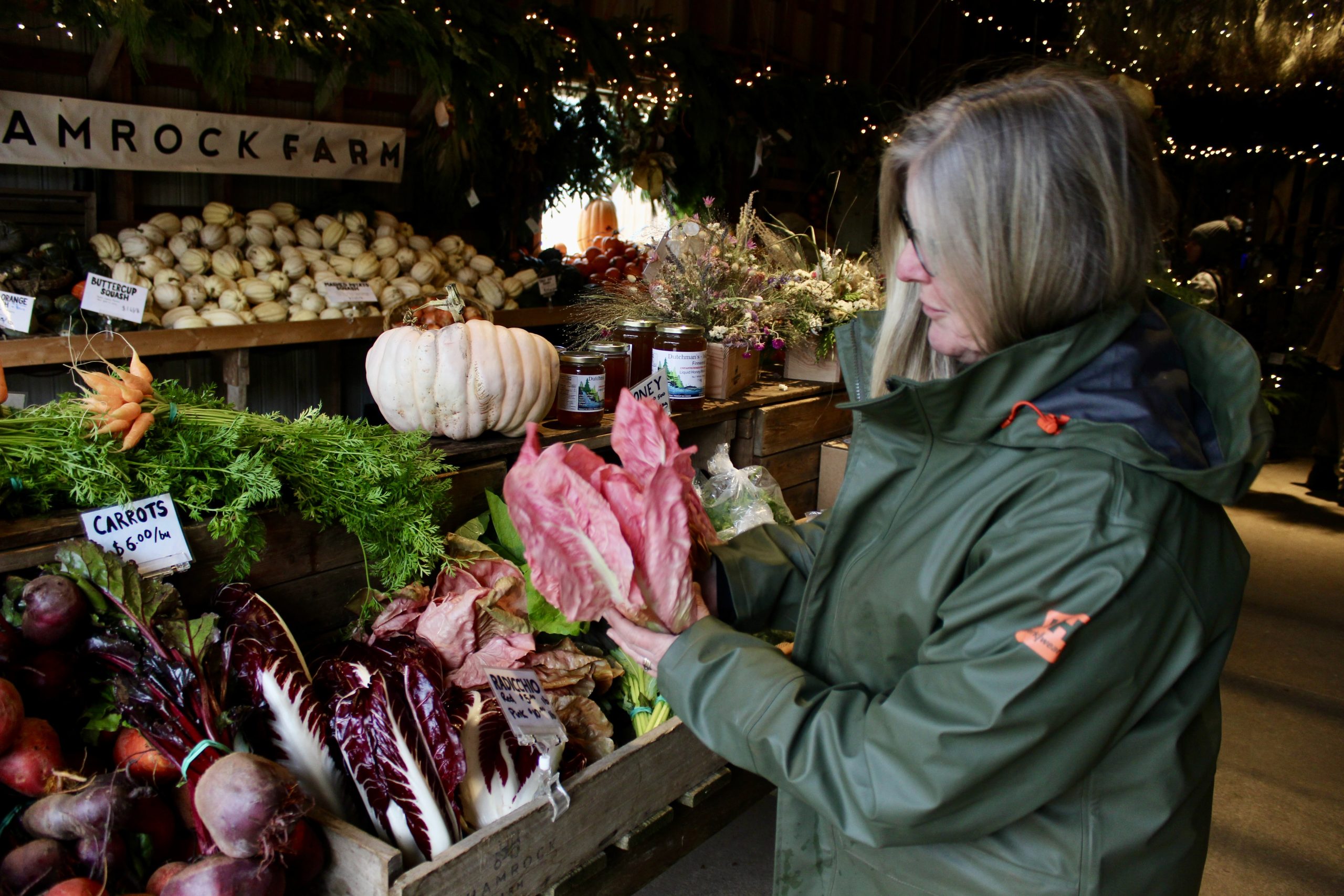
For those familiar with LUSH Valley, it may come as a surprise to learn that the non-profit society undertakes farm restoration work. LUSH is best known for its local produce boxes, tree fruit gleaning and other initiatives that bring food to the kitchens of Comox Valley residents. The name stands for Let Us Share the Harvest, which for the nonprofit and its team of nine staff begins with soil, water and sunlight.
“We take a food systems approach,” explains executive director Maurita Prato. “From how it’s grown to how it gets to our plates.”
Over the past four years, LUSH has worked with Origins Environmental to restore several farms in the Comox Valley. The needs vary between farms, but range from bank stabilization to reviving riparian corridors.
Most recently, a team of volunteers removed 780 square meters of invasive species, such as blackberry, from the Birkdale Farm streambank.
In its strategic plan, the society “talks specifically about climate change and regenerative practices,” Prato says.
When farmers implement practices that also provide ecological benefits, they can see increases in soil health, water resources and carbon absorption.
“The flip side of that is also true,” she adds.
A report that explores Comox Valley food systems through a climate, biodiversity and health lens notes that while agriculture relies on healthy ecological conditions, it is also a threat to species due to its considerable water and land use and the impact harmful pesticides and fertilizers can have on freshwater and coastal ecosystems.
“Healthy freshwater systems are essential for both agriculture and the survival of wildlife species, positioning water and watershed protection strategies at the intersection between agricultural productivity, climate adaptation and biodiversity conservation,” the report says.
As recently as August 2023, 45 license holders in the Tsolum River watershed were ordered to stop “using water for forage crops, which include grass for hay, alfalfa and forage corn,” due to persistent low stream flows that threatened the survival of salmon and trout, according to a statement from the province.
That year saw extreme drought conditions that affected river levels across Vancouver Island.
A summary report on a discussion about drought management in the Comox Valley says local farmers expressed that drought conditions in 2023 led to yield decreases, crop loss and livestock reductions.
They had to purchase off-farm forage crops to feed livestock, forcing farmers to either raise prices and/or reduce the size of their herd or flock.
Farmers shared a need for on-farm water storage solutions, particularly when irrigated water is scarce due to water restrictions. They also shared a desire for improved communications with government (and between government ministries) regarding water licensing, regulations, restrictions and the “interconnected nature of climate change impacts.”
LUSH Valley focuses on environmental connectivity
To see the unrealized ecological benefits that come from ecologically-minded agricultural practices, some Comox Valley farms are in need of restoration. Brooklyn Creek provides habitat for spawning salmon and countless other creatures, says Elodie Roger.
Roger is a registered professional biologist and the owner of Origins Environmental Services Ltd., specializing in wetland and riparian ecosystem restoration. When people talk about protecting salmon habitat, “they are often talking about the aquatic habitat,” Roger says. The adjacent riparian area is often overlooked.
A functioning riparian corridor at Birkdale Farm would include a tree canopy overhanging the creek and healthy native vegetation. These provide food, shelter and areas for salmon to hide from predators.
Plus, vegetation creates optimal conditions in the water, such as lower temperatures and increased available oxygen, which in turn raises salmon’s chances of survival, Roger explains. Salmon would also benefit from more continuity of habitat through the watershed.
As creeks dry out in summer, Roger says “we lose that connectivity” and juvenile salmon can become isolated in small pools and eventually may die.
“Salmon are a keystone species at the heart of our ecosystems that many other animals depend on,” Roger says. And farmers can benefit from healthy riparian areas, too.
How does the farmer benefit?
For the farmer, a healthy riparian corridor provides cleaner, more reliable water by filtering pollutants and mitigating erosion during high-flow events.
Water would move more slowly on the land, Roger says, “allowing more water to percolate into the ground,” and helping to maintain steady groundwater levels that support crop health.
On some Island farms, erosion is a real problem. Strong root systems stabilize stream banks, prevent soil loss and reduce flood damage to farmland, saving farmers lost acreage during high water events.
At Birkdale Farm, the first step in restoration included a site assessment. Roger says the site was a good candidate because of the fish in the stream. Plus, in-stream restoration activities were already taking place along the creek through Current Environmental and Brooklyn Creek Watershed Society.
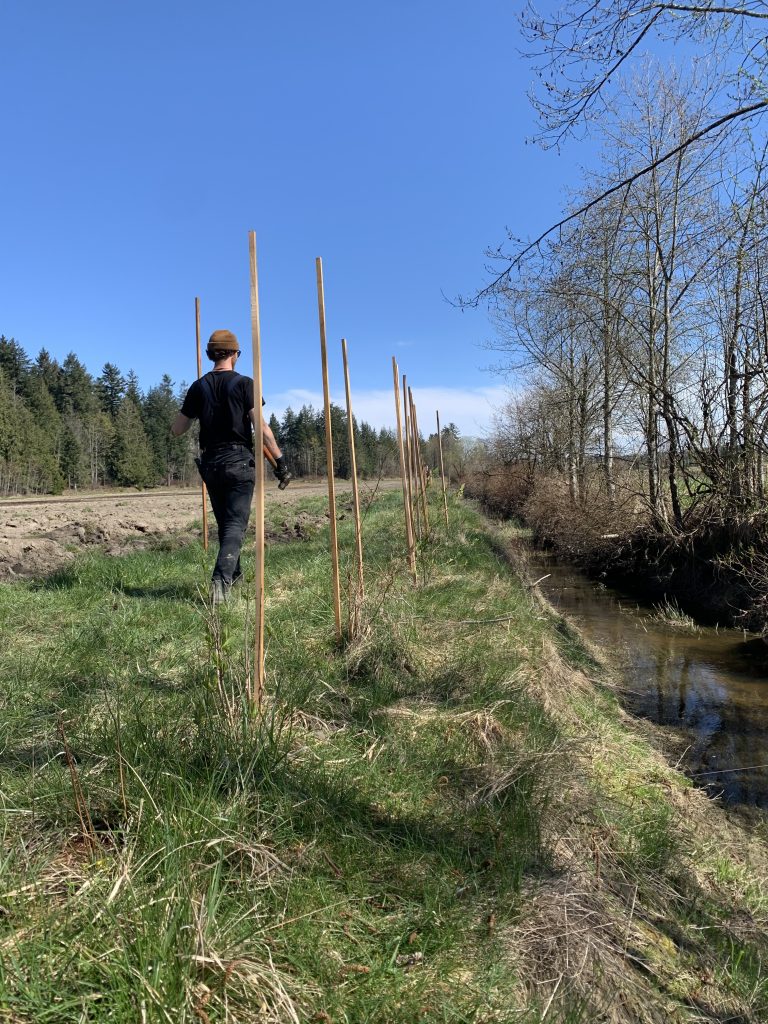
This fall, Roger and LUSH Valley pulled the equivalent of about 50 parking stalls of invasive blackberry and replanted the area with 450 native plants. According to LUSH Valley, volunteers will plant another 150 stems over the winter to establish a canopy over the creek.
Funding for the work came through the British Columbia Salmon Restoration and Innovation Fund, a provincially and federally co-funded program that supports protection and restoration activities for salmon.
Restoration work brings measurable successes
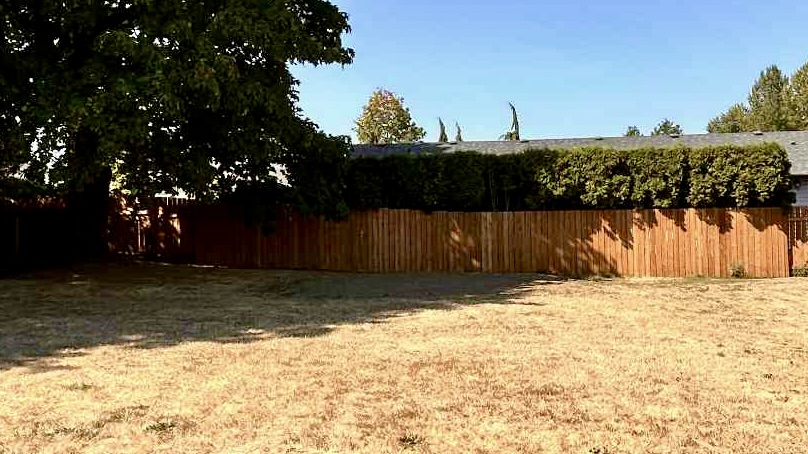
One way to measure success at Birkdale Farm is to add up the amount of restored riparian area. Roger notes that once you “make the environment inviting and provide everything the salmon need, they will come back naturally.”
“In 10, 20, 50 years from now, I’m hoping we can look back and do more fish surveys and notice the return of salmon and notice every year, more eggs in those spawning areas.”
LUSH undertakes restoration work at various farms along Black Creek as well, and farmers are excited to have this work done, LUSH’s Prato explains.
“Ultimately, farmers really understand the relationship between the health of the land and the health of their own livelihoods.”
And it’s not something they could undertake without the help from government-funded programs and LUSH’s volunteers and community partners, she explains.
“It’s been a great partnership,” Prato says about the work with Roger and Origins Environmental. “We’ve been able to get a lot of work done together.”
“I hope we can continue and increase the work because there is so much needed,” she adds. “It’s a really important and sometimes overlooked component of food systems.”
The work that LUSH undertakes relies partly on funding support from the community and work by volunteers.
“With the community’s support, we can keep saying yes to those who need us and nurture a more just, resilient food future,” Prato says.
What did you think of this story?
Your feedback after we publish a story helps ensure we're always improving our reporting to better serve you
Related Articles
Comox Valley, Nanaimo land trusts raising funds to support Deep Bay land conservation purchase
In a partnership with the Comox Valley and Nanaimo Area land trusts, BC Parks Foundation is fundraising to protect 50 hectares of pristine shoreline in Deep Bay and make it accessible to the public.
Community collaboration gives second chance to beloved dinghy in Comox
In a race against time to bring a public flower installation to life, Emily Yewchuk leans on support from Comox Valley’s Project Inclusion to make it a reality.
How is The Discourse’s journalism funded?
And what does it cost to produce The Discourse’s in-depth, independent journalism?