
Much needed expansion underway for Cowichan Valley Basket Society
The upgrade proposal comes at a time when food insecurity in the region keeps climbing.
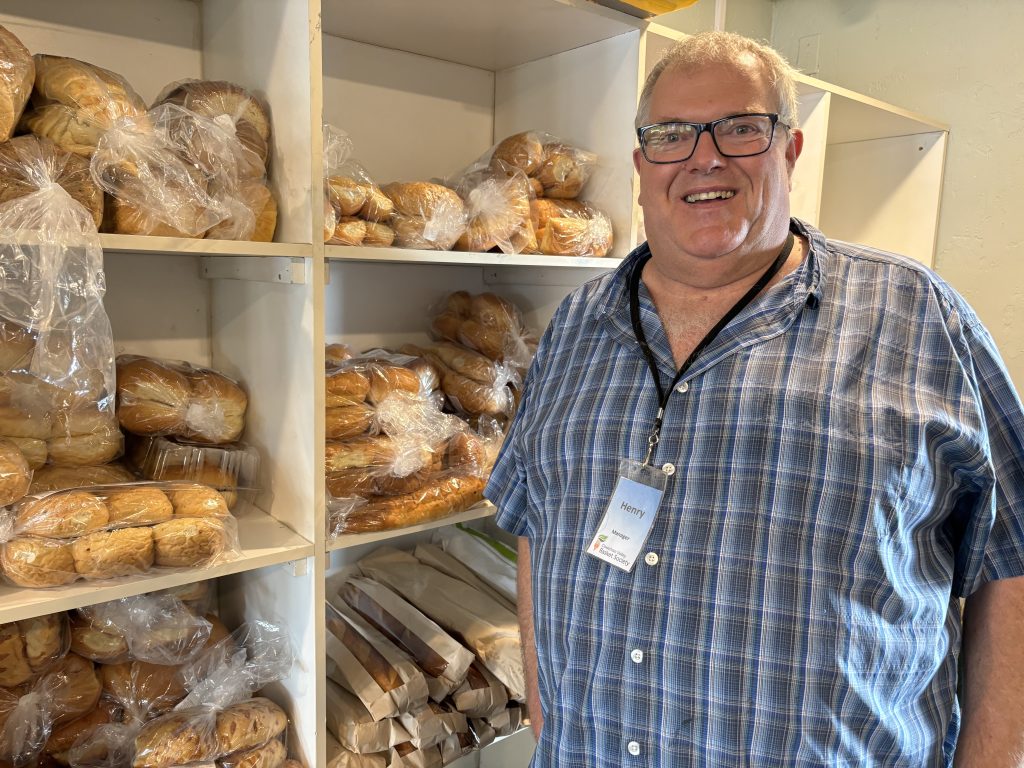
When Henry Wikkerink provides a tour of the Cowichan Valley Basket Society (CVBS), he comes off less as its manager and more like a jolly, gracious host.
Walking through the dining room where guests receive a hot lunch and out into the courtyard where men and women gather, Wikkerink greets every regular by name and shares the odd inside joke.
“We call them guests, because we want them to feel welcome here,” he says. “And it just sets that attitude for how you treat guests in your home.”
It’s a cheery place, but when he sits down to talk in his office, the reality of increasing food insecurity underlies the jovial atmosphere.
Today, one in five Canadians use, or know someone who uses, food bank services according to a 2024 national survey. The BCCDC defines food insecurity as when a household worries about or lacks the financial means to buy nutritious, safe, personally acceptable foods.
Wikkerink says there is no choice but to expand, as the Basket Society is running out of room to accommodate the growing number of people in need. The current location on Garden Street in Duncan has been operational since 2001, and is a beehive of guests and volunteers navigating a small space. In the backyard sit large metal shipping containers where extra food is stored.
“We’ve maxed out everything that we do,” Wikkerink says. “We got as efficient as we can.”
In 2022, Cowichan Valley Basket Society bought the property next door, a move that would greatly increase storage, food recovery, kitchen accessibility and access to hampers for people in need.
Wikkerink says that in 18 months, food hamper distribution has rocketed 200 per cent, with approximately 600 hampers now distributed out of the food bank each month.
“We have about 2,500 people in our database that have been served in our program over the last year,” Wikkerink says. “So if you base that on the community numbers, I mean, it’s hard to say how big a community we serve.”
Related story: Food bank usage doubles while funds for food programs grow scarce
Cowichan Valley Basket Society is multi-tasking to feed the community
A 40-something guest named Jack stands in the backyard lounge and says, “It’s beautiful. They cook good food every day. They’re really caring.”
Now in its 36th year, the Cowichan Valley Basket Society operates in a number of efficient ways to feed as many community members as possible.
On top of providing food hampers for families, CVBS repurposes goods from the community and from local grocery stores that need to clear shelves for newer products. In this food recovery cycle, items like produce, dairy and meat that are still perfectly safe for consumption find their way inside hampers and into hot meals, instead of going in the trash.
In the basement where food hampers are assembled, Wikkerink opens an industrial fridge to reveal a variety of cheeses, stacks of yogurt containers and rows of milk cartons.
“We get milk from the grocery stores past expiry date,” he says. “But it’s still good milk, right? Just they can’t sell it anymore.”
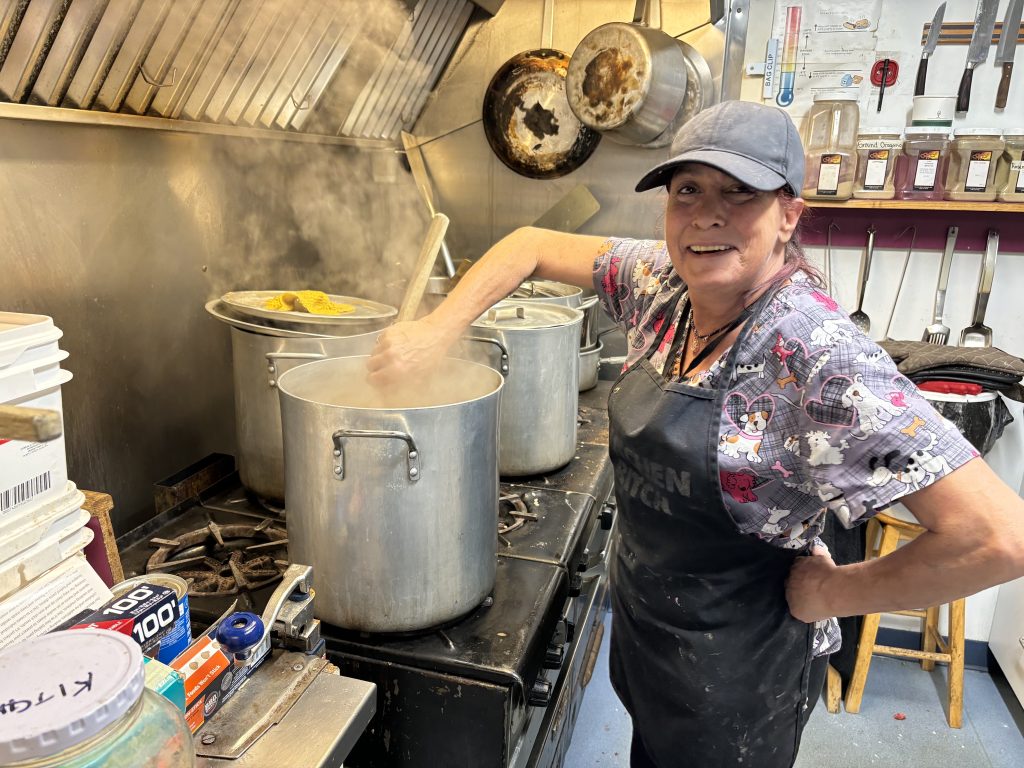
The Cowichan Valley Basket Society dining room serves a hot lunch six days a week, and this is often the only meal of the day guests can count on as they navigate hardship. The cooks are at the mercy of what ingredients come in, but they get creative in repurposing food for nutritious meals.
“The other day, we had a bunch of salmon come in, and one of our cooks is really good with it. So we were serving salmon out here with rice, and we have a full salad going on today,” Wikkerink says.
Simone Conner runs the Sunday Sandwiches program from the backyard of the Basket Society. The lunch initiative offers people a meal on Sundays and holidays when the dining room is closed. Volunteers provide sandwiches, coffee, fruit, vegetable bags, hard boiled eggs and snacks to about 200 people, including youth, seniors and families..
“There’s no consistent access to food in the Cowichan Valley on Sundays and statutory holidays,” Conner says. “This was bridging the gap of the work [Henry] was doing, and allowing his volunteers to have days off and not feel the weight of the world on their shoulders.”
Related story: Duncan Farmers’ Market calls for expansion to nutrition coupon program
Food bank guests are more diverse than ever today
“I’ve been out on the streets a few times and I’m glad we got this place,” one of the food bank guests says. The Discourse is keeping them anonymous to protect their privacy. “We got cover to stay out of the rain.”
Jack, a regular to CVBS, has his own apartment and works from job-to-job.
“This helps big time, because sometimes we don’t have the lunch for work,” he says. “Plus, I have a nephew, niece and a granddaughter that come to my place, so I get extra because sometimes they come around and they’re hungry.”
The food bank regular of today could be anyone, and does not just include people who are unhoused or precariously housed. Inflation, housing inaccessibility, increasing living wage with jobs that don’t match it and rising substance use are all contributing factors that could lead to food insecurity, according to Wikkerink.
At Cowichan Valley Basket Society, there are single parents with children, seniors, and groups of working men and women who need help acquiring nutritious food.
Many are one bag of groceries or one month’s rent away from needing the Basket Society in some way. Wikkerink says the stigma of attending a food bank might be softening because almost everyone is experiencing a high cost of living today.
“We see young families, we see youth. We get lots of seniors in here because a spouse has passed away so they’re trying to keep a roof over their head,” he says. “I had a lady come in today, she’s middle-aged, she’s got three kids, she’s a working person. So they’re working, but you’re just not getting enough with the way rates are.”
Conner adds, “The reality is more people are housed and just struggling with food security than are unhoused.”
With the CVBS expansion, the goal is to accommodate more numbers and offer guests a safe place without the stigma associated with needing help. Wikkerink tells me that growing the food bank is a positive direction, but broader solutions are needed.
“I know people that are in this Valley, that after their housing, they may get three or four hundred bucks after that to live on,” Wikkerink says. “And that’s to pay their cell phone bill.”
The power of choice
At the Basket Society, Wikkerink walks into an office that holds a refrigerator full of perishable items and has shelves of packaged food on the wall. It looks like an aisle of a small convenience store, where people can actually see the food they might need. Here, the guests choose what they want in their food hamper by checking off items from a nearby computer desk. From there, the order is printed in the basement and the hamper is assembled and brought to the guest.
With the expansion, the freedom of hamper item choices will expand with it, eventually to the point where guests can shop for their goods with a cart, as if in a grocery store. It’s a model that many food banks are adopting, and one that Wikkerink is excited about.
Asking for a food hamper can be a very vulnerable experience. But when guests have the ability to pick what goes into their hamper, they can gain a sense of agency and dignity.
“It’s empowering people by giving them choice, it takes away some of the stigma, and also it makes food go longer,” says Wikkerink. “They get stuff that they want, they know how to use, and they’re happy to use.”
A 2021 study by Food Banks Canada found that “the choice model was particularly helpful for people avoiding certain foods for medical reasons, such as following a diabetic-friendly diet or managing a gluten allergy, as well as cultural and religious reasons.”
Simone Conner also gives guests the power to choose their lunch bags each Sandwich Sunday and says it improves the experience of accepting food.
“It’s giving people the ability to be empowered and to not feel like they’re getting a handout,” she says. “People often say that ‘this reminds me of what my grandmother used to make, or this was my favourite sandwich growing up.’”

An expansion for an ever-growing need
According to Food Banks Canada, in 2023 almost two million people visited a food bank in the country in the month of March alone. Last year, there was a 79 per cent rise in food bank usage since 2019, making it the highest usage rate in Canada’s food bank history.
The Cowichan Valley Point in Time Homelessness Count surveyed 223 individuals in the region who identified as homeless. Of those 223, 49 per cent had experienced some form of homelessness before the age of 25. As for the region’s children, the Child Poverty Report Card from First Call Child and Youth Advocacy Society found that in 2021, 17.3 per cent of Cowichan Valley children lived in low income households.
These statistics are directly related to local food bank usage, as more and more people seek support to make ends meet. Last year, CVBS distributed more than 4,800 food hampers to help 2,500 unique individuals.
Even though the Basket Society has maximized its current space, the purchase of the property next door will help meet the ever increasing demand for food assistance.
Wikkerink says the expansion will begin next year by joining the two buildings and creating a comfortable 250 square foot lobby where people can gather. The second phase of the expansion will build a 3,000 square foot hamper store, a large food recovery area, a second floor dedicated to programming and larger storage and refrigeration spaces. The final phase of expansion will upgrade the kitchen and dining room.
The Cowichan Valley Basket Society’s goal is to raise $950,000 and complete the project by 2026.
What did you think of this story?
Your feedback after we publish a story helps ensure we're always improving our reporting to better serve you
Author

Related Articles
What to do and who to call when juvenile salmon are in danger
Officials say Cowichan Valley residents should call experts to move salmon in isolated pools because of risks associated with relocation.
How is The Discourse’s journalism funded?
And what does it cost to produce The Discourse’s in-depth, independent journalism?
Behind the backlash to the Cowichan Valley’s comprehensive zoning bylaw
The campaign against Bylaw 4710 was fuelled, in part, by misinformation and an organized group of advocates. What could this mean for the future of local politics?