
Fierce debate emerges over progressive vote-splitting in Cowichan Valley ridings
Some say they’re considering a ‘strategic’ vote on April 28 — hoping to keep a progressive MP in the electoral district.
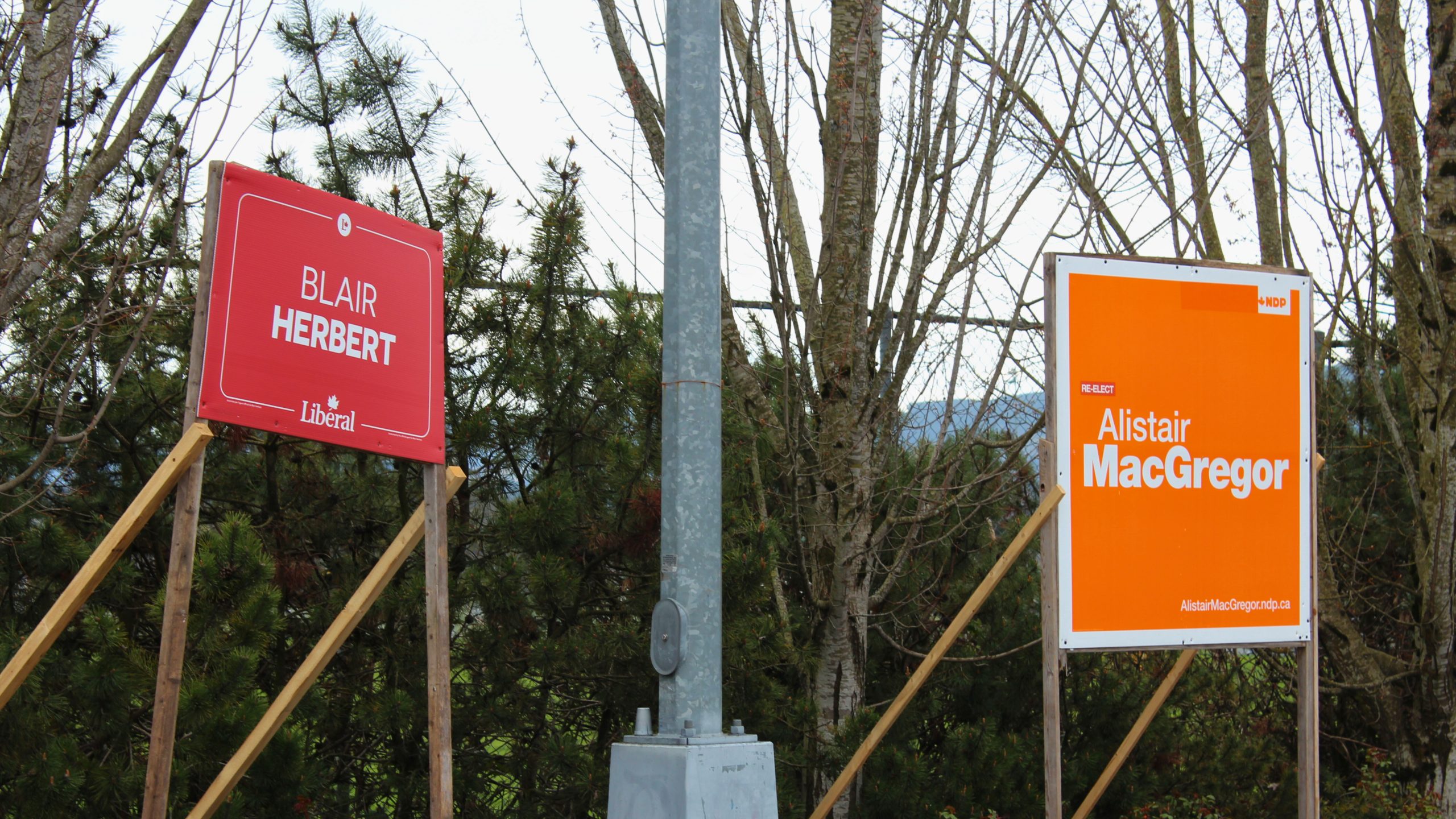
In several Cowichan Valley Facebook groups, some progressive voters are fiercely debating which candidate should get the non-Conservative vote on April 28.
Right now, according to polling aggregator 338 Canada, early voting intention appears to be split down the middle between the incumbent NDP candidate Alistair MacGregor and the Liberals’ nominee Blair Herbert.
Each is estimated to have just under 30 per cent support among voters — with the Greens’ Kathy Code trailing at around four per cent. (The predictions are a weighted average of other polls; 338 Canada estimates its NDP and Liberal forecasts are accurate within six to seven per cent).
As a result of a predicted Conservative victory in the riding, some are even arguing that one of the candidates should step aside to give progressive hopefuls a fighting chance.
“I’m suggesting Blair and Alistair sit down over a beer and decide who’s supporting who,” said one user on Let’s Talk Politics in the Cowichan Valley, a public Facebook group with more than 1,000 members. “Flip a coin, rock-paper-scissors, whatever.”
With 338 Canada forecasting the Conservatives’ Jeff Kibble to have roughly 38 per cent support in the riding — and the federal election less than two weeks away — current projections show a competitive race between the Liberals, Conservatives and NDP in Cowichan—Malahat—Langford.
“People are free to vote how they wish, and I’m hoping that they’re going to support our campaign,” Kibble told The Discourse when asked about strategic voting in the riding. “There’s so many different polls that show different things that I’m not really worried about it.”
As the conversation around strategic voting ramps up to keep a progressive seat in the region, some experts say the vote could go in any direction. In that context, political literacy, advocacy and showing up to vote could make all the difference.
“Either of these candidates would represent this riding far better than the Conservatives and the majority support that view,” another user said in a Facebook post.
“Something needs to give, or everyone loses.”
Vote split for progressive candidates in Cowichan—Malahat—Langford
NDP candidate and incumbent Alistair MacGregor says a vote for him is the best way to defeat the Conservatives in Cowichan—Malahat—Langford.
MacGregor has been MP in the region for 10 years, with Conservatives receiving significantly less support during that time.
Current projections from polling aggregator 338 shows the Conservative Party candidate Jeff Kibble in the lead to win Cowichan—Malahat—Langford, with the NDP and Liberals trailing behind and fighting for second place.
“People are free to vote how they wish, and I’m hoping that they’re going to support our campaign. There’s so many different polls that show different things that I’m not really worried about it,” Kibble said when asked about strategic voting in the riding.
“Look at the past three election results,” MacGregor told the Discourse in an interview. “This riding has always been a race between New Democrats and Conservatives, and the Liberals have always been a distant third, sometimes fourth.”
Historically, the NDP maintained a significant lead in the riding in the 2019 and 2021 federal elections, defeating the Conservatives by 10 points or more. But at the time of publishing this story, the NDP’s MacGregor was lagging behind the Conservative’s Kibble by nearly double digits, and only a few points separate MacGregor from the Liberals’ Blair Herbert .
Herbert argues that voters should choose him if they want to be strategic and keep the Conservatives out of power, since Liberal Party of Canada polling numbers are on the rise at the national level.
“We’re on our way up, Alistair’s on his way down, and they’re trying to stop the slide,” Herbert said. He suggests his party’s spike in popularity could be due to centrist- and progressive-leaning conservatives moving over to the Liberal camp.
According to 338 Canada’s forecast, the Liberal Party has only a one per cent chance of winning the riding, and the NDP a four per cent chance. Meanwhile, early projections suggest the Conservatives have a 95 per cent chance of winning there.
MacGregor said the federal NDP’s track record of pushing the Liberals to adopt more progressive policies — such as a national dental care plan — is why residents concerned about vote splitting should actually vote for him. He also pointed to his long experience serving the region for the past decade.
“They can see all of the things that I have fought for,” he said, “and I think in this environment, especially with the threat from Trump’s tariffs, I don’t think this riding can afford to vote split.”
Herbert said he tries not to worry about what polls and polling aggregators like 338 Canada are saying. He prefers to gauge voters’ reactions at the door.
“338 is not everything,” he said, “because they actually don’t do any polling, they use a whole bunch of different things — news articles and stuff they hear on the street.”
In fact, according to 338 Canada, its methodology only aggregates publicly available polling data and local demographic data for each region when it projects a riding’s voting intention. The Discourse could not find any evidence it uses “news articles” or interviews in creating its polling averages.
The polling aggregator’s 2021 projection of an NDP victory in Cowichan—Malahat—Langford turned out to be correct. 338 Canada estimated MacGregor would win with 47 per cent of the vote, plus or minus seven per cent. He ended up winning with approximately 43 per cent, well within the margin of error.
Political scientist says riding still a toss-up
Vancouver Island University political scientist Michael MacKenzie says the race is similar to others around B.C. where the NDP and Liberals are both competitive and the Conservatives could come up the middle and win.
Unlike the four-way race in Nanaimo—Ladysmith, MacKenzie said the campaign in Cowichan—Malahat—Langford between the Liberals, Conservatives and NDP is tighter. Projections show only a few percentage points separating the three parties, and large margins of error in polling means “anything could happen in Cowichan,” according to MacKenzie, who holds the Jarislowsky Chair in Trust and Political Leadership.
Weekly seat projections from pollster Nanos Research suggest the riding is still in the too-close-to-call category.
Since January, national polling averages for the NDP have dropped from 19 to just eight per cent. Meanwhile Liberals have seen a surge in the polls. MacKenzie said this could be driven by NDP voters who believe the Liberals may be the best way to defeat Conservative leader Pierre Poilievre as the race tightens between Liberals and Conservatives across the country.
In a recent editorial written for BNN Bloomberg, former NDP Leader Tom Mulcair called on left-leaning voters to consider this as an election between two parties, the Liberals and the Conservatives.
The Liberal Party of Canada jumped in the polls after former Prime Minister Justin Trudeau stepped down as party leader and was replaced by Prime Minister Mark Carney.
MacKenzie said this is evidence that “Canadians are thinking about who the leader is. They’re thinking about who they want to be Prime Minister [and are] voting accordingly because they know what makes a difference.”
But MacKenzie said neither polls nor aggregators can actually tell people who to cast their ballots for — it’s on “voters to figure out how to coalesce around one of the candidates” if they want to prevent another party from winning, he explained.
Education is key for strategic voting, activist says
A 2019 Leger poll found that 35 per cent of Canadians have considered voting strategically, or voting in a way that would prevent another party from winning.
For candidates, it’s not as simple as backing off to let another candidate win, MacKenzie warned, especially in such a competitive race.
Kieran Huggins, a software developer and voting-reform activist in Victoria, said he came up with the idea to build a website to help people vote strategically when he was explaining strategic voting to a co-worker.
But Huggins discovered that strategic voting actually requires a lot of manual work by voters to figure out who to support in the voting booth.
“And the software engineer part of my brain went, ‘We could automate these steps,’” he said.
To make it easier for voters, Huggins created VoteWell ahead of the 2019 federal election. The website helps users see if a strategic vote may be necessary in their riding for their preferred candidate to win.
The aim was to counteract progressive vote-splitting. To do so, the website does the work of collecting polling data, projecting the election results, and determining if a strategic vote is necessary. It then offers a suggestion for which left-leaning party would be the most competitive alternative to Conservatives.
Huggins said the website wouldn’t be necessary if the Liberals had kept their 2015 promise to reform the electoral system. After stepping down as Prime Minister, Justin Trudeau admitted he regretted not moving to a ranked-choice ballot system.
Strategic voting is a manual way of doing a ranked-vote ballot, Huggins said, “but the problem is you need to know who’s likely to win in your riding before you vote.”
His goal is to give people information to help inform their ballot choice.
”And then if they choose to vote strategically, they can,” he said.
Huggins still hopes to see electoral reform in the future. Until then, he says the next-best option for voters is to “understand what strategic voting is” — and then decide whether it’s the right choice for them.
“I’m looking forward to the day that I can delete the website — stop updating it — because it’s not a problem anymore,” Huggins said.
Until then, he said he’ll happily continue to run VoteWell.
With the race so close in Cowichan—Malahat—Langford, Huggins said it’s a great reminder that every little bit of political activism can help.
“Calling your relatives, talking to your neighbors, putting up a lawn sign, sharing a website,” he said. “Every little bit you do makes a huge difference.”
What did you think of this story?
Your feedback after we publish a story helps ensure we're always improving our reporting to better serve you
Author

Related Articles
What to do and who to call when juvenile salmon are in danger
Officials say Cowichan Valley residents should call experts to move salmon in isolated pools because of risks associated with relocation.
How is The Discourse’s journalism funded?
And what does it cost to produce The Discourse’s in-depth, independent journalism?
Behind the backlash to the Cowichan Valley’s comprehensive zoning bylaw
The campaign against Bylaw 4710 was fuelled, in part, by misinformation and an organized group of advocates. What could this mean for the future of local politics?