
‘A solution that nobody even imagined’: The Village as a model for housing and mental health and addictions support
Evidence shows that The Village is supporting residents with treatment and recovery, as well as housing.
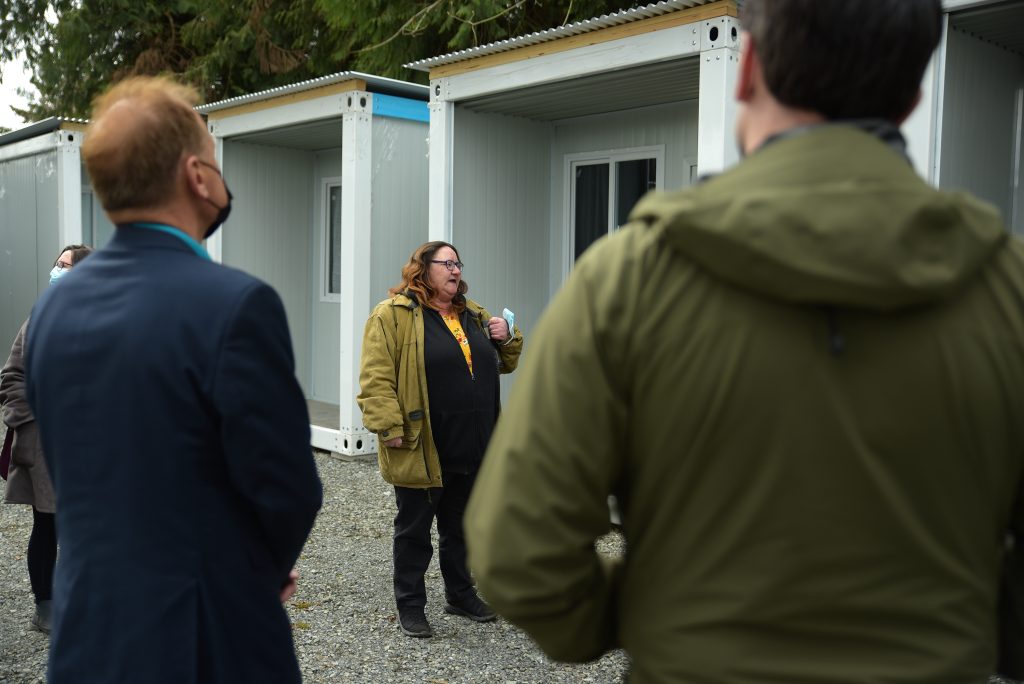
When John talks about how he meticulously arranged his sleeping quarters at transitional housing sites in Duncan, he does so with pride.
He details the furniture he brought into his cabin to help keep his things organized and paints a picture of the interior with his words. He talks about how clean he keeps his space and how he’s supporting others to make their cabins feel like home, too.
“I totally turned it into a home. For something that’s eight-by-eight [feet], everyone that came there said it was the cleanest — and actually homey,” he says.
John, whose name has been changed to protect his privacy, has been living on the streets for 22 years, since the age of 12 or 13. Some of his family members have experienced homelessness throughout their lives as well. He also struggles with substance use, and is seeking out support and treatment to be clean and sober.
During the height of the COVID-19 pandemic, John moved to a temporary housing site that was established at The Mound in Duncan. The site was created as a pandemic response to find a safe place to stay for people experiencing homelessness. John first slept in a tent and eventually moved into one of the sleeping cabins that was added to the site.
Cabin sites such as The Mound evolved into The Village, a transitional housing site in Duncan that is now being looked to across the country as a model to address the dual housing and toxic drug crises that communities are facing. It also holds potential as a treatment and recovery model, as evidence has shown that residents are benefitting from the stability, wraparound services and community support available at The Village. In some cases, this stability is creating conditions for residents to seek treatment, and succeed.
After feeling some stability at The Village over the past few months, John is three weeks clean from drugs. While John’s experiences are unique to him, the support he is receiving at The Village to meet his goals is available to all Village residents. The site is helping people stabilize and find a path in life they want to pursue. It’s integrating residents at The Village with the larger community, and providing them with a safe, supportive place to be.
But addressing the housing and toxic drug crises is complicated. What works for one person may not work for another. And while The Village is one solid solution to support people experiencing homelessness and people who use drugs, advocates are also calling for multiple housing and support models to diversify the options that are available to those who need it.
Read also: The Village housing site in Duncan funded until 2027
From a pandemic response to ongoing support
In 2020, The City of Duncan and other Cowichan Valley groups came together with BC Housing through the COVID-19 Cowichan Task Force for Vulnerable Populations. Their aim was to find shelter and support for people experiencing homelessness during the pandemic.
Temporary shelter spaces were set up throughout Cowichan at hotels, emergency response centres and outdoor tenting sites. One of those sites was in a location called The Mound, on Government Street in Duncan. The site was owned by Cowichan Tribes and provided residents with shelter, as well as outreach and hygiene services.
Other similar sites, including one on St. Julien Street in Duncan, were set up and serviced by the Cowichan Housing Association with support from the Canadian Mental Health Association’s Cowichan Valley branch.
Winter conditions damaged some of the residents’ tents and their belongings, and heated sleeping cabins were constructed and brought to the sites with the support of federal funding. The cabins, which measured eight-by-eight feet, provided people with warm, dry shelter and a place where they could lock their belongings. For many, it was the first time in a while that they had access to a space like this — one that was their own.

John says he worked hard to create a community at The Mound, where he was staying. He filled the inside of his sleeping cabin with belongings and furnishings that he was proud of and helped others set up a space where they could feel at home, too.
In 2022, The Village was created on Trunk Road in Duncan. It is a more permanent version of the cabin sites at The Mound and on St. Julien Street, and has been evolving with the support and feedback of people with lived experience and community members.
John moved to The Village recently, after spending some time in treatment and back on the streets. He says it’s helping him get on a path he wants to follow.
The Village sleeps 34 people and is operated by Lookout Housing and Health Society. Residents receive daily meals and other support such as health and wellness services and harm reduction supplies. There is an emphasis on making the space culturally safe as well, particularly for Indigenous community members, who are overrepresented among people experiencing homelessness and struggling with substance use.
Residents also have the choice to participate in community outreach, something John is very passionate about. He and others work to clean up the community and provide people with harm reduction supplies to help prevent more toxic drug deaths. They interact with neighbours and are given a sense of belonging by doing so, John says.
A treatment and recovery model
Cindy Lise, facilitator and executive director of Our Cowichan Communities Health Network, has been a part of The Village process since its inception. And before that, she has been involved in working with community partners to address the toxic drug crisis.
Our Cowichan Communities Health Network initially helped start the Community Action Team (CAT), a group of people — many with lived experience — working to improve the health and wellbeing of people who use drugs. They provide Naloxone training and harm reduction resources, neighbourhood clean-up teams, educational opportunities for frontline workers and community members, support, advocacy and more. The CAT also works to reduce stigma associated with people who use drugs — something that can hinder their wellbeing and recovery.

Lise says the CAT came together in 2016 and began exploring what the community could be doing better to provide support and resources to address substance use-related challenges.
The Village, she says, has grown into more than just a housing solution. It has also become a model for treatment and recovery that “nobody even imagined in the early days of responding to the pandemic.”
“The Village is an incredible model for people who are deeply street-entrenched, struggling with their mental health and addictions and homelessness,” Lise says.
Offering people stability and supports all in one place, with no timeline to leave, has helped them get on a path to recovery. Lise says just being able to have access to a roof over your head, meals, community and hygiene and harm reduction supplies makes a big difference.
“This is a culturally safe, culturally connected, culturally designed way of caring for people in our community,” Lise says. “Many people reduce their substance use just by being there, and then get to a point where they’re stable, they’re connected and ready for the actual treatment part. Some folks may need to stay in that model for however long and other folks can start there, regain their connections in their community and move to [supportive housing] or potentially their own space.”
And John agrees. Before moving to The Village, he was sleeping in various spots around Duncan, including under bridges and near buildings where he had access to an outlet to charge his phone. He’s been sober from alcohol for years, but continued using other substances until recently.

“[The Village] is a lot better than trying to figure out where I was going to be sleeping,” John says. “It’s not treatment or jail. That’s helping me to get clean and sober. It’s being in the middle of everything. It’s all there. We can get everything that we need.”
The Village is so successful as a recovery model that Lise has taken it to the United Way Public Policy Institute, a program that brings leaders across B.C. together to improve their skills in influencing public policy. The hope, she says, is that this model can be taken to the province or higher level organizations to help develop public policy that supports housing, treatment and recovery in B.C.
She says she’s exploring options for a public policy proposal that identifies The Village as a three-pronged approach of health, mental health and addictions and housing. The model is affordable to build and can be replicated anywhere, even in rural communities, if the services are available.
“The Village is a model that is super fast, affordable and effective in its design to meet the needs of our most at risk and vulnerable people in our communities,” Lise says. Expanding the model to rural communities, “would take so much strain off our central cores if we were able to have each community care for its residents that live there.”
Different housing and supports for different people needed
Tracy, a resident of a supportive housing building on Paddle Road in Duncan, has never lived in The Village but has been promoting it because she sees how it has positively impacted community members.
Tracy was experiencing homelessness for many years and recounts the struggles of feeling unsafe, worrying about her belongings being stolen or taken away, having to regularly move with the weight of her belongings on her back and finding a clean, safe place to go to the bathroom. She remembers not sleeping at night because she worried about her safety and feeling animosity from other community members.

“And that animosity towards the street people gets returned to them because the street people get pissed off with being told they deserve a place to live, just not here,” Tracy says. “After a while — there’s some people that have been out there for 10, 15, 20 years — they start to really believe it, that they’re not worth having a home.”
Paired with substance use struggles, living on the streets can change the way a person behaves or reacts due to the sheer amount of frustration, anger and loneliness that they face, Tracy says.
“Coming off of the street myself, I think The Village is the perfect first stage,” she says. “Because living on the street is so totally different. It’s a completely different world altogether. You don’t follow anybody’s rules but your own. And that’s not how you live and coexist in society, you have to learn rules,” Tracy says. “At The Village you start to learn just a few rules. You learn what it’s like to live with a roof over your head for the first time in however many years. You can put your stuff inside and lock that door and know that when you come back, it’s going to be there. You don’t have to pack your things around with you. That in itself is the biggest plus of having The Village, is that you can put your stuff in in that room.”
Supportive housing, which can be the next step for some residents of The Village, is also a great option for folks. Tracy says having independence, her own washroom, her own space and the support of staff when needed has been a great step for her as she works on her own recovery. However, the Paddle Road supportive housing development is full and construction on a new supportive housing building on White Road is stalled. BC Housing is looking to hire a new contractor following the bankruptcy of the previous one.
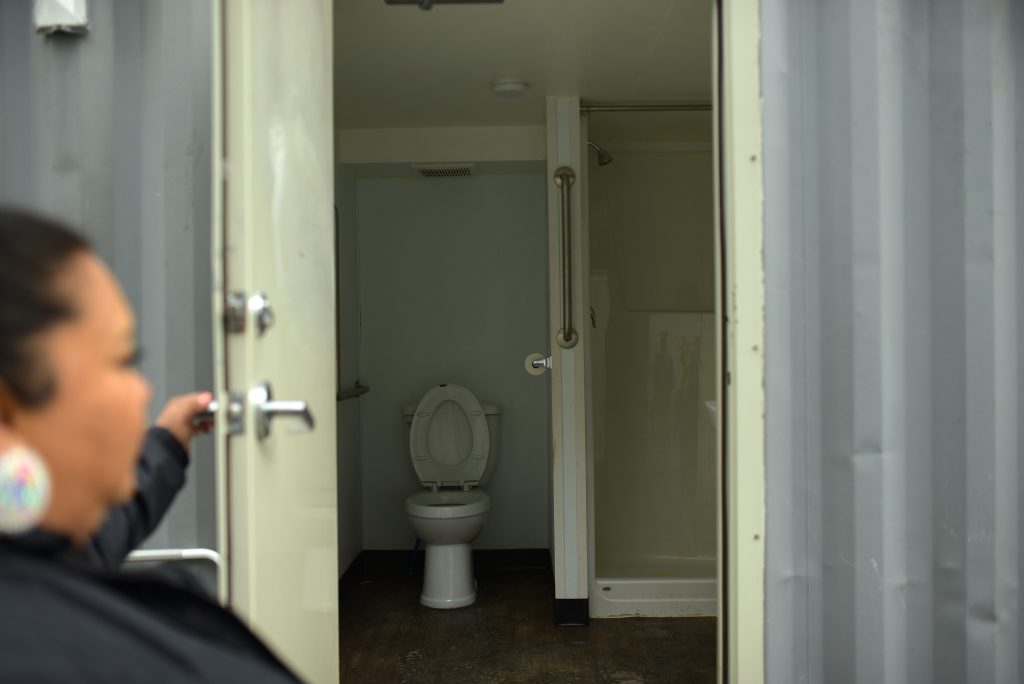
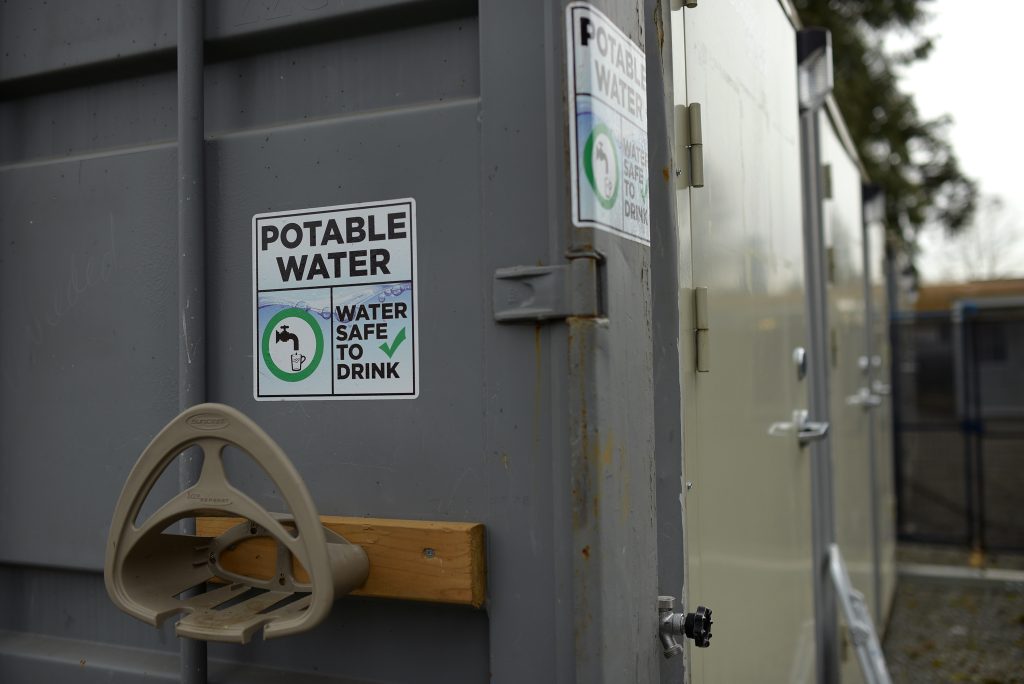
At The Village, residents have regular access to many basic needs, including washroom facilities, food and drinking water. Photos by Philip McLachlan/The Discourse
Tracy notes that there are hundreds of people in the Cowichan Valley living on the streets, as per the most recent Point In Time Count. Based on her experiences, she suspects the number is even higher. But diverse people come with diverse needs. What works for someone at The Village or Paddle Road may not work for someone else, depending on their experiences and circumstance.
“The events that happen to that person to get them to where they are, it’s all different,” Tracy says. “You can’t take someone off the street, dress them up and put them in society and expect it to be all hunky dory. They need time and space and support and understanding and no friggin judgment or stigma. And they’ll pull themselves together. We’ve proven it. Yeah. So many of us here have actual real jobs. And we’re moving away from the drugs, from the booze, from the addictions, from that lifestyle.”
The Village a model for other communities
Recently, the province extended funding for The Village so it can continue to operate for another three years. This came a few months after a resolution was passed at the Union of BC Municipalities convention urging the province to implement The Village model as part of its supportive housing continuum.
The resolution pointed out that The Village in Duncan has had various positive impacts on its residents and the community, including improved physical and mental wellbeing, peer outreach initiatives, neighbourhood monitoring, improved sanitation and street clean-up.
And Duncan Mayor Michelle Staples says other municipalities across Canada have shown interest in replicating The Village in their own communities.
Cailey Foster, a peer coordinator with the Cowichan Community Action Team, says one of the biggest positives about The Village is that people with lived experience have a hand in shaping it and running it. She says it makes for a safe atmosphere where residents feel comfortable talking to others and staff.
“I think if it’s going to be replicated in other places or on more sites, just really having that lived experience makes a huge difference,” Foster says.
In May, a report presented at a City of Duncan council meeting shared some data and evidence about The Village’s success in the community. A survey of more than 450 neighbours of The Village showed that 98 per cent agreed it had a positive community impact. RCMP also reported an 18 per cent decrease in crime in the immediate neighbourhood.
In an email statement from North Cowichan/Duncan RCMP Sgt. Trevor Busch, he says sustained efforts between RCMP and Lookout Housing Society to address safety concerns have been a success.
“Our detachment continues to meet regularly with The Village staff as well as the neighbouring residential and business community,” Busch says. “This partnership has been very productive to hear concerns and adjust proactive policing strategies accordingly.”
Busch says RCMP is pleased to see The Village’s success.
Community comes together
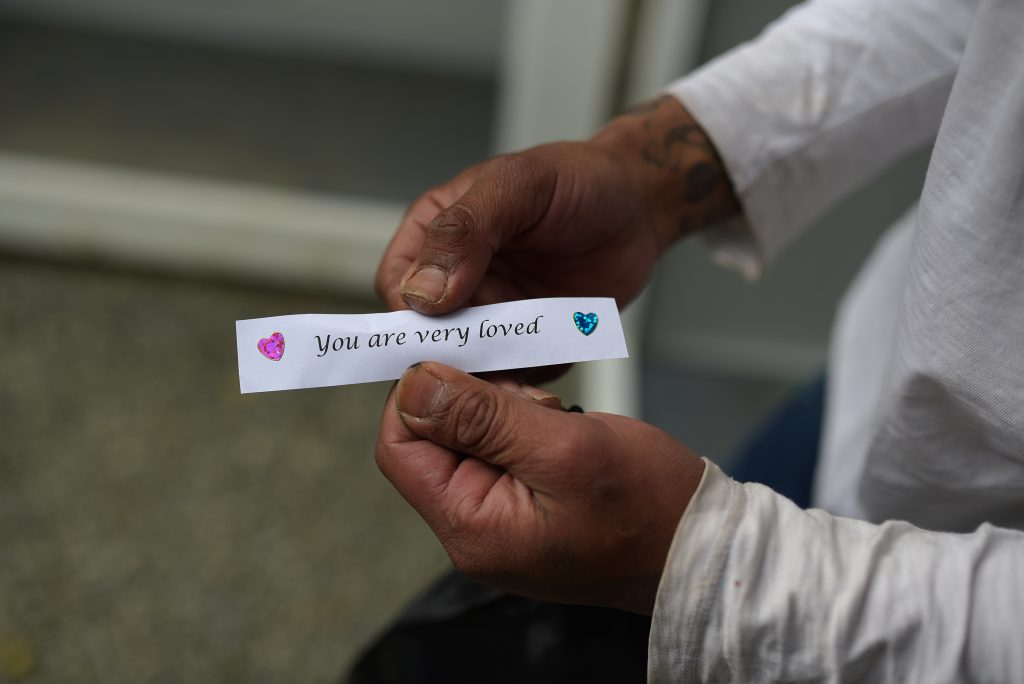
Foster says the communal model of The Village, where residents can connect when having meals together or sitting outside of their cabins, also helps because it creates community and more opportunities for support. Loved ones of residents, as well as service providers, have a consistent place to go to when searching for a resident, too.
John, who makes a great effort to create a community at The Village, says it’s important to have that.
“Why is it so important to build community? I mean, what has the world done until now? What is Duncan or other cities? They’re communities, are they not?” John says. “This is a community of people that are using. To have all of us there, and somewhere to be safe and not get kicked out, it’s great. They have all of us to sit with or come out and talk to one another, just to see how we’re doing and feeling. It’s to not have that loneliness, right?”
Most residents of The Village participate in outreach to the wider community. Some are part of a Community Advisory Committee, where residents, community members, businesses and anyone else is welcome, creating new connections in the neighbourhood. Foster says it creates an opportunity for people who hear what’s going on, raise any concerns and work to address them.
Lise says another big reason for The Village’s success is funding. It allows for infrastructure and services to be built and provided for people who need it, and also allows for multiple community partners to contribute to the project.
Relationships are a big part of it too, she says.
“It’s the relationships between the residents on site. It is the built relationships between outreach and the ministries and the pharmacists and Cowichan Tribes,” Lise says. “All of that support surrounds those folks in The Village, and has helped them rise above. Their medical needs are being met, their nutritional needs are being met, their emotional needs are being met, they have a sense of belonging and they’re caring for The Village. They’re growing the gardens, they’re taking care of the neighborhood, they’re taking care of each other.”
What did you think of this story?
Your feedback after we publish a story helps ensure we're always improving our reporting to better serve you
Author

Related Articles
DRIPA debated in B.C. election on Vancouver Island
The Conservative party of B.C. is promising to repeal the Declaration on the Rights of Indigenous Peoples Act (DRIPA), while other parties argue that would set back relations with First Nations and create economic uncertainty.

Where Cowichan region MLA candidates stand on water, old growth and reconciliation
MLA candidates in the three ridings that cover the Cowichan region answered questions from Discourse readers ahead of the Oct. 24 B.C. election.
Cowichan Valley’s guide to the 2026 B.C. election
What riding am I in? Who are the candidates? When do I vote? The B.C. election basics for Cowichan Valley residents.