
Gap in BC Ferries medical travel assistance program leaves parents of sick kids behind
‘We can’t be waiting on the whim of BC Ferries hoping to make it on the next ferry when there’s a child’s life at stake,’ says local mother

A Nanaimo mother with a son hospitalized in New Westminster with critical injuries is calling for changes to BC Ferries’ and the province’s programs for people traveling for medical reasons.
Mariam Mnguni’s 17-year-old son Max was driving a motorcycle in Maple Ridge on Sept. 8 with his girlfriend Sarah Mingo, 18, when a crash occurred with an SUV and the two were thrown from the bike.
Max suffered from a broken leg in two places, a fractured neck and eye socket, and chest and shoulder tearing that required emergency skin grafts (which have become infected). The extent of any potential tissue and ligament injuries or brain trauma is still unknown. Sarah is unresponsive and currently in the ICU. She was on a ventilator but has now started breathing on her own.
Due to the severity of the injuries, the Ridge Meadows RCMP serious crimes unit is investigating the incident, and are seeking witnesses to the crash.
In addition to the variety of procedures and tests that need parental consent, Max requires painful dressing changes and daily care such as teeth brushing and flossing that he is unable to do for himself, says Mariam.
Currently in the trauma and neurosurgery unit, Max is expected to remain in the Royal Columbian Hospital for at least 12 weeks.
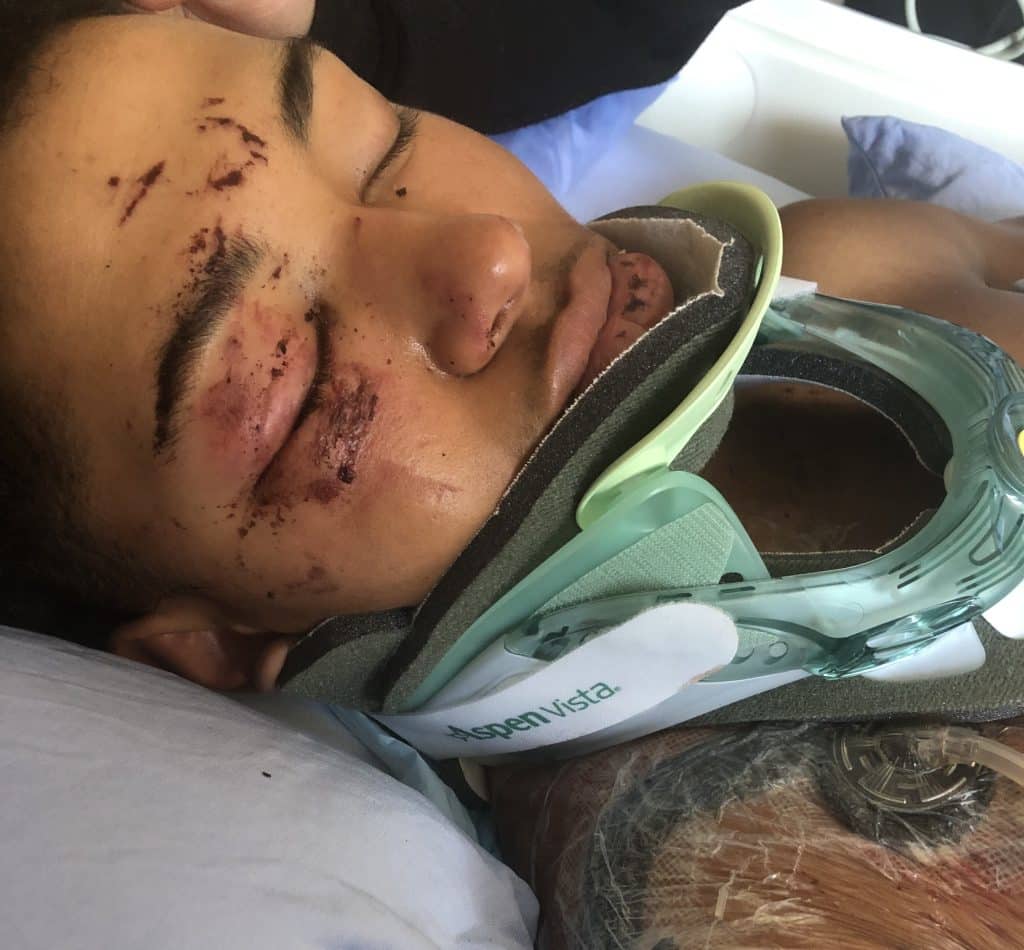
With six children, including a breastfeeding baby, a toddler and a 7-year-old, Mariam says that the cost, stress and time spent on near-daily BC Ferries runs has taken its toll.
A representative for BC Ferries responded via email to state that though they “completely understand the stress this family is under during this difficult time,” Mariam’s circumstance doesn’t fit within the current medical assured loading and travel assistance programs (TAP) being offered through the ferry service — a publicly owned company — and the province.
“It’s just crazy to me that we don’t have anything for a person in my situation. I know, it’s probably really rare that they get somebody in this situation. And that’s probably why nobody’s pushed for it yet. But now I’m in it,” says Mariam. “I’m not even asking for free ferry fares, even though I feel like this circumstance warrants it.”
The province’s TAP program is aimed at providing financial support to residents who need to travel within B.C. for non-emergency medical specialist services not available in their own community. But these programs are designed for those travelling to seek medical support, not for caregivers or guardians travelling alone, or to pick up the patient.
“Island parents who have a child in ICU or a trauma ward need to have all barriers removed to being with their child. We can’t be waiting on the whim of BC Ferries hoping to make it on the next ferry when there’s a child’s life at stake,” says Mariam.
“It’s crucial that we make it to the hospital in time to consult with surgeons, sign consent papers, and be by our child’s side during times of extreme pain and suffering. For all we know, those critical hours could be the last we have with them.”
At present, Mariam is required to travel nearly three hours each way, at full cost. Every time she pulls up to the terminal, she has to re-explain her entire situation to the person in the booth and present them with a letter from the neurosurgery unit’s social worker at Royal Columbian Hospital, which advocates for BC Ferries to offer Mariam whatever accommodation they can with respect to travel. The booth worker then phones the terminal manager.
It is never certain whether her daily travel time will also include multiple ferry waits. Most of the time, the manager denies her request and she has to wait to get on.
“Last time I tried getting through, they did approve assured boarding, but they first pulled me over to the side and made me wait while they called the hospital to confirm that my letter was actually real,” she says, adding that she spoke to a customer relations advisor and requested that the managers of both ferry terminals at least be advised of her situation so she can avoid explaining it every time, but was told that wasn’t possible.

In April, BC Ferries partnered with the province to offer complimentary reservations and/or assured loading onto the ferry for those who qualify for TAP and have a letter from their medical practitioner.
More than 26,400 patients used TAPs forms to board ferries in the month of August, and approximately 725 of those patients also utilized a medical assured loading letter, according to Deborah Marshall, BC Ferries’ executive director of public affairs.
“It’s complicated by the fact that yes, we administer this program but it’s actually funded by the province, so if there were going to be any changes, it would have to be in conjunction with the province,” says Karen Johnston, BC Ferries’ executive director of communications and engagement.
In an emailed statement, the ferry service said they “offered to make all necessary bookings on the family’s behalf” but only on sailings already discounted through the company’s fare saver program.
“They offered to make reservations for me on the Tsawwassen Ferry that arrives at Duke Point at 12:45 a.m.,” says Mariam, who added that there are rarely saver fare ferries for the morning sailings. “I told BC Ferries it wasn’t possible for me to make those bookings due to the late time of departure, and return home to my baby, who is still breastfeeding.”
Mariam says she has contacted MLA Sheila Malcolmson’s office and her oldest daughter Tazzy has set up a GoFundMe page to try and alleviate some of the travel costs associated with Max’s medical care.
What did you think of this story?
Your feedback after we publish a story helps ensure we're always improving our reporting to better serve you
Author

Related Articles
What are Nanaimo election candidates saying about the climate emergency?
All-candidates forum puts climate questions to Nanaimo election candidates.
Comox Valley, Nanaimo land trusts raising funds to support Deep Bay land conservation purchase
In a partnership with the Comox Valley and Nanaimo Area land trusts, BC Parks Foundation is fundraising to protect 50 hectares of pristine shoreline in Deep Bay and make it accessible to the public.

Nanaimo Jazz Festival celebrates 10 years with more than a dozen shows in September
Local and international artists to perform on multiple stages in the city at this year’s Nanaimo Jazz Festival.