
Thinking about building a cob home in the Nanaimo area?
FAQ about cob homes in the Regional District of Nanaimo.
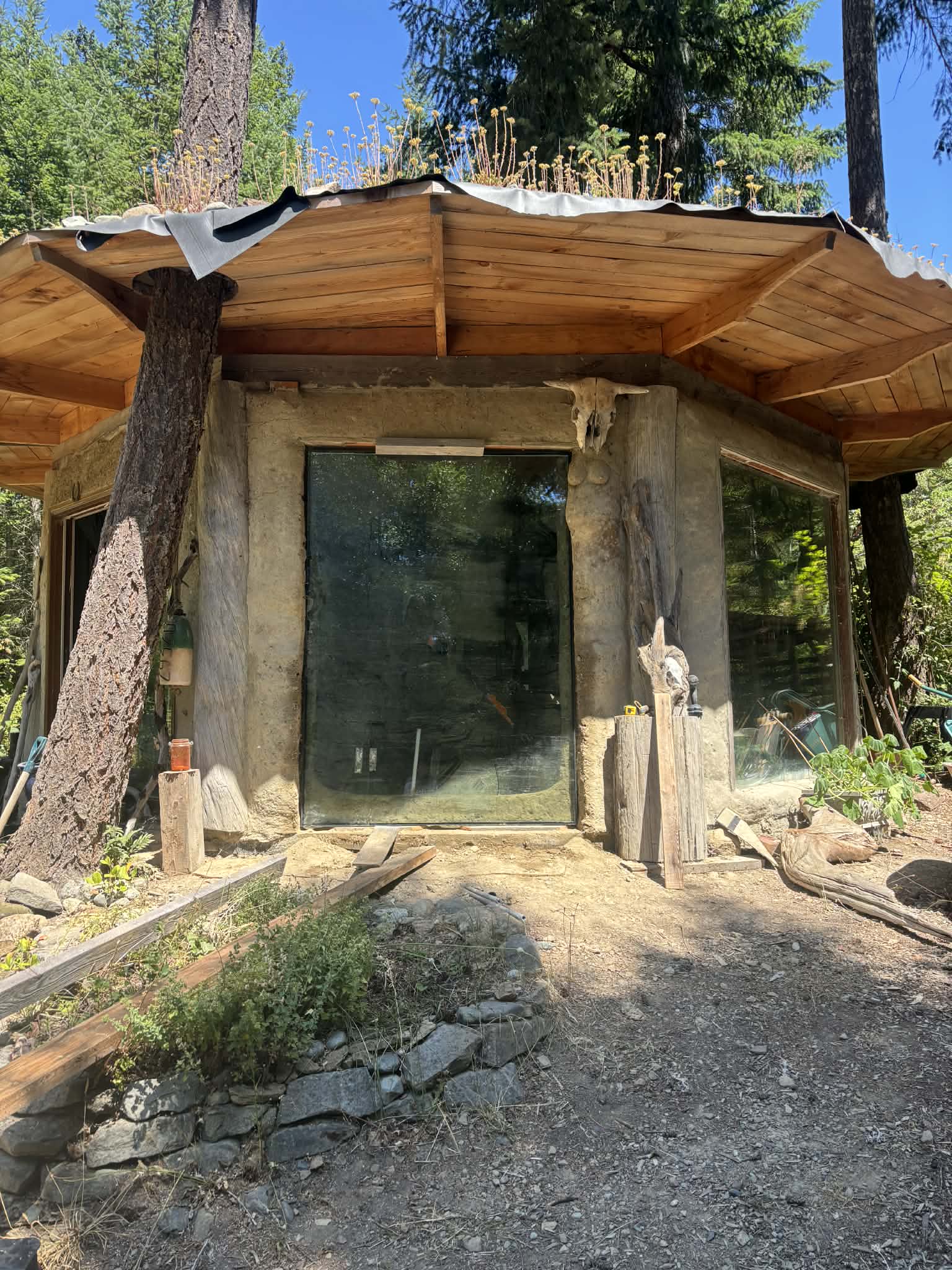
This October, Carl Boehm was given notice that the cob homes on his three properties on Gabriola Island were not compliant with the B.C. building code and Regional District of Nanaimo building regulations.
Boehm has helped build 10 buildings on his properties over the past 15 years using cob and mud construction practices, but did not obtain building permits for them. He estimates that about 20 people are living on the property in a variety of housing types, including trailers.
Boehm was given a deadline of Oct. 20 to apply for a demolition permit for the mud homes and a building permit for one of the cabins and was given a deadline of Dec. 1 to make the necessary applications for building permits, or demolition permits, for all other buildings larger than 10 square metres.
Speaking with The Discourse in late November, Boehm said the Regional District told him that if it puts what’s known as a Notice on Title on his properties and Boehm gets an engineering report on the buildings to ensure that they are safe to live in, “they’re going to leave us alone.”
Boehm said that this still needs to go to the Regional District of Nanaimo’s board of directors for final approval in February.
Lisa Grant, the district’s general manager of development, told The Discourse that the regional board would need to approve a Section 57, Notice on Title but it would not be appropriate to speculate if one would be approved for a specific property.
The Discourse dug into some frequently asked questions about cob homes and how they fit into the Regional District’s building regulations.
Frequently Asked Questions on cob homes in the Regional District of Nanaimo
Asked by The Discourse Nanaimo.
Are cob homes more affordable?
Boehm told The Discourse that one of the advantages of building with mud and cob is that it can help make building a house more affordable, but going through the official building permit process and regulations would drive up the cost of building them.
“With no permits you could probably do it for $50 a square foot if you’re doing it yourself,” Boehm said. “But as soon as you get a permit that goes to $500 a square foot, with the amount of professionals and all the things that those professionals will require.”
Gord Baird, a District of Highlands councillor who built his Eco-Sense home in Victoria in 2006 and now runs a green consulting business, said “the biggest misconception is that cob is less expensive than conventional.”
Baird said that while material costs for cob homes can be lower, labour costs are significantly higher. If the owner is the person who is building the home and puts in a lot of their own labour, that could help keep costs down, but ultimately Baird said it is “not less expensive” than conventional construction methods.
Are cob homes energy efficient?
Energy efficiency is just as important for a cob or mud home as it is for a conventional home. In fact, given the somewhat poor insulative quality of cob and mud walls, Baird suggested that people living on Vancouver Island and the Gulf Islands consider a hybrid construction method that combines cob or mud walls with an exterior framed wall that can hold conventional insulation.
“By blending it, you actually are getting a better building for our climate because you are getting the insulative values that you need.”
When Baird tested his own house for thermal energy use, he found that the wall on the front of his house which faces the sun was far better than the wall at the back of his house that was in the shade.
Citing the cool, damp wet winters on Vancouver Island, Baird said areas of cob houses that are on the north or shaded areas of a property are not going to perform to the expectations of the building code.
“Cob might be low-carbon to build, but if you have to use a ton of energy [to heat or cool the home] you are actually missing the point.”
Boehm said he is all for more insulation in bigger houses but questions the need for the same standards to apply to small, 500-square-foot cabins.
“Why should you have to have that level of insulation when most people that I know heat with wood, which doesn’t cost really anything to heat,” he said. “What’s the point of all the insulation and sealing a house up so much when it just doesn’t need to be like that?”
As the Regional District of Nanaimo follows the B.C. Building Code, buildings have to meet the energy and emission objectives set out in the B.C. Building Code, which is Step 3 of the Energy Step Code.
In an email to The Discourse, the Regional District of Nanaimo said there are options and different ways to achieve compliance, but they must meet the B.C. Building Code. The Regional District does not have the authority to change or waive those standards.
Can you get home warranty insurance for a cob home?
According to Baird, the main barrier to building cob and mud homes is not the building code, but rather the reluctance of insurers to offer home warranty protection for contractors or owner builders to meet.
When a contractor builds a house, they need a home warranty insurance policy that protects them from any defects for things like roofing, the building’s envelope and electrical.
However, home warranty providers don’t recognize cob, straw bale or hemp or any other sort of alternative building systems as a methodology that is insurable, Baird told The Discourse.
“What that means is you have a lot of contractors that just won’t participate, or can’t participate, in building a structure unless it has some post and beam or other elements in it,” he said. As private insurers won’t provide home warranty protection for green alternative homes, Baird said he would like to see the province step in with some form of public insurance for people who want to use alternative building materials.
Is there anything specific I need to do when I’m building a cob home?
The Regional District of Nanaimo notes that all homes need to follow the B.C. Building Code and suggests that if you are building a new home using alternative methods, it is a good idea to set up a meeting with the district’s building inspection services to discuss your project early in the process, such as while you are designing your home. The district also recommends working with an experienced green building designer who is familiar with the permitting process and requirements.
Are there any incentives to help people build green alternative buildings?
The Regional District of Nanaimo has a Sustainable Development Checklist that residents can apply for when building new buildings. Those who receive a “high score” on a completed checklist may qualify for $500 to $1,000.It also has a green building rebate of up to $1,000 for sustainably constructed homes. This rebate considers energy efficiency, home size and other sustainability factors, including low carbon construction. Residents constructing a new cob home in RDN electoral areas can discuss their project with RDN staff to see if it qualifies for the rebate. Rebates are only available for structures that are compliant with the provincial building code.
If a cob home is not compliant with the building code and RDN building regulations, what are the options available to homeowners?
The Regional District of Nanaimo said it cannot approve non-compliant buildings. Homeowners and builders must comply with the B.C. Building Code or may be subject to bylaw enforcement. Most likely, a Notice on Title would be registered to the land title if the building or buildings were not compliant.
Section 57 of the Community Charter allows local governments such as the RDN to register a notice on a property’s title through the Land Title and Survey Authority of B.C. This may be considered when there are unresolved B.C. Building Code or Building Bylaw contraventions, including unpermitted work that lacks verification for code compliance and may pose safety risks to occupants and the public.
Is there a possibility for regulations for alternative modes of housing to be relaxed in order to address housing shortages?
The Regional District of Nanaimo says any changes to allow greater flexibility for alternative housing models — such as tiny homes, cob structures or other innovative designs — must be made at the provincial level. The branch responsible for administering and updating the B.C. Building Code is the Building and Safety Standards Branch, which operates under the Ministry of Housing.
What did you think of this story?
Your feedback after we publish a story helps ensure we're always improving our reporting to better serve you
Author

Related Articles
Comox Valley, Nanaimo land trusts raising funds to support Deep Bay land conservation purchase
In a partnership with the Comox Valley and Nanaimo Area land trusts, BC Parks Foundation is fundraising to protect 50 hectares of pristine shoreline in Deep Bay and make it accessible to the public.

Nanaimo Jazz Festival celebrates 10 years with more than a dozen shows in September
Local and international artists to perform on multiple stages in the city at this year’s Nanaimo Jazz Festival.
Snuneymuxw Elder C’tasi:a shares traditional plant knowledge in new book
‘Plant Teachings from my Auntie’ by Snuneymuxw Elder C’tasi:a and ethnobotanist Nancy Turner delves into traditional plants and plant medicine.