
Come on a tour of Nanaimo’s heritage trees
Nanaimo’s urban forestry coordinator shows off some of the city’s leafiest assets

Many residents have their favourite Nanaimo tree — maybe it’s one that you climbed in your yard growing up, eat your lunch under, or cycle past on your way to work.
For me, it’s a big beautiful oak tree along Fifth Street, across from the University Village complex. In the winter, the full breadth of branches is completely visible as they snake up and out in ever-smaller curves and it’s lovely.
It’s a tree that also holds special significance for Patrick McIntosh, the City of Nanaimo’s urban forestry coordinator who oversees the management of city-owned trees. Along with the developer and their arborists, he helped to ensure the oak tree was properly cared for when the property around it was developed.
The sidewalk and surrounding complex have been built to give the tree’s roots a wide berth, and McIntosh says.
It’s an unusual species as it was originally thought to be a Garry oak, but he now believes “it’s probably the byproduct of an English oak and a Garry oak making baby oaks,” he says, with a laugh.

We’re on a tour around Nanaimo to look at some of the city’s most remarkable trees, with the city’s heritage tree registry as our guide.
Created in the 1990s, McIntosh says the city will soon ask residents to help update the list by submitting suggestions for trees they want to see added. The city’s tree voucher program is also now open for residents who want to purchase a tree to plant on their property for $25.
We start at Deverill Park, which was originally called Deverill Square after George Deverill, the assistant manager of the Vancouver Coal Mining and Land Company. Behind the park’s playground, along Irwin Street, stands a towering line of London plane trees.
More than 100 years old, the trees have a lifespan of up to 500 years and have unique bark that exfoliates, somewhat like an Arbutus. With long branches and large, maple-like leaves, it forms a shady canopy over the street in summer.
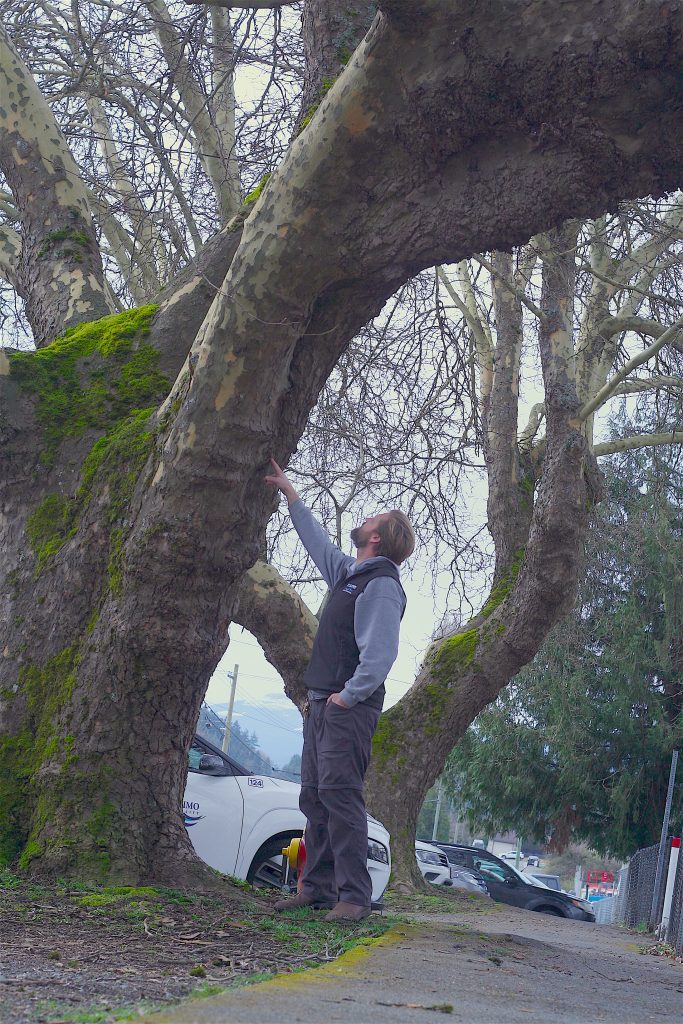
“This is what a street canopy could look like, with established older trees,” he says, adding that some of the trees are interspersed with Linden trees. “[London planes] are one of the biggest and most majestic deciduous trees.”
Next, we head to what is known as Robin’s Grove or Robins Gardens on Esplanade Street, the former property of mine superintendent Samuel Robins of the Vancouver Coal Mining and Land Company.
A gardener who collected plant specimens from all over the world, Robins planted a variety of trees on the grounds of his estate in the late 1800s, and these were preserved when the property became the site of luxury condominiums in 2016.
According to the City of Nanaimo, this area was once a wealthy part of town, and Robins owned an 18-room home on the site, surrounded by a gazebo, fish pond and rose garden.
When Western Fuel Corporation then purchased the entire block around 1930, it took down all the buildings. Robin’s property then became the Evergreen Auto Court in the 1940s, and by the time developer Glen Hommy purchased the site in 2005, it was home to some small rustic cabins.
Through all the changes, the trees remained.
On the driveway, McIntosh points out a Copper beech tree that he says “suffered a bit of construction malaise, but it seems to have rebounded, health-wise. It had its roots trampled on and stuff. There’s more development planned here, but this tree will be well-protected.”
Inside the gated enclosure is a rare and unique evergreen tree known as a Holm oak, and at the centre of the yard towers a Giant sequoia.

“They grow to be the largest trees on planet earth. So at 150 years old or so, these are just seedlings,” he says. Near the opposite fence is a Blue Atlas cedar and two Lebanon cedars.
Many of the trees on our tour significantly pre-date the development that has sprung up around them, and most of the ones we look at on our tour have been planted in the last couple of hundred years.
We make a stop at Westwood Ravine Park off Belwood Road to see a pocket of old growth Douglas firs — some with a two-metre diameter — that, along with Western red cedars, offers a glimpse of what the area might have looked like prior to logging and development.
“I’m told we also had quite a population of Sitka spruce, and areas of vibrant Garry oak meadows,” says McIntosh. “Maple, red alder, dogwoods, cascara, Pacific crab apple and Western yew would have all been in that mix as well.”
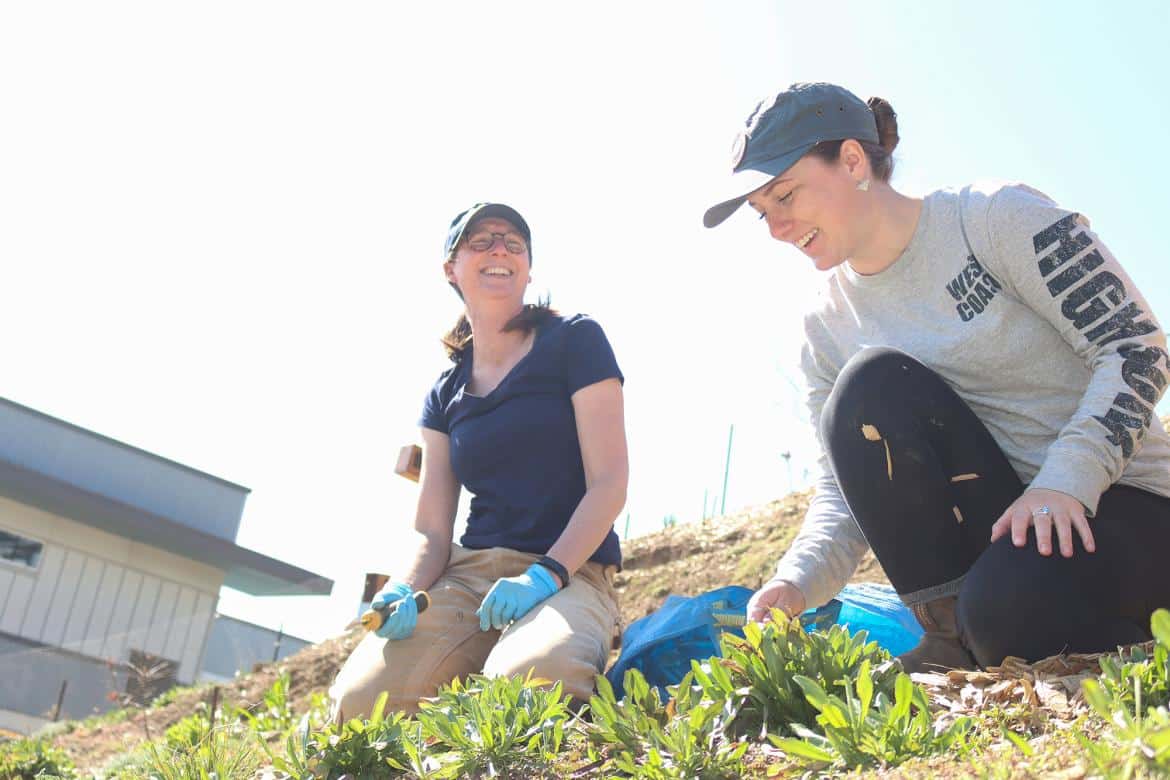
Back downtown along the waterfront, the stairs down to the walkway circle past a huge Garry oak as it towers over the bust of Mark Bate, Nanaimo’s first mayor.
On Wesley Street in the Old City Quarter, is an Indian bean tree — with characteristic long bean pods and huge leaves — that also stood in its spot well before all of the shops were constructed around it.
When McIntosh started his job as an arborist at the city in 2011, he noticed the tree was hollow inside, so he consulted with arborist and professional forester Dr. Julian Dunster, who performed a sonic tomography imaging test on it.

“Tomo is Latin for ‘cut’, so it uses soundwaves with a high-tech computer that measures 10 points of soundwaves and measures the speed at which sound travels to create a cross-sectional image of what the inside of the tree looks like,” he says. “We learned that there is some substantial decay in the tree, but given the species — it’s a lightweight, corky wood — it’s pretty common to have some hollowing decay in the trunk. So the recommendation was that we reduce about 30 per cent of the weight off the end of the branches and retain the tree instead of cutting it down.”
Another remarkable tree that benefited from a little support is an old cherry tree along the waterfront that McIntosh says “is a stunner” and “blooms like a cloud.”
Cracked throughout its crown, the obvious solution was to cut it down, but it seemed like such a loss as the tree still had so much vitality and life left. City carpenter Ed Tremblay fashioned some supports for the tree to help hold up its branches in 2014, and it continues to bloom to this day.

Sometimes, old trees can’t be saved. In 2018, a huge Arbutus tree on Millstone Avenue had to be removed when structural decay caused it to become a hazard.
The Nanaimo Public Cemetery is the final resting place for many notable and historic Nanaimo names, from working-class miners to some of the wealthier families.
It’s also home to some beautiful and interesting trees, including a Camperdown elm on the city’s heritage trees list. McIntosh says it’s worth noting that the low population of elms has made Vancouver Island one of the safest places for elm trees, as it has not yet had any cases of Dutch elm disease, a fatal fungus carried by elm bark beetles that is currently tearing through Canada and the U.S.
Perhaps the rarest tree species growing in Nanaimo is found in the Chinese Memorial Gardens Park, which overlooks Stewart Avenue and the Newcastle Channel. Hidden in there is a stand of 10 rare Dawn Redwood trees — a species that was thought to have gone extinct millions of years ago.
However in the 1940s, a grove was found in China’s Hubei province (formerly Sichuan) and since then, virtually all Dawn Redwoods can be traced back to the progeny of an original seed lot harvested during an expedition to the site by the Arnold Arboretum at Harvard University in 1948.

When it comes to protecting trees, developers and homeowners alike have to follow the city’s development permit process, says McIntosh.
Illegal cutting of trees without proper permits and in contravention of the city’s management and protection of trees bylaw has definitely been an issue in the city at times, says McIntosh, and has resulted in fines and other penalties.
There have been several high-profile cases involving trees over the years, including one in 2022 that resulted in a $50,000 fine issued to a developer that removed 100 trees on Old Victoria Road without the proper permits.
And it’s not just developers receiving fines. In 2018, Nanaimo resident Mladen Zuvich was fined $12,500 under the city’s tree bylaw for illegally cutting down a 170-year-old Douglas fir on his Jingle Pot Road property that was 55 inches in diameter and 180 feet tall. The man who cut the tree down was also convicted.
Residents who have tree concerns or want to let the city know about a particular tree can email parksandrecreation@nanaimo.ca. The tree voucher program also aims to increase the urban tree population of canopy and fruit trees by providing trees for purchase at a reduced cost to residents.
What did you think of this story?
Your feedback after we publish a story helps ensure we're always improving our reporting to better serve you
Author

Related Articles

Nanaimo Jazz Festival celebrates 10 years with more than a dozen shows in September
Local and international artists to perform on multiple stages in the city at this year’s Nanaimo Jazz Festival.
Snuneymuxw Elder C’tasi:a shares traditional plant knowledge in new book
‘Plant Teachings from my Auntie’ by Snuneymuxw Elder C’tasi:a and ethnobotanist Nancy Turner delves into traditional plants and plant medicine.
How is The Discourse’s journalism funded?
And what does it cost to produce The Discourse’s in-depth, independent journalism?