
Community Safety Officer program in Nanaimo an alternative to police
Community Safety Officers are helping respond to Nanaimo’s homelessness crisis, but councillors and experts say more supports are needed.
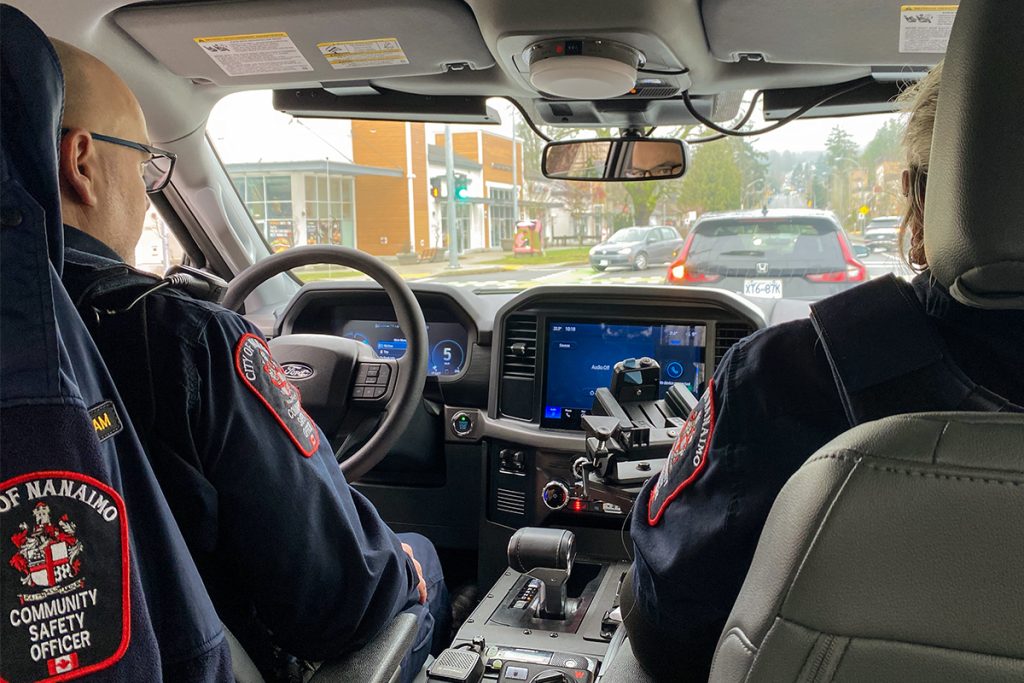
It was a foggy Wednesday morning as two of Nanaimo’s community safety officers (CSO) drove down Milton Street past the Superette Market. As they passed the train tracks, one of the officers spotted a person lying on the ground under an awning of an empty commercial building. They turned their fully equipped electric truck around and stopped by the building to do a wellness check on the person.
A woman standing under the awning immediately started screaming, “get the fuck away from me!” as the officers pulled up to the curb.
CSO Adam Collishaw told The Discourse that he knew the woman who was screaming at them and said she has a history of mental health challenges. But they needed to check on the other person to see if they were overdosing and in need of assistance.
As Collishaw exited the truck, the woman closed on him, yelling within inches of his face. He didn’t flinch as she passed him and walked away down the street still yelling threats.
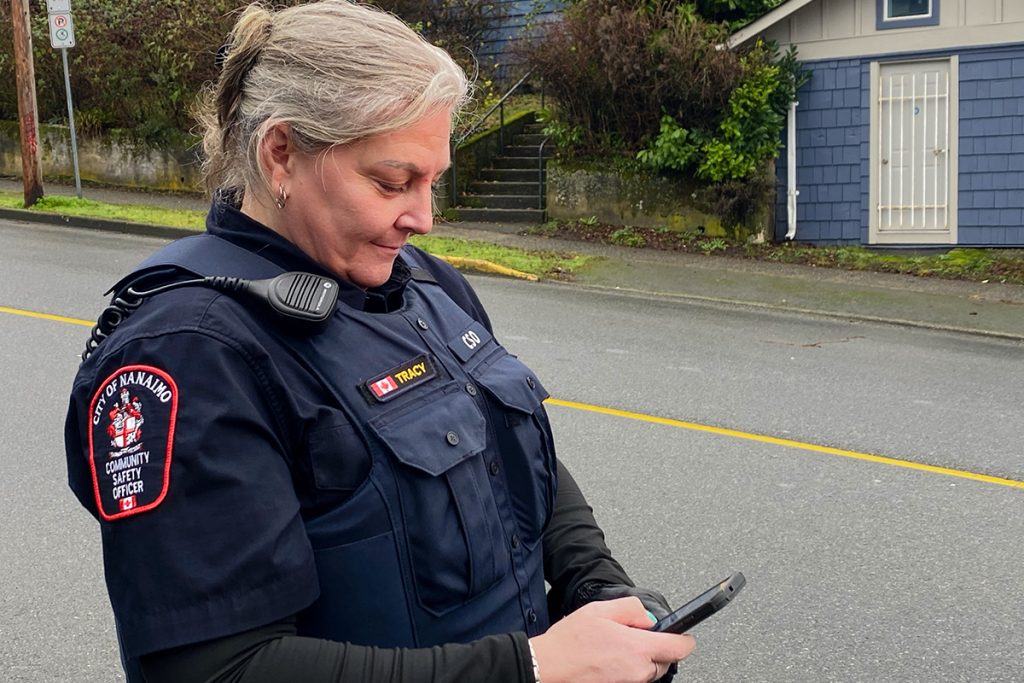
Collishaw, along with his partner CSO Tracey Calverley, went to the person who was on the ground and checked on them to make sure they were OK. They then gave him and other people who came by items such as a bottle of water, hand warmers and granola bars.
“I keep very calm,” Collishaw said about the confrontation after the stop was completed. “There’s no reason to go hands-on in that particular situation. She had her hands lowered and I didn’t feel threatened. Because I have history with that individual, I know that it’s just bravado.”
Community safety officers are City of Nanaimo employees and are not police officers but, like bylaw officers, are considered peace officers under Canada’s Criminal Code.
Collishaw said the best way to understand the difference between them and police is that the local RCMP detachment is responsible for policing people’s behaviour in Nanaimo, while the community safety officers have authority over city property such as parks, sidewalks and city buildings.
Nanaimo’s CSOs are required to have completed Grade 12 as well as courses on bylaw compliance, investigation and enforcement from the Justice Institute of BC. They also must have a minimum of two years of bylaw enforcement or clinical experience in crisis response and homelessness outreach.
Collishaw’s knowledge of people on Nanaimo’s streets and experience in de-escalation is the core of Nanaimo’s Community Safety Officer program, and it’s one that has gained support from city councillors, downtown business owners and social service providers in the city. It’s also one that is costing the city more to maintain each year, and some experts and city councillors say more supports are needed to address root causes of homelessness.
A history of the Community Safety Officer program in Nanaimo
In 2023, there were 11 community safety officers and one supervisor in Nanaimo, which the city budgeted $1,676,684 for. This year, that number will increase to 20 full-time CSOs and two senior CSOs and is projected to cost $2,274,449 — a 35.7 per cent increase in the past four years. By 2030 it is estimated the program will cost the City of Nanaimo almost $3 million.
Part of the reason for that increase is to ensure there are enough CSOs so officers such as Collishaw and Calverley can work in pairs for their own safety and put two teams on the streets seven days a week.
That was a recommendation from a third-party evaluation conducted by Deloitte on the Downtown Nanaimo Community Safety Action Plan and approved by city council.
Another option, which is not being pursued by city council, was to expand the CSOs catchment area beyond downtown and hire an additional 10 officers and one supervisor, bringing the total to the equivalent of 30 full-time community safety officers.
“We’re not trying to create a second police service at the municipal level,” Coun. Hilary Eastmure told The Discourse. “That’s not what this is about. It’s about the commitment to our downtown core, improving the perception of safety downtown and giving business owners and residents an added layer of service that they can call when they need support.”
The Community Safety Officer program started in summer 2022 as an initiative to respond to complaints about public disorder in the downtown area.
Fred Jeffery has owned and operated Lucid clothing on Commercial Street for more than 20 years. He also lives in Nanaimo’s South End neighborhood close to the drop-in hub at 55 Victoria Rd. He said he sees Nanaimo’s community safety officers almost every day.
“I wake up in the morning and come out after I make coffee, and they’re out there on the street talking to the folks and guiding them along or just checking in on them,” he told The Discourse.
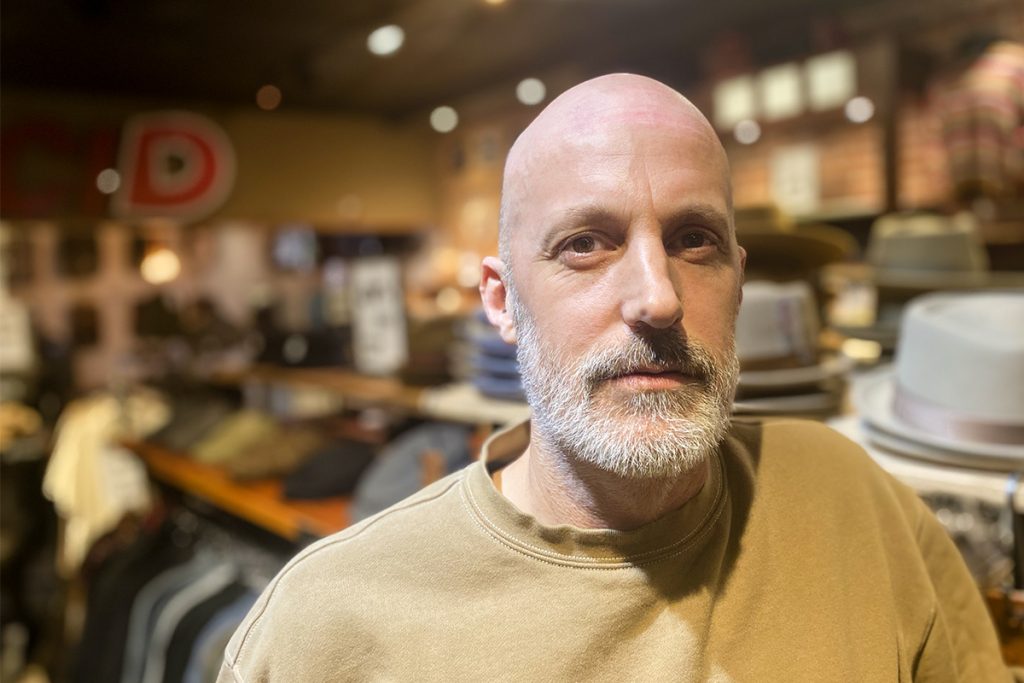
He has seen the officers respond to and try to resuscitate people who have overdosed.
Jeffery said he saw the area start to change between 2016 to 2018 as property values in the city went up and his neighbourhood experienced gentrification. He recalls the neighbourhood had a number of “flophouses” where people came and went at all hours that were designated as nuisance properties. The landlords, or “slumlords” as Jeffery puts it, of those properties evicted tenants and sold the properties to cash in on the rising real estate market.
“It was the first time I saw unhoused folks pushing a cart downtown, and that’s when you first saw people sleeping in doorways,” Jeffery said.
Jeffery said that within a couple of years there was an “avalanche of folks” who were visibly homeless downtown, overwhelming the local RCMP’s ability to respond to related calls.
Kim Smyth, the former chair of the Downtown Nanaimo Business Association — which Jeffery now heads — worked with the City of Nanaimo to establish the Community Safety Officer program in summer 2022.
Jeffery said the community safety officers know people by name. He sees the program as being “instrumental” in helping connect people with housing and health-care services.
He said the officers also play an important role for downtown business owners and residents who have been “traumatized by the presence of folks who are struggling with mental health problems and addictions.”
Jeffery credits the “wake up calls” that the officers do on Commercial Street early in the morning for reducing conflicts between business owners and people who are sheltering in doorways.
“We’re retailers,” Jeffery said. “It’s not our chosen job to come in and to have to deal with folks’ mental health or addiction issues. We’re not social service workers and we’re not trained in that way.”
A form of community policing
Nanaimo City Councillor Sheryl Armstrong estimates that the Community Safety Officer program has diverted close to 1,000 calls that would have otherwise gone to the RCMP to respond to.
“Police shouldn’t be involved with mental health, other than to provide backup for a mental health support worker if required,” Armstrong told The Discourse. “But because there’s not enough mental health people, there’s not enough supports, it falls onto the police’s shoulders to respond to all of these calls and takes them away from actual investigations.”
Armstrong, who has a background in community policing as an RCMP officer before being elected, said the other important difference is that the community safety officers take the time to get to know people who are living on the streets and learn their names.
“If you can call somebody by their name, and you walk up to them and say, ‘Hey, Jim, how’s it going?’ That’s better than [just saying] ‘What’s going on?’” Armstrong said.
She said the community safety officers are able to take more specialized training in de-escalation and because they are not first responders, they can take time with people and not be “running from call to call the way police officers are.”
Lauren Mayes, a criminology professor at Vancouver Island University, said Nanaimo’s Community Safety Officer program may be relatively new but its approach goes back to the early 2000s, with similar community policing programs in Canada, the United Kingdom and Australia.
One of the differences with the community safety officers is that unlike RCMP officers, they are not armed with firearms.
“They don’t have a gun, so it takes one level of authority and coercion down,” Mayes said. “It deescalates a situation at least that much.”
However, similar to police, the CSOs carry battons, OC (pepper) spray and handcuffs, which Collishaw said he has never had to use in the three years he has worked as a community safety officer.
Mayes co-chairs the Nanaimo Acute Response Table which includes a wide-range of city staff, including community safety officers and local social service organizations. She said the program is a “positive step forward” in an attempt to reduce social disorder and provide services for Nanaimo’s homeless.
She said CSOs play a key role by being the boots on the ground that can help find people once supports like housing become available for them, but housing workers can’t reach the person.
“CSOs will be like, ‘Oh yeah, we saw them 15 minutes ago right out there,’” Mayes said.
Another aspect of the community safety officers’ work is that they can spend more time working with a person than a police officer might be able to.
Mayes recalled one day when she was waiting for the Acute Response Table meeting to begin and she saw a CSO talking with a person. They were giving them a bottle of water and were able to walk them to where they needed to go to access services.
“To actually take somebody to somebody else who can help them is another level of service that can be the make or break point between somebody accepting services and actually utilizing them,” Mayes said.
Community safety officers help with housing, health care and city properties
Back on patrol with Collishaw and Calverley, their next stop was to check in on a group of people in a cul-de-sac on Finlayson Street, which has been a popular gathering place near the drop-in hub on Terminal Avenue.
As they pulled up, people in the group said they were leaving but Collishaw recognized one of them as a woman who he was trying to help find housing and wanted to check in with her about it.
After a conversation about her preferred housing placement, Collishaw said there was a meeting his supervisor was going to later that day with housing providers and he would try to see if anything could be done to speed up her application.
As the officers were finishing up the conversation, another woman came up to them seeking medical attention for a cut on her hand. The cut wasn’t fresh but still needed to be treated so Calverley got on her cell phone and called Island Health’s primary care outreach team, where a nurse said she would like to treat the wound at the drop-in hub and arranged to meet the woman there.
It wasn’t long before they made another stop at the city-owned OV Arts Centre, where a man was lying flat on his back in front of the entrance. As the officers walked up to him, he remained motionless.
“He’s breathing,” Collishaw said with relief as he got closer.
The man was able to be roused and was a bit grumpy but stood up and walked up the street. After he left, Calverley cleaned a small amount of trash that was around the entrance where the man had been.
Not all experiences with CSOs are positive
Brad, who declined to give a last name, is a 54-year old man who stays at the overnight shelter at the drop-in hub and is waiting on housing at the end of the month.
He said he spends much of his day at the daytime drop-in hub, talking with people and trying to help out.
He’s lived in Nanaimo for 12 years and told The Discourse he has had both “good and bad experiences” with the community safety officers.
Before staying at the shelter he was living in a tent in a public park, as is allowed in some city parks overnight after a BC Supreme Court ruling in 2015 found that blanket bans violated Charter rights to safety and security of a person.
The City of Nanaimo changed its bylaw in 2019 to comply with the court’s decision and allows overnight camping between 7 p.m. and 9 a.m. in designated parks such as Beban Park, Bowen Park and Colliery Dam Park.
This means that people who are camping have to take down their tent and pack up all of their belongings each morning.
“I remember one time quite well,” Brad said. “I was quite sick and was in my tent and three of them came and unzipped my tent when I was sleeping, which pissed me off. That’s my home. Don’t come into my home until nine o’clock.”
Brad said he was “verbally ambitious,” using profanity, and someone told him “you better get moving before you get hurt.”
The Discourse was not able to independently verify Brad’s account.
Brad said he suffers from “severe anger issues” and is currently on anti-psychotic medication. These days, he said he just “bows down and moves along” when the community safety officers interact with him.
Brad said CSOs have called the RCMP on him a few times because he wouldn’t do what they were telling him to do.
“I think the [camping] bylaw is ridiculous. Some of the aggression back and forth is my fault,” Brad admitted. “Their jobs are not easy, because some of us out here are not easy to deal with.”
The drop-in hub and community safety officers
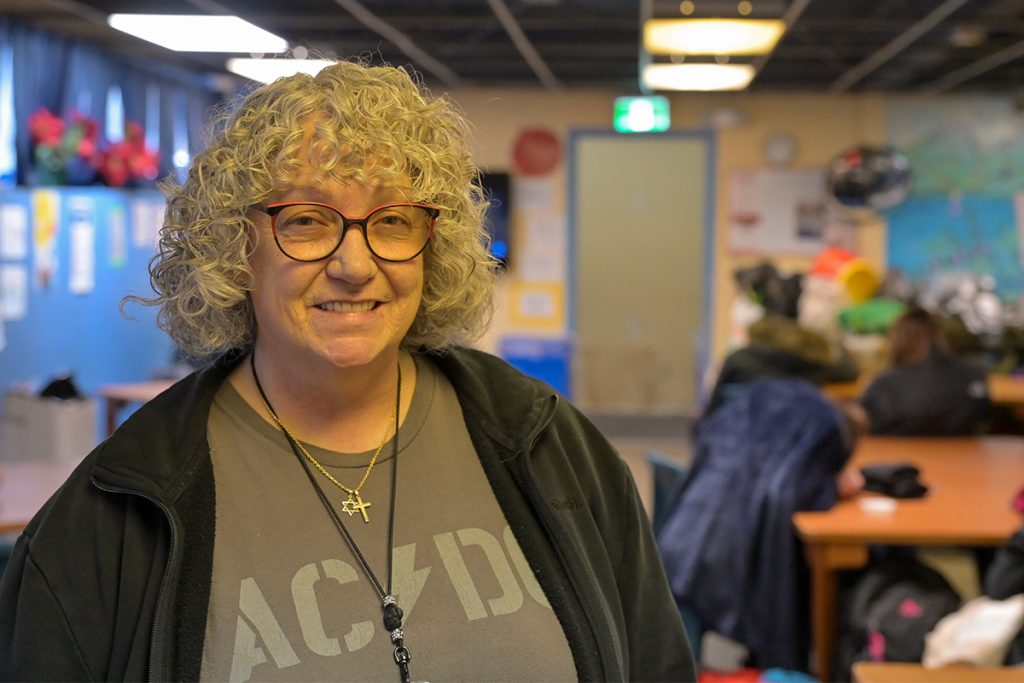
Lisa Clason is the program manager for daytime services at the drop-in hub at 55 Victoria Rd., which is open seven days a week from 9 a.m to 4 p.m. The space is modest with tables and chairs in a lounge area with a TV in the corner. Some people were dozing with their heads down on the tables.
“Lots of people stay awake all night, so they sleep at the table,” Clason explained.
The space has capacity for 30 people at a time but Clason estimates that about 120 different people will use the space in the course of a day.
Aside from providing a safe and warm place to go in the day, the drop-in hub also provides simple sandwiches and instant noodle soup for people to eat as well as clean, dry clothing and harm reduction supplies.
Island Health’s primary care outreach team visits on a regular basis to provide wound care. The Ministry of Social Development and Poverty Reduction helps people access income assistance and BC Housing staff help people apply for housing.
Clason said that when the drop-in hub first opened they had to call community safety officers every day, sometimes twice a day, to get people to move their belongings off Nicol Street. But now, she said people are more respectful about keeping the sidewalk clear.
“Community safety officers are there when we need them,” Clason said. She noted that drop-in hub staff will call the officers if there is someone outside with a “big pile of stuff” who isn’t being responsive to the staff’s request to clear the sidewalk, but isn’t being violent. RCMP officers are called if there is violence, but Clason said the CSOs have built more trust with people and generally get a better response if people are being aggressive or uncooperative.
“There’s more of a community with CSOs,” Clason said. “They’re not just a uniform. They’re kind, compassionate and want to help.”
The officers will also help keep drop-in staff informed if there are people who are new to the area who are exhibiting behavioural issues so they are aware of potential risks.
But the officers’ role at the drop-in hub goes beyond moving people and their stuff along. Clason recalls one time where there was an overdose death in Nob Hill and the CSOs came inside the hub to check on the deceased’s partner who uses the space.
One thing Clason thinks would help is if there was a place downtown where people could store their stuff during the day instead of carting it around and having to guard it against disposal by the city or theft.
A lack of provincial services and upstream solutions
A constant caveat about the Community Safety Officer program is that while it can respond to Nanaimo’s growing homeless population and provide referrals to services, there aren’t enough services for people to access.
“I see them trying to work with people in a humane and respectful way and trying to direct them to services,” Eastmure said. “But the fact is, we don’t have enough frontline services and it’s the role of the provincial government to be providing adequate shelter, housing and health-care support that would really make a difference.”
Eastmure said she was initially skeptical of the Community Safety Officer program when she was elected to council in 2022, but has seen how they use trauma-informed training to “approach people in very vulnerable, difficult situations with a level of gentleness and care.”
“I wish we didn’t need CSOs, because that would mean we would have adequate shelter, housing, health care, mental health care and support for people who are stuck on the street with nowhere to go,” she said.
Eastmure said that while the officers can help move people out of the entrances of downtown businesses, what’s really needed is the ability to get them into shelters, treatment and housing.
Navigating the “complex matrix” of agencies at multiple levels of government is difficult, but Eastmure said the city is working with its provincial and federal counterparts to do so.
Eastmure said Vancouver and Victoria get a lot of attention from the province, but Nanaimo would receive more support if the province was using “data-driven decisions,” as it has a “disproportionate number of unhoused people with no access to any kind of shelter.”
Mayes said one thing that needs to be addressed in Nanaimo is the high levels of child poverty in the city.
“Our children are being traumatized,” she said. “We know that people who have encountered traumatic situations as children are more likely to have trouble with substances, to have trouble with mental illness, to be incarcerated, to be homeless, to have physical health issues.”
Armstrong agrees, and added that there should be more investment in child therapy “right away when a child needs it, not waiting until they act out so badly that they’re in big trouble.”
She said everyone should have access to mental health professionals when they need it as well as detox, treatment and follow-up treatment or people will wind up back on the streets.
“We can keep putting all these band-aids on, but until we actually have the treatment programs in place we’re going to keep bleeding and bleeding.”
What did you think of this story?
Your feedback after we publish a story helps ensure we're always improving our reporting to better serve you
Author

Related Articles

How is The Discourse’s journalism funded?
And what does it cost to produce The Discourse’s in-depth, independent journalism?
Nanaimo Blues Festival brings international headliners and local talent to Maffeo Sutton Park
‘Blues is for everyone,’ says Nanaimo Blues Society president

What to do and where to go during extreme heat events in Nanaimo, the Comox Valley and the Cowichan Valley
A guide to prepare for extreme heat events on Vancouver Island