
Nanaimo council ask for ‘dry’ supportive housing dismissed by province
Community association and city council request permanent supportive housing on Terminal Avenue require abstinence.
Nanaimo City Council wants a proposed supportive housing site in Nanaimo’s Newcastle neighbourhood to be a “dry” location — where no drugs or alcohol use is permitted — but the province’s housing minister says that a harm-reduction approach is better suited for the people who may live there.
Residents in the neighbourhood, who have been advocating for dry housing facilities, say it’s an important option to have for those who are in recovery and seeking support.
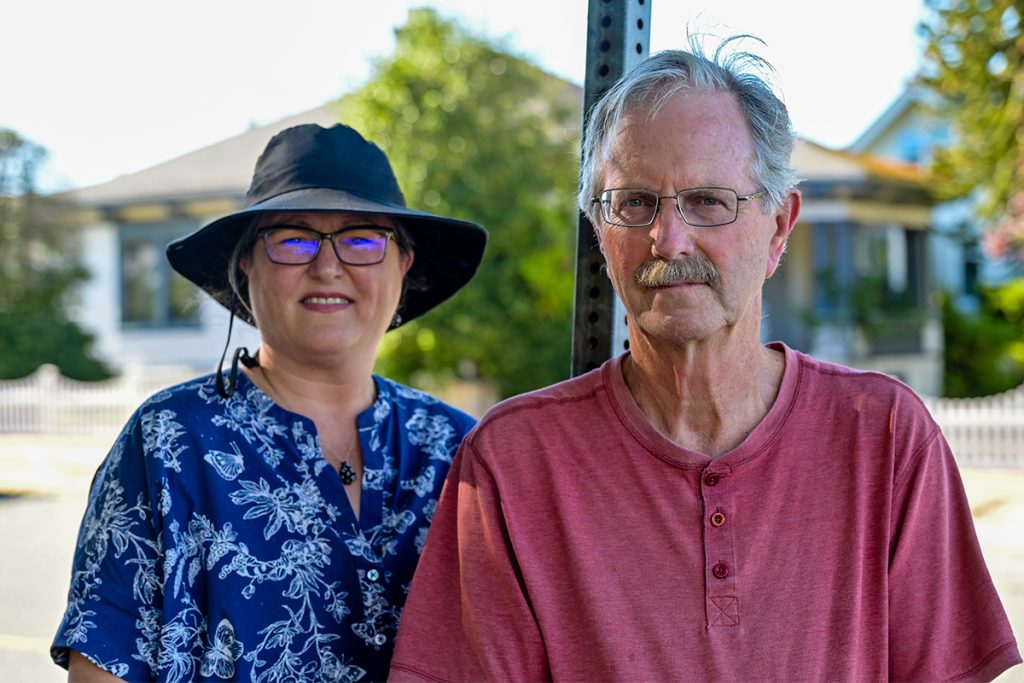
Newcastle Community Association president Karen Kuwica said the request for sober supportive housing was precipitated when a senior resident of the temporary housing at 250 Terminal Ave. struck up a connection with a neighbor and asked for help.
“They were very concerned about being a sober or a clean-living person in the supportive housing and the struggles they were having — feeling intimidated by a culture that they didn’t connect with — and asked for outside help,” Kuwica said, adding that the person said they were being intimidated by drug dealers and had recently lost a friend who lived there to an overdose.
“It was all very distressing and we did what we could to assist them, and it’s my understanding that the individual did get the help they were looking for,” Kuwica said.
That incident led the community association to look for models of supportive housing where people who were recovering from drug and alcohol addiction would be supported.
“We’ve long advocated for dry housing,” Kuwica said, arguing that having to go back into temporary housing with a “culture of substance use and the exposure to criminal activity” threatens the sobriety of people coming out of recovery programs.
In February 2024, the province decided to extend the use of temporary housing at 250 Terminal Ave. until the new permanent housing was ready to be built, but reduced the number of units from 78 to 50. The original plan was to close the temporary housing on the site when the 49 residents moved into the Cornerstone supportive housing building on Prideaux Street, but with rising homelessness in the city, the decision was made to keep it open for people transitioning from shelters to housing.
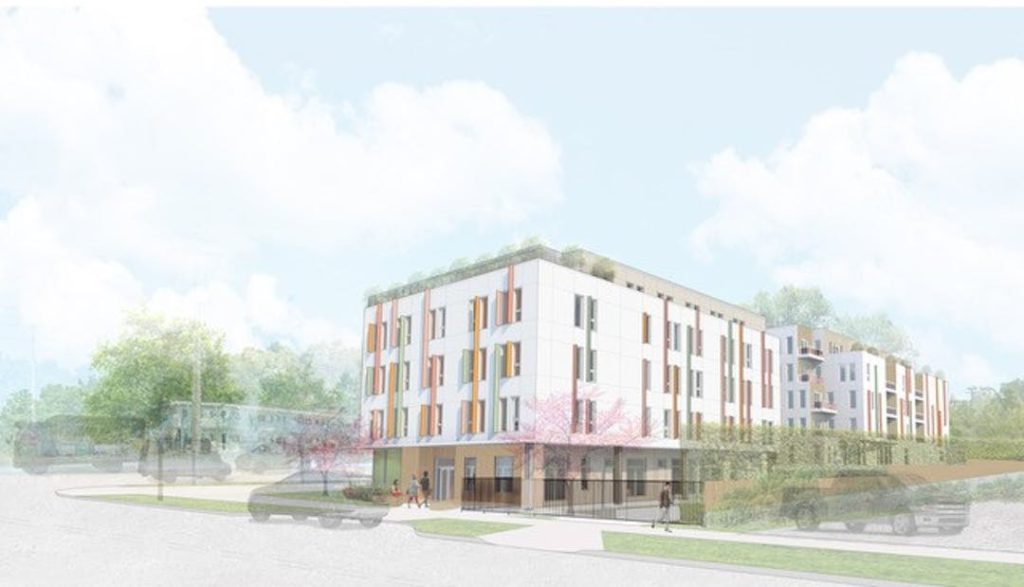
Currently, the plan for 250 Terminal Ave. is in two-phases. It would build two, five-story buildings on the site with 50 permanent supportive housing units built in the first phase and a 34-unit affordable housing building for low-income families, seniors and people with disabilities in the second phase.
Those developments will replace the temporary housing in trailers that have been on the site since 2018, operated by the Island Crisis Care Society.
After hearing from the Newcastle Community Association, Nanaimo city council voted to empower Mayor Leonard Krog to write to the housing minister on July 30, asking for the building to be recovery oriented. As of August 14, Krog told The Discourse that the city has not heard back officially but the minister spoke with CBC’s Stephen Quinn on The Early Edition and defended BC Housing’s current harm-reduction approach.
City council supports dry housing option but housing minister unmoved
Coun. Paul Manly, the former executive director of the Unitarian Shelter located nearby on Townsite Road, said he was “strongly in favour” of the site being recovery-focused housing.
“Having run a shelter and seeing people coming out of recovery and treatment going back into the shelter and being exposed to substance abuse around them, I think that the people who are seeking a clean and sober lifestyle should be provided with supportive housing to do that,” Manly said at a city council meeting on July 28.
Coun. Erin Hemmens said her motion was “driven by the voices of the neighbourhood.”
“Newcastle specifically asked for this, so I think we can meet them there,” she said at the meeting.
In an interview with CBC’s The Early Edition Housing Minister Christine Boyle said the province isn’t considering changing its “widely recognized” housing first model that prioritizes people getting into housing with support that uses a harm-reduction approach.
“The request for the Newcastle space isn’t something that we’re looking at on that site,” she said.
Boyle said the harm reduction model connects people with access to health care and other supports after they are housed.
Housing first and harm reduction
The Homeless Hub, which calls itself the “largest homelessness research library in the world,” states that the housing first model includes a harm-reduction based recovery orientation that gives residents who use substances an environment that reduces the “risks and harmful effects associated with substance use and addictive behaviours for the individual, the community and society as a whole, without requiring abstinence.”
It also says some people may desire and choose abstinence-based housing as part of the spectrum of choices that underline the housing first approach.
An overview of harm reduction in housing settings by the US-based NASTAD (National Alliance of State and Territorial AIDS Directors) said while harm reduction is central to housing first approaches, it is “rarely implemented and often met with community misunderstanding and opposition.”
A peer-reviewed article published in Canadian Family Physician said “housing is a precondition for recovery from substance-use disorder and that it should not be offered on a conditional basis of ‘housing readiness’ such as participation in mandatory programming with a focus on abstinence.”
It notes that a housing first model has shown to have a positive effect on health outcomes by decreasing exposure to violence and behaviour associated with risk of HIV and hepatitis C infection. It also results in “fewer accidental overdoses and lower overall mortality among people who inject drugs” as well as a reduction in use of emergency services.
A study referenced in the article said Canadians who were unhoused with mental illness and then were offered stable housing demonstrated more control over substance use, built positive relationships and developed valued social roles compared to those who were not offered housing. The latter group was four times more likely to be negatively impacted due to “precarious housing, isolation, hopelessness, negative social contacts and heavy substance abuse.”
Mayor and neighbourhood association president react to minister’s comments
“Relapse is often part of recovery,” Boyle said in the CBC interview. “What we don’t want is for people who have a relapse to lose their housing and go through the destabilizing impacts that can continue to have.”
Krog said the housing minister’s comments were “very disappointing.”
“Just because you relapse doesn’t mean you should be kicked out of a place where active substance use is not allowed,” he told The Discourse. “If people relapse, so be it. Lots of people relapse while they’re in recovery centers and you don’t just toss them out on the street. You continue to work with them.”
Kuwica told The Discourse she thought the Minister’s response was “predictable” noting that the community association doesn’t want to tell BC Housing how to run its operations but asks that it take into account what people living in the supportive housing and surrounding community needs.
“That is the recipe for success, responding to the needs on the ground, not digging in on a policy that has become stale and unsupportive,” Kuwica said.
Boyle said the province is “on track” to build supportive housing at a different location in Nanaimo “that prioritizes individuals who have expressed a desire to minimize their exposure to alcohol.”
Boyle is referring to the Sparrow project on the site of the former Travellers Lodge care facility at 1298 Nelson St., which is planned to have 78 beds of temporary supportive housing.
Originally, the plan was to have people move into the building in February 2025 but that has been paused due to required site upgrades, which a City of Nanaimo staff report from July said are still ongoing.
Laura McLeod, a spokesperson for BC Housing, told The Discourse the “opening has been delayed due to unanticipated challenges but we expect to begin welcoming residents later this year or early next year.”
Krog said he understands the minister’s position and while the beds at the former Travellers Lodge will help, “it’s not a substantive number in terms of the beds versus the problem.”
“It’s not unreasonable to say we’d like a housing facility for people who are at a stage where we have some real hope for them to continue to be, and remain, clean or free of substance abuse.”
A decision ‘imposed’ on the neighbourhood
Fred MacDonald, vice president of the Newcastle Community Association, said when the decision for the temporary housing was originally “imposed” on the neighbourhood in 2018, the community “was very, very upset to put it mildly.” But over the years he and the association have spent significant time providing input on design, location and size of the proposed supportive housing buildings.
“None of those things have been taken very seriously,” MacDonald said. “But we’re saying, ‘Look, why don’t you try this? Try this in this community. We’re ready to support people who want to help themselves.’”
Kuwica said the Newcastle Community Association wants a permanent supportive housing development at 250 Terminal Ave. but would like to see it limited to 35 units, not the 50 that are currently being proposed by BC Housing. The association says 35 units would be the most successful for both residents of the building and for the community to support.
Kuwica and MacDonald point to the 23-unit independent living housing operated by the Vancouver Island Mental Health Society on the corner of Terminal Avenue and Rosehill Street as a positive model that has integrated well into the community.
“This is attractive,” MacDonald said standing outside the building. “Well designed, the right size and there’s nothing for you to say there’s anything wrong.”
Hemmens told The Discourse that she and Coun. Sheryl Armstrong have both been “quite vocal about 50 people being too many in supportive housing.” She acknowledges that lower numbers of units poses another problem of having to find more sites that are available in neighbourhoods across the city.
“We love our neighbourhood,” Kuwica said. “It’s very connected. We know all our neighbours and everybody’s invested in it being a safe and thriving community, and we hope that the permanent building is a total success.”
Editors note, Aug. 15, 2025: A previous version of this story stated BC Housing does not have timeline for the opening of The Sparrow, which has been delayed due to renovations and permitting. This story was updated to reflect a clearer timeline from BC Housing.
Aug. 18, 2025: The story has been updated to reflect that Coun. Paul Manly is the former executive director of the Unitarian Shelter, not the current one. He left the role when Nanaimo Family Life Association took over shelter operations last summer.
What did you think of this story?
Your feedback after we publish a story helps ensure we're always improving our reporting to better serve you
Author

Related Articles
Comox Valley, Nanaimo land trusts raising funds to support Deep Bay land conservation purchase
In a partnership with the Comox Valley and Nanaimo Area land trusts, BC Parks Foundation is fundraising to protect 50 hectares of pristine shoreline in Deep Bay and make it accessible to the public.

Nanaimo Jazz Festival celebrates 10 years with more than a dozen shows in September
Local and international artists to perform on multiple stages in the city at this year’s Nanaimo Jazz Festival.

Snuneymuxw Elder C’tasi:a shares traditional plant knowledge in new book
‘Plant Teachings from my Auntie’ by Snuneymuxw Elder C’tasi:a and ethnobotanist Nancy Turner delves into traditional plants and plant medicine.