
Q&A: MJ McGregor speaks their TRUTH
Raised in a secretive religion, local artist MJ McGregor uses music to find and form a new identity.

Content warning: This interview mentions suicidal ideation. For resources check the Vancouver Island Crisis Society. The 24-hour Vancouver Island Crisis Line can be reached at 1‑888‑494‑3888.
I’ve seen MJ McGregor’s musical project TRUTH a number of times over the past few years and always thought it was a unique and emotional experience to watch them perform.
We have become acquaintances through my concert photography and would often say hello to one another and make small talk but we never had a chance to talk at length.
I met up with MJ at The Vault Cafe where we had a long and fascinating conversation about their journey — from growing up in an isolated religious household near Ladysmith, to being an artist and musician in a queer relationship in Nanaimo — and how they use music to “talk back” to the environment in which they were raised.
The interview has been lightly edited for length and clarity.
Q & A with MJ McGregor / TRUTH
Mick Sweetman: Can you tell me a bit about where you come from?
MJ McGregor: I come from an area just outside of what’s known as Ladysmith. So the unceded territory of the Stz’uminus First Nation. Where I was raised was a very small non-Indigenous community with reserve lands surrounding us. A huge component to my upbringing was the religious background that I come from. From what I understand, for five generations on both sides of my family, matrilineal and patrilineal, there’s involvement in the church without a name. People in it will maybe refer to it as “the truth,” or outside people call it “Two By Twos.” It’s an unorganized organization, is what I was told. It’s all over the world, but it’s really secretive [and] very exclusive, but it’s Christian-based. So I was really entrenched in that ideology, and it was very, “keep separate from the worldly people,” so that obviously shaped how I viewed the world.
MS: Your band name, TRUTH, is it related to that?
MJ: Absolutely. I decided on the name TRUTH as a way to speak back to how I was raised. Because, unpacking what it was like, I realized eventually that this “one truth” that I was being raised to live by is, in fact, not how I see the world. All my music ends up being a bit of a catharsis, unlearning a lot of the narratives or dealing with the different pain and hurt that came from that.
When I was a teenager, I got baptized. And baptism in the church I was raised in is an extremely important step. I woke up the next day and it was very physical. It felt like the whole world had got on a dimmer switch, like everything just kind of went darker. And it was like all of my understanding had left me. I was just in utter confusion. And from that point on, I slipped into a really deep depression, and that hung around for a year or two. I struggled with suicidal ideation because my understanding of the world sort of collapsed in on itself, and the community and my family treated it as if I was the problem and I just needed to do more work to be closer to God.
Ultimately, I was completely ostracized from everybody that I knew. I was still within my family unit, but it was like I was treated like I had some type of infection or something. So that sort of undoing has been pivotal in informing my music and healing from that kind of destabilization. I just lost my identity entirely, and so kind of since then, it’s been this awkward, like, “who am I?” I didn’t have any other guides or mentors. And of course, being indoctrinated to think that everybody else is wrong, I think that it made it really difficult to find other people that I trusted. Alcoholism became part of my story as well, to deal with a lot of the hurt.
MS: You talked about who you were, but who are you now?
MJ: I would say that’s always in flux. Honestly, I don’t feel like I can ever define my identity in a total way. Some more definitive facts about my identity is that first and foremost, I’m a parent, and that absolutely takes precedence over everything else in my life. My son is 11 now and I’m in a relationship. My partner and I have been together for a while now, and we’re in a queer relationship. So that’s also very different from how I was raised to think about relationships and everything like that. And I’m a student in the Indigenous studies program at VIU. I absolutely connect with nature and find a lot of guidance there. I think that that’s probably been my biggest guide to be able to trust in life.
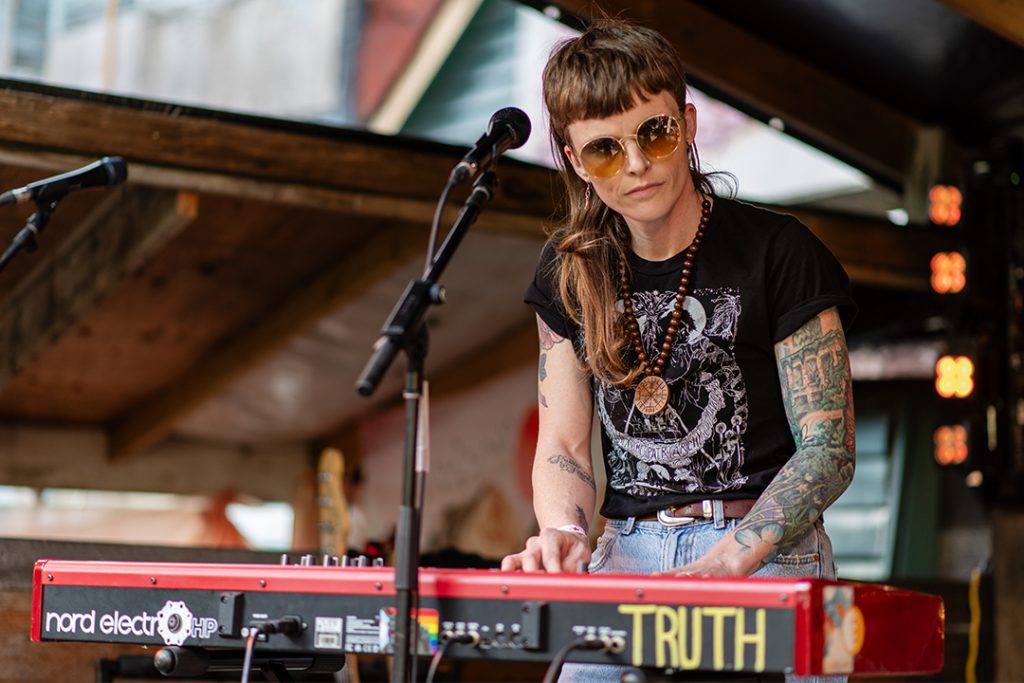
MS: You grew up adjacent to Stz’uminus First Nation and now you are a student in Indigenous studies. Is there a connection between those two things?
MJ: Yeah, I would say so. [It’s] kind of speaking back to how I’ve always connected with nature. I think that growing up where I did, we were fortunate to have a quarter acre that we were on, and it backed onto wilderness. Once that undoing sort of happened for me, I think that what absolutely kept me alive was being able to go into nature and feel my feelings and have some sort of groundedness in that regard. I think that that ended up connecting to where I’m at now. Learning over the years about different Indigenous ways of thinking and being, I felt a connection to being drawn to that, but also an awareness of the marginalization and different oppressive methods that I saw growing up. There was definitely a very distinct difference, even within our school, and it just felt like we were two different kinds of people. And I guess that was always sort of curious to me.
MS: I know that you had different roles at Literacy Central Vancouver Island. Can you tell me a little bit about that?
MJ: I started there as a janitor, and I still hold that as a part-time position. I got the job through a friend, they were working there and asked if I wanted to do it, because they knew I was having a difficult time being a parent. At first glance it seemed like a really nice, flexible kind of position for a parent but once I got in there, I was like, “wow, this is like, way, way more than I kind of anticipated.”
Literacy to me was just about reading books, being able to understand how to read a book. So talking with different program coordinators because they’d be there after hours, kind of learning a little bit more about literacy and it kind of just piqued my interest, I suppose. I would have more engaging conversations with the people that were working there in these more literacy positions. Samantha Letourneau was the executive director at the time and I kind of knew her from the music community prior to that. She saw something in me that was beyond a position of cleaning … and literally came up with another job that was for me — curating the Word on the Street bulletin board. It was started during COVID-19 and aimed to provide information to those who are displaced or don’t have easy access to the Internet.
Then I was asked if I would like to facilitate a discussion group about critical literacy. I hardly understood what literacy was, what’s critical literacy? It was a really eye opening experience for me to take on. I had to do a lot of methodology that I wasn’t familiar with, and do a lot of learning and failing and not having a lot of success with the actual group but eventually I realized that I can actually do some of this stuff.
I know I want to work within the community. I want it to be participatory in some type of healing work. It’s thanks to the community and people I’ve ended up encountering who have helped me to see who I am.
MS: Last year you decided to start going by MJ. Could you talk a bit about what was behind that for you, what you were thinking in that decision?
MJ: I have never looked in the mirror and been like, “that’s who I am.” I’ve never felt settled in that and I don’t know if it’s because I’m in the wrong body, or if it’s because of my reaction to how I’ve perceived my body to be interpreted by the world around me.
I started to really seriously consider my gender identity and sexuality, incidentally, when I started working here at The Vault. I hadn’t really been around a community of folks that were gender diverse, who had that kind of language. So yeah, working here, I just became aware of the language and realized that I fit in there somewhere.
More specific to your question of going from Monica to MJ, MJ is my initials. My full name is Monica Jane McGregor. I didn’t feel like I wanted to completely go away from my given name, because I feel that for me, it does inform who I am, but I think it speaks a lot of the shifts in my life, and recognizing those shifts and honoring that for myself and taking ownership of who I am for the first time. I think that going from Monica to MJ is just me claiming myself and coming home to who I am on my own terms, and not being told who I am.

MS: I think The Vault Cafe is actually quite a unique space in the city. It’s a nice cafe that has good coffee, but it’s really the people who make it what it is here. How did you first connect with the community that’s around The Vault Cafe?
MJ: I moved into town with my ex-husband and our little guy from the Ladysmith area. Gosh, that was 2016 or 2017, and we moved into the Harewood area. I was trying to get out of the house and walk a lot with my son in a stroller, and just kind of happened across The Vault. They had been open a little less than a year and I really appreciated this vibe that I felt like I could hang out with my kid and have a beer and talk with people about whatever. It was a really welcoming atmosphere. And I remember one day I was sitting by myself on the patio and overheard Amanda talking to somebody else about needing a cook and I was like, “Yeah, I’m interested in working here.” Once Amanda found out that I was a cook and I knew other people that worked here, she said “oh, come on board.” But for me, what really drew me [in] was the fact that there was a piano here, because that’s what I grew up playing. I still have that piano, actually, it’s been in my family for five generations and one day my son will take it. The Vault was a place where I kind of started understanding a new kind of language, new ways to look at the world, new ways to look at myself.
MS: What is it like to perform as TRUTH?
MJ: It’s a very embodied experience. I’m very committed to speaking my truth, to singing my truth. I owe it to the songs, I owe it to my story, to show up as authentically as possible, but that is a very vulnerable thing to do. It’s unsettling every time, but telling my story has gotten a little easier. These songs are me sharing my experiences and I want to honour [them]. That’s why I don’t do shows very often, because it is a very emotionally invested experience for me to perform live.
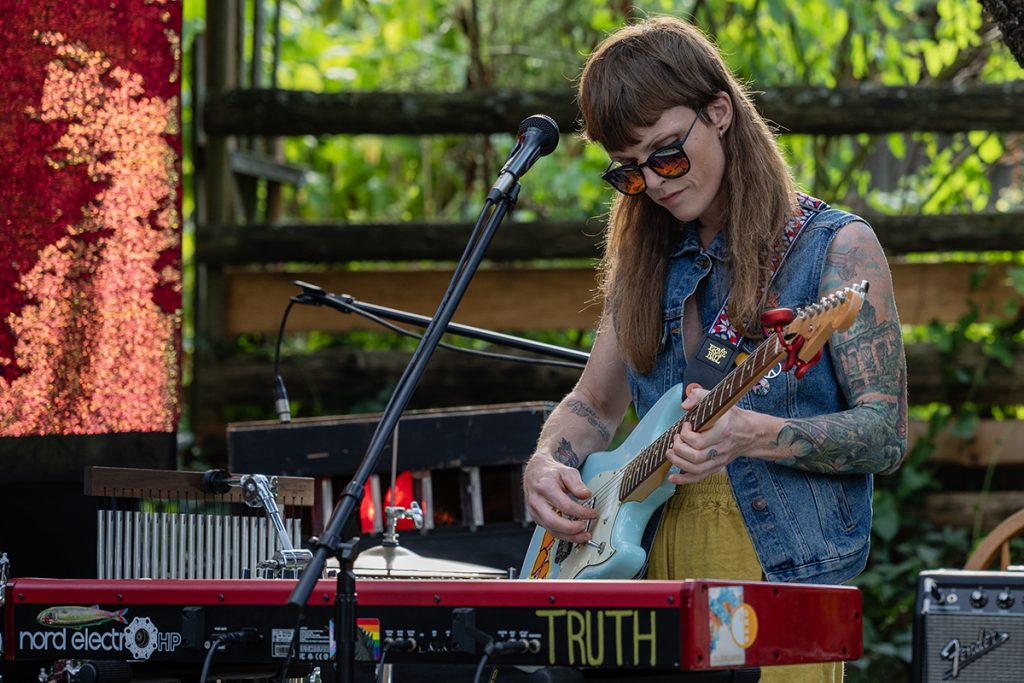
MS: When I saw you perform at Crace Mountain earlier this month the song that really stood out to me was Shadow Work. Can you tell me a bit about that. Where did that come from?
MJ: Shadow Work is, interestingly, one of my least favorite songs to try to perform, because instrumentally it’s tricky for me to sing and play because I play it on guitar and guitar is actually not my instrument. But Shadow Work is about the journey of recognizing that we all have our young self that walks through life with us as we get older, because how we were raised shapes how we experience the world.
I don’t sit down and write songs, I get gifted songs from time to time, and I happen to be in a space that I can capture it. It just kind of comes out sometimes. I don’t even really remember the circumstances that I wrote that song in, but my songs give me more information about myself as time moves on. Every time I sing them, I kind of reinterpret it. People might see it over time coming to shows that I kind of reinterpret many of my songs in different ways, musically, because I don’t have a large amount of songs. But that’s also speaking to the fact that I’m always kind of reinterpreting who I am.
MS: You also have a song about your partner Will.
MJ: It’s on Bandcamp as Will’s Song, so it’s Will’s song. They were away working, doing archeology work for eight months of the year, and that song came out of just recognizing that I was in an unconditionally loving relationship, and sort of the response to that. That song was neat when it came because I really was like, “whoa, this song is unlike any of the other songs I’ve ever written.” All the other songs really kind of talk about my internal struggles and stuff like that. Whereas this song was more of a celebratory type of song for me.
MS: I love that.
MJ: I want to mention that part of how I’m understanding myself these days, is through a lens of neurodivergency. It’s kind of funny because I have only really been kind of using that lens for the last couple of years or so. So, when I’m doing stuff like this interview, my brain is doing another narrative over top all the time. It can be a little bit tricky, because I’m just processing a lot all the time and trying to react, and I have all these convictions about giving right answers and it can get a little bit messy up in here.
MS: So what’s next for TRUTH?
MJ: I’m working on my learning, because that informs my music. A part of how I end up writing songs is putting the time into experiencing life, and then the songs will come. If I kept myself in a really small circle, didn’t try new things, didn’t experience new stuff, then it’s just going to be like an echo chamber. The TRUTH project will always remain the same. They’ll always be songs that will make people cry. I don’t want to make music that just makes people feel kind of fucked up. I want to write happy music.
I do want to record the songs that I’ve got this far in a studio. I’ve recorded them with my partner at home, so it would be really cool to go into the studio and really flesh out those songs and have them as a complete package at some point. Music isn’t something that is something to be commodified, although I know that it is, and that’s fine, but in my experience music is sacred. I feel like it’s a real sacred language to be able to communicate and so it takes time. I want to respect that part of it. For me, it’s a lot about building relationships and not trying to dominate music as something that can work for me, but understand that it’s sort of a gift that I’m able to partake in when I respect it that way. I think that it comes out in my music and that’s what provokes people to connect to it.
What did you think of this story?
Your feedback after we publish a story helps ensure we're always improving our reporting to better serve you
Author

Related Articles
Nanaimo mayoral candidates address the homelessness crisis
Homelessness is a key election issue but what can the City of Nanaimo do about it?
How Nanaimo candidates would pay for rising infrastructure costs
City of Nanaimo’s 2026 candidates share how they’d manage the budget to cover rising infrastructure and repair costs without overburdening taxpayers.
Nanaimo candidates on how the city can cut emissions
City of Nanaimo’s 2026 candidates share two actions within city jurisdiction they’d prioritize to reduce emissions, and how they’d know if they were working.