Q&A: Nanaimo artist Lenae Silva on substance use, support and ‘bright endings’
Lenae Silva talks about her experiences as a person who uses drugs in her new exhibit at Vancouver Island University.
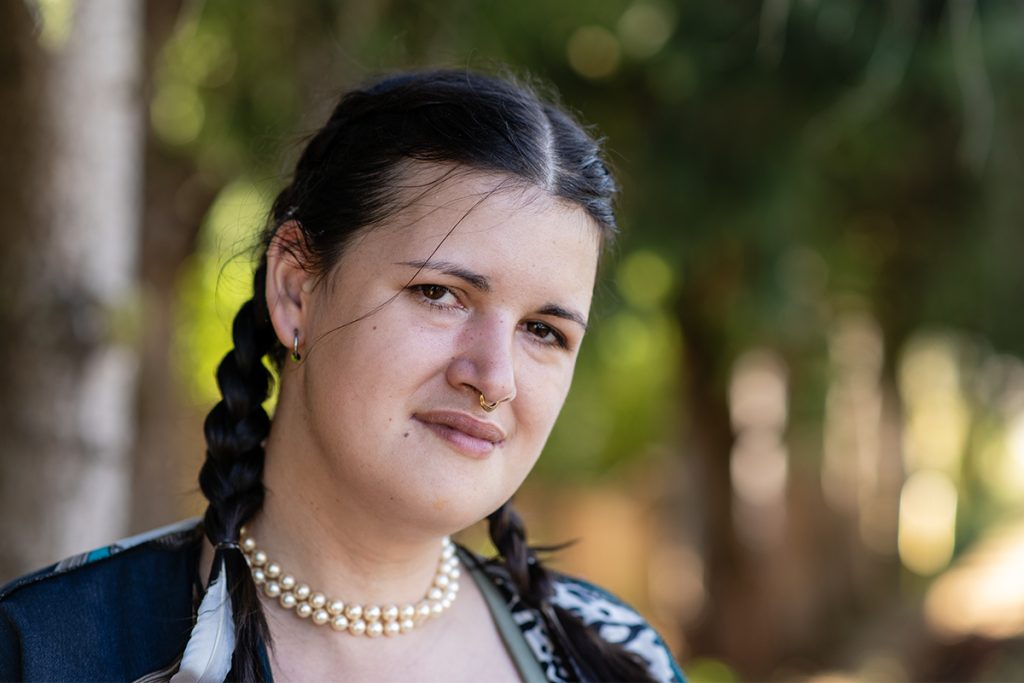
Lenae Silva is a Sḵwx̱wú7mesh/Chilean artist who has lived in Nanaimo for most of her life. She is also an advocate for people experiencing mental health challenges, poverty and substance use and co-founded the Open Heart Collaborative, a peer-run community group that focuses on trauma-informed care and education, outreach and advocacy.
On Wednesday, Sept. 24, Silva’s exhibit, which is part of an event titled Harm Reduction is an Act of Love, will open in Vancouver Island University’s Malaspina Theatre along with a screening of Kímmapiiyipitssini: The Meaning of Empathy at 7:30 p.m.
Her exhibit will be on display in the lobby of the Malaspina Theatre until October 10.
Silva spoke with The Discourse about how she finds value in being able to express her experience of using drugs.
Mick Sweetman, The Discourse: Can you tell me a bit about yourself, both the activism and the art that you do?
Lenae Silva:. I grew up in a very addicted household, not necessarily with drugs, but with alcohol and other things. And so there was a lot of neglect that was very hard to overcome in my journey as a youth but has helped shape who I am and helped make me strong and helped make me feel like I can overcome anything. That’s something that I definitely want to pass on to people.
I started utilizing substances quite early. I was about 11 when I first smoked methamphetamines and before that, I was drinking whenever there was a party. I started using opiates for the first time when I was 16, and was heavily addicted by the time I was about 18, and that has just continued. I got help with heroin and opiates. I found that methadone worked, but not so much methadose. I ended up not having much sobriety throughout the whole 20 years. Art definitely has been one of the things that has helped me feel like I have something that I can contribute.
That kind of crossed over into peer work. I can contribute to helping other people feel like they have something to contribute, whether it’s to society, whether it’s activism, whether it’s to just saying, “Hey doctor, this stuff isn’t working. No matter how many times you tell me that methadone and methadose are the same things, it’s not working.”
So they kind of started crossing paths, the art being my internal form of care and form of advocacy and then moving onto the streets through the CAT teams, which eventually led up to co-founding the Open Heart Collaborative.
Can you tell me a bit about the Open Heart Collaborative and what you do with it?
Around the time that Wesley Street was being encamped, right at the beginning of Covid, there was a major crisis getting access to safe supply in terms of needles, harm reduction supplies and safe products. With the border closures, a lot of different substances were kind of just being mixed up in a basement. It was very rough and caused a lot of chronic wounds. Eventually, we were seeing our friends with holes [from drug use] so big that you could see through their arms, almost like that Krokodil stuff you hear of in Russia — just bad, chronic wounds and no doctors were available.
After the Harris House [Health Clinic] shut down, we asked “can we have some of your extra supplies?” We hired some people off the streets and we’d all make kits. We would go and hand out supplies and that led to being able to be welcomed into tents. People would tell us, “Hey, I have this really bad issue on my arm right here,” or, “my teeth are killing me.” We had a connection with Island Health and told them “you guys have got to come down here, but you need to let us lead the way.” It was the first time I ever saw health care stand back and wait for us to say, “this person wants to see you … let’s see if they’re still there or if they’re still interested in seeing you.”
It ended up becoming a weekly thing where they would come up and check up on wound care and bring down some food for people and that turned into the primary care outreach team. From that, we have had so many different and evolved programs.
The event is called “harm reduction is an act of love.” Can you tell me about the exhibit and how that came about?
People just kind of know me as the artist and the activist. Sarah Lovegrove, who I believe is a big part of putting some of this together, invited me and said, “Would you like to come bring in some pieces, whether they’re old or new?” I said yes and it went from there.
I’m bringing in some old pieces, some new, and hoping to find enough time to do a couple of more deep pieces that are not going to be as intense as the watercolors that I usually do. I usually do life portraits with watercolors, but I’m going to be representing my friends who are on the streets right now and are facing major, continuous barriers. I have a small four-by-four portrait, I’m still trying to figure out a name for it, but something like, “I’ll do anything” and it’s a mouth that’s open. I’m hoping to have some sidebars of the pieces and what they represent to me.
Is there a theme that kind of ties it together?
Drug use, love, just the experiences. It’s such a strange experience going through these things, it’s often compared to war though I don’t ever want to minimize anybody’s trauma who has been through war.
One piece is about forced sex work and drug addiction and how that could very easily be changed into safe sex work. It could be the same amount, same price, same thing, but with safety. We’re losing a lot of girls and for some reason it’s not making the news. We’re just losing track of a lot of people right now.
It’s difficult for me to have that bright ending, that harm reduction is love, because this is my bright ending right now. I am at the healthiest I’ve been in years. I’m housed, I’m healthy, I feel great, I’m painting, I got engaged. I have a wonderful partner — there’s so many things in my life that are positive that I wouldn’t have without them.
I’m also doing an Indigenous piece that’s dedicated to the Sḵwx̱wú7mesh side of my family. We’re part Chilean and part Sḵwx̱wú7mesh, and this is a really sensitive one for me, as I have all brothers, one is is heavily addicted living down in [Vancouver’s] Downtown East Side. I don’t get to see him ever. I don’t get to talk to him ever, and it’s been like that for years.
My dad and his sisters and brothers knew they were Indigenous but if we were around our grandparents, they were like, “We are Chilean. We are not indigenous.” Excuse my language, but they said, “Don’t bring your Indian friends around.” Sometimes even [with] a smack across the head. I really feel as a female, the three generations of trauma will always be passed down through the umbilical cord.
So this is going to be a traditionally beaded piece on a beaded loom. It’s kind of abstract and beaded, bright and sunny, and growing out from the sky into the colorful Earth, and then it starts dripping into the gray and the black.
Is there anything else about the exhibit or about yourself as an artist that you would like to say?
About the exhibit, just come with an open mind. Most of my work has a double entendre, it’s speaking to both the loss and the growth that can come with community. The loss of a person through opiate use and the community-wide pick up that can happen when we all come together and hold each other up when we lose someone very close to us. So keep that in mind. Some of it may seem negative or may not seem attached, I hope I can talk a little bit about it, but I’ll be mingling there, so you can always ask me directly.
For me as an artist, it’s one of the few things I can say in life that I’m truly proud of myself for being able to do. I feel I have a skill, and it gives me value as a human being. When you look at opiate use, it tends to take away those small values, it takes little things away one by one. You might stop doing your makeup, doing your hair, stop painting and art is something I’ve continued throughout. I’m very proud of the growth that I’ve made through my art.
What did you think of this story?
Your feedback after we publish a story helps ensure we're always improving our reporting to better serve you
Author
Related Articles
DRIPA debated in B.C. election on Vancouver Island
The Conservative party of B.C. is promising to repeal the Declaration on the Rights of Indigenous Peoples Act (DRIPA), while other parties argue that would set back relations with First Nations and create economic uncertainty.
Where Nanaimo’s MLA candidates stand on addictions care, family doctors and Island rail
Candidates in Nanaimo-Gabriola and Nanaimo-Lantzville answered three questions from Discourse readers ahead of the Oct. 24 B.C. election.
Nanaimo’s guide to the 2026 B.C. election
What riding am I in? Who are the candidates? When do I vote? B.C. election basics for Nanaimo voters.