
Vancouver Island University faces tough decisions amidst a deficit crisis
‘There is a moral and legal obligation towards students to finish what the administration has started,’ said one VIU student.

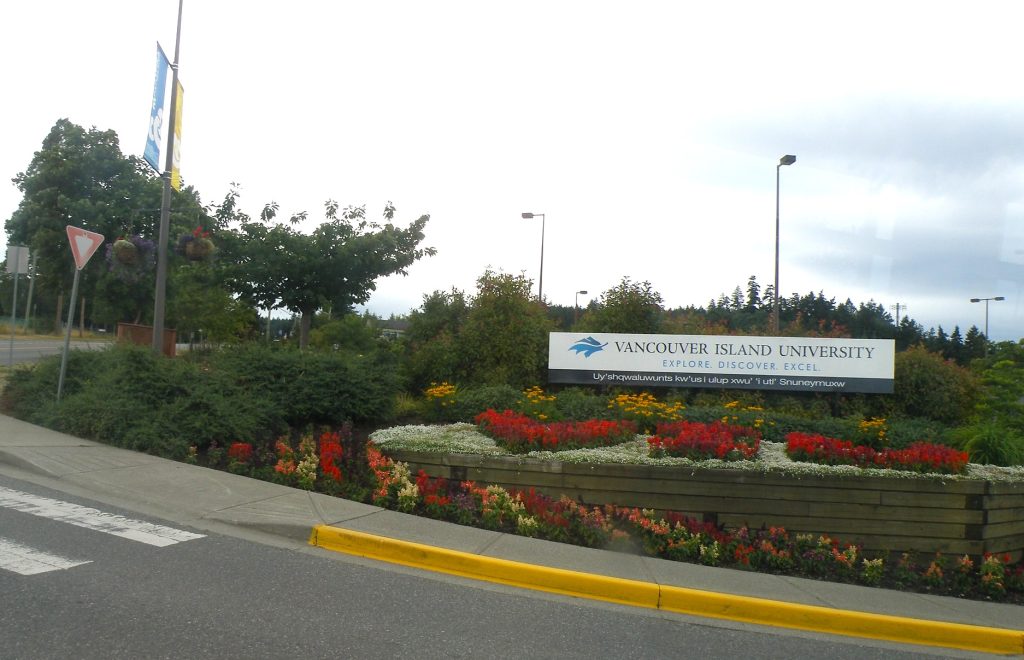
A tense scene unfolded at Vancouver Island University on March 7 as students, instructors, university staff and administration crowded into a senate meeting on the top floor of the library, with some spilling out into the hall, straining to peer in.
The meeting was held to decide the fate of three programs — the integrated engineering technologist diploma (IETD), and both the advanced diploma and master’s level Geographic Information Systems (GIS) programs — which the senate voted to cancel amidst the university’s $20.2 million deficit crisis.
Controversially, on March 4, the senate’s planning and priorities committee also voted to phase out the university’s flagship bachelor of music and jazz diploma programs, a move opposed alike by the program’s instructors, musical luminaries like Juno Award-winning jazz musician Phil Dwyer, veteran music teachers like Bryan Stovell and organizations like the Nanaimo International Jazz Festival.
The university’s major in economics option has also been suspended, a pause that gives faculty an “opportunity to take a closer look” at the curriculum and “rethink and reshape it,” said VIU in a statement.
The decisions to suspend or phase out programs “are not made lightly,” the statement added, and are based on a number of factors including demand for programs as well as current enrollment and applications.
Students who oppose the cancellations spoke up at the senate meeting, saying they have not been properly consulted about the cancellations, that the university doesn’t appear to be exploring alternative solutions to the cancellation of valuable programs, and that promises associated with their programs have not been fulfilled.
“Educational institutions across Canada are facing difficulties, but it will be said that only VIU management sacrificed its students to bail themselves out,” said former student Tarek Kayal, who graduated from the IETD program in 2022, in his speech at the senate meeting on Thursday.
“Who will have faith in an institution that promises the world to its students then leaves them hanging in the middle of their educational paths?”
‘A hard transition’
“Right now what we have is not sustainable, and it hasn’t been for a long time,” VIU President and Vice-Chancellor Deborah Saucier acknowledged at the senate meeting, characterizing the issue as “an identity problem” of a university in its teenage years.
“We are in the middle of a hard transition,” said Saucier. “Now we’re faced with cuts. And in the face of constant austerity — and I’ve heard that loud and clear, about people seeing constant austerity — I can tell you that if we do not change, we will have 15, 20 years more of austerity. Because if we grow at the rate of the population of this area, [in 11 years] we will be short another $11 million. We have choices to make here.”
The stakes are high — according to the university’s latest audit from KPMG, if the initial stages of the deficit recovery plan are not successful, the university “could run out of cash within 18 months.”
The financial crisis became apparent early last year, when an internal university email sent out to faculty and staff, obtained by The Discourse, outlined the administration’s plan for a hiring freeze and asked for all departments to resubmit their budgets for the following year.

It acknowledged the university had been in a deficit since 2019, which was approved as required by the province, and pointed to inflation and lower-than-expected enrollment of domestic and international students as key causes.
By October, the university had announced its plan to close its ElderCollege program, aimed at students 50 years old and up, by the end of the year. The program had been running since 1993 and had 647 students enrolled.
At the same time, the university revealed its mitigation plan for what it said was a $20.2 million deficit in its 2023-24 academic year, and an operating deficit of $46.9 million that had accumulated from 2019 to 2023-24.
The aim was to balance annual budgets within three years, and part of this plan includes a 10 per cent cut in expenditures for academic and non-academic units (things like the library, president’s office or student affairs).
Two months later, VIU announced the withdrawal of its financial and administrative support for its independent high school, which will cease operations this July, and only just obtained its international baccalaureate diploma accreditation in May.
These cuts and other measures taken by the university have now brought this year-to-date’s expected deficit down from $20.2 million to approximately $12 million, says Emily Huner, VIU’s Chief Financial Officer.
After the senate’s March 7 vote to cancel the IETD and GIS programs, the next step is for that recommendation to go to VIU’s board of governors, which will then make a final decision based on the senate’s advice.
Next in line to be cut is VIU’s bachelor of music and jazz diploma program, which will go through the same process of a discussion and vote at a public senate meeting on April 4. If the vote to cancel goes through, it will then move to the VIU Board on May 28.
No path forward
After Tarek Kayal graduated from VIU’s IETD program in 2022, of four resumes he sent out, he says three ended up in a request for interviews, after which he accepted a job offer from the City of Nanaimo where he now works as a civil design technologist.
There is a strong need for an engineering skill set, and the City of Nanaimo experiences “numerous chronic vacancies” in its engineering department, wrote Poul Rosen, the city’s Director of Engineering, in a letter to senate. Without a local engineering program, “we will need to keep searching farther afield for qualified people,” he added.
Kayal similarly told the senate there were 230 Engineering Technologist job offers listed for Vancouver Island last time he checked, and he struggles to understand why the university would want to cancel the program.
Launched by the university in 2020 during the challenges of COVID-19, the program was part of an engineering and technology expansion initiative and combined mechanical, drafting and civil engineering into one learning stream.
The university argues that the original proposal for the program aimed for a student intake of 20 to 24 students per year, and in its rationale for cancelling wrote that “the actual number has varied from three to five students with no indication of growth,” and that there has been “only been one graduate so far.”
This conflicts with the presentation made by Dr. Brian Dick, who chairs the physics, engineering, and astronomy department and coordinates the IETD program. Dick asserts that the decision to cancel the program is premature as it wasn’t given sufficient time to get on its feet, and says current applications for the program are currently at 17 and climbing.
“In the past few weeks since this proposed cancellation, I’ve become completely demoralized,” said Ryan Bartlett, a father who is currently halfway through his second semester of the IETD program, which he has gone into significant debt to take.
“I put trust in VIU, and I never imagined a respected, accredited university would rob me of being able to complete a program, especially in an industry that has so many job prospects. This isn’t just a program for me, this is a means to provide for my family and have meaningful work in my community…
“If this program is cancelled I will be left with no prospects, a dismal future and massive financial hardship. I have no path forward without completing this program.”
Kayal says he is also disturbed by the promises made by the university regarding the program’s accreditation process, which he was told would be submitted once the first student graduated and would take approximately 11 to 17 months.
“I was surprised to learn during the senate meeting that they were lying, and that the process was on hold the whole time,” he says, via email. “What really happened is that the internal audit for this program has taken three years to date, and they still have not submitted it yet.”
Even though he graduated, Kayal says he is not eligible for the highest-paying jobs without the accreditation that the program initially offered, which is both national and international.
Originally from Lebanon, Kayal said he had planned to work in the Middle East so his five-year-old daughter could be close to his grandparents. However, to do this without accreditation means he would need to take nine different exams to achieve the same level of accreditation that was originally offered by the program.
“If I moved to another province, I would need to take those nine exams again. If I wanted to downgrade and settle for civil engineering only, I will need to take four different exams to maintain equivalent accreditation. Are we expected to accept this as a suitable accommodation?” he asked the senate.
The problem with accreditation is that it “requires a significant number of graduates before there’s enough evidence for the professional body to approve the program,” says Dr. Mike Quinn, VIU’s Provost and Vice-President Academic, in an interview with The Discourse. “Because enrollment has been so low for the first couple of years, we haven’t been able to move forward with that.”
There is not technically a minimum number of students needed to complete the accreditation process, and it is “somewhat a professional judgement call,” and “a conversation between the program and the profession.”
Quinn says the university is looking into what the options are for accreditation now that it’s likely the program will be cancelled.
Beyond this issue, Kayal says he also struggles with what he perceives as a lack of communication and accountability from the university.
“There is a moral and legal obligation towards students to finish what the administration has started and dragged them into,” he says.
“After the motion was passed [to cancel], I requested to talk to President Saucier for two minutes, and told her that that is the least that they owe us for the hardships they caused us. She refused to talk to us, and her staff kept sending me off.”
Left hanging
Many of the university’s issues can be traced back to a decline in domestic and international student enrollment, which started as far back as 2013, confirms VIU’s Chief Financial Officer Emily Huner.
But even as enrollment declined, she says VIU continued to offer the same number of courses and levels of services.
“During the last 10 years, our revenues have decreased while expenses either stayed the same, or in many areas rose [due to things like] inflationary pressures, as well as increased hiring across all our employee groups.
“VIU currently has the largest number of employees and the lowest number of students since 2013. And where those two lines cross was when we started our deficit — in the 2018/19 year,” she says.
VIU’s Student Union executive director James Bowen characterizes it in a similar way.
“Trying to do too much at once and not taking a step back, rationalizing and taking a look at what’s working, what’s not,” he says. “We depended largely on international student revenues without thinking that that could go away. Even though it was obvious that it could, and would, go away.”
Just prior to the COVID-19 pandemic in 2020, the student’s union made a presentation to the university’s board of governors to make that very case.
At the time, the board was seeking to restructure the masters of business administration program in such a way that it would result in steep increases to its tuition fees, which would disproportionately fall on international students.
Student union representatives gave a presentation about the unfairness of unregulated increases in international student tuition and over-dependence on that funding source, cautioning that if it continued to do so, it would jeopardize VIU’s ability to move forward.
“Two months later, COVID hit and we were proven right,” says Bowen.

If enrollment is one of the university’s main issues, then one of the key solutions is communication and consultation with students, he says, especially when it comes to disruptions to their education.
In addition to the program cancellations, he says the university is also engaged in suspending programs, like the economics major, or in the case of power engineering, just not running them (the program might resume in October if enrollment is up).
“They just put a pause button on it, and they don’t have to go to senate to do that. They can just say, ‘low enrollment, we’re not running the program,’” which then makes planning and financial decisions exceedingly difficult for students, he says.
As a personal example, Bowen says he was planning to apply for the master’s of educational leadership program at VIU, which was offering a part time option for working professionals.
“I don’t remember the last time I looked at the website for it, maybe two weeks ago? I knew that the deadline was coming up in about a week to apply. So this morning I was working on my application, and I go to the website, and [that particular cohort] doesn’t exist anymore,” he says.
When this happens and a student has already applied and paid tuition fees, they’re faced with a tough decision: either leave that money with the university in the hopes the program will run again in the fall, or request a refund — which means they forfeit their place in the program.
In cases like this, Bowen thinks the university could make more of an effort to retain these students by refunding the tuition and offering to hold the place for them.
“I don’t think they are doing their best to consider the impact on students of the decisions they’re making,” he says.
“Students know why they’re not coming here, or why they’re leaving. If the issue is low enrollment, the institution should be hyper-focused on finding that out from students. There should be legitimate consultation.
“The university says they’re interested in hearing from students, but decision after decision is being made without this student feedback, and in a year or two we’ll likely have a radically transformed VIU that hasn’t addressed the problems that got us here in the first place.”
VIU’s board of governors will decide on the fate of the university’s GIS and IETD programs at its March 28 meeting, which is public and will be held upstairs in the university library at 4 p.m.
The proposal to phase out the university’s bachelor of music and jazz diploma will go to the senate for a vote on Apr. 4, and for approval by the board of governors on May 28.
Editor’s note, March 18, 2024: This article has been updated to reflect that the cuts are also 10 per cent for non-academic units, not 5 per cent as previously stated. The article has also been modified to clarify that the part time option for the master’s of educational leadership program is no longer running. The program itself is not suspended or cancelled.
What did you think of this story?
Your feedback after we publish a story helps ensure we're always improving our reporting to better serve you
Author

Related Articles

Nanaimo mayoral candidates address the homelessness crisis
Homelessness is a key election issue but what can the City of Nanaimo do about it?
How Nanaimo candidates would pay for rising infrastructure costs
City of Nanaimo’s 2026 candidates share how they’d manage the budget to cover rising infrastructure and repair costs without overburdening taxpayers.

Nanaimo candidates on how the city can cut emissions
City of Nanaimo’s 2026 candidates share two actions within city jurisdiction they’d prioritize to reduce emissions, and how they’d know if they were working.