
Local advocates look ahead to a healthier year for Somenos Lake
After a massive fish kill in August 2024, the Somenos Marsh Wildlife Society hopes to secure a healthy future for the watershed.
In August of last year, a major fish kill event involving thousands of invasive pumpkinseed fish and a few hundred juvenile coho took place in Somenos Lake. Photos of the dead fish circulated on social media as news outlets shared details about the fish deaths.
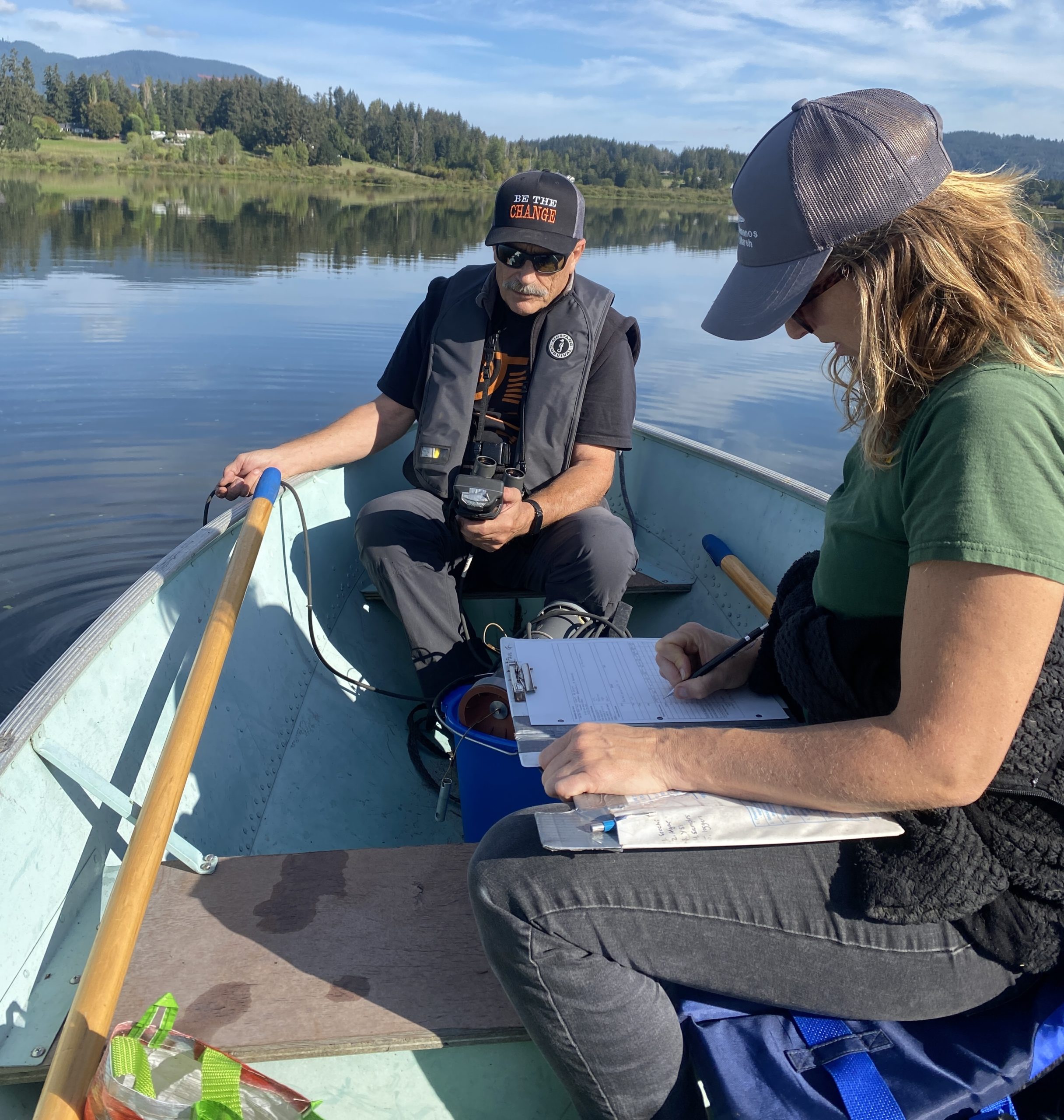
Somenos Marsh Wildlife Society (SMWS) was one of the first organizations to document the fish kill, and its underwater monitoring sensors captured the drop in oxygen levels in the S’amunu/Somenos watershed.
A recent report presented to the Municipality of North Cowichan determined that a steep drop in oxygen levels fuelled by an algae bloom was the main culprit behind the event.
Last year, representatives from Somenos Marsh Wildlife Society, Cowichan Tribes, all levels of government and other local advocates held a workshop to devise a plan to prevent another fish kill. As the new year begins, the Somenos Marsh Wildlife Society hopes to improve the health of the S’amunu/Somenos Watershed through different projects with the help of volunteers and its continuing partnership with North Cowichan.
A community response to support Somenos Lake
Two of the main actions that came out of the workshop were to control the invasive pumpkinseed fish population and monitor the level of nutrients — such as phosphorus — that are entering the water.
Pumpkinseed culling could help the lake, says Paul Gowland, president of Somenos Marsh Wildlife Society.
“We don’t have enough zooplankton because these pumpkinseeds are eating them. If you have more zooplankton, you’d have less algae,” Gowland says.
He also notes that increased algae blooms were partly to blame for the fish kill in August.
There are many methods for controlling invasive species like putting traps in the water or introducing a predator fish to the watershed to consume the pumpkinseed fish. The problem, however, is that these options are often expensive, Gowland says.
For now, managing the pumpkinseed population is not within reach for Somenos Marsh Wildlife Society, but Gowland says the society’s ongoing work to monitor water quality could help find the source of excess nutrients entering the lake.
Charting a path for the S’amunu/Somenos watershed
Alongside the normal water quality monitoring that Somenos Marsh Wildlife Society does, the group also plans to track down where excess nutrients in the watershed are coming from this year — another action that came out of the community workshop.
“We don’t have a good handle on that,” Gowland says. “If we did, we could address some of those issues in the short term and alleviate the lake’s problems.” The more nutrients, like phosphorus, in the lake, the higher the chances are for an algae bloom to happen.”
The society will start by narrowing down which streams flowing into the lake have elevated phosphorus levels. Those samples will then be sent to a lab for testing, and the data will be shared to a national database used by researchers from all over Canada who study lakes with similar problems.
Improved water flow monitoring would require more funding so for now, the society will use Bings Creek, a tributary of the S’amunu/Somenos Watershed, as a proxy for all streams flowing into the lake.
Monitoring where the phosphorus is coming from and how much is just one piece of the puzzle, Gowland says. Years of sediment build up can also store phosphorus in the lake bed which will take a decade to deplete.
“The restoration of these lakes is a long, slow process. It’s difficult to deal with,” Gowland says.
Beyond water monitoring
Monitoring phosphorus and managing the pumpkinseed fish population aren’t the only things on the docket for Somenos Marsh Wildlife Society in 2025. The federal government is also providing funding for a new three-year project to bring back native plants to the S’amunu/Somenos Watershed.
“We’re working with people who live on Bings [Creek] and Averill Creek to help them restore riparian [plants],” Gowland says. “There’s so many benefits to having plants and trees grow beside a creek … If you have more plants, you get more bugs and litter falling into the creek. And those are all good for the fish in the creek.”
Riparian ecosystems do a lot of heavy lifting to keep the watershed and the animals that live there healthy. Their roots give fish fry a place to live, hold soil in place and slow down water to minimize erosion. Fallen debris like decomposing trees can hold more water as well helping to prevent floods and store water for times of drought.
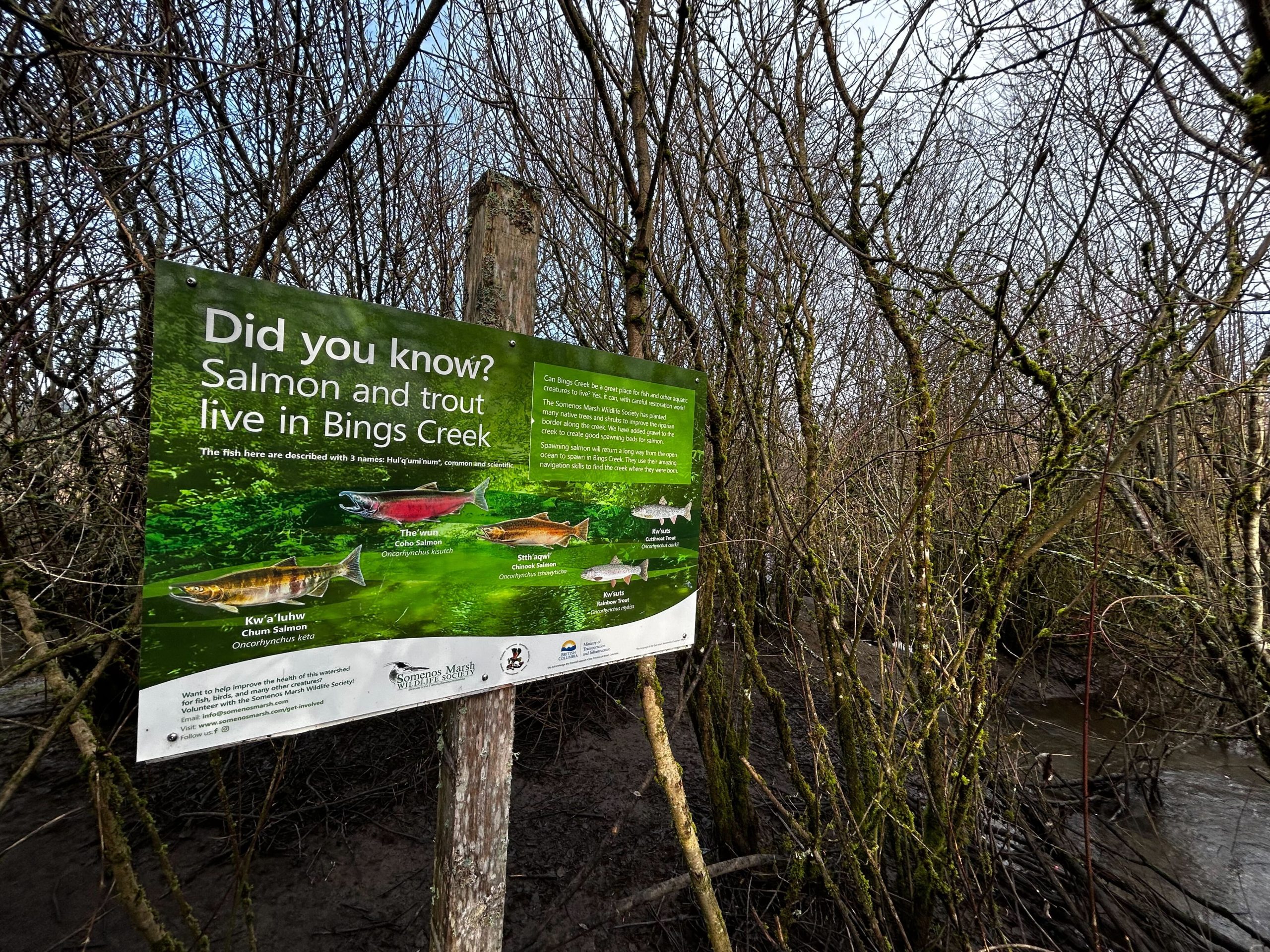
The project with Somenos Marsh Wildlife Society would involve volunteers entering participating properties bordering the creeks to assess what plants would work best there, and then planting them. Government funding would completely cover the cost.
Gowland says Somenos Marsh Wildlife Society volunteers have already assessed multiple properties for riparian planting in 2025.
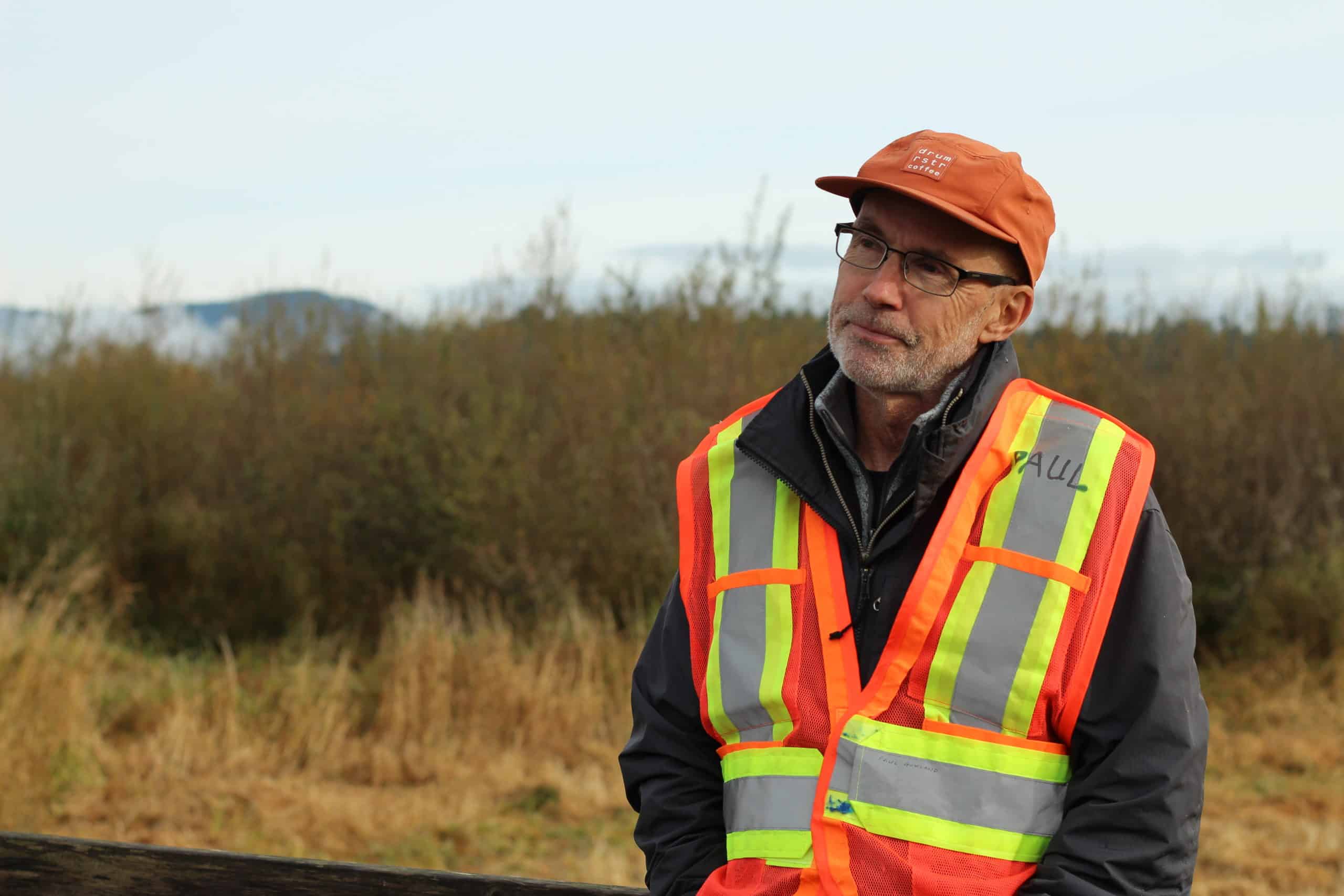
Gowland sees this program as a win for the residents who live on the creek and for Somenos Marsh Wildlife Society.
“It’s a great thing because residents get the assessment and the work done, and for our society, the benefit is seeing the establishment of a better riparian zone bordering the creeks that increases the creek health,” he says.
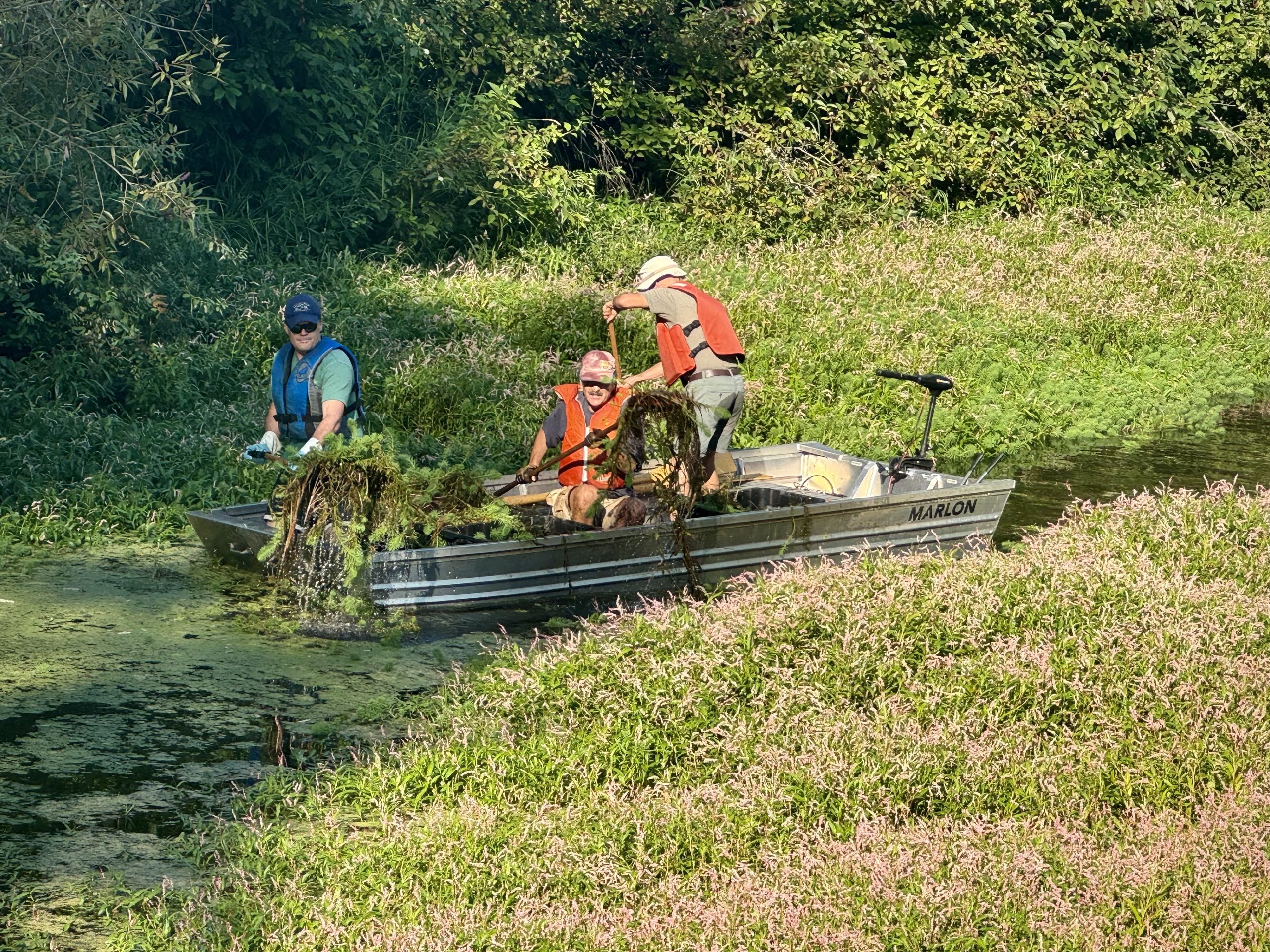
The society is also in talks with Cowichan Tribes to extend its parrot’s feather removal project to parts of the creek that flow through reserve land from Tzouhalem Road down to the Quw’utsun Sta’lo’ (Cowichan River).
“We’re looking forward to expanding this program we do for the municipality,” Gowland says.
Future plans for the watershed
The Somenos Marsh Wildlife Society mainly focuses its efforts on the immediate areas surrounding the lake and wetlands but after the workshop, it was decided a higher level plan is needed to help the watershed.
“Things have advanced to the point where the area of interest has expanded to include all the tributaries that flow from Mount Sicker, Mount Prevost and Mount Richards into the lake, and how should those be looked after,” Gowland says.
The workshop gave some insight into what such a plan might look like. Participants called for creating a “State of the Watershed” report to help better understand the conditions of the lake and identify areas that need restoration work.
The proposed plan would also look to slow down water that flows into the lake using detention ponds and human made beaver dams.
Gowland says the November workshop was a good first step and he hopes a formal plan to remediate the lake “on a larger scale” is coming soon.
What did you think of this story?
Your feedback after we publish a story helps ensure we're always improving our reporting to better serve you
Author

Related Articles
DRIPA debated in B.C. election on Vancouver Island
The Conservative party of B.C. is promising to repeal the Declaration on the Rights of Indigenous Peoples Act (DRIPA), while other parties argue that would set back relations with First Nations and create economic uncertainty.
Where Cowichan region MLA candidates stand on water, old growth and reconciliation
MLA candidates in the three ridings that cover the Cowichan region answered questions from Discourse readers ahead of the Oct. 24 B.C. election.
Cowichan Valley’s guide to the 2026 B.C. election
What riding am I in? Who are the candidates? When do I vote? The B.C. election basics for Cowichan Valley residents.