
North Cowichan council axes plans to resume harvesting in forest reserve
Following public backlash and pushback from First Nations, council moved to scrap plans to explore logging in the Municipal Forest Reserve.
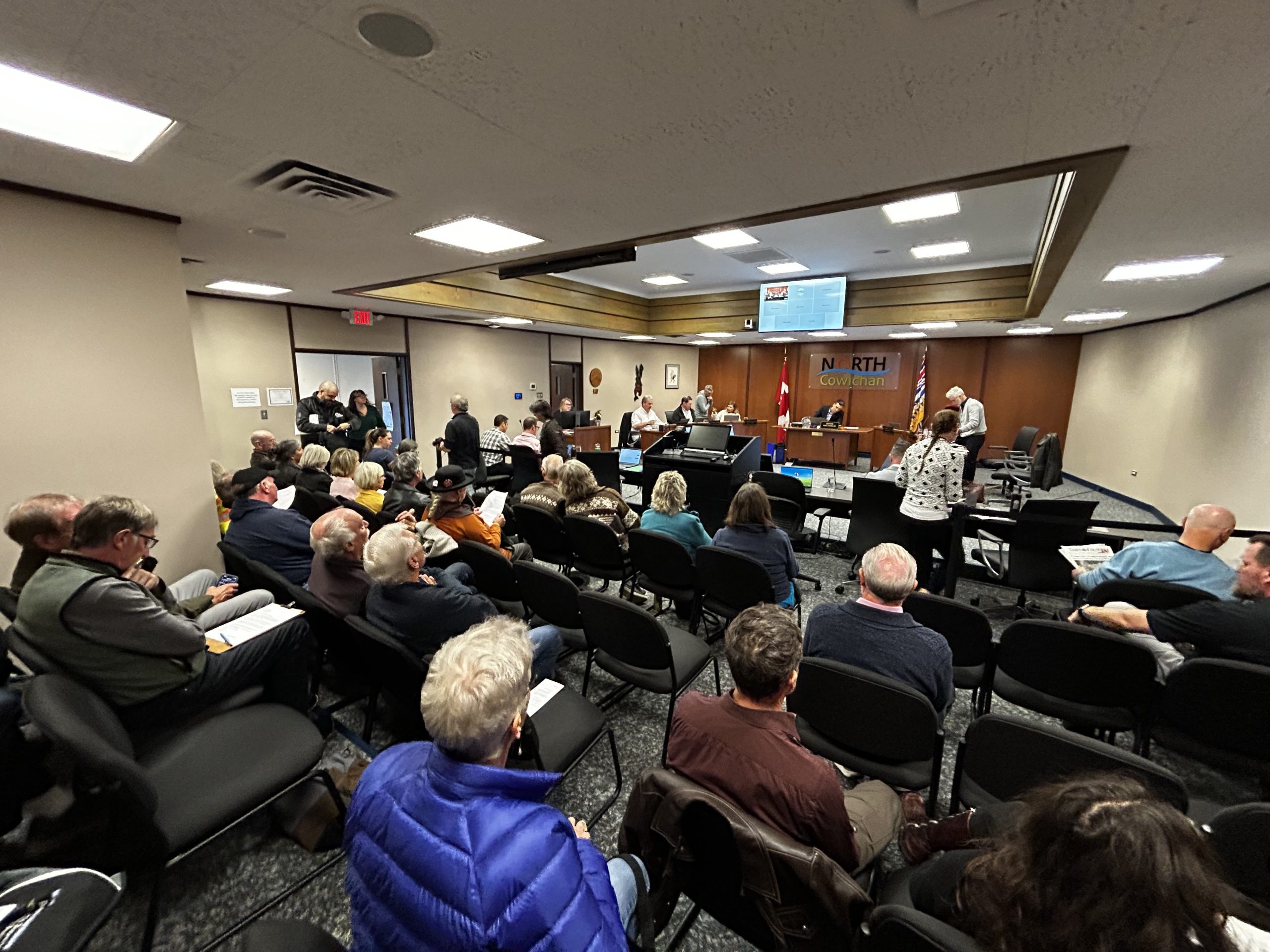
At a special meeting last week, North Cowichan council backed down from plans to resume logging in the Municipal Forest Reserve and voted to restart talks on a co-management framework with Quw’utsun Nation. The meeting was not without surprises, including an apology from one councillor and the introduction of a last-minute motion by another.
The gallery was packed with residents, many of whom voiced concerns about exploring logging options in the municipally-owned forest, while others spoke in support of considering harvesting.
On Aug. 20, 2025, council voted to make logging in the Municipal Forest Reserve a strategic priority, despite opposition from residents and warnings that the decision could jeopardize years of work with Quw’utsun Nation — which includes Cowichan Tribes, Halalt First Nation, Lyackson First Nation, Penelakut Tribe and Stz’uminus First Nation — on a forest co-management framework. Timber harvesting in the public forest, which is roughly 5,000 hectares, has been on pause since 2019 to allow for public engagement and consultation with local First Nations and other experts.
Last week at the special council meeting, North Cowichan staff presented a report to council at a special meeting with background, options and implications related to potentially resuming harvesting in the municipal forest.
There was also opportunity for public input and questions, and Halalt First Nation Chief James Thomas and biologist Cheri Ayers presented a report on the ongoing work of the Chemainus Watershed Initiative, which is working to create an Indigenous-led watershed restoration plan.
After the public input period, Coun. Bruce Findlay introduced a last-minute motion he described as “a hybrid” of the recommendations included in the staff report.
Findlay’s motion was not part of the agenda package released ahead of the meeting, but it was displayed for the public on the livestream and on screens in the gallery.
Part of Findlay’s six-point motion proposed continuing co-management framework talks under the already signed Memorandum of Understanding between Quw’utsun Nation and the municipality, while also directing staff to explore the creation of a five-year forestry plan. The motion did not commit to any actual logging in the reserve.
In response, Coun. Chris Istace noted that it has been a little more than 170 years since the signing of the Douglas Treaties.
“The action of saying clearly we will have an agreement with you, and we’re going to talk with you, but this is our land so we’re going to keep doing our thing at the same time,” he said. “Where have they [the Nations] heard that before?
“It’s the message. We gave our word. Other communities are watching and looking at what we’re doing,” he said.
Coun. Becky Hogg agreed with Istace and said that while she appreciated Findlay’s motion, she believed such a proposal should be discussed with the Nations first.
Hogg also took a moment during the meeting to address Thomas specifically and apologize to Quw’utsun Nation for “the harm and disappointment” caused by council’s vote in August, which she voted in favour of.
“It was never my intention to create this upset. Thank you to Chief Thomas for taking the time to speak with us and share your insight. I really look forward to building a relationship together,” she said.
The Discourse contacted Hogg for further comment on her vote but did not hear back in time for publication.
Ultimately, Findlay’s motion was defeated, with councillors Hogg, Christopher Justice, Istace and Mayor Rob Douglas opposed.
Council then unanimously passed the first recommendation of the staff report, directing staff to resume co-management framework talks with the Nations.
Direct impacts of logging on watersheds
The meeting opened with a presentation from Halalt First Nation Chief James Thomas who spoke about the flooding challenges his Nation faces in the Chemainus watershed. He said the flooding is a direct result of logging practices. Part of the watershed also falls within the Municipal Forest Reserve.
Thomas has been a vocal critic of council’s earlier decision to add logging in the municipal forest as a strategic priority. In early October, he penned a letter to council on behalf of Halalt Nation.
“We were shocked and dismayed to learn of the Municipality of North Cowichan’s unilateral decision on Aug. 20, 2025,” the letter reads. It notes an “abundance of evidence” that forestry activities have impacted the watershed, causing bank erosion, sediment accumulation, a higher rate of landslides, hydrological and geomorphological instability, low flow rates in the warm season, high flows in the cold season and more.
During his presentation, Thomas said the watershed has been a vital food source for his nation for generations, and noted that salmon returns have declined following an atmospheric river four years ago that washed many salmon out of the river.
“Those staple foods are in jeopardy from the watershed logging practices of the last 150 years,” he said.
Thomas told council the Nation is currently rebuilding 44 houses damaged by flooding during two recent atmospheric rivers.
“Thirty-five million dollars to redo all of our homes — that’s the budget that was identified,” Thomas said. The new home foundations will be built at a higher elevation, further increasing construction costs.
‘You can’t ride two horses’
Since August, all work on the co-management framework between North Cowichan and Quw’utsun Nation has been suspended, according to chief administrative officer Ted Swabey. This suspension came after members of the Quw’utsun Nation expressed concerns following council’s new priority direction.
“You can’t ride two horses in this case — it’s all or nothing,” Swabey said. “We have to put our faith in our relationships with the Quw’utsun Nations, and out of that will come a co-management framework.”
In the report, staff noted the risk that the Quw’utsun Nation may choose not to participate in future engagement processes if council’s new direction was perceived to conflict with the spirit of the Memorandum of Understanding between the Nations and the municipality.
“We heard very clearly today from Chief Thomas his views on forestry, so I can’t imagine how they would feel if we had a motion that dealt with both,” Swabey said.
Revisiting the financials
Findlay’s last-minute motion also included one provision: to hire consulting firm KPMG to model a forecast for revenue from carbon credits and harvesting.
“The community should see what that modeling out would look like,” Findlay said.
While he said he had “run” the model himself and that the results were “phenomenally interesting,” Findlay declined to comment to council on what the results actually were.
In 2022, a community engagement survey took place to gauge community opinions on the future of the municipal forest. Community members were asked to choose from four scenarios for the forest, as developed by University of British Columbia forestry experts:
- Status Quo — Continue timber harvesting as it has been done in the past
- Reduced Harvesting — Cut the timber harvest to 40 per cent of historic levels, with a focus on minimizing negative environmental and social impacts
- Active Conservation — Timber harvesting is limited to areas where cutting trees can help to protect or enhance rare ecosystems
- Passive Conservation — No timber is harvested, with exceptions for cutting trees that pose a fire risk or safety hazard
The survey also asked participants why they selected whichever option they chose. At the most recent council meeting, Mayor Rob Douglas pointed out that those who selected scenarios of active or passive conservation did not list the financial benefits as a reason for why they chose it.
Historically, revenue from the forest reserve was highly sensitive to changes in the timber market, resulting in small profits or even losing money in some years, according to the staff report.
Resident Valerie Russell told council at the meeting that the potential revenue from logging is miniscule compared to the long term social and ecological benefits mature forests provide.
“Ignoring experienced expert advice, community input and commitments to Indigenous partners raises serious concerns about governance and long-term sustainability,” she said.
Staff also said creating a new five-year forest management plan would cost an estimated $500,000 and would require external funding if staff were to stick within a five per cent increase to the 2026 Budget.
“When we’re facing a tax increase, which we know is going to impact our residents who are already struggling with the high cost of living, we shouldn’t be adding another half-million dollars on top of that,” Douglas said.
Now that the vote has passed, staff have been directed to notify the Quw’utsun Nation of the decision, and the municipality hopes that work on the co-management framework can resume as soon as possible.
The decision still leaves the option for reconsidering forest harvesting on the table, but the municipality has publicly committed to completing talks with the nations first, before adding it as a strategic priority.
What did you think of this story?
Your feedback after we publish a story helps ensure we're always improving our reporting to better serve you
Author
Related Articles
DRIPA debated in B.C. election on Vancouver Island
The Conservative party of B.C. is promising to repeal the Declaration on the Rights of Indigenous Peoples Act (DRIPA), while other parties argue that would set back relations with First Nations and create economic uncertainty.
Where Cowichan region MLA candidates stand on water, old growth and reconciliation
MLA candidates in the three ridings that cover the Cowichan region answered questions from Discourse readers ahead of the Oct. 24 B.C. election.
Cowichan Valley’s guide to the 2026 B.C. election
What riding am I in? Who are the candidates? When do I vote? The B.C. election basics for Cowichan Valley residents.