
Most Nanaimo residents support urban farms. So why are these birds on the chopping block?
Mossy Rock Urban Farm is ‘stuck in limbo’ as animal control issues orders to cut flock.

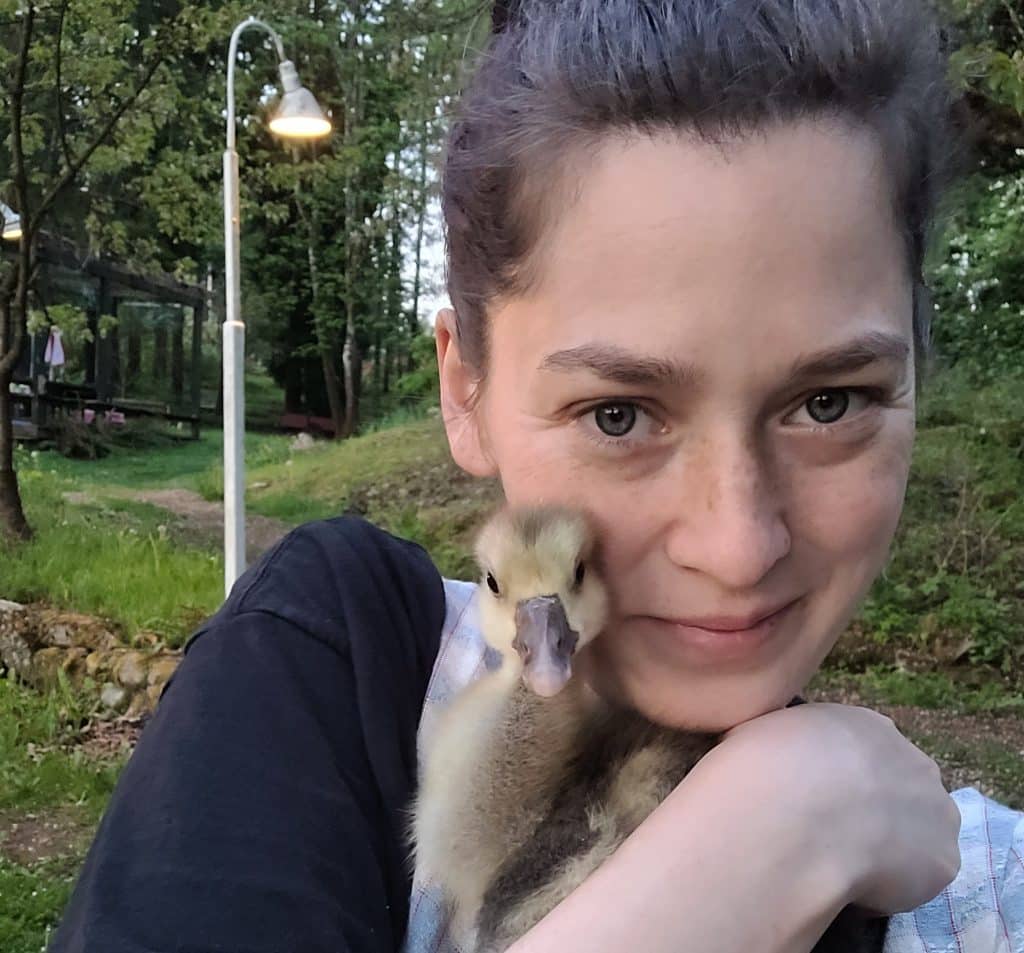
When Danyelle Brown took over a hobby farm business two years ago, she had visions of selling locally-grown eggs, chicks and vegetables to the community while teaching her children sustainable agriculture.
However, all that changed on August 29 when Nanaimo animal control visited Mossy Rock Urban Farm with a letter informing Brown that she had more chickens and ducks on the South Nanaimo property than was permitted, according to the city’s animal responsibility bylaw, which was adopted in 2021.
What it meant was that Brown had 14 days to cut her flock of approximately 100 chickens, ducks and geese down to 12 birds, or face a fine of $150 for each day she was in violation of the bylaw — effectively putting an end to her small farm business.
For the moment, the farm has caught a reprieve. At present, the animal control contractor has been asked to not take any further action “until we get further instruction from council” who are reviewing the issue, says Dave LaBerge, the city’s manager of bylaw services.
But it’s small comfort to Brown, who says she lives in uncertainty about the future of her animals and farm business.
“It’s hard being stuck in limbo. It makes my stomach sick just thinking, well, is this my last day? What am I going to do?” says Brown. “The most important thing is just keeping my kids’ mental health good, because my daughter Siena was super affected by this. How do you tell a child that you have to pick 12 animals to save?”
Built in 1928, Brown says the roughly one hectare property on Ninth Street has been a farm for decades, and over the last 11 years it was run by her mother-in-law, who had inherited ducks, chickens and turkeys from the previous owners, who had also farmed the property.
Brown’s trouble first started on July 7, when Nanaimo animal control services arrived at the farm to inform her they had received a noise complaint about her roosters.
After she told the animal control officer that it was a farm and she believed they were allowed to have roosters, he left.
Concerned about the situation, she contacted City Hall — along with other concerned residents — and days later, mayor Leonard Krog issued a general letter confirming that as the size of her farm was just over a hectare, roosters were permitted and “no further enforcement action” would be taken at that time.
Brown said City Hall also called her back, “and they said continue on farming, we support farming, animal control won’t bother you anymore.”
Relieved, Brown resumed operations, but began to re-home her roosters just in case.
When the Aug. 29 violation notice — stating she had more poultry than was permitted by bylaw — came in just over a month later, she was surprised, as she thought the issue had been resolved, says Brown.
“I believed the mayor. I felt completely betrayed in that moment. I felt like, why would someone I had faith in go back on his word?” she says.
Mayor Leonard Krog is currently away and did not respond to a request for comment.
She was also confused to see that the letter contained the wrong address and property size, and instead referred to a property known as the Uplands Farm, located on Uplands Drive.
This was a clerical error that has since been corrected, says LaBerge. Nevertheless, the Mossy Rock farm is still in violation of the animal responsibility bylaw, this time due to the number of birds on the property. LaBerge also points out that because the property zoning is residential, commercial poultry operations are not allowed — they are only permitted on land zoned for agricultural use.
This confuses many people, because prior to 2021 the animal control act allowed for people to keep four to six chickens, depending on the size of the lot, “but it didn’t speak to a maximum number of chickens if the lot was larger than one acre,” says LaBerge.
“So some folks were thinking, ‘I have more than an acre so I can keep as many chickens as I want’ but you also have to look at what the zoning bylaw allows, [which] speaks to land use.”
This issue is being reviewed by the city, in part because of strong support for small urban farms by residents who say it’s part of local food security, says LaBerge, who adds that it’s important to “strike a balance between commercial poultry operations in residential areas because it’s impactful in a lot of ways to the neighbours.”
According to the 2022 results of public engagement surveys and analysis conducted over two years as part of the city’s official community plan process, 94 per cent of residents support the improvement of the city’s affordable access to food by “continuing to support food infrastructure on city lands, including farmer’s markets, urban farms, greenhouses, food forests and community gardens.”
Some commonly noted themes in residents’ written survey responses include requests that the city “add policy that supports and enables food growing in all yards and residential areas so all residents have equitable opportunity to grow their own food (regardless of where they live or type of housing)” and to “incentivize and encourage” the use of productive lands for growing food.
Healthy food is becoming increasingly hard to access for low-income families in B.C. and Vancouver Island continues to import approximately 90 per cent of its food, at ever-rising prices.
The need to support farms in every capacity is more crucial than ever, says urban farm and food sustainability advocate Dirk Becker, whose roughly one-hectare Compassion Farm in Lantzville was shut down in 2013 after a long and heated battle with neighbours and Lantzville’s municipal authorities.
It’s a “cultural sickness” that farmers like Brown are treated as a hindrance or as interfering with progress, rather than viewed as people who “add to our society, our community and to sustainability and public education,” Becker says.
“Whether [Mossy Rock] are rescuing and having an old folks home for chickens, or they’re eating them, or selling the eggs, it doesn’t matter. We need to do everything within our power to adjust our culture and enshrine it within law to protect these types of people.”
On Sept. 25, council passed a motion to direct city staff to review the animal control and zoning bylaws with an eye towards providing options to support the city’s food security goals.
Editor’s note, Oct. 6: This story has been corrected to reflect that the motion will not be debated on Oct. 16 but rather that it was passed by city council on Sept. 25.
What did you think of this story?
Your feedback after we publish a story helps ensure we're always improving our reporting to better serve you
Author

Related Articles

Proposal to cut VIU’s music programs called ‘reductive and short-sighted’
As the university searches for ways to address its deficit, proponents of music education say these cuts aren’t the answer.

Vancouver Island University faces tough decisions amidst a deficit crisis
‘There is a moral and legal obligation towards students to finish what the administration has started,’ said one VIU student.

After years of extreme droughts, what’s in store for Vancouver Island’s watersheds?
Vancouver Island University’s Alan Gilchrist is researching how water flows may be affected by climate change.