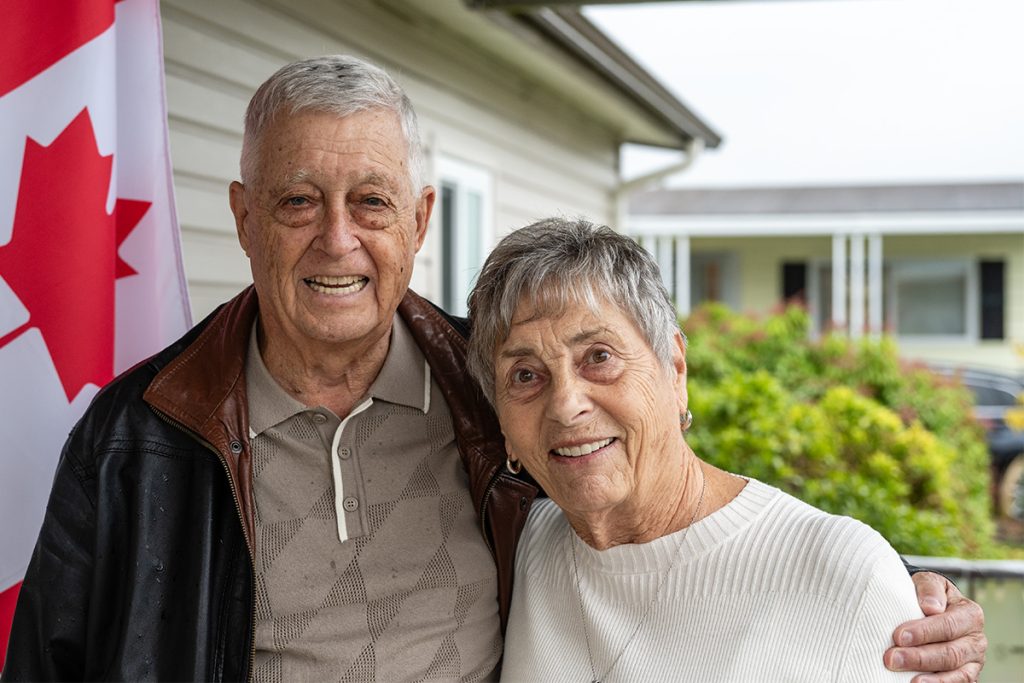
Brian Snyder has been living with his wife, Lynn Crowther, in the Sharman Mobile Home Park in North Nanaimo for the past eight years.
The two of them are pensioners who downsized from a three-bedroom house in Duncan to a manufactured home, with the low monthly cost for a pad rental appealing to them.
“If you want to buy a house, even if you make $75,000 to $80,000 a year, you can’t afford a home here,” Snyder said about Nanaimo. “We have $40,000 in income and we live quite well.”
The couple told The Discourse they enjoy being part of the tight-knit community where neighbours know and help look after one another.
Crowther said she helps a neighbor with dementia remember to take out the garbage on garbage day and that her neighbour comes over and checks in on Crowther as well.
“I go over there quite regularly,” she said. “It’s a real community feeling.”
There are approximately 22 manufactured home communities containing 1,700 homes in the City of Nanaimo, and the City Plan “supports higher residential densities on these properties,” a city staff report states.
For the past three years, Snyder has been advocating for better protections for manufactured home owners as part of the Manufactured Home Community Stakeholder Group in the city.
On Friday, Oct. 31 the City of Nanaimo’s governance and priorities committee accepted staff recommendations to put additional protections in place for owners of mobile homes in the city, but Snyder says the protections still aren’t enough.
He is concerned about what he has seen in communities such as Surrey, where mobile home parks are being rezoned for the development of multi-family residential housing.
The Crispen Bays and Bear Creek Glen manufactured home communities in Surrey have been slated for redevelopment since 2022. Three years later, the Bear Creek Glen park has been demolished for new condominiums and townhomes while the remaining 200 residents of Crispen Bays are complaining about the deterioration of their community.
“Those people are stuck there … for three or four years, not able to do anything, and some of them are selling their homes at a discount just to get out now,” Snyder told The Discourse.
Encouraging developers to ‘do the right thing’
In April 2024, the province passed Bill 16 – Housing Statutes Amendment Act 2024 which gave municipalities the authority to develop tenant protection bylaws that could “require property owners and developers to provide added support (beyond provincial requirements) for tenants facing displacement in cases of redevelopment,” according to a city staff report in January.
Before then, the city could try and secure tenant protections from developers through the rezoning process.
Currently, the provincial legislation that governs manufactured home parks is the Manufactured Home Park Tenancy Act. Under that law, the landlord may issue a 12-month termination notice once a rezoning or subdivision application is complete. The landlord has to provide $20,000 of compensation on or before the effective date of the notice.
Tenants can request additional compensation if they can show that they were unable to obtain permits to move their home or were unable to move it to another site and do not owe any taxes on the home.
A new municipal Manufactured Home Community Relocation Assistance Policy in the City of Nanaimo will require landowners to compensate manufactured home owners with payment for an amount that is at least equal to the assessed or appraised value of their home. A quarter of the purchase price would have to be paid within 30 days of rezoning with the remainder due when the lease for the land the home is on ends.
The city policy will also “streamline” the process by requiring the applicants — the party applying for rezoning — to provide similar compensation as required in the provincial Manufactured Home Park Tenancy Act so residents “do not need to prove they were unable to obtain the necessary approvals to move the home” and that the developer pays the assessed value of the home.
But it still falls short of what Snyder, and the Mobile Home Community Stakeholder Group, was asking for.
They wanted a buyout of two times the current or appraised value of the home, and 80 per cent payment to the homeowner within 30 days of rezoning and up to five years from rezoning to move.
City staff said that if those clauses were added to the policy, it could mean that a developer would “barely be able to afford” the minimum compensation and could lead to park owners simply shutting down and evicting residents instead of going through the rezoning process.
Coun. Erin Hemmens asked staff if park owners could decide to just close a mobile home park, evict the tenants and sit on the property.
“They can always, at any time, choose to close a park and the city has no role in that decision,” Lisa Brinkman, the city’s manager of community planning replied.
“So they close it, they sit on it and when everyone’s gone, they can go to redevelopment?” Hemmens asked.
“That is correct.” Brinkman said in response.
Brinkman said that in a rezoning process, the city would look at a variety of factors such as design, density, height and park contributions, but also that applicants “want to do the right thing.”
“A lot of them may know the residents of the community. They do want to help people move. So the policy is to encourage them to do the right thing, not encourage them to ignore the residents altogether,” Brinkman said.
That is why city staff recommended a policy that Brinkman said was “realistic and encourages them to help residents in the best way that they can.”
A ‘realistic’ policy
Coun. Ben Geselbracht said he didn’t see “any benefit” to current mobile home communities redeveloping.
“What I do see is that homeowners in these parks aren’t adequately protected,” he said, explaining why he couldn’t support the policy as written.
Geselbracht tried to move an amendment to the policy that would have changed the compensation to two times the home’s current assessed value and 50 per cent of the purchase payment within 30 days of rezoning. However, that amendment was not seconded and died on the floor.
Nanaimo Mayor Leonard Krog said council had to be realistic with the policy.
“It’s not perfect from the point of view of what people want, but it is certainly a substantive improvement over the current situation, where the onus is on the homeowner, as opposed to the [manufactured home] park.”
Susan Belford, president of the Active Manufactured Home Owners Society of BC, called the policy “a step in the right direction,” but said she would have liked to see more of the stakeholders group’s recommendations incorporated into the policy. She said she did not think compensating homeowners with payment of at least 25 per cent of the home’s assessed value within 30 days of rezoning was “really adequate.”
“If it’s between that and nothing, we’ll go with that, but I would urge you to reconsider some of those [stakeholder recommendations] that we’ve been discussing,” she told council.
In a letter submitted to council, the executive director of the Manufactured Home Park Owners’ Alliance of British Columbia said the provincial legislation is sufficient and that the policy would devalue the property and make it less likely an owner would be able to sell the land.
“The policy actually borders on discriminatory to the land owner, A.K.A. landlord,” Dian Koch wrote.
Policy could be precedent-setting for other municipalities
Snyder said the protections in Nanaimo’s policy are precedent-setting and mark the first time a municipality has added additional protections for residents of manufactured homes beyond what is required by provincial law.
“When we started this, we thought this could be the gold standard,” he said. “We think that it will help a lot of other municipalities to have the courage to step up and do it too.”
Snyder said people should know that councils will listen to them, “if they stand up for themselves and put forth reasonable arguments.”
The mayor and councillors voted for the policy with Geselbracht as the lone vote against it.