
Angela Sterritt on Unbroken and being a journalist in Canada
‘There’s an Indigenous truth, and then there’s the Canadian truth, and they’re very, very different.’
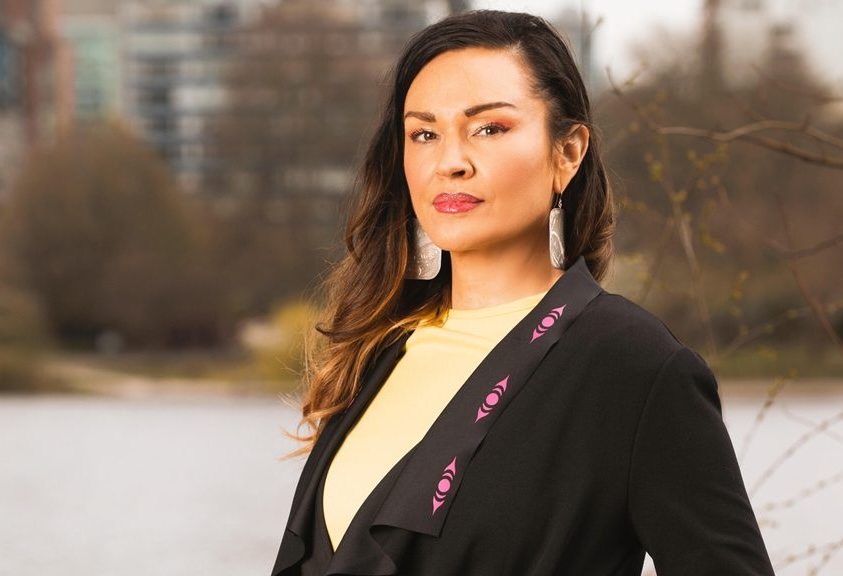
When Angela Sterritt’s book Unbroken hit the shelves it was an instant national bestseller and a finalist for the Governor General’s Literary Award and the Hilary Weston Writers’ Trust Prize for Nonfiction. But it also represented a deeply personal journey. From the Wilp Wiik’aax of the Gitanmaax community within the Gitxsan Nation on her dad’s side and from Bell Island Newfoundland on her maternal side, Sterritt’s book was part memoir and part investigative journalism.
It not only details how colonialism and racism have created a society where Sterritt herself struggled for survival growing up, but also includes her investigations as a journalist into the lives of missing and murdered Indigenous women.
In addition to her virtual talk at Vancouver Island Regional Library, Sterritt will speak at a number of Red Dress Day events around the province, including on May 7 in Victoria at the National Day of Awareness of Missing and Murdered Indigenous Women and Girls in Canada.
The Discourse reporter Julie Chadwick spoke with Sterritt about the book tours and her upcoming talk. This conversation has been edited for length and clarity.
Julie Chadwick: This talk is billed as a Red Dress Day event and I was curious what your thoughts are on that. Is it a similar thing to land acknowledgements, where we’re starting to move past the purely symbolic gestures?
Angela Sterritt: I think these days are important, because it kind of forces people to think about things that they’re not used to thinking about on a daily level. Indigenous women and girls are 12 times more likely to be murdered or go missing than any other race of females in Canada; 16 times more likely than white women. So if you are a white woman, then it’s perhaps something that you don’t need to think about when you leave the house each day — that you or your relatives might not make it home alive.
These are things that Indigenous people are forced to think about every day. We’re hearing about this, you know, fear that a man is more scary than a bear. This is not breaking news for Indigenous people. We’ve feared for our lives since first contact. We’ve been put in a position where it’s not safe for us, we don’t have the same access to human security as every other person in the country.
There’s a great distance that we’ve gone, as Canadians and journalists to some degree, in coming to terms with the truth. In this country, there’s a huge level of denialism going on right now. But one way to look at things is through a journalist lens, and you can see it’s very different from 10 years ago, where you’re looking at websites, and they’re populated with tons of Indigenous stories. Not nearly enough, and not from a lens of Indigenous voices, which we need more of. But 10 years ago, it was difficult to pitch Indigenous stories. Journalists would say, ‘people don’t want to hear about those.’
But then we had metrics on our stories and we could see, actually, a million people have clicked on the story and are reading it. Or we could see on social media that everyone’s talking about this story, so maybe we should cover it. I think we’ve come a great, great distance.
However, when it comes to missing and murdered Indigenous women and girls, I mean, 231 calls to justice were put out in 2019 by the National Inquiry. And by January 2023, only two of those calls to justice had been met or completed.
That’s sort of where we’re at. We can talk a lot about racism in health care or about residential schools — really important things. But when it comes to violence against Indigenous women and girls, the patriarchy has a grip on that. The patriarchy is this long-standing social system that we can’t seem to shake, as a society. Coupled with racism, it’s an extremely pernicious reality.
JC: A lot of things have kind of shifted when it comes to journalism. You’re absolutely correct, 10 years ago I remember working at the daily newspaper and pitching Indigenous-focused stories and it was like, ‘Nobody wants to read those.’
I was curious about something I read that you were told as a journalist, which was that ‘compassion makes you biased,’ and to rein that in. Can you talk a bit about that?
AS: Yeah, I mean, now, I’m completely out of journalism [now]. I haven’t written a story since September 2023. And I tried to quit many times before that, but then something would happen, like the Maxwell Johnson story.
But I was always trying to leave, because it was like a toxic relationship. I was constantly told, ‘You do not belong here.’ Like if you want to be Indigenous and work in a newsroom you can assimilate, and you can cover the stories that you’re assigned.
And then on the other hand, constantly being told, ‘We don’t trust you with telling the truth in the way that you do, you’re not trusted to tell the truth because you’re Indigenous.’ And it just mirrors Canadian society, right? Where our truth is not the truth.
There’s an Indigenous truth, and then there’s the Canadian truth, and they’re very, very different. One casts us in stereotypes that are easy tropes and caricatures, and the other one is a fully-developed, complex, multi-dimensional human story of existence, that we’re still here. And there was just always pushback on that, constant.
[There is] this notion that being cold makes you legitimate, listening to platforms like Dateline or 60 Minutes for most of my life and seeing how cold they are. Or having a host of one of the radio shows treat a residential school survivor as if it was an accountability interview and just badgering her: ‘Did this really happen? Are you sure this really happened to you?’ This is in my book, and I have a CBC comment on it.
Having a white investigative journalist come with me to some of my shoots and having them ask a woman — on camera, who was pregnant — for eight minutes straight if she drank alcohol. This was a story about child welfare and Indigenous children being apprehended, and we have a journalist who’s carrying out the same behaviour that we’re critiquing, just assuming that all Indigenous people are alcoholics.
I would do interviews with family members of missing and murdered Indigenous women and they would always say, ‘This is the first interview I’m giving. I heard you’re so different.’ And I was like, what am I doing that’s different? But then I would listen to other journalists and it was just so cold. They’re treating the person as if they’re a robot, and they have absolutely no consideration or care. It’s pretty wild, just having a level of care be tied up into bias.
JC: It doesn’t even get you better interviews, being cold.
AS: I’ve done a lot of research about what being trauma-informed means, and the basic tenet of trauma is that you don’t have control. Your prefrontal cortex is blurred, and your amygdala is on fire. You’re in flight or fight and you feel like you have zero control. So just [telling] someone: ‘You have control of the situation. If you want to leave, you can leave, if you want to shut it down, you can shut it down’ is a no-no. That could almost lead to a firing, to tell people that they can cancel the interview.
Some of the family members have told me they feel like journalists are just trying to get tears for the camera. That’s the opposite of what I’m trying to get at. I’m trying to offer them space to heal, and to also get at the truth and help them find justice. And if that makes me biased, then that means every single journalist out there is biased, because every single journalist I’ve ever talked to in my life wants impact. They want change.
JC: When you left journalism, did you feel like that was still the attitude? Or was that also shifting?
AS: In 2006 I had this South African guy tell me that you have all these Black faces in government, but it’s window dressing. I just started reading Michelle Cyca’s latest article about this. And that’s exactly how I feel like it is, often, for media. You have all these hosts who are telling the news or seem diverse. But when you get into the nuts and bolts of it, they don’t want you to be an Indigenous person speaking as an Indigenous person; speaking about racism, or saying it isn’t fair, the way that you’re treating this Indigenous person in my story.
They want you to be assimilated. They want you to be an assimilated Indigenous person, who’s in the newsroom.
You have leaders, executives, who are speaking about diversity on panels and how great we’re doing with our numbers, but numbers are not the same as: are you covering Indigenous issues in a deep way, with integrity? Or are you just covering the powwow that happened the other day? Are you covering stories about missing and murdered Indigenous women and doing those investigations and allocating resources into communities?
I think there’s a lot of window dressing that goes on, where it’s not real dedication or resources to address the needs of actual diversity in our communities. Are we reflecting the people that we see when we’re walking down the street?
There’s two sides to every story, well sometimes there’s not. What’s the other side of missing and murdered Indigenous women and girls? What’s the other side of genocide? The other side of genocide is that it didn’t exist. So you have journalists in mainstream media interviewing all these experts on genocide, saying genocide didn’t happen here. Then you get into erasing Indigenous people once again. That’s the ‘other side’ of violence against us, is that it just didn’t happen.
That’s bias, right? So who gets to determine what bias is? It’s the colonial culture that is just so very rigid and will take decades to change, if ever.
JC: How was it for you in your book, putting your own memoir in with investigative journalism? Did you feel like you had to get out of journalism first, in order to be able to do that?
AS: I left journalism almost five months after I released the book. The memoir aspect of it was very difficult, because I think you’re trained as a journalist — in many ways rightly so — not to include yourself in the story. It’s not about you. It’s about the people who you’re telling the stories of, and I wanted it to be about my survival of violence, but also, I wanted to center the women who didn’t survive.
But including my own story, I think, was so integral and important in telling the larger story about violence against Indigenous women and girls, because I could sort of shine a spotlight into the entire belly of the beast, into the entire system, and the entire apparatus that creates this reality where we’re not afforded the same type of safety or human security as all other women in Canada.
Instead of just shining a light on systems and silos, like child welfare, or residential school, or policing, or media, I was able to shine a light on how all of these systems communicate and interact with each other to keep that machine going. But it was really hard to go through all of that trauma all over again. I found it very traumatic to constantly have white women, for example, coming up for me to sign their book crying. I just don’t know how to handle that. I had to really change my perspective.
It’s been amazing, to be honest. I really feel like I dealt with so much, and I learned to connect. And I learned to just see what I’ve been through as a human experience. It’s been very healing for me to let all of this go and not be afraid to speak my truth.
That’s a big thing for successful women, is that we feel like our experiences are going to diminish our power, where it’s actually the opposite. It’s how I can inspire people, like — you can do this too. You can do anything, no matter where you come from, or who you are. You can do whatever you dream is possible. That’s kind of a big message that I have. And I wouldn’t be able to share that if I didn’t share some of the harder things that I’ve been through.
So it’s been a whole journey, but a really, really beautiful journey.
What did you think of this story?
Your feedback after we publish a story helps ensure we're always improving our reporting to better serve you
Author

Related Articles

Nanaimo Jazz Festival celebrates 10 years with more than a dozen shows in September
Local and international artists to perform on multiple stages in the city at this year’s Nanaimo Jazz Festival.
Snuneymuxw Elder C’tasi:a shares traditional plant knowledge in new book
‘Plant Teachings from my Auntie’ by Snuneymuxw Elder C’tasi:a and ethnobotanist Nancy Turner delves into traditional plants and plant medicine.
How is The Discourse’s journalism funded?
And what does it cost to produce The Discourse’s in-depth, independent journalism?