
Broken promises and a broken system: What happened to electoral reform?
Inside a local MP’s push to change the way we vote.
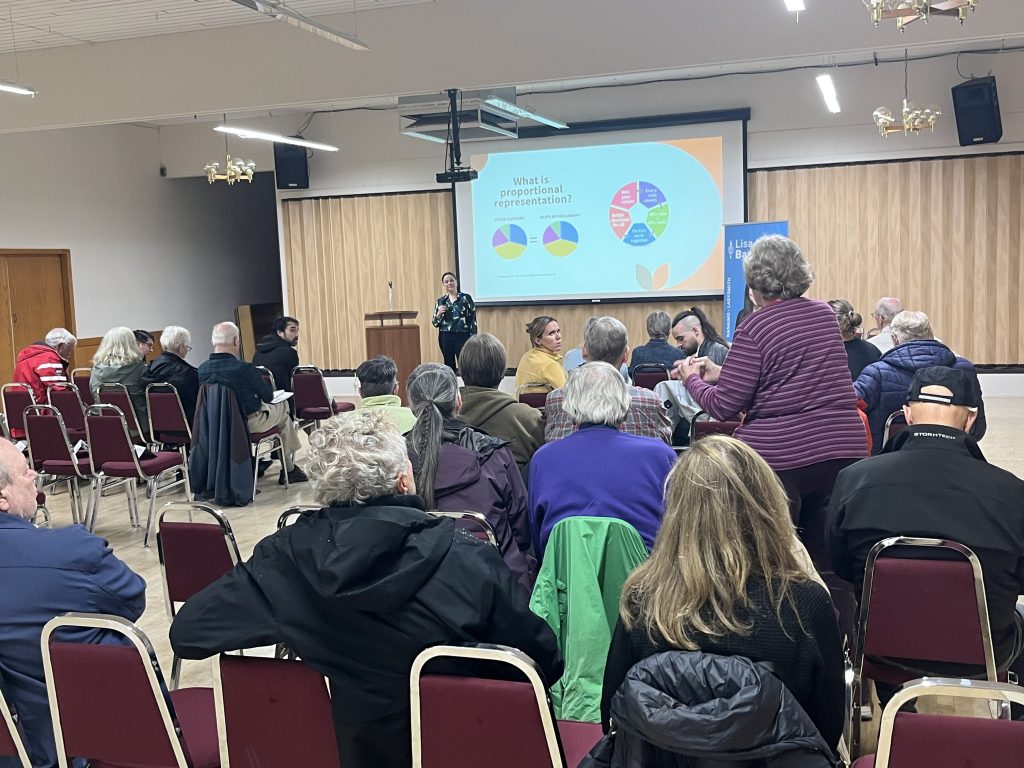
In early November, members of parliament debated Nanaimo – Ladysmith MP Lisa Marie Barron’s motion to create a national citizens’ assembly on electoral reform, as part of an effort to revive an issue that proponents feel has dropped off the map in recent years.
After putting the motion forward in June, Barron hit the road in October to host town hall meetings on the subject of electoral reform in several Vancouver Island communities, including Nanaimo.
“It’s very evident to me, since I’ve been elected in 2021 — I recognize it’s only a short time — but in that short time, I can see that we currently have a very outdated electoral system that results in members of parliament being elected that do not represent our communities.
“So many voices are being left out. The first-past-the-post system currently in place actually encourages divisive politics. And we know that there are ways that we can be doing this better,” says Barron.
“I’m not optimistic that we’re going to see the [systemic] changes that we need in the time required if we keep navigating through the existing systems with the existing electoral system that we have in place.”
In the lead-up to the 2015 election, Prime Minister Justin Trudeau famously promised he would make sure it was “the last under first-past-the-post system.”
Under Canada’s current voting system, the person who receives the highest number of votes gets a seat in the House of Commons, and represents that electoral district as its member of Parliament. A candidate doesn’t need to get a majority of the votes to be elected, sometimes resulting in a disparity between the number of votes cast and who gets a seat.
The push to replace this system with one that is arguably more effective and more democratic gained some momentum during this time.
In 2016 a Special Committee on Electoral Reform was created by the Liberal government, which invited members of parliament to hold town hall meetings within their constituencies to “conduct a study of viable alternative voting systems to replace the first-past-the-post system.”

In the ensuing report from these consultations and deliberations, the committee issued a list of recommendations, including that the government hold a referendum on proportional representation.
Proportional representation systems explored in the committee report include alternative vote or ranked ballots (used in Australia’s house of commons) single transferable vote or STV (used in Ireland and the senate in Australia) and mixed-member proportional or MPP systems (used in Germany, New Zealand and Scotland) and other variations.
The main argument in favour of proportional representation systems, according to the report, is that “they more fairly translate votes cast for political parties into seats in the legislature.”
The downside is that some systems potentially make it harder for a party to win a majority, and therefore increase the likelihood of coalition governments, which can slow the process of forming governments.
The report also concluded that some proportional representation systems diminish local representation, as constituencies would have to be larger and, under some systems, would require more than one representative.
To resolve this issue, most of the people advocating for electoral reform were in favour of mixed-member proportional (MPP) systems — where votes are cast both for local representatives and for a party — according to the report.
While the report suggests MPP is likely the best proportional representation system for Canada, there was disagreement among its members on the best way to move forward — which fell along party lines.
“The evidence was overwhelming that Canadian democracy will be reinvigorated and the quality of it vastly improved as we reject the archaic [first-past-the-post] voting system,” NDP and Green members of the committee concluded.
“There was a large divergence of opinion on almost all aspects of the issue that the committee studied,” the Liberal committee members concluded, adding the recommendations put forward in the committee’s main report were “rushed and are too radical to impose at this time as Canadians must be more engaged.”
All members of the committee, including the Conservatives and the Bloc Québécois, seemed to agree that more public education and consultation was needed. Though the committee as a whole recommended proportional representation be put to the public in a referendum, as reported by CBC News, this referendum never happened.
By 2017, Trudeau had officially abandoned the entire plan of electoral reform itself, stating in a letter to then-minister of democratic institutions Karina Gould that changing the electoral system would not be in her mandate, as “a clear preference for a new electoral system, let alone a consensus, has not emerged. Furthermore, without a clear preference or a clear question, a referendum would not be in Canada’s interest.”
Days before the 2021 federal election, Trudeau claimed he was still open to the possibility of electoral reform, but had always favoured a ranked ballot electoral system.
Also known as a preferential ballot or alternative vote system, it permits voters to rank their vote choices (first, second, third, etc.) and candidates with the fewest votes are successively dropped until a winning candidate has more than 50 per cent of the vote.
The government’s 2016 committee specifically recommended against this system, and its report showed that using ranked ballots in single-member constituencies can be less effective at achieving proportionality than other proportional systems like STV, and “result in such minor change that it would not be worth the effort.”
During this 2021 press conference, which was aimed at gaining Green and NDP support, Trudeau added that he was “not a fan” of proportional representation as he felt it gave “more weight to smaller parties that are perhaps fringe parties.”
The Liberal Party potentially stands to lose the most from proportional representation, according to an analysis authored by University of British Columbia professor Werner Antweiler.
If a modified proportional representation system had been used in the 2021 election, the Conservatives would have gained four seats, the Liberals would have lost 36 seats, the NDP would have gained 40 seats and the Bloc Québécois would have lost six seats.
A news interactive published in 2019 by CBC News shows similar outcomes.
The NDP and Green parties have long supported electoral reform and specifically proportional representation, and Barron says it makes sense to move forward with it now because citizens are being hit hard by struggles with things like affordable housing and impacts from the climate crisis like heat domes and floods.
Federal politics is also not as representative as it could be — for example, women make up just 30 per cent of the members of parliament.
“It’s not just women, we see an under-representation of Indigenous people, BIPOC, those living with disabilities, people living with low incomes. There’s a lot of privilege embedded into our electoral systems,” says Barron.
During her town hall sessions, Barron said she’s heard frustration from her constituents that at a time when sound solutions need to be put forward in a timely manner, what they’re seeing is divisive politics and delays in moving forward.
A national citizens’ assembly “would give Canadians the tools that they need to be able to move forward with the work required,” says Barron. “To bring in experts to have collaborative discussions, to take the partisanship out of that, to have an independent process, to talk about the ways to strengthen our democracy,” she says. Not just with vote-counting but on issues like improving access to voting and reconsidering the voting age.
One benefit to forming a citizens’ assembly is that it can bring together people who are not necessarily connected to or a part of existing organizations or political parties, says Dennis Pilon, associate professor in the Political Science department at York University and author of The Politics of Voting: Reforming Canada’s Electoral System.
“The challenge we have in letting the parties make the decision is that there are so many veto players in their party that don’t want to see these changes,” he says, and even when members try to support reform, their opponents often seek to decry it as manipulative or part of a vested interest.
“It’s harder to go after citizens,” says Pilon. “The value of a citizens’ assembly is that it can lend a degree of transparency and non-partisanship like, ‘Hey this is not rigged in anyone’s favour, let’s find a system that will benefit everybody.’ It can lend a degree of legitimacy to the process.”
Seventy-six per cent of Canadians support the formation of a national citizens’ assembly on electoral reform, according to a national poll conducted last December by Ekos Research and commissioned by Fair Vote Canada, a non-partisan national citizens’ campaign for proportional representation.
The 2016 parliamentary committee report also found that a majority of online survey respondents agreed with the statement that “broad public support should be gauged through … in-person and online consultation with Canadians representative of Canadian society (demographically and geographically).”
The motion to create a national citizens’ assembly on electoral reform will go to a second debate sometime in the coming weeks, with a final vote likely to take place sometime before February.
What did you think of this story?
Your feedback after we publish a story helps ensure we're always improving our reporting to better serve you
Author

Related Articles
DRIPA debated in B.C. election on Vancouver Island
The Conservative party of B.C. is promising to repeal the Declaration on the Rights of Indigenous Peoples Act (DRIPA), while other parties argue that would set back relations with First Nations and create economic uncertainty.
Where Nanaimo’s MLA candidates stand on addictions care, family doctors and Island rail
Candidates in Nanaimo-Gabriola and Nanaimo-Lantzville answered three questions from Discourse readers ahead of the Oct. 24 B.C. election.
Nanaimo’s guide to the 2026 B.C. election
What riding am I in? Who are the candidates? When do I vote? B.C. election basics for Nanaimo voters.