
How artist Jesse Gray transforms beach trash into bronze works of art
Bringing discarded objects back to life, the artists’ latest installation will be an interactive musical sculpture in Nanaimo’s Deverill Square Park.
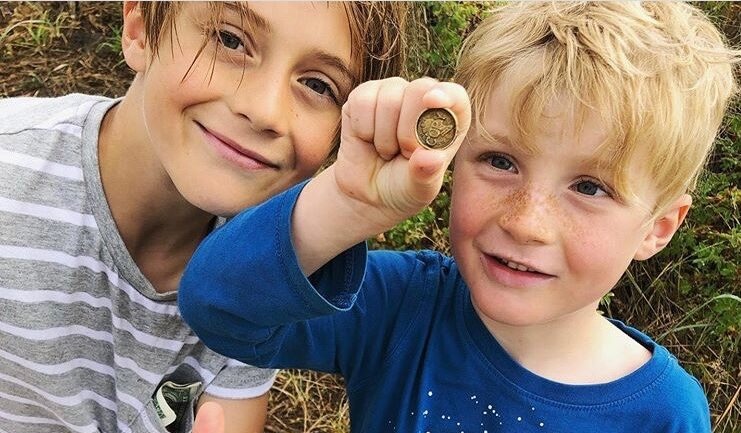
When artist Jesse Gray moved to Nanaimo in 2014 from Vancouver, she found herself on the beach a lot with her dog, picking up interesting stones and chunks of sea glass.
She made a deal with herself: for every piece she took off the beach, she also had to take a piece of garbage.
“These plastics are really interesting, because … a lot of these pieces looked like modernist jewelry,” she says.
“They were utilitarian mass-produced forms — they have concentric circles and geometric lines — but then they’re often broken into pieces, or you only see a part of it. So it has a different sensibility,” she adds.
So she began to think about how they could be used in her art. “My whole practice is based around using objects that already exist, thinking about histories and usage and international commerce.”
While earning a Master of Fine Arts (MFA) at the University of British Columbia, Gray incorporated a variety of found objects into her work — most spectacularly in a three-by-eight-foot chandelier she created from salvaged, broken window glass for The Sooner the Better Late than Never, her 2009 MFA graduate exhibition.

After she graduated, Gray went on to study jewellery art and design at Vancouver Community College, where she learned a variety of different techniques but was especially drawn to casting.
In the process of casting, a mold is created with a wax or polymer plastic object that is then incinerated or melted away, leaving a space that becomes filled with molten metal.
“Casting kind of really captured my heart because it’s like magic. You put this thing in, and you get it back and it’s the same thing but metal. It’s amazing,” she says.
Gray began to cast the plastic garbage she collected from beaches, primarily into bronze, and her first project was Plastic Brutalism, a line of jewelry that either directly referenced iconic modernist jewellers or was influenced by brutalism, minimalism and art deco styles.

Another project emerged when she took more than 300 of the cast pieces back to beaches in Nanaimo, Vancouver and Sointula, and experimented with leaving them there for people to find.
This concept of giving objects away then carried through into Mesomonuments, Gray’s 2020 solo exhibit at Vancouver’s Artspeak Gallery, which showcased 55 bronze sculptures constructed from cast beach plastic, entitled Mesomonuments: Scrap Figures after Elza Mayhew.
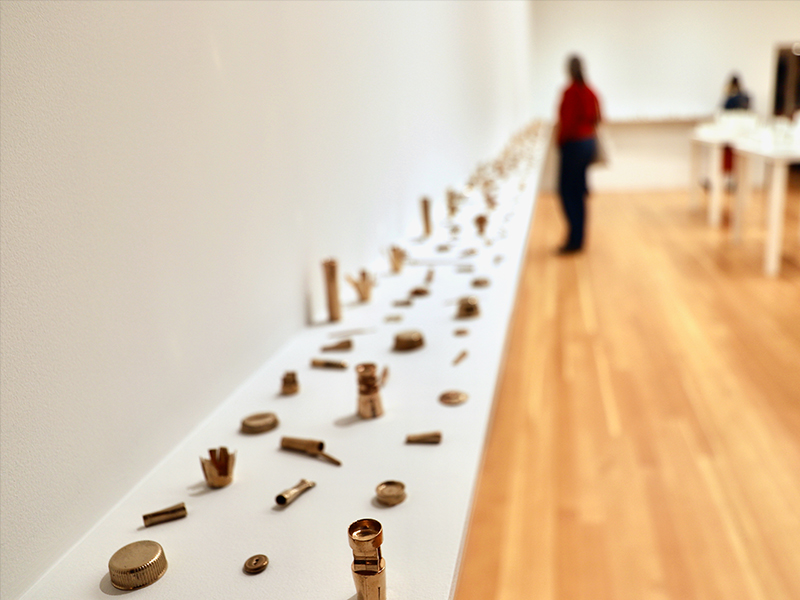
Strewn along a perimeter shelf was a second collection, Mesomonuments: Ex-situ, which featured 980 cast pieces — bread tags, plastic lids, coffee stir sticks, children’s toy parts, old flossing sticks — that visitors were encouraged to take home with them.
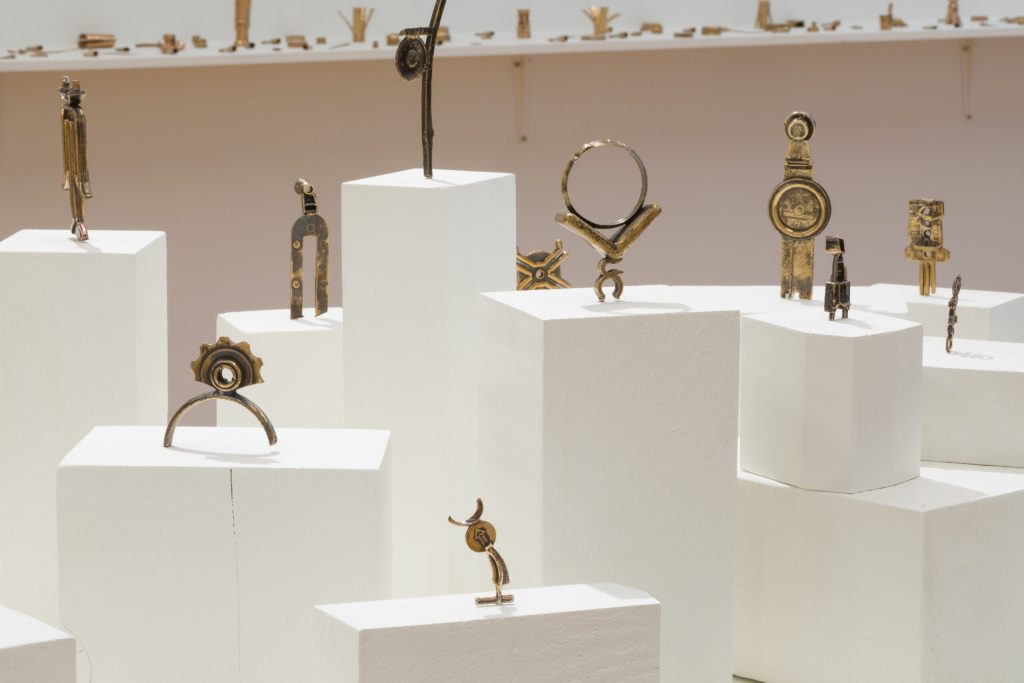
“[Casting] has this one-to-one relationship with the object — it’s the exact replica, but in bronze, and the original no longer exists. So you would have these pieces like a cigarillo butt that still had teeth marks and chew bits, or someone else had chewed on the end of a pen, or you can see where people bent a stir stick because they were fiddling with it or whatever. And all those things come out completely. And they just change the value of the object immediately,” she says.
Give someone a used cigarillo butt or tampon applicator and they would likely be disgusted, she explains. But in the process of casting it, the object is not only physically transformed but symbolically too.
“It really shifts the value of these things that are literally disposable, right? They’re just trash. And [then] suddenly, there’s something covetable about it. It also has a longevity that’s similar to plastic, but it has this whole different connotation: with sculpture and monuments and bells and 3000-year-old Bronze Age things,” she says.
Gray’s latest work is a series of cast plastic keychains, which are made with salvaged hardware and are the offshoot of a larger in-progress public art piece that will be on display in Nanaimo this spring as part of the city’s temporary public art program.
Titled Chimes for the South End, the interactive musical sculpture is made from cast plastic objects at the end of tuned rods, which viewers can move with their hands, and will be displayed in the South End’s Deverill Square Park. All the cast plastic components in this sculpture were found in Gray’s own South End neighbourhood.
“[I was] just thinking of garbage as a kind of social portrait and how in archaeology, they’re always studying what people left behind. So the things that people often leave behind really can create a portrait of the neighborhood or the environment,” she says.
“I wanted this to be like a love letter to my neighbourhood, because they’ve treated us so well since we’ve been here.”

What did you think of this story?
Your feedback after we publish a story helps ensure we're always improving our reporting to better serve you
Author

Related Articles
Comox Valley, Nanaimo land trusts raising funds to support Deep Bay land conservation purchase
In a partnership with the Comox Valley and Nanaimo Area land trusts, BC Parks Foundation is fundraising to protect 50 hectares of pristine shoreline in Deep Bay and make it accessible to the public.

Nanaimo Jazz Festival celebrates 10 years with more than a dozen shows in September
Local and international artists to perform on multiple stages in the city at this year’s Nanaimo Jazz Festival.

Snuneymuxw Elder C’tasi:a shares traditional plant knowledge in new book
‘Plant Teachings from my Auntie’ by Snuneymuxw Elder C’tasi:a and ethnobotanist Nancy Turner delves into traditional plants and plant medicine.