
Motion to close Nanaimo’s Overdose Prevention Site withdrawn
New motion will ask province to reexamine its policy on responding to the overdose crisis.
Nanaimo city councillor Ian Thorpe won’t be asking Island Health to close the city’s only Overdose Prevention Site at 250 Albert St. after he withdrew his motion to that effect at Monday’s council meeting.
Instead, he will be asking council to send a letter to the provincial government asking it to “reexamine its philosophy regarding the ongoing drug addiction crisis and resulting mental health and street disorder issues, stating that the current policy of decriminalization and enabling drug use at consumption sites is failing to provide effective long-term solutions for either those with addictions or for neighbourhoods impacted by the problem.”
That motion will be debated at the next city council meeting on Monday, Dec. 1.
Speaking to The Discourse following the meeting, Thorpe said the original motion asking Island Health to close the Overdose Prevention Site “seemed to be focused more against Island Health or against that particular consumption site.”
“That wasn’t my intent. My intent was to get the provincial government to reexamine its philosophy and policy towards the whole idea of how we deal with the addiction crisis.”
The original motion from Thorpe was made in the summer, following controversy around a proposal to build a $300,000 fence around the City Hall and the City’s Service and Resource Centre parking lots due to safety concerns related to loitering, violence, vandalism, substance use and more.
Nursing professor Sarah Lovegrove had previously written council in July saying that each semester, she brings groups of nursing students to the Overdose Prevention Site and has seen first-hand the lifesaving work that happens there.
“One day when we were there, staff had to run out of the building to save someone’s life with Naloxone and portable oxygen outside of the mayor’s office of City Hall,” she wrote. “Thankfully they were there to respond and saved that person’s life.”
Following Monday’s council meeting, Lovegrove told The Discourse decriminalization was meant to improve access to services for people who use drugs by decreasing stigma. But she said the province has already recriminalized public drug use.
“The suggestion that they need to reevaluate their philosophy is redundant because the provincial government has already changed their philosophies significantly,” Lovegrove said.
Thorpe said the province has started to adjust towards a more recovery-based approach but he doesn’t accept that it is the government’s main focus.
“I think they need to hear more voices from cities and municipalities to tell them, ‘What you’re doing isn’t working. Please do something different and do it more quickly,’” he said.
A statement from the Ministry of Health sent to The Discourse says, “overdose prevention services are vital programs that reduce public drug use, save lives and help connect people to treatment programs.”
“However, street disorder and congregation are ongoing challenges when people do not have sufficient access to shelter or housing,” the statement says.
The province said operators are expected to take steps to mitigate street disorder outside the sites during operating hours and that Island Health is committed to working with the operator and the city to address the issues as best as possible.
Beverly Planes, a peer-research associate with the Canadian Institute for Substance Use Research, told The Discourse that Thorpe’s motion could harm people who use drugs.
“When Thorpe labels these sites as enabling he’s not just making a neutral statement,” she said. “He’s telling the public that keeping people alive is the problem, and that narrative justifies cutting or opposing services that prevent death. That narrative pushes people back into alleys, cars, tents and single rooms where there is no one there to intervene.”
Planes also takes issue with the motion because she said it links drug addiction to mental health and street disorder.
“The real drivers of what people call disorder are a toxic illegal supply, a brutal housing crisis and poverty and untreated trauma,” she said.
Planes said supervised consumption sites, when properly resourced, reduce public drug use, discarded needles and calls to emergency services.
“When you stigmatize and undermine these services, you don’t make neighbourhoods safer,” she said. “You push drug use back into stairwells, parks and doorways with no medical backup, and you increase the number of body bags.”
Debate stretches back to summer
The summer staff report on erecting the fence, which was voted down by council, said the Service and Resource Centre staff parking lot “continues to be a frequent location for congregations, loitering, violence and property related concerns including damage to and theft from staff vehicles, fires, litter, vandalism and safety risks for staff accessing the facility.”
The proposal stemmed from safety concerns by city staff who have been threatened and say the parking lot is “a thoroughfare of drug dealers” driving through as they cut between Wesley Street and the Overdose Prevention Site on Albert Street, said Dave LaBerge, director of public safety for the city.
“Drug dealing or drug use, fires, graffiti. We’ve had damage to our buildings and our infrastructure,” he said. “We’ve had our heat pumps stripped out, thousands of dollars [of damage] for a small amount of recyclables. Our staff have been harassed and intimidated.”
At a special council meeting on July 28, Thorpe made a motion that read:
“That Council formally request Island Health to close the supervised drug consumption site at 250 Albert St., and put future efforts toward drug free treatment facilities.”
Speaking to council at that meeting, Thorpe said he didn’t “make the motion lightly.”
“But I honestly think that it is time for our council to discuss this, to take a stand and make a statement regarding the harm that is being done currently to our community.”
A similar motion by Victoria Coun. Marg Gardiner to ask Island Health to shutter Overdose Prevention Sites in that city was recently defeated 7-2 at a city council meeting on Nov. 6.
Coun. Sheryl Armstrong moved to defer the motion to a future meeting and invite Island Health and the Canadian Mental Health Association Mid-Island, who runs the overdose prevention site, to present to council.
“Drugs aren’t free at the consumption site, they’re tested to make sure they’re safe. They’re not getting drugs there,” she said.
Armstrong said she agreed with Thorpe that the “chaos” around the Overdose Prevention Site is a problem but there’s “absolutely no doubt” that the service saves lives
At the time, she said she wanted Island Health and the Canadian Mental Health Association Mid-Island to look at options to address disorder near the site, but she couldn’t, “in good faith, shut something down without hearing from the operators and Island Health and knowing what other options there are.”
Coun. Hilary Eastmure said the vote was as if council was holding a referendum on harm reduction.
“At the end of the day, this is ensuring that less harm is being done,” Eastmure said about the Overdose Prevention Site.
Nanaimo experiencing higher rates of overdose deaths
At the city council’s Governance and Priorities Committee meeting on Oct. 31, representatives from Island Health presented to council about the unregulated drug crisis in Nanaimo and its plans to open a wellness and recovery centre with primary care services at the same location as the Overdose Prevention Site.
Dr. Tribesty Nguyen, resident physician and Island Health’s incoming Medical Health Officer for Nanaimo and Oceanside, said Nanaimo has a rate of deaths from unregulated drugs that is almost twice that of Island Health and of B.C. as a whole.
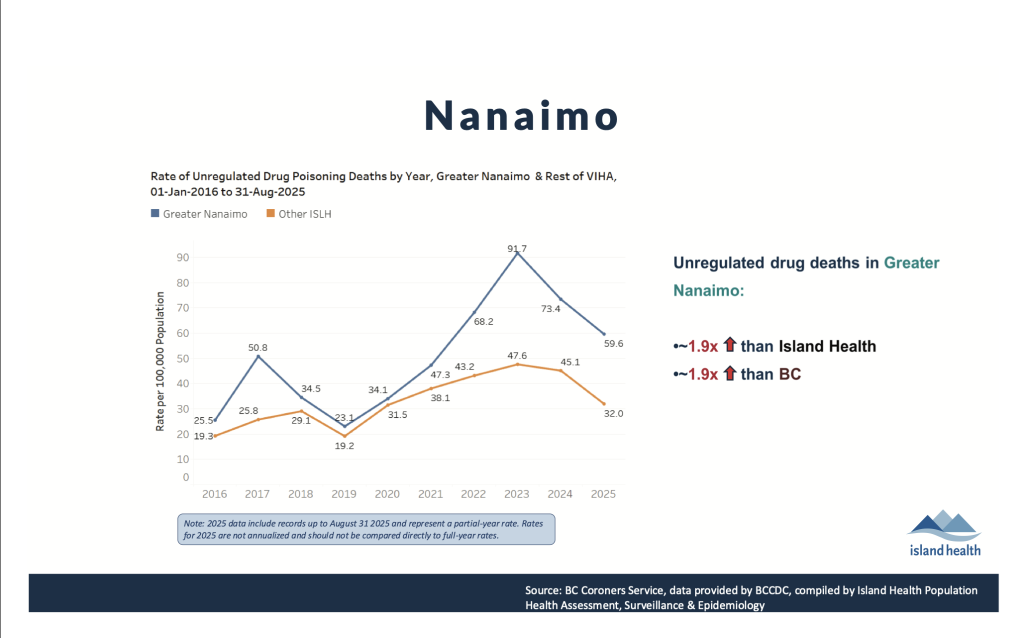
It also has the second-highest death rate among Local Health Areas on Vancouver Island, following Campbell River.
Nguyen said interventions such as take-home naloxone, use of a supervised consumption site or opioid agonist therapy have saved lives in Nanaimo 1,960 times between July 2024 and July 2025.
Plans for a Wellness and Recovery Centre
According to Island Health officials, the plan for a “wellness and recovery centre” at 250 Albert St. is to provide primary care with a team of doctors and allied health staff seven days a week for 10 to 12 hours a day, during the day.
As of Oct. 31, not all of the positions for those teams have been posted as Island Health is launching different services throughout the region, including a 24-7 site in Oceanside, and does not want to compete for nursing staff between those communities.
Thorpe was absent from that meeting but said he watched the recording of the meeting afterwards and acknowledges that supervised consumption sites save lives “in the short term.”
“[But] I don’t think in the long term it’s beneficial for people. It entrenches their drug use and doesn’t attempt to attack the root of the problem, and that is we’ve got to get people treatment,” Thorpe told The Discourse on Monday.
The wellness and recovery centre, first announced in December 2022, is expected to open by late spring 2026.
Zoning rules for Overdose Prevention Sites in Nanaimo
The location of supervised consumption sites in Nanaimo is regulated in zoning bylaws, requiring site-specific approval.
However, due to the ongoing public health emergency declared in 2016, the Overdose Prevention Site on Albert Street operates under a Provincial Ministerial Order, which supersedes municipal bylaws.
This means that while the public health emergency is ongoing, the city doesn’t have the power to regulate where Overdose Prevention Sites are located. However, should that ministerial order end, the city would have to approve the specific location for a supervised consumption site.
In 2020, city council voted to amend its zoning ordinance, which previously required site-specific zoning for any drug addiction treatment facility. That requirement was relaxed and drug addiction treatment facilities can now operate in any area zoned for medical office use.
But this doesn’t include supervised consumption sites, which were excluded when the bylaw was amended. Those sites still require site-specific approval by Nanaimo City Council.
The building at 250 Albert St. is located in an area zoned for medical office use and is more than 400 metres from the nearest school, according to a city report on the bylaw changes in 2020.
Motion to return to council in December
Thorpe’s motion will be back at council on Monday, Dec. 1 and he said he will be happy to speak to it at that time.
“We’re dealing with the results of government policy which is set above our heads,” he said.
Thorpe said his new motion intends to ask the province to reconsider its harm reduction approach.
“I’m not sure that there is such a thing as harm reduction when you’re dealing with toxic drugs,” he said. “All you’re doing is postponing or prolonging a bad ending.”
Thorpe said the city currently spends taxpayers’ money on things like street cleaning and hiring community safety officers, and that social disorder is impacting bylaw officers’ ability “to do much of anything else in the city.”
Planes said she hopes to present to council on the issue.
“I look forward to engaging with City Council on this matter,” she said.
Lovegrove said she would like to see Nanaimo City Council advocate for evidence-based interventions to the toxic drug crisis instead of “perpetuating misinformation and catering to the loudest, most privileged people in the community.”
What did you think of this story?
Your feedback after we publish a story helps ensure we're always improving our reporting to better serve you
Author

Related Articles

DRIPA debated in B.C. election on Vancouver Island
The Conservative party of B.C. is promising to repeal the Declaration on the Rights of Indigenous Peoples Act (DRIPA), while other parties argue that would set back relations with First Nations and create economic uncertainty.

Where Nanaimo’s MLA candidates stand on addictions care, family doctors and Island rail
Candidates in Nanaimo-Gabriola and Nanaimo-Lantzville answered three questions from Discourse readers ahead of the Oct. 24 B.C. election.
Nanaimo’s guide to the 2026 B.C. election
What riding am I in? Who are the candidates? When do I vote? B.C. election basics for Nanaimo voters.