
What to expect on Vancouver Island this wildfire season
What meteorologists are saying to expect and how Nanaimo-area fire departments are preparing for the summer wildfire season.
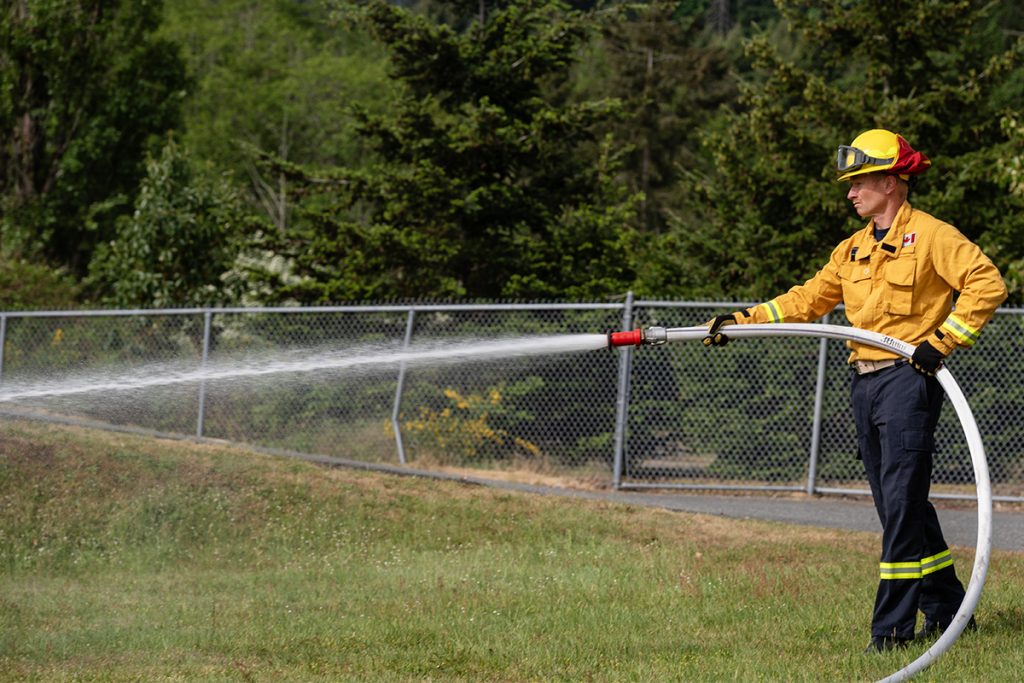
It is a hot and sunny Saturday afternoon at the Nanaimo Military Camp and dozens of firetrucks are lined up in the parking lot. More than 50 firefighters from six local fire departments gather in a semi-circle for a briefing before a joint wildfire training exercise.
Nanaimo fire chief Tim Doyle addresses the group of firefighters, telling them that while they have worked on fires together in the past, the training is a good opportunity to get to know one another and learn how they work with their own equipment.
“Don’t be too hard on each other,” he tells them. “Don’t be too intimidated by each other. Just go out there and do what you know how to do.”
This summer is primed to be hotter and drier than usual, according to meteorologists, increasing the possibility of extreme heat events and wildfire risk across B.C., including on Vancouver Island.
Derek Lee, a meteorologist with Environment and Climate Change Canada, said that if trends hold, Vancouver Island and B.C. could see above average temperatures from June to August and into September this summer.
Along with higher temperatures, less rain is also being forecast as the warm weather will be accompanied by high-pressure systems, keeping out low-pressure systems that carry in rain from the Pacific Ocean.
Nanaimo deputy fire chief Stuart Kenning said the hotter and drier summers on the Island are the reason why the departments chose to focus on a wildfire training exercise.
The fire risk in early May was already “extreme,” Doyle said, noting that “it feels like we’re seeing that happen earlier and earlier every year.”
The impact of El Niño
This year is also an El Niño year, which means that the sea surface temperatures at the equator are warmer than normal. Those ocean temperatures can change global weather patterns and lead to warmer temperatures, Lee said.
However, Lee told The Discourse that the fixation on it being an El Niño year when it comes to summer weather is a bit misplaced as most of its effects will be felt in the winter, which could lead to less snowfall and increased drought in 2027.
While this past season was a La Niña winter and atmospheric rivers still brought precipitation to Vancouver Island, what was needed is non-atmospheric river low pressure systems that are cool enough for it to snow at higher elevations. Environment Canada’s weather stations on Vancouver Island showed 20 per cent to 40 per cent less precipitation than normal between September 2025 and April 2026, Lee said.
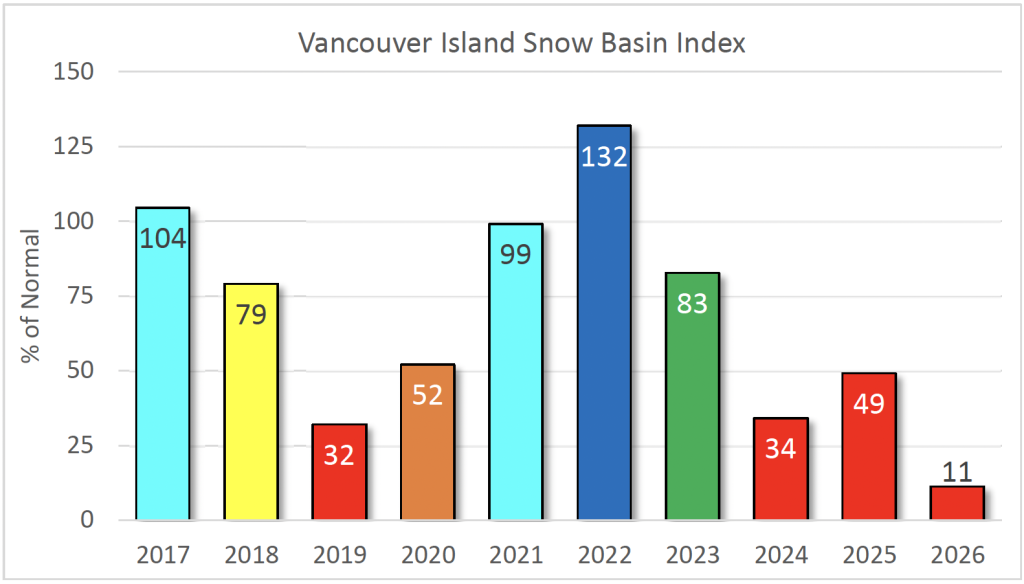
A report from the Ministry of Water, Land and Resource Stewardship on May 15 shows that the snowpack on Vancouver Island was just 11 per cent of normal levels, a 38 per cent drop from the previous year, and the lowest level recorded in the past decade.
The last time there was an El Niño summer was in 2023, which saw 2.84 million hectares burn from wildfires in B.C., but Lee cautioned that doesn’t mean the same will happen this year.
Extreme weather events, such as the 2021 heat dome — which killed more than 600 people in B.C. — are hard to predict and don’t necessarily correlate to seasonal forecasts. For example, the 2021 heat dome occurred during a La Niña year (different from El Niño) which is generally cooler and wetter.
But Islanders hoping for a cooler “Juneuary” shouldn’t get their hopes up despite a spell of cool weather and rain this week. Lee said the trend for the month is for above-average temperatures and drier conditions, but every day of rain helps mitigate the conditions that allow wildfires to burn out of control.
“We would hope for a June that is a little bit on the wet side,” Lee said. “But seeing that the forecast doesn’t match what I want, it’s a little bit on the lower hope side that we would get anything to recover from this.”
Nanaimo Fire and Rescue holds joint wildfire exercise with surrounding fire departments
During the wildfire training exercise at the Nanaimo Military Camp, firefighters were sweating as they hauled hoses in the heat.
Nanaimo Fire Chief Tim Doyle said the large-scale exercise was done with heightened expectations for this year’s wildfire season.
When wildfires happen and reach the city limits, Doyle said they are usually large, complex operations involving multiple departments so a joint exercise gives firefighters the opportunity to train together in real time before there’s a big emergency.
“Today’s training is to get more familiar with our equipment, our tactics, our strategies, and build relationships,” Doyle said. “So that when a big emergency happens, the big interface fire happens, whether it’s in our jurisdiction or their jurisdiction, we respond seamlessly, smoothly and are able to support our community as best as possible.”
Experience of firefighters who have deployed ‘invaluable’ in training exercise
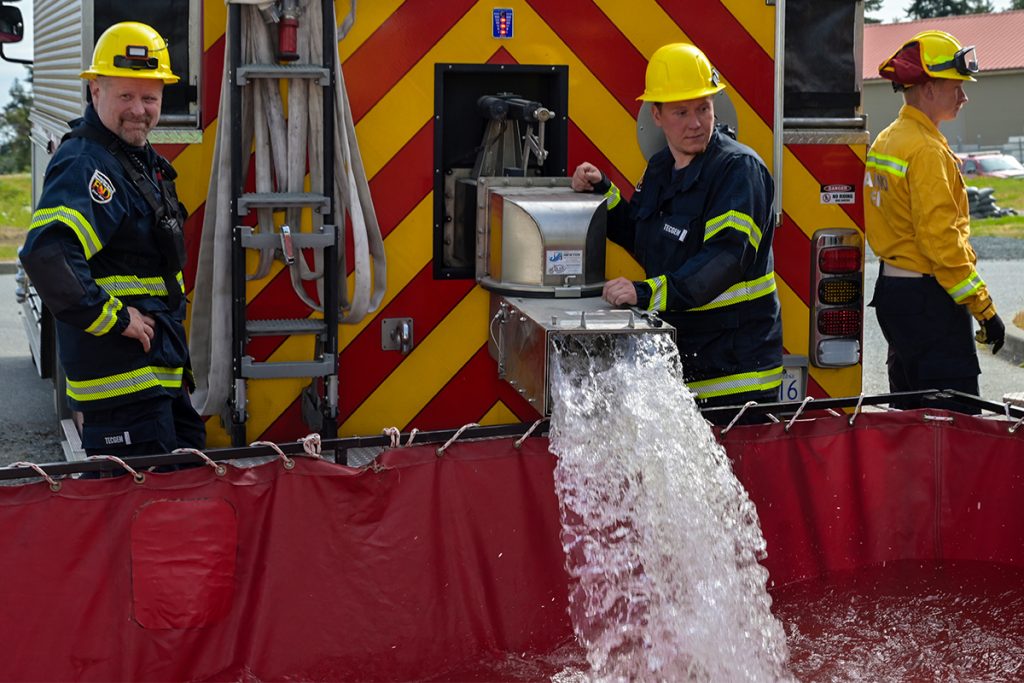
Doyle said having firefighters who are veterans of the Wesley Ridge Fire, which threatened people’s homes near Cameron Lake last year, training with firefighters from other departments was invaluable.
Bart Rosser, a captain with the Cranberry Volunteer Fire Department, said he has been deployed five times to help fight wildfires in other communities including Fort St. John, Lillooet and Adams Lake.
“It’s the middle of May, and we’re super dry right now,” Rosser said. “So we’re preparing a lot more for [wildfires], getting more resources and everything ready to go.”
Shaun Payne, deputy chief of the North Cedar Fire Department, said his department has been deploying firefighters to help with major wildfires since 2017 and that they have experience fighting wildfires near Vanderhoof and Fraser Lake.
“We’ve been going on multiple deployments every year,” Payne said. “So our crews are fairly well versed in the wildland-urban interface.”
Payne said the joint exercise in Nanaimo was great because it helps train departments on what to do if the fire is in an area where they have jurisdiction instead of working under the BC Wildfire Service.
Over the past three years, the City of Nanaimo has hired 40 additional firefighters, which Doyle said has made an “incredible difference” in the department’s ability to respond to multiple emergencies at once.
Doyle said a lot of the new hires have experience working with the BC Wildfire Service and have technical rescue training. He also said the BC Wildfire Service is a “great background” to have for people who are interested in firefighting as a career.
Wildfires on Vancouver Island, such as the Wesley Ridge Wildfire in 2025, are generally what Payne called a rank two or rank three fire, meaning they are a “moderately vigorous surface fire.” But he noted that the Mount Underwood Fire later in the year was a rank five fire and an “extremely vigorous surface or crown fire.”
“Which nobody ever expected to see [on Vancouver Island],” Payne said. “So you can see the changing environment for sure. I think we have to be ready for that potential.”
What did you think of this story?
Your feedback after we publish a story helps ensure we're always improving our reporting to better serve you
Author

Related Articles
Nanaimo’s guide to the 2026 B.C. election
What riding am I in? Who are the candidates? When do I vote? B.C. election basics for Nanaimo voters.
Nanaimo mayoral candidates address the homelessness crisis
Homelessness is a key election issue but what can the City of Nanaimo do about it?
How Nanaimo candidates would pay for rising infrastructure costs
City of Nanaimo’s 2026 candidates share how they’d manage the budget to cover rising infrastructure and repair costs without overburdening taxpayers.