
‘It makes you feel not alone’: VIU meal program fights student hunger and loneliness
With food insecurity growing at Vancouver Island University, students and faculty are working to study the problem and respond.
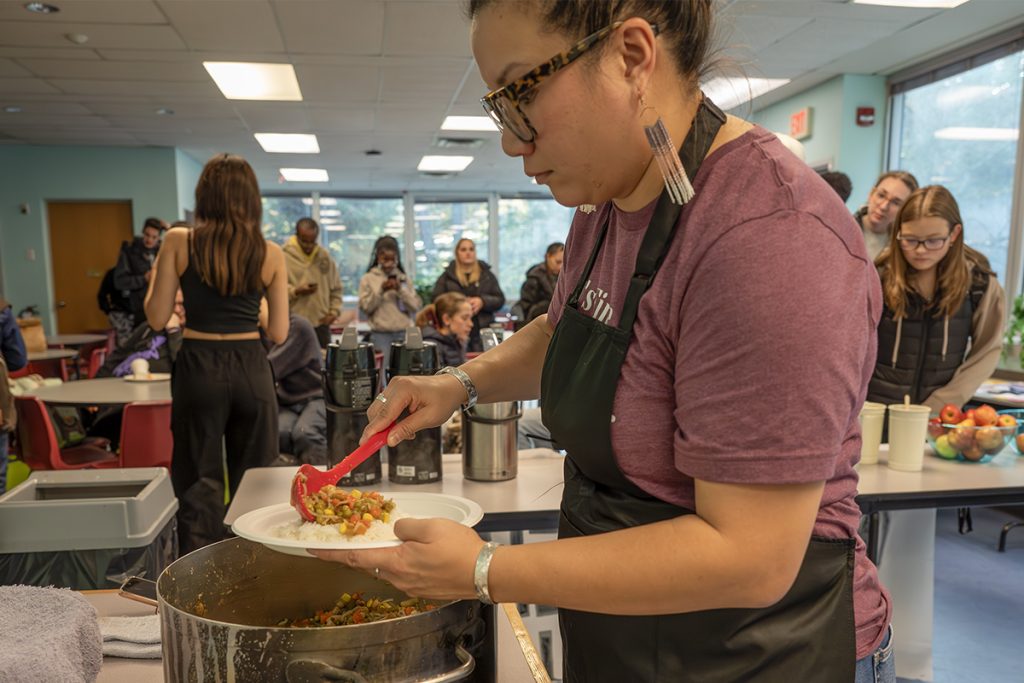
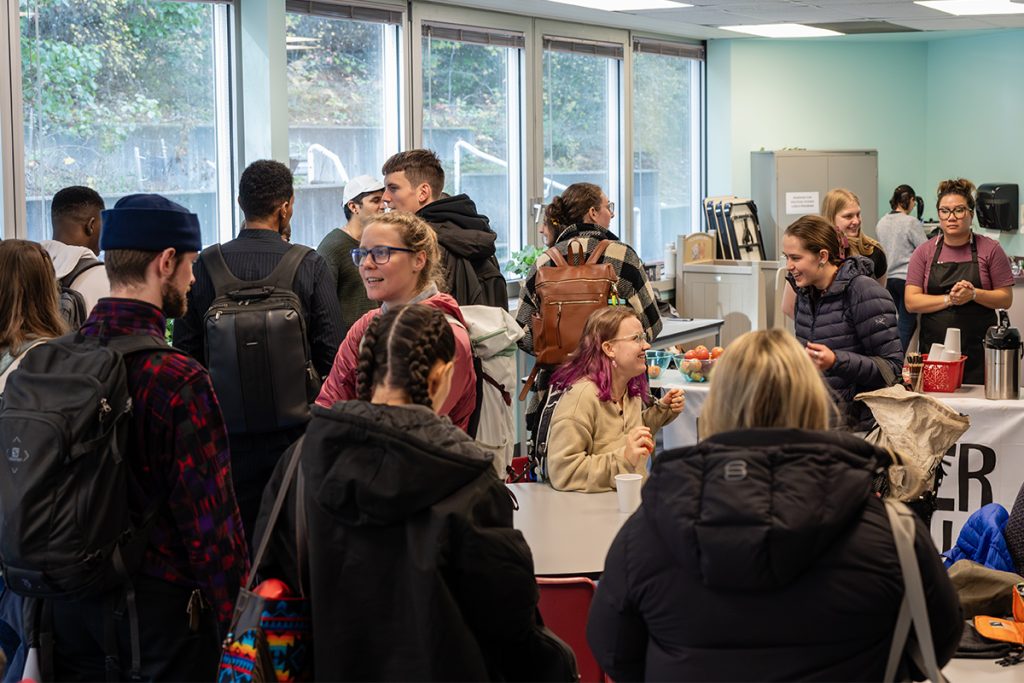
A normally empty meeting room in Vancouver Island University’s (VIU) social sciences building was transformed into a busy eatery on Tuesday as more than 100 students were served plates of Thai curry on rice as part of a new hot meal program called No Hunger at VIU.
The free program serves students every two weeks in Building 355 and started when Leah Vaisanen, a political studies student, saw food prices rising over the past year and was talking with other students who were barely able to afford food even though they were working while in school.
“Some students don’t even eat, or they don’t have time to eat. And that’s the main idea that led into this,” she said. “So students have at least one hot meal instead of sitting in class hungry.”
In addition to serving free hot meals every other week, the program also helps provide care packages to students containing items like toothpaste, toothbrushes, soap, deodorant and feminine hygiene products.
The initial seed money for the meals came through the Vancouver Island University Students Union (VIUSU) which allowed Vaisanen to use $2,000 of her budget as the union’s Indigenous representative to start the program.
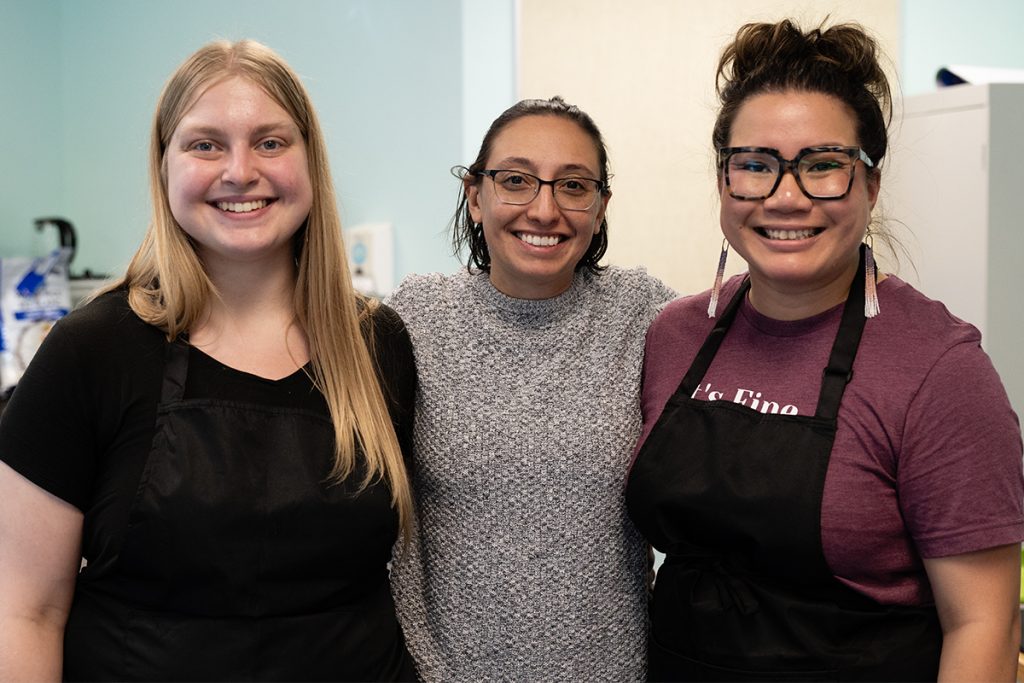
No Hunger at VIU is organized by Vaisanen with political studies professors Lauren Touchant and Jocelyne Praud with support from the dean of social sciences Elizabeth Brimacombe.
The group collects donations from faculty in a donation bin in Building 356 and has just received funding from the Embark Foundation to continue the program until the end of the academic year.
Data from Food Banks Canada shows that food bank use in British Columbia has increased by 15 per cent in the past year and is up 81 percent from 2019.
Nationally, the percentage of people accessing food banks who are post-secondary students has jumped from five per cent of food bank users in 2019 to 7.7 per cent in 2024.
Vaisanen cooks the meals with Touchant at home and brings a rice-cooker that runs non-stop during the servings. Demand is so high that students are eating the food faster than it can be cooked.
“We had students coming in class, and we heard the stomachs rumbling,” Touchant said.
Students were telling her they were struggling to afford to live between increasing rent, bills and groceries. She was seeing more students with mental distress which could be a symptom of hunger.
Over time, word spread about the care packages, Touchant said, and they started to fly off the shelves.
While the biweekly meals are directly addressing student hunger on campus, they are also an opportunity for students to come together and build community, Touchant added.
Arkan Ghebremaram is an international student from Eritrea who moved to Canada in September to study computer science. He says loneliness is something that students are feeling.
“Coming here for my first term is difficult, because of the new culture, new environment, new school, a town you barely know. It’s hard,” Ghebremaram said.
“What I find really difficult here is having social events so that people can socialize and meet new people, because usually people are very couped up in their own way, and there aren’t any visible ways you can meet new people and interact and find common interests.”
Ghebremaram said he appreciates the biweekly meals because they help cut through that isolation. He would like to see more events with food organized for students so they can socialize with one another.
Read more: International students ‘exhausted’ from carrying the financial burden of their universities
Alexandra Wiebe is an education student at VIU who is living entirely on a student loan and is struggling to pay for groceries.
“I brought an onion yesterday, and it was $4 per onion, so I had to put back most of my onions because it was too expensive for me,” she said.
Her classmate Cassandra Mitchell said she started out in the school year making minestrone soup for lunch at school.
“My first week’s minestrone soup was all fresh produce and it was absolutely delicious,” she said. “The second, minestrone soup was mostly canned vegetables instead. As the semester has gone on, I’ve used more and more canned vegetables instead of fresh produce.”
Wiebe would like to see VIU start a program similar to the one at Nanaimo District Secondary School, where she works as a student teacher, where students make meals and sell them for an affordable price in the school cafeteria.
Sarah Fahr is an international student from Switzerland who has found it impossible to afford to eat vegetarian in Canada.
“When it comes to fruit and vegetables they are way more expensive here. In Switzerland, meat is very, very expensive and here it’s the other way around and being a vegetarian here is very hard because of that.”
Brandi Klee, a second-year political studies major, was volunteering with Vaisanen and Touchant to serve the meal to students. She is also the vice president of the Political Studies Club on campus which shows movies during the meals. The movie playing on November 5, election day in the United States, was The Trial of the Chicago 7.
Klee says that expenses like rent, food and her phone bill mean she’s in debt. With the biweekly meal, she can eat a “hot meal and not just ramen noodles” that day.
Klee would like to see the program eventually expand to serving hot meals five days a week.
“You at least have one hot meal a day. You get to go somewhere comfortable and a lot of people don’t have that safe space,” she says.
Gen Bouchard, an education student, came to enjoy a hot meal and hang out with her classmates.
“Education is expensive, housing is expensive, so it’s nice to not have to spring for my meal today,” she said. “It fosters connection. It gives you a warm meal. It makes you feel not alone.”
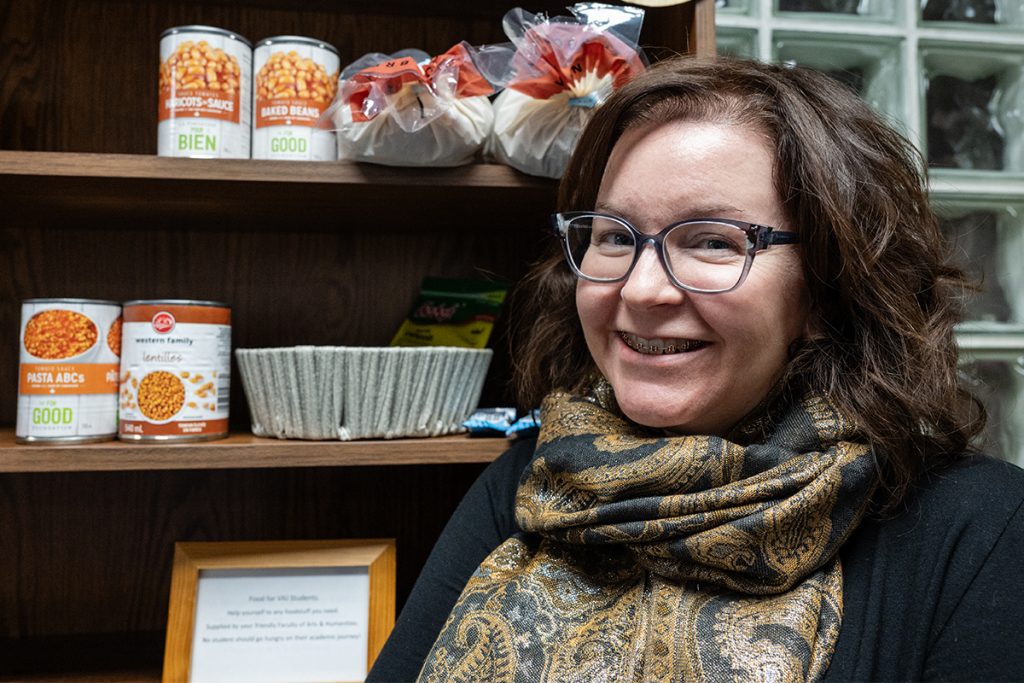
Another initiative at the university is the establishment of three free food shelves, supplied by the Loaves and Fishes food bank. A variety of non-perishable food items can be found at the student residence, Shq’apthut (A Gathering Place) and the arts and humanities building.
The food shelf at the humanities building started last spring after a couple of incidents of students fainting in class.
“In discussion with them, we found that it had a lot to do [with] that they weren’t eating, especially in the mornings,” said English professor Amelia Horsburgh who organizes the food shelf in the humanities building. “It became apparent to us that it had a lot to do with food insecurity, and we don’t want any of our students to go hungry on their academic journey.”
The food shelf in the humanities building is stocked every Thursday morning with non-perishable items such as peanut butter, tins of tuna, beans, pasta and loaves of bread as well as snacks that students can eat in class.
Horsburgh said that a colleague of hers had a connection with a farm in the Cowichan Valley and they donated 50 pounds of fresh apples, which were gone in 24 hours.
One of the challenges with the various programs is the lack of infrastructure on campus, Horsbourgh said. The lack of access to refrigeration means she can’t stock fresh foods.
This is just one way to make the university food program more sustainable longterm, she added. “Because it doesn’t look like it’s going to change in regards to food insecurity in our community for the next little while.”
Irlanda Gonzalez Price, VIU’s associate vice-president of student affairs, acknowledged the “unfortunate trend” of students being forced to choose between their education and basic living needs due to inflation.
In an emailed statement to The Discourse, she said the university also runs a “give a meal” program through the school cafeteria where students can use vouchers on their student card. The vouchers are distributed by university departments that interact with students in need such as financial aid, counselling, services for Indigenous students and the student residences.
The VIUSU also provides a free breakfast bar where students can grab some cereal as well as coffee and tea each day.
As part of the $400,000 funding from the Embark Student Foundation to address student hunger, student-driven research on food security and initiatives for meeting the immediate needs of students is in early stages of development.
Touchant said that the research is needed so the university can better know what the needs are on campus so they can address them.
“This is so critical for us to do,” she said. “If we want to see some programs and initiatives being supported by the university, we actually need to understand what the need is.”
Editor’s note Nov.14, 2024: This story has been updated to include the names of all of the No Hunger at VIU organizers.
What did you think of this story?
Your feedback after we publish a story helps ensure we're always improving our reporting to better serve you
Author

Related Articles
Nanaimo mayoral candidates address the homelessness crisis
Homelessness is a key election issue but what can the City of Nanaimo do about it?
How Nanaimo candidates would pay for rising infrastructure costs
City of Nanaimo’s 2026 candidates share how they’d manage the budget to cover rising infrastructure and repair costs without overburdening taxpayers.

Nanaimo candidates on how the city can cut emissions
City of Nanaimo’s 2026 candidates share two actions within city jurisdiction they’d prioritize to reduce emissions, and how they’d know if they were working.