
Nanaimo Art Gallery exhibit ‘the other side’ connects land and spirit
Michelle Sound and Eliot White-Hill, Kwulasultun explore connection between the land, family, and the supernatural.

The Nanaimo Art Gallery’s new exhibit shnu’a’th, ᐊᑳᒥᕽ akâmihk, the other side (written Hul’qumi’num, Cree and English) by artists Michelle Sound and Eliot White-Hill, Kwulasultun uses photography to explore their connections between the land and the spirit world.
On Sunday, the two artists sat down with the gallery’s Indigenous engagement coordinator, bailey macabre, for an hour-long discussion about the exhibit, its relationship to family and ancestors and how the two artists collaborated to create it.
Michelle Sound is a member of Wapsewsipi Swan River First Nation in Treaty 8 territory in northern Alberta. Her father was Métis from Buffalo Lake and Kikino Métis settlements in central Alberta, Treaty 6 territory.
Her work in the exhibit features prints of old family photographs that she has torn and then repaired using embroidery thread, beads, pom-poms and porcupine quills. She also printed a series of cyanotypes on elk-hide drums that are arranged in a constellation on the wall of the gallery.
One of Sound’s photos is a landscape photo of Swan River, which is where her grandfather is from.
“This one is very particular to my family, because my mooshum, my grandfather, became enfranchised in 1944,” she told the small crowd at the gallery. “He was a residential ‘school’ survivor, and he really wanted to make sure that his children didn’t have to go so he became enfranchised, which means he became a Canadian citizen and no longer had Indian status or treaty rights.”
Because of this, Sound’s family was not allowed to live on the reserve and instead lived in a “two-room shack” with no running water or electricity on a strip of land called “the jungle” on the edge of the reserve land.
“It was really about that forced displacement, and also our continued displacement from that territory,” she said.
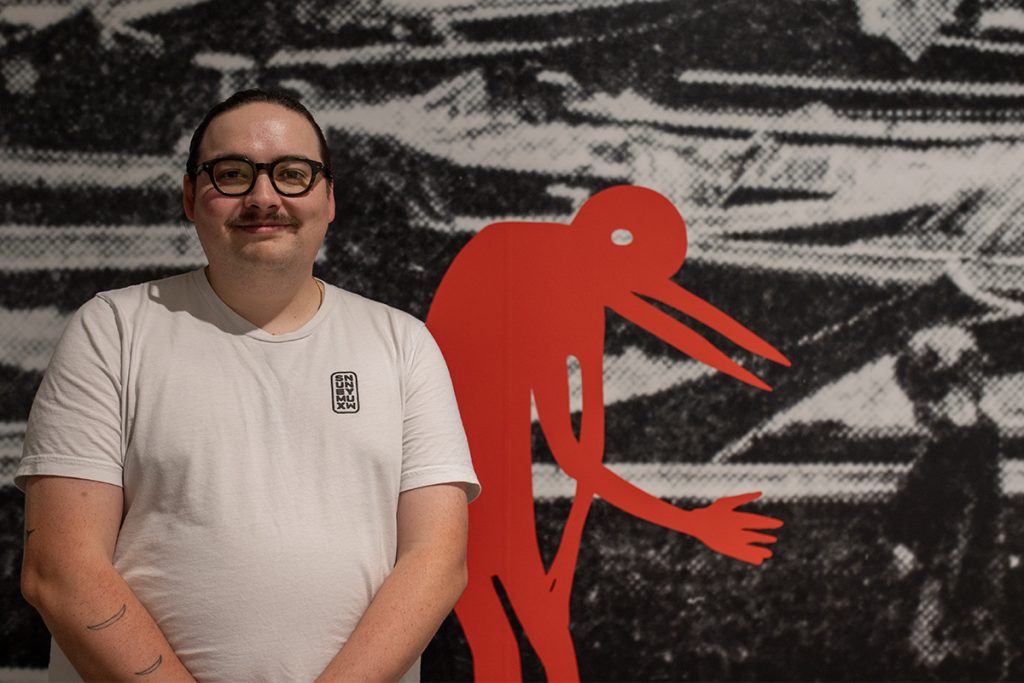
White-Hill is an interdisciplinary artist and storyteller from the Snuneymuxw First Nation whose family has roots in Penelakut, in the Nuu Chah Nulth world in Hupacasath, and further up and down the Northwest Coast
He spoke about how he uses archival photographs of local landscapes from museums, combined with Spindle Whorl drawings to connect the land with supernatural beings or spirits.
“These photographs all come from this place, they’re interwoven with spindle whorl designs that were carved by ancestors from the same region, and thinking about the displacement and the dispossession of not just the land but also the cultural information about who we are,” he said.
The designs White-Hill used for the exhibit come from artifacts in museums around the world, including the Royal BC Museum, Chicago and the U.K.
“Some of them are in London in an unmarked warehouse that I had the chance to visit in May. So really thinking about that connection to place and bringing these home in a way, even if I can’t bring the actual objects home I can bring the designs home and share them.”
Sound said what connects her work and White-Hill’s is that both of them use photographs to explore Indigenous relations to the land.
“We’re both working with photography in this exhibit, and it’s not something we actually both even normally do all the time,” she told The Discourse. “But this connection to family and place is what connects our work.”
shnu’a’th, ᐊᑳᒥᕽ akâmihk, the other side will be on display at the Nanaimo Art Gallery until Jan. 12, 2025. The gallery is open Tuesday to Sunday. Admission is by donation.
What did you think of this story?
Your feedback after we publish a story helps ensure we're always improving our reporting to better serve you
Author

Related Articles
Comox Valley, Nanaimo land trusts raising funds to support Deep Bay land conservation purchase
In a partnership with the Comox Valley and Nanaimo Area land trusts, BC Parks Foundation is fundraising to protect 50 hectares of pristine shoreline in Deep Bay and make it accessible to the public.

Nanaimo Jazz Festival celebrates 10 years with more than a dozen shows in September
Local and international artists to perform on multiple stages in the city at this year’s Nanaimo Jazz Festival.
Snuneymuxw Elder C’tasi:a shares traditional plant knowledge in new book
‘Plant Teachings from my Auntie’ by Snuneymuxw Elder C’tasi:a and ethnobotanist Nancy Turner delves into traditional plants and plant medicine.