
Scales and slithers abound at the Vancouver Reptile Expo
A range of creatures from snakes to scorpions descended on Beban Park for the two-day expo.

The final push for local mom Roxi Allen to realize her dream of owning a ball python was what she described as a mid-pandemic “midlife crisis.”
At the time she worked for Nanaimo Fire Rescue, and was laid off when the City of Nanaimo decided not to renew the dispatchers’ contract in the fall of 2020. Also in the midst of a breakup, she says she thought, “I’m going to live life for me” and got a snake.
“I’ve wanted one for 25-some-odd years,” she says. “If anyone else comes into my life, they’re just going to like it — or not.”
Many more ball pythons were to follow — she has approximately 30 now — and were on display at the weekend-long Island edition of the Vancouver Reptile Expo at Beban Park.
Allen has now gone into the business of raising ball pythons with her daughter Brit, and their Chemainus-based company TantaLite Creations (or TLC, as she likes to call it) is one of only a few that breeds snakes on Vancouver Island. It’s also one of the few in the reptile world that is both Indigenous and women-owned (Allen is from the Katzie and Dene First Nations).
The pipeline from ball python owner to breeder was swift for Allen, who says she first became fascinated — or obsessed — with the science of breeding, and the sheer variety of genetic mutations or “morphs” within the breed.
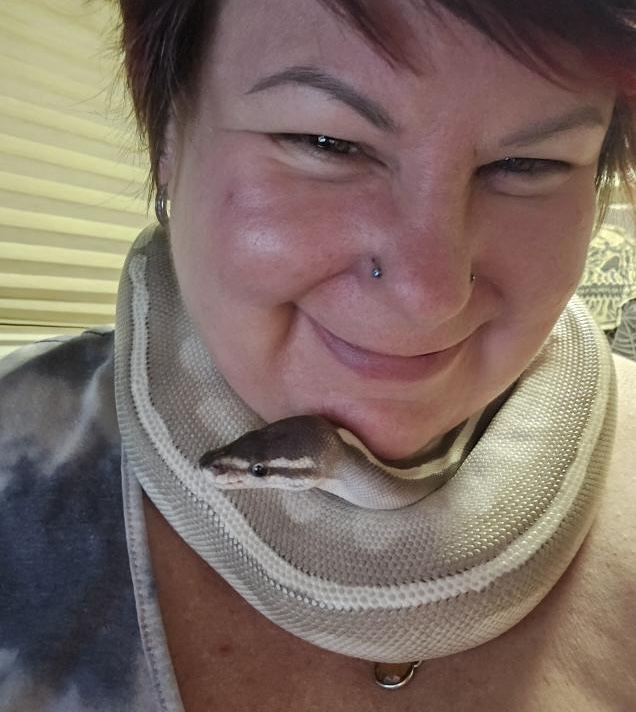
There was little information on ball pythons 25 years ago, she says. Most advice on how to care for them was learned through books or word of mouth, and they were mostly of a ‘normal’ — brown, patterned — variety.
But when Allen began her research in 2020, she discovered “a whole new world had exploded” within the world of ball pythons.
“I couldn’t stop watching YouTube. I was floored. If you mix this and this, like two dark snakes, you can get a white snake? How is that possible? There were all these different combinations,” she says. “That’s it. I was hooked.”
Once she started raising them, Allen was especially struck by how good-natured ball pythons are.
“What I had [originally] thought these creatures were was absolutely nothing at all like what they are in person. They are known as the ‘puppy dog’ or the ‘lap dog’ of the snake world because they are so gentle and slow, and just very sweet,” she says, adding that their name comes from how they curl up into a ball when they are startled or feel threatened. “Everything I thought I had known was just false information.”
Misconceptions in the world of reptile ownership and breeding run rife, agrees Alexander Robbins, who had a stand at the Expo over the weekend for his business Twizted Foolz Exotix in Whiskey Creek.

“These animals are way more personable and intelligent than we have given them credit for in the past, due in part from television often depicting them in works of fiction as antagonists or pests,” he says, via message. “In reality, these animals have the capacity to form bonds of trust with people, and a lot of them can be trained to a certain extent. But like with any creature, each individual has its own personality and tolerance to being bothered.”
An example of this, he says, is the pair of blood pythons he brought to sell at the Expo. The male is “an absolute sweetheart” who emerges from his enclosure to curl up with him and hang out, whereas the female prefers to be left to do her own thing.
Reptiles and snakes are far more intelligent and sensitive than previously thought, according to the BC SPCA, which does not generally recommend them as a beginner-level pet.
Robbins’ first reptile was a Bearded dragon, a common first pet and one of the first he bred, he says. Over the years as his interest and skills grew, he moved on to basilisk lizards, several gecko species, carpet pythons, corn snakes, dart frogs, and a variety of invertebrates. But these days he’s most excited about his pair of Halmahera sailfin dragons, which he hopes to breed when they are big enough.

Reptiles weren’t the only creatures at the Reptile Expo, which organizers said was their “most-attended expo yet,” and featured tables of scorpions, tarantulas, geckos, snakes, iguanas, exotic plants, various bugs and grubs for feeding — and ants.
Canada Ant Colony is the brainchild of 19-year-old Zachary Liu, who has been in the ant business since he was 15 and is now studying biology and entomology at McGill University.
“Ant-keeping as a hobby is one of the fastest-growing hobbies in the world right now,” but it’s more than just having a few ants in a jar full of dirt, says Liu, who describes ant-keeping as an “observational” hobby comparable to keeping fish.
“As science has developed, people have become better at keeping ants alive,” he says. “We’re having colonies that can last 15, 20 years so you’ll see really cool behaviours and get to interact with them.”
A fascinating ant behaviour he has observed is that in some species the queen will sometimes go outside a different ant colony and curl up to disguise herself as a baby or larval ant. When a worker from the host colony sees her, it carries her inside to where the other babies are — usually near that colony’s queen.
“[Then] she’ll stage an assassination,” says Liu.
In some species, after the queen has staged a coup, she has to convince the workers that she is the real queen and to work for her instead.
“She’ll make her own workers and you’ll see colonies where there were originally all black ants and then you’ll see a red queen enter, and one day there’s one red ant, then there’s two, then there’s three, then there’s a hundred,” he says. “They are activities that a lot of times, people will see, and it kind of reminds them of people.”

Liu says his curiosity about ants and insects was sparked by his mother, who grew up in rural China and was terrified of bugs. She didn’t want her son to inherit the same fear, so she read him a lot of books about insects, he says.
Started in 2019, Canada Ant Colony now supplies ant colonies, beginner ant kits and ant-keeping supplies to researchers and hobbyists all over Canada, and have started expanding into the U.S.
For now, Liu plans to keep attending trade shows and reptile expos to continue growing the business with a goal to make ant-keeping more accessible and affordable for the general hobbyist.
The next Vancouver Reptile Expo takes place at the South Delta Recreation Centre on April 13 and 14.
What did you think of this story?
Your feedback after we publish a story helps ensure we're always improving our reporting to better serve you
Author

Related Articles
Comox Valley, Nanaimo land trusts raising funds to support Deep Bay land conservation purchase
In a partnership with the Comox Valley and Nanaimo Area land trusts, BC Parks Foundation is fundraising to protect 50 hectares of pristine shoreline in Deep Bay and make it accessible to the public.

Nanaimo Jazz Festival celebrates 10 years with more than a dozen shows in September
Local and international artists to perform on multiple stages in the city at this year’s Nanaimo Jazz Festival.
Snuneymuxw Elder C’tasi:a shares traditional plant knowledge in new book
‘Plant Teachings from my Auntie’ by Snuneymuxw Elder C’tasi:a and ethnobotanist Nancy Turner delves into traditional plants and plant medicine.