
Packed OneBC meeting in Nanaimo taps into controversy over Indigenous rights
Provincial party’s leader Dallas Brodie calls to throw out B.C. Indigenous rights law, reconciliation and the federal Indian Act. We fact-checked what she said.
Content warning: The following story includes remarks about Indigenous peoples and residential “schools” that may be distressing to some. Please read with care.
Editor’s note: The Discourse uses quotation marks around the word “school,” because the Truth and Reconciliation Commission found residential “schools” were “an education system in name only for much of its existence.” The Indian Residential School Survivors Society crisis line is available any time at 1-800-721-0066. Please reach out if you need support.
The leader of a small right-wing provincial party shared her controversial views on Indigenous rights to a packed crowd in Nanaimo earlier this month — soon after a landmark agreement between the Musqueam Indian Band and Ottawa declared Aboriginal land title across much of B.C.’s Lower Mainland.
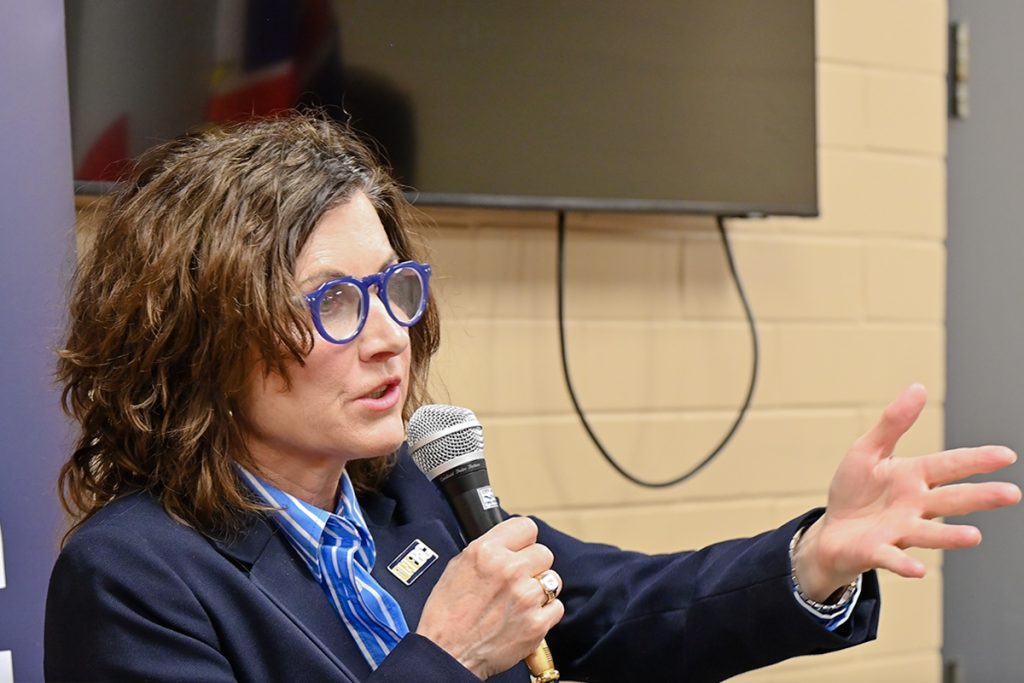
OneBC Leader Dallas Brodie spoke to a packed room of more than 100 people at the Beban Park Social Centre in Nanaimo on March 3.
The MLA for Vancouver-Quilchena declared her party’s opposition to what she sees as the expansion of Indigenous rights and Aboriginal land title in B.C.
For two hours, Brodie worked the crowd, proposing radical steps to the land question — including repealing the federal Indian Act, abolishing the reserve system, and making First Nations regular municipalities under the authority of the province.
Such views are increasingly common in the province after B.C.’s Supreme Court ruled that a group of Cowichan First Nations still held title to 7.5 square kilometres of land around a former village in Richmond last August.
An Angus Reid Institute survey last October found two-thirds of British Columbians believe the ruling was “serious because it could impact private property rights,” and nearly half think the province is “too focused on reconciliation” with Indigenous people.
‘Swayed by the fear-mongering’
In her talk, Brodie repeated her previous claims that the ruling invalidated the fee-simple title to those Richmond landowners’ homes.
But claims “that a declaration of Aboriginal title will destroy the land title system,” the B.C. Supreme Court justice in the case ruled, “is not a reasoned analysis on the evidence. It inflames and incites.”
The justice also declared plainly: “The property rights of the private landowners are not undermined.”
But the popular perception that the ruling did do just that has created uncertainty in the housing market — and values for people’s homes in the area have fallen, even in parts of Richmond not directly named in the court ruling.
Sean Carleton, a historian and Indigenous studies scholar specializing in the study of residential “schools” at the University of Manitoba, told The Discourse that whipping up fear and misrepresenting the outcomes of the recent court ruling is part of the political strategy for the B.C. Conservatives and OneBC.
“Most people don’t know that treaties weren’t signed [in B.C.],” he said. “They don’t know about the history of the reserve, the way in which reserves were set up in British Columbia.
“They don’t know the deeper conflicts of colonization in the province and across the country — and as a result, they’re more easily swayed by the fear-mongering.”
While popular sentiment towards Indigenous land issues has clearly shifted in B.C., several of Brodie’s remarks in Nanaimo veered into more extreme rhetoric.
“Go to the reserve — they’re living in squalor, some of them, no pride in ownership and no help,” Brodie told the crowd. “And anybody who tries to complain is penalized by the council; they lose their job at the office, or they get their hot water turned off, or their welfare check isn’t given to them, or whatever it is.
“It’s just horrible. So what would you do? I’d probably feel like drinking, too.”
Wyatt Claypool, the party’s communications director, said that it would be “quite offensive to try and ignore the problems facing First Nation British Columbians in reserves by claiming our statements contain racist stereotypes,” in an email to The Discourse.
He said that Brodie regularly hears from people living on reserves about “issues the band councils refuse to address.”
While such views may seem fringe to many British Columbians, Brodie was elected to the provincial legislature as a member of the B.C. Conservative Party.
It came within two seats of winning a plurality of seats in 2024, and then-leader John Rustad appointed Brodie as his critic for the Attorney General.
Eventually, however, Rustad removed her from his caucus following a tweet in which she said, “The number of confirmed child burials at the former Kamloops Indian Residential School site is zero. Zero. No one should be afraid of the truth. Not lawyers, their governing bodies, or anyone else.”
The Union of British Columbia Indian Chiefs called Brodie’s comments at the time as “racist residential school denialism” and called for a public apology.
Brodie then appeared on a podcast, on which she mocked survivors of residential “schools” using a child-like voice.
Exiled from her former B.C. Conservative caucus, Brodie went on to form a new political party, OneBC, which she founded with Kelowna-Lake Country-Coldstream MLA Tara Armstrong, who herself had resigned from the B.C. Conservatives to protest Brodie’s removal.
In December, Armstrong left OneBC after an internal leadership struggle briefly saw Brodie ousted as its leader.
Both Brodie and Armstrong now sit as independent MLAs, costing OneBC official party status in the legislature.
(After The Discourse published this story, Claypool emailed to state Brodie’s remarks were taken out of context by the B.C. Conservatives, and insisted she was not mocking survivors but “post-modern people citing subjective ‘truth,’” adding, “the OneBC team have been calling this out as a lie for an entire year.”)
‘Backbone of B.C.’ speaking tour
Earlier this year, Brodie embarked on what she called a “Backbone of B.C. Tour,” appealing to the alienation smaller communities may feel towards the provincial power centres in Vancouver and Victoria.
Past tour stops in Sorrento, Creston and Vancouver attracted protests, and a small number of protesters were denied entry to the event in Nanaimo.
Her stop in Nanaimo was organized by Stephen Welton, the People’s Party of Canada candidate in the 2021 and 2025 federal elections.
Welton described Brodie as a “fellow traveller,” even though he said he is not a OneBC party member himself.
The Nanaimo meeting reached capacity, and organizers turned away people who had not pre-registered.
Those turned away included a small group of people wearing orange shirts bearing the slogan “Every child matters,” in memory of residential “school” survivors.
One of those OneBC opponents was Howard Breen, a local activist with Extinction Rebellion Nanaimo.
He told The Discourse he wanted to attend “to witness the racism that is filling that room right at the moment.”
Breen said he found it “repugnant” that a city-owned venue was being used for the meeting.
Marsha Flad also attended to protest the tour stop, and stood outside the room holding a sign reading, “City hall endorses racism.”
She said she was concerned that the OneBC meeting would “escalate the problem” of racism, and the impact it has on Indigenous women, including sexual violence. .
Juanessa Prince, who lives in Nanaimo and is originally from the Sucker Creek First Nation in Alberta, said her grandmother went to residential “school.”
To her, Brodie’s remarks were “offensive” and “disrespectful.”
She shared others’ disappointment in the city for allowing the meeting to take place at Beban Park.
“To not say anything about it or acknowledge it, I think, is going to bite them in the ass come the mayoral election,” she said.
Nanaimo Mayor Leonard Krog told The Discourse the idea the city would deny space to an elected MLA would be a “form of fascism.”
“I thought we fought a Second World War to ensure that fascism didn’t triumph,” he said.
Carleton told The Discourse that Brodie appears more interested in creating online political content than engaging in good-faith dialogue.
“When you scratch the surface, they’re not people that are just concerned about the truth about residential schools,” Carleton said. “They’re engaging in the content production of this material for very deliberate and concerning objectives.
“They’re monetizing misinformation. They’re profiting from anti-Indigenous racism.”
The Discourse attended the OneBC town hall to document what was being said and fact-check some of the key points made by Brodie at the meeting.
Aboriginal title and property rights
One of the major topics Brodie talked about was the recent Rights Recognition Agreement between Musqueam Indian Band and Ottawa, which recognized Musqueam rights and title within the nation’s ancestral territories.
Brodie told the audience, “The Musqueam Indian Band has been given title over the entire Lower Mainland.”
In fact, the Musqueam were not actually “given” title by Canada.
Rather, the agreement declared that the First Nation instead held “unextinguished Rights and Title within the Musqueam Territory.”
“The existence of Rights and Title within Musqueam Territory is not contingent on recognition by court declaration or any agreement,” states the agreement’s preamble.
Instead, the agreement declares that it “restores life to the Rights and Title of Musqueam” and provides a foundation for reconciliation to “incrementally implementing Musquem’s Rights and Title.”
But Brodie called the agreement “the biggest land grab in the history of Canada.”
A statement from the Ministry of Crown-Indigenous Relations disputed Brodie’s interpretation.
“The recently signed Musqueam Agreements do not affect private property,” a spokesperson told The Discourse in an email.
“Suggestions otherwise are false.”
The ministry spokesperson added that the agreement creates “a path forward” for negotiations — instead of litigation in the courts.
“This more collaborative approach prevents uncertainty and allows us to come to an agreement that respects the rights of Indigenous People, protects existing property rights, and is in the best interests of British Columbians and Indigenous People,” the spokesperson wrote.
A message addressed to the Musqueam community from their leadership said the agreement “does not constitute a treaty or land claims agreement.”
Instead, the message emphasized, it sets out a “framework for negotiation” — but does not assign land title over fee-simple private property.
“Musqueam is not using this agreement to go after private property,” the band council letter stated.
Brodie acknowledged this at the meeting, but said she did not believe it.
“The band [is] now trying to backtrack and saying ‘Oh no, no, we’re not coming for your private property, we promise,’” she said.
“Well, I call BS on that.”
Musqueam council also addressed the backlash that news of the agreement generated.
“Council also acknowledges how tough it has been this week to see the negativity and racism that has come from misrepresentation and misunderstanding,” the First Nation’s elected council stated.
“While we recognize that false information about Musqueam claiming private property created unnecessary anxiety in people, there is never a place for racism.”
The agreement declares that “Aboriginal title is an inherent right and a legal interest in land,” as recognized by the Supreme Court of Canada.
And it emphasizes it includes an “inescapable economic component and the right to participate in decisions about the use and development of territory.”
The agreement pledges Musqueam and Canada will work together to develop “processes for shared decision-making, revenue, benefit sharing and dispute resolution.”
Abolishing Truth and Reconciliation Day
One of Brodie’s key talking points in the meeting is what Carleton calls “residential school denialism.”
Carleton told The Discourse that “residential school denialism is not people who deny that residential schools existed.”
“In fact, many residential school denialists even acknowledge that there were harms and abuses that happened in the school,” he explained.
“So that’s not the denial that the system happened or that it had bad characteristics.”
Instead, like other types of misinformation — including climate change denialism — the strategy is one of “distorting, downplaying, minimizing basic facts about something to open space for counter-narratives to grow and push back on emerging consensus,”Carleton argued.
“What residential school denialists are doing is questioning certain aspects of the residential school narrative to shake people’s confidence in why the system was bad, the damage that it caused, and why healing and moving towards reconciliation is important,” he said.
Claypool said Carelton “sounds more like a left-wing activist than an actual historian,” and that “the label of “denialism” or “denialist” has been thrown around a lot to try and scare people.”
One point Brodie made at the event was federal funding for Tk̓emlúps te Secwépemc to investigate the 215 possible graves the First Nation announced it found with ground-penetrating radar in 2021.
On Feb. 12, Tk̓emlúps te Secwépemc released a statement that, between 2021 and 2025, it used ground-penetrating radar, light detection and ranging (LiDAR) scanning and dogs trained to identify historic human remains.
Some areas were ruled out as burials, while others are now the areas of focus.
However, there have been significant challenges to getting government and church records that would confirm the identities of the children who never returned home from the school — and which communities of the 38 affected First Nations they belonged to.
With 38 First Nations and 119 communities across B.C., each with its own “cultural and spiritual protocols for how ancestral remains must be treated,” the Tk̓emlúps te Secwépemc say a full consensus on if the site should be preserved as a sacred site or excavated and the remains returned to home communities “may never be achieved.”
Brodie did not mention this update at the meeting, instead choosing to focus on the federal funding, which she claimed was “to dig.”
“All the money was spent and there was no digging,” she told the audience.
Brodie also was critical of a $12.5-million-dollar project for a healing house for residential “school” survivors in the Tk’emlúps te Secwépemc Nation.
“So we’ve got a burial that didn’t happen, and a healing house to heal from something that didn’t happen,” Brodie said to laughs from the audience.
Brodie then called for the resignation of Kúkwpi7 (Chief) Rosanne Casimir and for her to “apologize to Canada for propagating this lie against the citizens of Canada and shaming us all” — and to return the funding to the federal government, to cheers and applause from the audience.
Casimir has called for Brodie’s resignation as an MLA, and says that her conduct undermines public trust and reconciliation.
In November, Brodie had attempted to introduce a private member’s bill that would remove Truth and Reconciliation Day as a holiday in B.C.
But the bill failed to pass first reading — after only Brodie, Armstrong, and Independent MLA Jordan Kealy voted in favour.
It is extraordinarily rare for a bill to fail its first reading, as it is considered a parliamentary courtesy to allow MLAs to place a bill on the order paper — even if the odds of it being debated, much less adopted, are slim
READ MORE: Tk̓emlúps te Secwépemc provides update on burial investigation
Repealing DRIPA and the Indian Act
A major talking point for Brodie was OneBC’s position on repealing the Declaration on the Rights of Indigenous Peoples Act (DRIPA), a position shared by her former B.C. Conservative Party.
DRIPA commits the province to aligning its laws with the UN Declaration on the Rights of Indigenous Peoples, or UNDRIP.
Earlier this year, Premier David Eby promised to amend the Act, after the B.C. Court of Appeal ruled the province’s mineral-rights permit system was not aligned with DRIPA.
“Reconciliation is the business of government-to-government relationships between the provincial government, the federal government and First Nations governments,” Eby said last month. “It is not for the courts to take over.”
A bill to amend DRIPA has not yet been introduced to the legislature. First Nations leaders have criticized Eby’s promise, saying it could lead to more court cases and economic uncertainty.
But Carleton said if there were a change in government that brought the B.C. Conservatives to power, even they would still have to negotiate with First Nations.
“They’re putting the province at risk when you poison that political relationship,” he said. “It’s a very dangerous game they are playing.
“But they’re more interested in gaining political power than they are at resolving these important issues.”
Brodie promised her party would “demand constitutional reforms to repeal the Indian Act, transform reserves into townships and unite all British Columbians under one law and political framework” — acknowledging these reforms are outside provincial control.
During the town hall Brodie said the “next step” would be “along the lines” of what Alberta Premier Danielle Smith has done — demanding the federal government amend Section 35 of Canada’s Constitution, which protects Aboriginal and treaty rights.
“That’s where it’s all coming from, these horrendous judgements out of our courts and the politicians going along, just cowardly,” Brodie said.
However, just a few days after the town hall, Premier Smith rose in the Alberta Legislature and said that “we respect that Section 35 is absolutely a section of the constitution that is the highest law of the land” — and that her government is seeking to negotiate other sections in the Constitution that deal with powers of provincial legislatures.
Claypool said that, while amending Section 35 may be a stance unique to OneBC, the party sees Smith’s government as a potential ally, particularly her desire to reopen the Constitution and opposition to giving First Nations a “veto” over resource projects.
“OneBC is the only party wanting to bring individualism to reserves in British Columbia,” he said in an email.
“First Nations British Columbians have been forced to live in a corrupt reserve system where they have no property rights of their own and are being used as props by the reconciliation industry to push land claims.”
An ‘anti-Indigenous a political identity’
Carleton said, as a historian, that anti-indigenous racism “was one of the core pillars of the creation of British Columbia as a settler-capitalist society.”
Nineteenth-century historical figures in B.C. — such as Lt.-Gov. Joseph Trutch and Premier Amor De Cosmos — built their political careers “basically hating on Indigenous people,” Carleton argued.
He said that involved governments “restricting their rights, settling areas without properly signing treaties, and creating stingy reserves that have created the foundation of a lot of the contemporary problems that Canadian courts are pointing out.”
But today, few Canadians know this history, he lamented, which is why he believes politicians like Brodie can gain political momentum by using Indigenous rights as a divisive wedge issue.
Carleton said OneBC has made being “anti-Indigenous a political identity.”
That, in turn, has helped open up space in the public discourse for others on the right, including the Official Opposition B.C. Conservatives, to demand the repeal of DRIPA, too.
“Racists aren’t afraid anymore,” Carleton warned.
What did you think of this story?
Your feedback after we publish a story helps ensure we're always improving our reporting to better serve you
Author
Related Articles
Comox Valley, Nanaimo land trusts raising funds to support Deep Bay land conservation purchase
In a partnership with the Comox Valley and Nanaimo Area land trusts, BC Parks Foundation is fundraising to protect 50 hectares of pristine shoreline in Deep Bay and make it accessible to the public.

Nanaimo Jazz Festival celebrates 10 years with more than a dozen shows in September
Local and international artists to perform on multiple stages in the city at this year’s Nanaimo Jazz Festival.
Snuneymuxw Elder C’tasi:a shares traditional plant knowledge in new book
‘Plant Teachings from my Auntie’ by Snuneymuxw Elder C’tasi:a and ethnobotanist Nancy Turner delves into traditional plants and plant medicine.