
Second Nanaimo Infusion attracts hundreds of health-care workers
Nanaimo hospital ER now boasts a cohort of American nurses, and more want to join them.

On a sunny Saturday afternoon in Nanaimo’s Maffeo Sutton park, Alyssa Clements was one of hundreds of people visiting from the United States for the second Nanaimo Infusion event.
She was at an information table — staffed by American health-care workers who recently immigrated to Canada and are working in B.C’s public health-care system — and was peppering the volunteers with questions about what it is like to work as a nurse in Canada.
“I think I was American by birth, Canadian by heart,” she told The Discourse.
The viral tourist event that started online and attracted hundreds of American visitors to Nanaimo last year was even bigger this year, filling Maffeo Sutton Park.
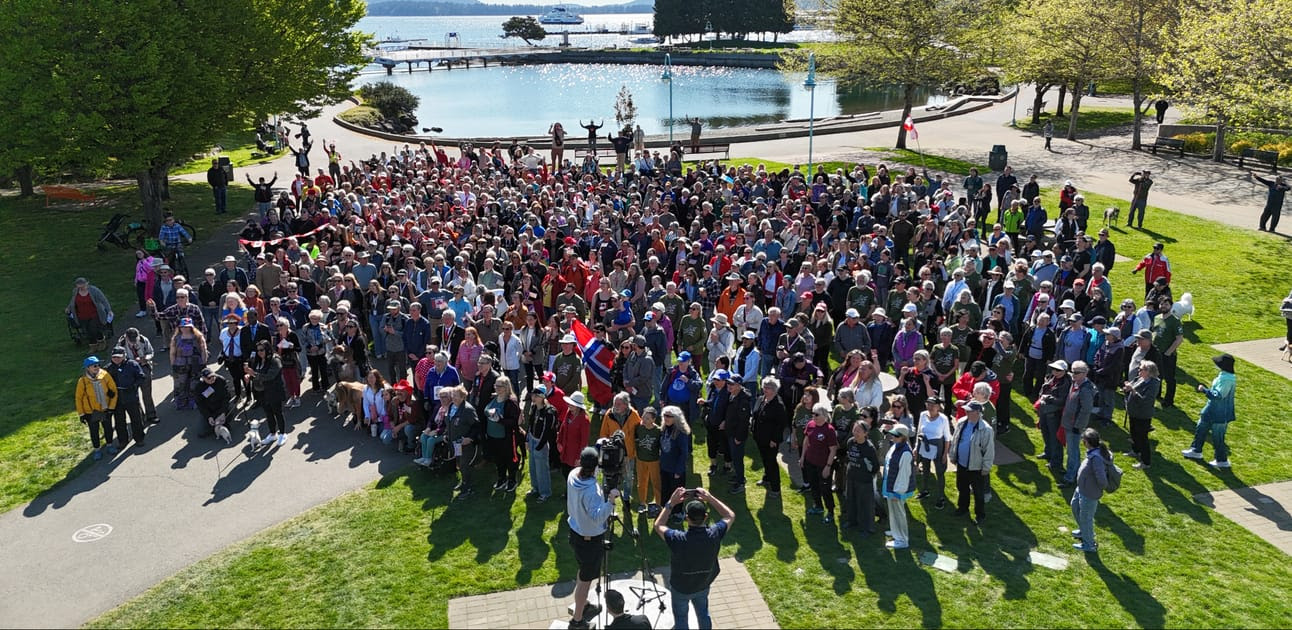
Event organizer Tod Maffin said the Nanaimo Infusion had more than 600 confirmed visitors attend, roughly double the number from the previous year, and that number didn’t count people who just showed up without filling out a voluntary registration form.
Standing on the Lion’s Club Gazebo in Maffeo Sutton Park on Saturday, Maffin looked out over the crowd of people who had shown up for the “family photo” portion of the event.
“Holy crap, there’s a lot of you,” he said.
The first Nanaimo Infusion took place as a response to United States President Donald Trump’s tariffs and was a way to support Vancouver Island’s economy, but the focus of the event shifted this year.
“It feels more like a celebration of B.C. and the Island,” Maffin said.
B.C. Premier David Eby welcomed the American visitors at Maffeo Sutton Park saying that he met a U.S. health-care worker and a teacher who were visiting from Seattle.
“Late check out is available,” the premier joked. “Stay as long as you want. We have lots of room for you.”
Eby told the crowd that the political tensions between the United States and Canada is not a fight between Americans and Canadians and events like the Nanaimo Infusion help bridge the divide between the two countries.
After last year’s tourism event, Maffin started the Healthcare Infusion to attract American health-care professionals to Nanaimo. It’s a volunteer-driven movement that has spread across Canada to connect American health-care professionals with those in Canadian communities facing health care shortages.
Maffin’s wife, Jocelyn, is paraplegic and has undergone 24 surgeries in her life, so the shortage of medical specialists on Vancouver Island is something that directly affects their lives.
Originally, their goal was to try and attract one U.S. nurse to move to Nanaimo but Maffin estimates that close to 50 have made the move since he and his wife started the Healthcare Infusion a year ago.
According to the B.C. Ministry of Health, a total of 141 U.S.-trained health-care professionals have accepted jobs with Island Health as of February, the highest number of any health authority in the province. More than 500 have taken jobs across the province.
“Vancouver Island really became known as a place where health-care workers are really welcomed by the community,” Maffin said. “We will turn over trucks to get people what they need to make the decision to come.”
Nanaimo’s Healthcare Infusion inspired people in other communities to start their own chapters and there are now 40 similar groups across Canada.
“The world needs a lot more Tod and Jocelyn,” Premier Eby told the crowd to applause.
The Discourse spoke with three American health-care workers who have either moved to or are looking to move to Nanaimo.
Shane Tyson, RN at Nanaimo Regional General Hospital’s emergency department
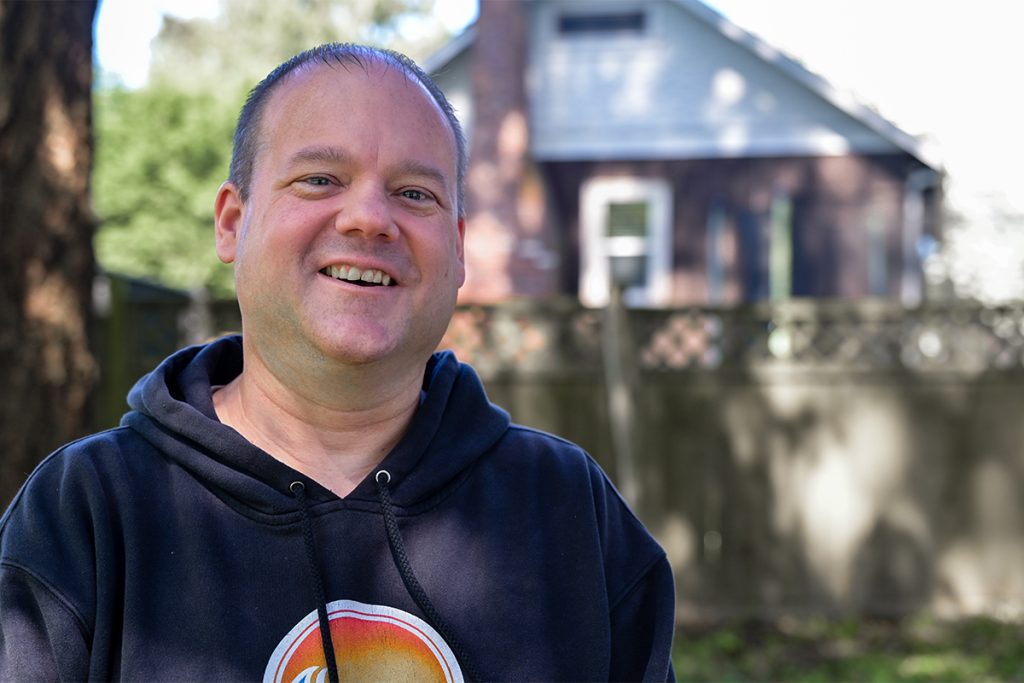
Shane Tyson is a registered nurse who moved to Nanaimo from the state of Minnesota in January, just one week before intensive care nurse Alex Pretti was gunned down in the streets of Minneapolis by agents of the Immigration and Customs Enforcement (ICE) agency.
“My texts were blowing up from people back home,” Tyson told The Discourse. “[That] definitely was an emotional moment and made me realize that I had definitely made the correct decision getting the heck out of there.”
Tyson works in the emergency department of the Nanaimo Regional General Hospital, one of a cohort of U.S. nurses in the department who now call Nanaimo home.
Every Sunday, Tyson gets together with other U.S. health-care workers living in Nanaimo for a walk. On the Sunday following the shooting of Pretti, it was what they talked about.
“All of us felt a lot of hurt and anger at the same time about what had happened to Alex and what was going on in Minneapolis,” Tyson said. “[It is] basically a government occupation of the city that I loved.”
Tyson worked as a paramedic in Texas before retraining as a nurse and had job offers in both Nanaimo and Fort St. John in Northern B.C.
He picked Nanaimo after doing a long road trip to see both communities but decided that he “liked the vibe” in Nanaimo better.
He said there are differences between working at the Nanaimo hospital and a hospital in the United States, such as not having access to a 24-hour pharmacy and a higher nurse-to-patient ratio than he was used to working.
“Sometimes when I’m working on one of the units, we’ll have up to six patients for one nurse that are pretty sick people,” he said. “In the States, usually three to four was about the most we would have per nurse. So it’s a bit of an adjustment, but as staffing is getting better, the ratios are coming down.”
One thing he said is better in Canada is that there are rules about how many consecutive hours a nurse can work. In the United States, it was common to have eight, 12-hour shifts in a row. The most a nurse can work here is six shifts before taking at least 24 hours off.
“The management truly seems to care about their employees,” he said. “Checking in and seeing how things are going.”
Tyson was initially a little worried about anti-Americanism in Canada when driving with Minnesota licence plates until one day when he parked at Country Club Mall about a month into living in Nanaimo.
“I came back out and someone had put a note and a Canadian moose sticker on my vehicle,” he said. “The note said, ‘Welcome to Nanaimo. So sorry what the mango Mussolini is doing to your home state.’ It definitely made my day and made me realize I’m going to be okay here.”
Tyson said he doesn’t think damage to the relationship between the United States and Canada will be undone in his lifetime.
“It’s just really unfortunate,” he said. “It’s not the same country that I grew up in and lived in for 53 years.”
Kelli Portnoy, RN at Nanaimo Regional General Hospital’s medical admissions unit

Kelli Portnoy grew up in Wisconsin being told that Americans are “number one,” but she said the past year has changed that for her.
“When ICE [Immigrations and Customs Enforcement] started coming and taking our neighbours for reasons that are just invalid it broke my heart. It was incredibly sad and I felt very powerless,” she told The Discourse.
Then the Big Beautiful Bill passed, gutting funding for health care and Medicare in the United States and increasing spending for Immigrations and Customs Enforcement.
The American Medical Association said the impact of the bill will “reverberate for years” with less accessible health care that will mean patients don’t see a doctor due to cuts to Medicaid.
“It will make it harder to access care and make patients sicker. It will make it more likely that acute, treatable illnesses will turn into life-threatening or costly chronic conditions,” a statement from the Association said. “That is disappointing, maddening and unacceptable.”
For Portnoy, the changes made working in a private health-care system in Arizona even worse.
“The moral injury that I felt working in a for-profit health-care system was soul sucking,” she said. “It was soul draining.”
She said she doesn’t feel that way working in the Nanaimo Hospital’s medical admissions unit.
“I feel like I’m actually making a difference,” she said. “I feel like I’m actually helping people here, and I don’t worry about whether or not my patients are going to be able to pay the bill.”
Portnoy said a Memorandum of Understanding between the BC Nurses Union and the province on improving nurse-to-patient ratios is making progress. She noted that the states with similar ratios in the U.S. are seeing better patient outcomes.
The nurse-to-patient ratios are being phased in, starting with acute care with one nurse to four patients in general medical and surgical units and one nurse to one patient in intensive care units.
Emergency departments are covered in phase two of the process and sets the ratio at one nurse to three patients for general emergencies and a one-to-one ratio for trauma and critical care patients.
“B.C. is working towards hiring more nurses in order to be able to accommodate those ratios. So we’re getting better,” she said. “It’s not perfect, and there’s definitely room to grow, but we’re moving in the right direction.”
On Saturday, Portnoy was busy working a table in Maffeo Sutton Park with Tyson and other colleagues who were eager to tell visiting American health-care workers what it’s like to work in Canada.
She said the people she met were interested in talking with those who already made the jump and immigrated to Canada. She said they had a lot of questions about the process.
Alyssa Clements, RN from New York

One of the visitors who spoke with Portnoy was Alyssa Clements, a registered nurse from the upstate New York area.
She is already licensed to practice nursing in B.C. and was in town to attend an open-house at the Nanaimo General Hospital and do an interview for a position on the medical-surgical floors.
Like her colleagues, she was worried about ICE entering hospitals in the United States and harassing patients and health-care workers who are trying to provide people with care.
“As nurses, we’re protective of our patients. We advocate for them. And that worry is just always on our mind,” she told The Discourse.
She said the infusion has given her the opportunity to share frustrations with the American health-care system and the state of the country.
“It’s been so nice to be in the company of other Americans who have similar anxieties, similar feelings,” she said. “It’s very cathartic to get together and just vent.”
Clements said she wants to work somewhere that has better nurse-to-patient ratios instead of up to seven complex trauma patients to one nurse.
“I want to pursue emergency medicine, and I want to feel safe while doing it. So I think the time has come to leave the only home I’ve ever known, because it’s not safe anymore.”
The future of the Nanaimo Infusion
Maffin said the Nanaimo Infusion has grown past his capacity, as he does it on a part-time volunteer basis. It has consumed his and Joceyln’s evenings and weekends for the past number of months.
“It’s just too much work for us,” Maffin told The Discourse. “It’s stressful as hell. So we’re hoping that we can connect with a community group that wants to take the tourism part of this.”
In an update after the event, Maffin said he is in talks with an unidentified group that has experience running similar events and hopes to pass the reins to them.
In the meantime, they will be working on creating a Tourism Infusion Playbook to help people in other communities organize similar events.
What did you think of this story?
Your feedback after we publish a story helps ensure we're always improving our reporting to better serve you
Author

Related Articles
Comox Valley, Nanaimo land trusts raising funds to support Deep Bay land conservation purchase
In a partnership with the Comox Valley and Nanaimo Area land trusts, BC Parks Foundation is fundraising to protect 50 hectares of pristine shoreline in Deep Bay and make it accessible to the public.

Nanaimo Jazz Festival celebrates 10 years with more than a dozen shows in September
Local and international artists to perform on multiple stages in the city at this year’s Nanaimo Jazz Festival.

Snuneymuxw Elder C’tasi:a shares traditional plant knowledge in new book
‘Plant Teachings from my Auntie’ by Snuneymuxw Elder C’tasi:a and ethnobotanist Nancy Turner delves into traditional plants and plant medicine.