
Snuneymuxw Elders and local residents oppose rezoning of land near Cable Bay Trail
Harmac officials say development of industrial park is key to economic diversification
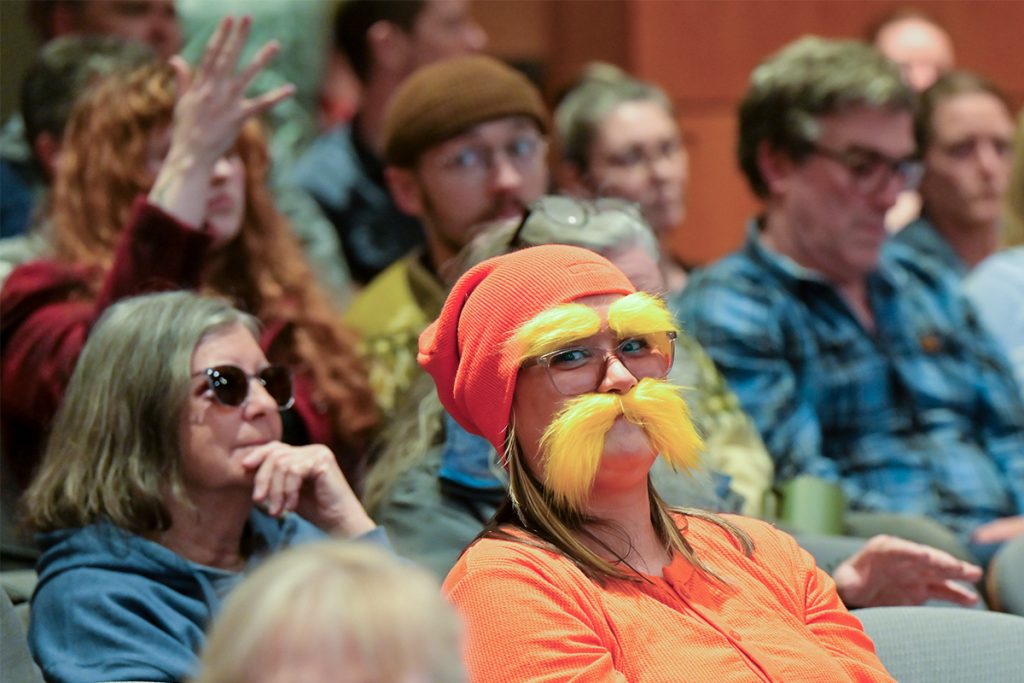
Hundreds of people spilled out of the Nanaimo’s Shaw Auditorium into an overflow viewing area during a lively public hearing on Thursday, April 16.
They were there to share their thoughts and concerns regarding the rezoning of an 86-hectare property owned by Nanaimo Forest Products — that is adjacent to the popular Cable Bay Trail — from rural resource to a mix of industrial and parks zoning.
The 1.9 kilometre trail is located on Snuneymuxw territory and borders the small community of what is now known as Cedar, though most of the trail is within the City of Nanaimo boundary. It is surrounded by private property with Douglas fir forests and rare Garry oak meadows and ends at the ocean where marine wildlife such as sea lions, otters and orcas can be seen.
Nanaimo Forest Products, popularly referred to as Harmac, is proposing to build an industrial park on the property. It is also proposing that an 11-hectare section of the property along the west side of the trail be zoned as parkland for a future parks dedication.
The proposed zoning includes site-specific provisions for agricultural use and commercial greenhouses and would limit heavy industrial use within 100 metres of Cable Bay Trail and 50 metres from the southern lot line (see map below).
The proposal has been met with both alarm and support, with opponents calling for proper consultation with Snuneymuxw First Nation and environmental protections and proponents pointing to job creation and a need for more industrial land in Nanaimo.
Snuneymuxw Chief and Elders oppose rezoning
Among the public hearing attendees was Snuneymuxw Elder C’tasi:a Geraldine Manson.
“The land that this rezoning is happening is land that belongs to the ancestors,” C’tasi:a said as she addressed the meeting.
She said the land is “of the Sarlequun People” — ancestors of Snuneymuxw First Nation — and part of a treaty that was signed in 1854 between the Crown and Snuneymuxw People. The treaty is recognized and affirmed by section 35 of the 1982 Constitution Act and is an agreement to “forever and always preserve and protect Snuneymuxw villages, enclosed fields, waterways, harvesting and gathering and the rights to hunt and fisheries [sic] as they did formerly.”
“We now echo their words,” C’tasi:a said. “The importance of standing strong and protecting the land that they still have. Because the land that was theirs is gone.”
In a letter found on page 110 of the written submissions to the City of Nanaimo, Snuneymuxw First Nation Chief Xumtilum Micheal Wyse writes that “substantial issues remain unresolved” and “any rezoning process that proceeds without meaningful engagement with [Snuneymuxw First Nation] will cause unnecessary conflict and challenges that are best avoided.”
Xumtilum writes that the lands are subject to Snuneymuxw First Nation’s section 35 rights under the Constitution Act, and that Snuneymuxw “Aboriginal and treaty rights and title are directly relevant, material and applicable to the rezoning application.”
According to Xumtilum, the lands are an integral part of Snuneymuxw First Nation’s treaty-protected village sites. He notes that there are multiple archaeological sites within two-kilometres of the land that is up for rezoning. He also writes that the lands are on top of fields that have been cultivated by Snuneymuxw people and used as gathering places, hunting grounds and resource camps.
“The lands carry enduring cultural, spiritual and historical significance to [Snuneymuxw First Nation] despite their historical unlawful alienation from the Snuneymuxw people and subsequent devastation occurring to our catastrophic detriment,” Xumtilum states.
The letter ends with Xumtilum writing that “Snuneymuxw does not provide its free, prior and informed consent for the rezoning application” and that conversations are underway to resolve significant issues with Nanaimo Forest Products and the City of Nanaimo.
At the public hearing, former Snuneymuxw councillor Bill White said the Snuneymuxw Sarlequun Treaty of 1854 drew lines around Snuneymuxw reserves, but the concept of fences and borders was a western concept and Snuynemuxw People had to cross those borders to hunt, fish and gather medicine and materials for ceremonies.
“That small piece of land is basically what is left of our natural territory and it would be an abomination to take that away for more economic development,” he said.
Rezoning proposal includes parkland dedication and zone for ‘limited industrial use’
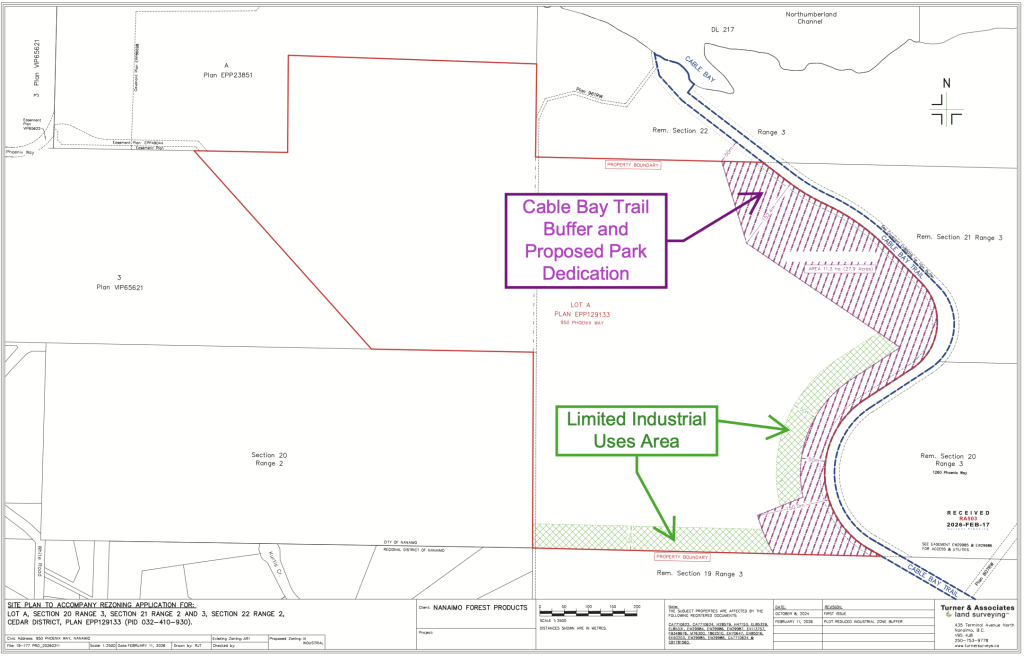
The rezoning proposal seeks to designate an 86-hectare parcel of land located at 950 Phoenix Way from Rural Resource to Industrial and Parks, Recreation and Culture zoning to allow future industrial and agro-industrial development and parkland dedication.
The land was designated for future industrial use in the City Plan, adopted in 2022 (see page 165).
The proposal is for 74.7 hectares to be rezoned as Industrial and the remaining 11.3 hectares along the buffer of Cable Bay Trail to be rezoned and dedicated as parkland. The proposal also includes limits on industrial use within 100 metres of the Cable Bay Trail and 50 metres of the south lot line of the property.
The proposals include site-specific use for farm buildings and housing for temporary farm workers.
The city staff report said the property “has areas of high archaeological potential” and that an Archaeological Overview Assessment and Archaeological Impact Assessment were submitted as part of the application.
The conditions of the rezoning include a Community Amenity Contribution of $4.4 million — including $2.1 million worth of parkland — restrictions on access to the property, following recommendations in the environmental assessment and providing a “detailed biophysical assessment prior to land-altering activity.”
The need for more industrial land and good-paying jobs
Paul Sadler, CEO of Nanaimo Forest Products, said that while Harmac is best known as a mill, in recent years it has also become a green power generator producing enough electricity for 25,000 homes. He said the company has been working to diversify its operations to help buffer the volatile pulp industry and wants to build an industrial park on the property to attract businesses such as sawmills or those that can use the energy that the mill produces.
“We are not the evil empire. We are responsible local owners and operators. We have proven that industry, industrial activity and environmental sustainability can coexist.”
Sadler said Harmac pays $2.6 million in taxes to the City of Nanaimo each year and pays $200 million in wages.
Toby Seward from Seward Developments, and the agent for Nanaimo Forest Products, urged council to approve the rezoning application saying that there is not enough industrial land for the demand in Nanaimo.
“Many companies wish to locate to the central Island with well established transportation networks and a large and experienced workforce,” he said.
Seward said much of the land has been previously logged and the company is working with city arborists to protect trees on the property. He said there was a “detailed archeological study” done on the site with representatives from Snuneymuxw First Nation that failed to find “archeological matter” after five days of digging.
Frank Crucil, a director of Nanaimo Forest Products, said he thinks opponents of the rezoning would be happy to see the “shuttering of Harmac, much like Crofton.”
Crucil said Nanaimo Forest Products was given the opportunity to buy the parcel of land to the east of Cable Bay Trail but rejected the idea and suggested that the City of Nanaimo, RDN and opponents should buy that land and turn it into a park.
“The owner is exhausted. The land is untouched.”
He said the purchase of that land for a park would be a “win for all.”
David Mjoen, Environmental Coordinator at Harmac, gave an overview of daily environmental monitoring at the mill and said the company “is committed to maintaining a high standard of environmental management” with the proposed industrial park.
Ryan Prontack, Harmac engineering and maintenance manager, told council that the company plans to create an “integrated forestry hub” with a sawmill closer to the mill site that will produce byproducts that the mill can use in making pulp, with less intense use such as warehousing and logistics on the outskirts of the property.
Steven Newell, founder, president and CEO of Winston Farms, spoke in favour of the rezoning saying his company wants to grow produce for the Vancouver Island market on the site which he said would create 200 to 300 jobs and use waste heat from the mill for its greenhouses.
“We want to be close to our consumers, to reduce the carbon footprint with trucking food miles and have fresher products that taste better,” he said.
Local residents encourage council to ‘listen to our neighbourhood’

A number of local residents who live near the property spoke against the proposed rezoning.
Jeff Wagner lives “500 meters as the crow flies” from the property and said he’s OK with hearing and smelling Harmac because he chose to live where he does and was aware of the surrounding area. However, he said he is not OK with additional heavy industrial zoning that “will multiply those impacts.”
“There’s a difference between accepting existing operations and approving permanent expansion that your own city plan says doesn’t belong here,” he told city council.
He warned the mayor and councillors that the decision they make on the rezoning will “forever” impact their legacy.
“I would encourage you to listen to our neighborhood,” Wagner said.
There were also a number of people who took the ferry over from Gabriola Island to speak to the rezoning application.
Marcus Swift lives on a property he bought six months ago that backs onto the parcel of land in question. He was under the impression that it would be zoned for light industrial use, not the heavy industrial zoning that is proposed. He was not swayed by the presentations by the company, saying that he smells the mill every night and does not think they are good stewards of the land.
“We’ve heard over and over again from the proponents for this that they’re trustworthy and their proof of that is ‘because we said so,’” Swift said. “Well, I’m six foot two inches and 250 pounds and dead sexy because I said so. That’s the level of evidence that’s been presented here.”
Bob Andrew said when he went to Islands Trust about his concerns with the rezoning he learned that the trust does not have any direct say in the decision, despite Gabriola Island being less than two kilometres from the site.
Andrew said he has collected 250 signatures from Gabriola Island residents who are opposed to the rezoning. He said those people are “disenfranchised” and are not being heard.
He said he was also concerned that the proposed buffer around the wetland was not sufficient and worried about the lack of protection for Garry oak meadows.
“I look at it as trading yet another piece of the planet for profit,” he said.
Advocates urge council to Save Cable Bay
Jackie Wasyluk, a resident of Cedar and member of the Save Cable Bay group, told council that she is glad that the previous company that owned Harmac built the trail. “However, proposing to destroy everything surrounding it is not acceptable.”
She said she speaks with people on the trail “almost daily” and that the surrounding forest is “part of the Cable Bay experience.”
Wasyluk said she has woken up to the taste of the mill in her mouth.
“We don’t need more of that,” she said.
Cheryl Bancroft from Save Cable Bay asked why the zoning was for I4 Industrial instead of zoning for high-tech or light industrial. She said Harmac “has been a very good community corporation” and asked that it considers the needs of trail users to come to a balance with the proposal.
Deanna Fourt, a board member of the Nanaimo Climate Action Hub, spoke against the proposal and noted that Nanaimo’s City Plan marked the property as being an environmentally sensitive area.
The staff report notes that if the property is rezoned, subsequent development permits will have to follow guidelines in the city’s Development Permit Areas for Environmentally Sensitive Areas, as well as Wildfire Hazard and Form and Character for industrial development.
Economic development is a choice says Nanaimo Prosperity Corporation CEO
Colin Stansfield, CEO of the Nanaimo Prosperity Corporation, told council members that increasing the amount of industrial land is a key priority for the city’s economic development.
He said cities “don’t drift into prosperity. They choose it, decision by decision, and the most consequential of those decisions are about industrial land.”
Stansfield said people have an outdated idea of what industry is like today.
“This is not yesterday’s industry,” he said. “This is the modern economy, clean technology-driven and essential.”
He also said good paying industrial jobs are needed in the city to help people afford the rising cost of housing.
“If we are serious about affordability, we have to be serious about income,” he said. “Because for many people in Nanaimo, the issue is not access to a trail, it’s access to a job that allows them to stay.”
The public hearing will resume on Wednesday, April 22 at 7 p.m. in the Vancouver Island Conference Centre’s Shaw Auditorium. The deadline for written submissions has expired but people can still sign up to speak at the hearing.
What did you think of this story?
Your feedback after we publish a story helps ensure we're always improving our reporting to better serve you
Author

Related Articles

DRIPA debated in B.C. election on Vancouver Island
The Conservative party of B.C. is promising to repeal the Declaration on the Rights of Indigenous Peoples Act (DRIPA), while other parties argue that would set back relations with First Nations and create economic uncertainty.
Where Nanaimo’s MLA candidates stand on addictions care, family doctors and Island rail
Candidates in Nanaimo-Gabriola and Nanaimo-Lantzville answered three questions from Discourse readers ahead of the Oct. 24 B.C. election.
Nanaimo’s guide to the 2026 B.C. election
What riding am I in? Who are the candidates? When do I vote? B.C. election basics for Nanaimo voters.