
‘It was time we did something about it’: Village site returned to Snuneymuxw First Nation
Old Howard Johnson hotel site purchased by the province and Snuneymuxw First Nation demonstrates the ‘magic of mediation,’ says minister.

The treaty-protected sxwayxum village site in downtown Nanaimo will be returned to Snuneymuxw First Nation, the province announced on July 15.
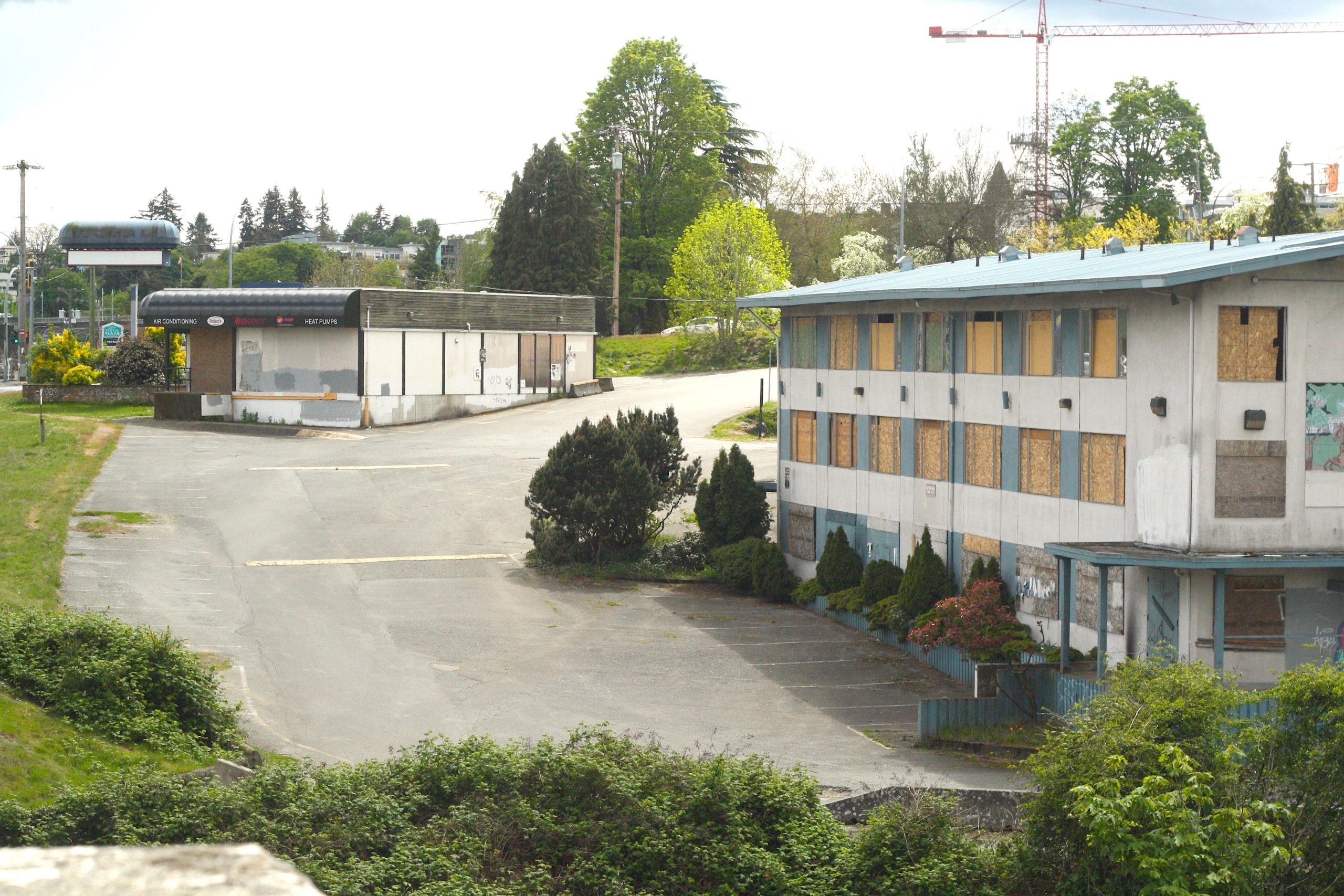
The province and Snuneymuxw acquired the lots currently occupied by the old Howard Johnson hotel, a 2.67-hectare property at 1 Terminal Ave. with adjacent lots on Comox Road and Mill Street, for $28.5 million.
Of that amount, nearly $26 million was contributed by the province, “with the explicit purpose of returning it to Snuneymuxw for redevelopment,” according to a release.
“This is the place where our people have lived for thousands of years, as the first peoples of this land,” said Snuneymuxw Chief Michael Wyse (Xumtilum) at Monday’s announcement at Swy-a-Lana Park, near the property. “Living for centuries before the arrival of the newcomers, here is the place where we had several longhouses, fisheries, medicines, and other cultural and spiritual practices of our people that are inherently connected to these lands.”
When settlers arrived they relied on Snuneymuxw’s existing legal, economic, cultural and legal systems for sustenance and survival, said Wyse. Sxwayxum was also one of many village sites that helped build the local coal mining industry, which “generated tremendous wealth for the province.”
The village site was protected by the Saarlequun Snuneymuxw Treaty of 1854 which promises to preserve the nation’s villages and marine areas for the Snuneymuxw people in perpetuity. Despite this, the Snuneymuxw people were forcefully removed from sxwayxum and the site was put into private hands, said Wyse.

“It’s exactly 170 years ago this year that Governor Douglas sat down with the Snuneymuxw Nation and said, okay, you’re gonna have this village site along the river there — that’s going to be yours going forward. Well, guess what? It wasn’t,” Murray Rankin, Minister of Indigenous Relations and Reconciliation told The Discourse after the event.
“We felt that was a breach of our solemn commitment to the First Nations. And it was time we did something about it.”
The nation was not consulted during the development of site and construction of the former Howard Johnson hotel when it was built in the 1960s, according to Wyse. The Saarlequun Snuneymuxw Treaty also requires the recognition of Snuneymuxw rights when it comes to proposed developments on village sites.
More recently, the land was slated for development by Victoria-based developer Oakwood Park Estates. A rezoning application for the property passed third reading by the city several times, but that was then rescinded and submitted for review when Snuneymuxw First Nation repeatedly raised objections to the process, stating the city was “reverting to colonial and extinguish-based approaches to working with the Snuneymuxw people.”
In July of 2023, the province intervened and appointed mediator Lorne Brownsey, a former deputy minister of Aboriginal affairs, to attempt a negotiation of “mutually agreeable understandings” between all the parties.
“This would be a potential breach of the [Saarlequun] Treaty. And so we are responsible, as the Crown, to ensure we do everything we can to avoid breaching solemn commitments,” says Rankin. “I don’t care how long ago they were made.”
That process appeared to be in jeopardy when during a city council meeting on March 18 Jeremy Holm, the city’s director of development and planning stated that the landowner’s representatives had withdrawn from the facilitation process with the province.
However on April 30, negotiations seemed to be back on track when Minister Rankin informed The Discourse that the province was in the midst of “very productive discussions” with the developer.
“The magic of mediation has facilitated a resolution that worked for everyone. And I think it’s a really positive outcome,” Rankin told The Discourse on Tuesday.
Quoting Supreme Court of Canada Justice Malcolm Rowe, Rankin says he believes that “reconciliation is rarely, if ever, achieved in a courtroom.”
Though litigation is always available to First Nations, especially in light of an injustice or a sense that the government has not acted honorably, litigation is “a zero sum game” in which one party always loses and it’s never certain what a judge is going to find, he says.
“We are trying to find ways where the parties can take responsibility for the outcomes rather than putting it in the hands of a third party — a judge,” he says.
“When parties can forge their own solutions together they’re more durable. Because one side winning and one side losing isn’t usually the prescription for a positive outcome, going forward. Whereas if you construct your own resolution, then people get what they need, not always what they want. That is a way where we can achieve — I think — lasting outcomes.”

In his speech on Monday, Wyse said the city must recognize the nation’s deep spiritual and cultural connections to these lands, and then directly thanked Rankin for his leadership and the province for “remaining steadfast to true and real reconciliation.”
The land return not only honoured treaty commitments “but also support[s] the shared economic goals and aspirations that our Nation has with your government,” he added.
“This is going to be a wonderful economic opportunity for the city, most importantly for Snuneymuxw,” Mayor Leonard Krog told local media after the event. “ And the province has demonstrated once again that it’s committed to reconciliation because, I’m old fashioned, you put your money where your mouth is, and the province has done that today.”
Wyse confirmed the nation has “full intention” to develop the site and current plans for the site include remediation and demolition of the existing derelict buildings as soon as possible, to which the province hascommitted $1 million.
Details as to what that development will look like are still undetermined, he added.
The latest combined assessed values of the properties at 1 Terminal Ave, Comox Road and Mill St is $18.647 million, according to BC Assessment.
The $28.5 million purchase price was negotiated with the seller based on appraisals that also considered the development potential of the property for commercial and residential purposes, according to the province.
“We of course are responsible for the public purse. We got an evaluation from a third party to tell us the value of the property and we acted accordingly,” says Rankin, when asked by The Discourse about the amount paid by the province for the properties.
What did you think of this story?
Your feedback after we publish a story helps ensure we're always improving our reporting to better serve you
Author

Related Articles
Comox Valley, Nanaimo land trusts raising funds to support Deep Bay land conservation purchase
In a partnership with the Comox Valley and Nanaimo Area land trusts, BC Parks Foundation is fundraising to protect 50 hectares of pristine shoreline in Deep Bay and make it accessible to the public.

Nanaimo Jazz Festival celebrates 10 years with more than a dozen shows in September
Local and international artists to perform on multiple stages in the city at this year’s Nanaimo Jazz Festival.
Snuneymuxw Elder C’tasi:a shares traditional plant knowledge in new book
‘Plant Teachings from my Auntie’ by Snuneymuxw Elder C’tasi:a and ethnobotanist Nancy Turner delves into traditional plants and plant medicine.