
What’s going on with the old Howard Johnson hotel site?
Rezoning of village site passes third reading, despite opposition from Snuneymuxw First Nation.

A few weeks ago, a rezoning application for a controversial development plan on the old Howard Johnson hotel site at the intersection of Terminal Avenue and Comox Road passed third reading — for the third time — after a public hearing on April 18.
The land in question is Sxwayxum, a treaty-protected Snuneymuxw village site that was occupied at the time the village was “wrongfully taken from us and given to private owners,” according to Snuneymuxw First Nation Chief Michael Wyse (Xumtilum), in a statement to the city in 2023.
When it was developed into a hotel site in the 1960s, the nation was not involved or consulted, he said.
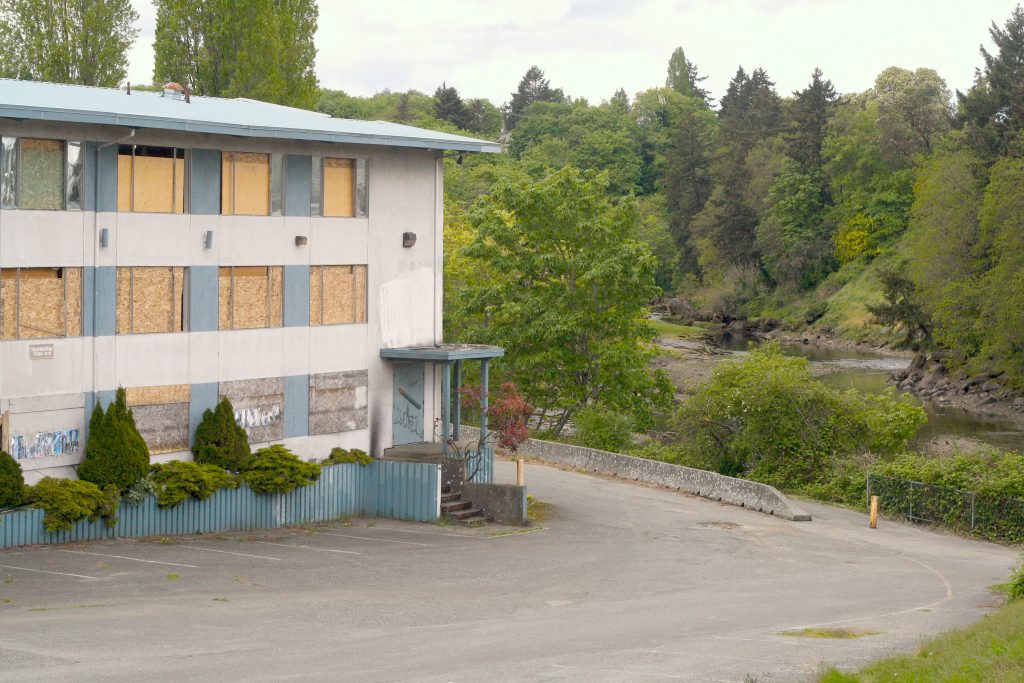
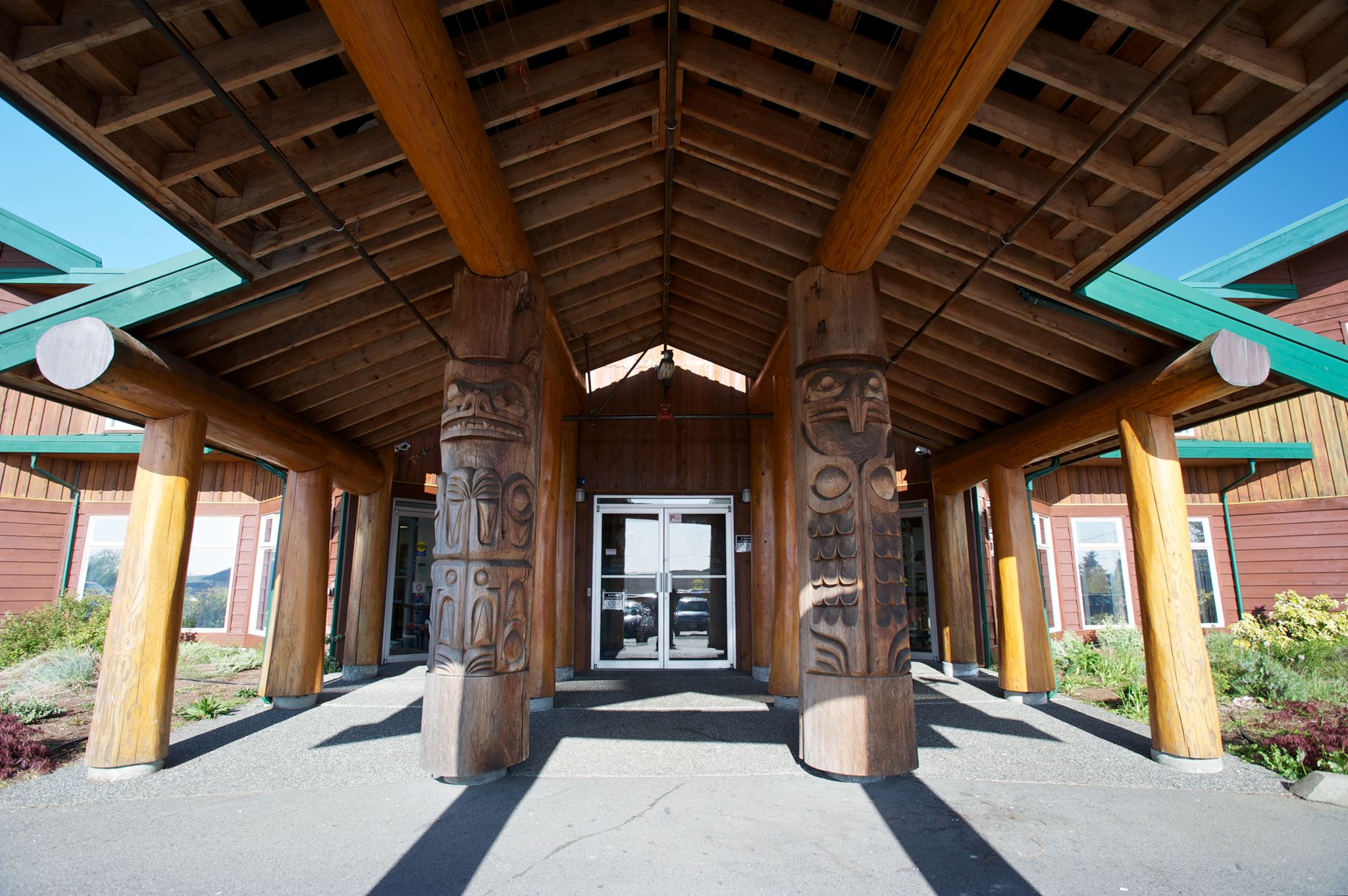
Approximately three hectares in size, the property houses a number of buildings — which included a gym, restaurant and separate plumbing and heating shop — that fell into disrepair following several fires and the shuttering of the Howard Johnson hotel in 2018.
Formerly a thriving hub in a prime location, easily accessible on the way in and out of downtown, over the years it also boasted a liquor store, the Grizzly B’ar nightclub and a Greyhound bus depot, in addition to the 100-room hotel and its outdoor pool.
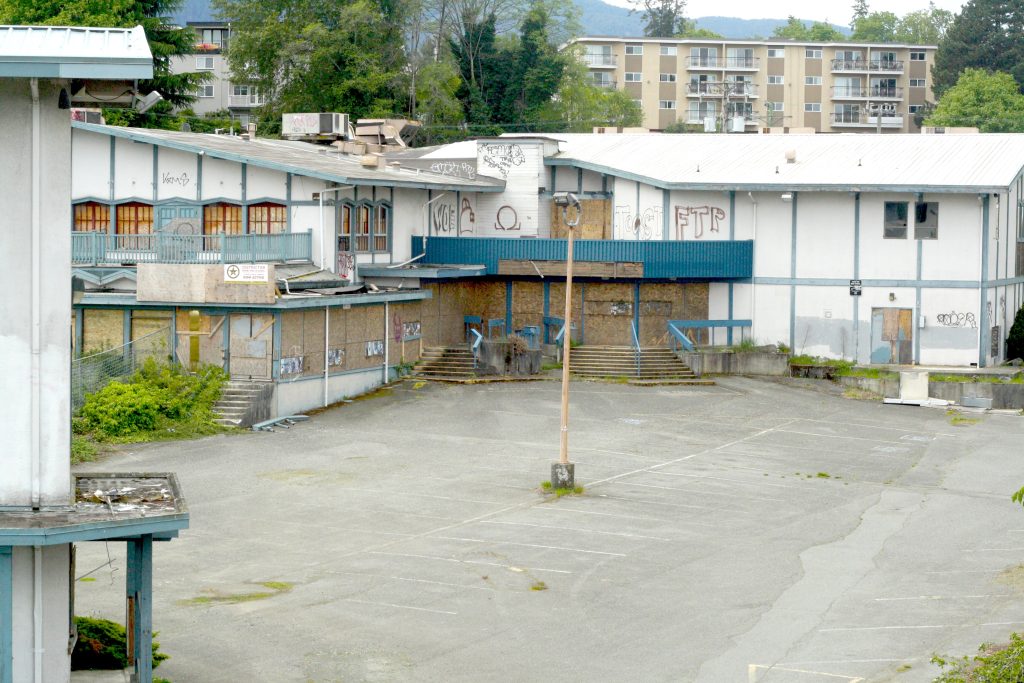
Victoria-based developer Oakwood Park Estates’ plans for the site include a mixed-use commercial and residential development and subdivision with approximately 760 housing units, a hotel, park space along the adjacent Millstone River and a range of complexes that run from five to 16 storeys.
However, the project has also been the subject of vocal concern from Snuneymuxw First Nation since the spring of 2022, when the nation had its first meeting with the project developers. Plans for the site were first unveiled in 2021.
Most recently, Wyse raised new concerns around what he described as a failure to address the environmentally sensitive area at the mouth of the Millstone River, a lack of accounting for the site’s archaeological significance and a failure by the developer to properly acknowledge the pre-colonial history of the site, in a five-page written submission to the April 18 public hearing.
In the emailed submission he again outlined the nation’s position that the rezoning application should be denied, referencing the “substantive arguments” made in prior correspondence with the city that their position was “based upon the rights enshrined within our 1854 Saarlequn Snuneymuxw Treaty with the Crown.”
The nation’s pre-confederation treaty directly affects the site in question. The Saarlequn treaty, though often referred to as a Douglas Treaty after the Crown’s representative Sir James Douglas, “forever and always preserve[s] and protect[s] Snuneymuxw villages, enclosed fields, waterways, harvesting and gathering, and the rights to hunt and fisheries as formerly,” states the nation.
When this treaty was signed, Sxwayxum was “to be protected and kept for the use of the Snuneymuxw people,” said Wyse in a statement released on May 19, 2023, the day after the city held a public hearing during which the rezoning application passed its third reading (this was later rescinded, in a move that was described as “rarely seen” in development applications in B.C.).
In this May 2023 statement, the nation also pointed out that the advancement of the development signified the city had “chosen to conduct business in a way that is expressly inconsistent with its own commitments and agreed-upon government-to-government protocols with SFN,” commitments also outlined in city’s own official community plan, which contains an entire section on truth and reconciliation.
By the summer of 2023, the province had waded into the issue, informing the city they had appointed an independent “fact finder” to try and negotiate “mutually agreeable understandings” between all the parties.
Like all municipalities, the City of Nanaimo’s authority to zone land is set out by the province, so provincial ministries are involved in approving the final stage of rezoning applications.
Ancestral village sites are automatically protected by the B.C. Heritage Conservation Act. According to the province, a protected archaeological site was confirmed on the development properties, which requires that the private developer secure a permit before altering it, and to mitigate damages.
The nation engaged its own consulting company to review the applicant’s archaeological impact assessment and found what Wyse described as “significant concerns” in the tests that were completed by the developer.
These included a potential missed archaeological site due to the shallow depth machine tests used and deficiencies in the assessment around how the developer plans to deal with further archaeological discoveries. In one site 50 metres away, the SFN assessment identified shell middens and two intact burials. In another were “the remains of as many as 10 individuals,” Wyse wrote in his April 18 submission.
So how did the development’s rezoning application pass third reading again on April 18?
While the mediation with the province and SFN was ongoing, the city deferred making any decisions on the site, a move that developer Brad Martin told the Times Colonist in July of 2023 could kill the project and “should send a shiver down the spine of any residential home builder or private property owner.”
The Discourse reached out to Martin, who said he had no comment on the matter at present.
It was unclear what the status of the mediation with the province and SFN was until a March 18, 2024 city council meeting, during which Jeremy Holm, the city’s director of development and planning, revealed that the landowner had “indicated that they have withdrawn from the facilitated process.”
During that same meeting, the city voted to rescind the third reading that had passed the previous May, and proceed to another public hearing on April 18 — where it passed third reading again.
When The Discourse contacted the province to ask what happened, a media representative confirmed that the mediation had concluded, but that the process itself was not complete. The province is aware that the city has moved ahead to third reading, and acknowledged that that was within their jurisdiction to do so, stated the representative, but could not state anything further.
“We are having very productive discussions with the developer,” said Murray Rankin, Minister of Indigenous Relations and Reconciliation, in an emailed statement to The Discourse on April 30.
Sxwayxum, treaty and reconciliation
Prior to signing of the Saarlequn Snuneymuxw Treaty with the Crown in 1854, the SFN’s territory encompassed an estimated core territory of approximately 98,000 hectares. Even though the treaty guarantees the retention of those village sites and the right to utilize the territory and its waterways to hunt and fish as formerly, nation members were eventually confined to six small reserves that totalled approximately 266 hectares — an area smaller in size than the proposed Sandstone development in Nanaimo’s south end.
More recently, though agreements with the federal and provincial governments have returned some land like a 80-hectare portion along Fifth Street and 3,100 hectares on Te’tuxwtun (Mount Benson), SFN remains one of the largest nations in the province with one of the smallest land bases.
Just 10 years after the Saarlequn treaty was signed, a group of chiefs made a speech to Governor Arthur Kennedy, to speak about the theft of their land and the promises made by his predecessor James Douglas that were already being broken.
“We want to keep our land here and up the river. Some white men tell us we will soon have to remove again, but we don’t want to lose these reserves. All of our other land is gone and we have been paid very little for it,” they told Kennedy on Nov. 15, 1864 during his visit to Nanaimo in a translated speech published in the British Colonist newspaper.
“God gave it to us a long time ago, and now we are very poor and do not know where our homes will be if we leave this. We want our land up the river to plant for food. Mr. Douglas said it should be ours and our children’s after we are gone,” they said.
Three chiefs again tried to address the issue in May of 1872.
“Our land should never be taken away from us; and still the white man come and take our land,” stated a petition to the Lieutenant Governor printed in the British Colonist newspaper. “They have lately taken some from our reserve up the river, and it is likely to make our hearts very angry.
“We wish to be kind to the white man, and we hope he will be kind to us and not take our land which we use for planting, as this is all we have to get our food from now.”
The petition also questioned why they were being asked to pay money to build roads for settlers.
“They have taken our land with coal, timber and grass, and we have had nothing in return for it, and now they ask us to make roads for them. Last year we all had to pay two dollars, and if not paid our canoes would be sold to raise it.”
Both the United Nations Declaration on the Rights of Indigenous Peoples (UNDRIP) and the provincial adoption of the Declaration on the Rights of Indigenous Peoples Act (DRIPA) state that “Indigenous peoples have the right to the recognition, observance and enforcement of treaties” and that the free, prior and informed consent of Indigenous peoples needs to be obtained prior to the approval of any project affecting their lands or territories.
Despite this, “we are seeing yet another development being rammed through for this proposed project site that does not involve our people and on which we have not been consulted, after repeated attempts to convene for discussion,” wrote Wyse in May of 2023.
Anticipating a potential conflict, city council directed staff in February 2023 to prepare a report on how the rezoning affected the reconciliation policies within the Nanaimo ReImagined official community plan that had just been completed the previous summer.
The resulting report presented to council argues that the approval of rezoning does not conflict with UNDRIP or DRIPA, and that the policy as stated in the city plan does not “limit the City’s authority to consider a rezoning application.”
“The application actually came in while we were in the middle of preparing our new official community plan, and… there’s no comparable section in the previous OCP,” said Dale Lindsay during his presentation of the report at a Feb. 27, 2023 council meeting. “Our opinion at the time was that the application did comply with the entirety of [the] city plan.”
However, the city had already signed a renewed protocol agreement with SFN in 2019 that required the city to maintain a government-to-government relationship when it moved forward on projects.
From the city’s perspective, as outlined in the report presented to council, neither DRIPA nor the protocol agreement “requires referral of rezoning applications,” though “in the spirit of information-sharing as described by the agreement” it was sent to Snuneymuxw First Nation to review in April 2022.
SFN was also invited into the public hearing process, the report states, and may be entitled to compensation for loss of land that “may have been part of the Sxwayxum village site.”
“If the city approves the rezoning application, the proponent will effectively dismantle the reconciliation-based processes that we have worked hard to put in place. Moreover, it would be a decision made with an engagement process that is incomplete,” wrote former city councillor Bill Yoachim (Sqwulutsutun) when he was acting chief in 2022. “I believe that our hard work does not rise or fall on a developer or personal interests.”
Yoachim stated that SFN first heard about the development in early April of 2022, when it received a referral regarding the rezoning application from the City of Nanaimo. After that point, he said the nation participated in subsequent technical working group meetings with the city, during which issues with the development were raised.
However, Deane Strongitharm of Victoria-based Strongitharm Developments (which represents the property owner), claimed that SFN representatives did not convey opposition to the development, according to minutes from the city’s initial public hearing in September 2022.
Yoachim’s statement to council at the time directly contradicted these claims, detailing how representatives from SFN had communicated “serious concerns” about the impact of the project just prior to an August 29, 2022, city council meeting when they met with the development company for the first time.
Until recently, discussions around what could take place on this property had been a more collaborative process between the city, SFN and other stakeholders, but “serious issues” were created when the nation was not invited to participate in the vision process for this particular project, added Yoachim.
“The City and SFN have agreed to work together on the growth and development of Nanaimo, but the City is reverting to colonial and extinguish-based approaches to working with the Snuneymuxw People, propagating oppressive processes and destructive outcomes,” Wyse echoed in his statement.
“Any attempts to develop this Ancestral village site will be plagued by opposition from our Nation, delays from inevitable archaeological discoveries, and other challenges that are insurmountable without our involvement. By working together, we can accomplish outcomes for the betterment of all.”
Representatives from SFN were not available to speak on the current status of the project, and members of city staff were also not able to comment as the application is between third and fourth readings. At present there is no date set for the consideration of the final adoption of the rezoning bylaw by council.

What did you think of this story?
Your feedback after we publish a story helps ensure we're always improving our reporting to better serve you
Author

Related Articles
Comox Valley, Nanaimo land trusts raising funds to support Deep Bay land conservation purchase
In a partnership with the Comox Valley and Nanaimo Area land trusts, BC Parks Foundation is fundraising to protect 50 hectares of pristine shoreline in Deep Bay and make it accessible to the public.

Nanaimo Jazz Festival celebrates 10 years with more than a dozen shows in September
Local and international artists to perform on multiple stages in the city at this year’s Nanaimo Jazz Festival.
Snuneymuxw Elder C’tasi:a shares traditional plant knowledge in new book
‘Plant Teachings from my Auntie’ by Snuneymuxw Elder C’tasi:a and ethnobotanist Nancy Turner delves into traditional plants and plant medicine.