
Why the City of Nanaimo wants to include Snuneymuxw reserve lands in its boundary
New boundaries will allow people living on the reserves to vote in city elections this fall.
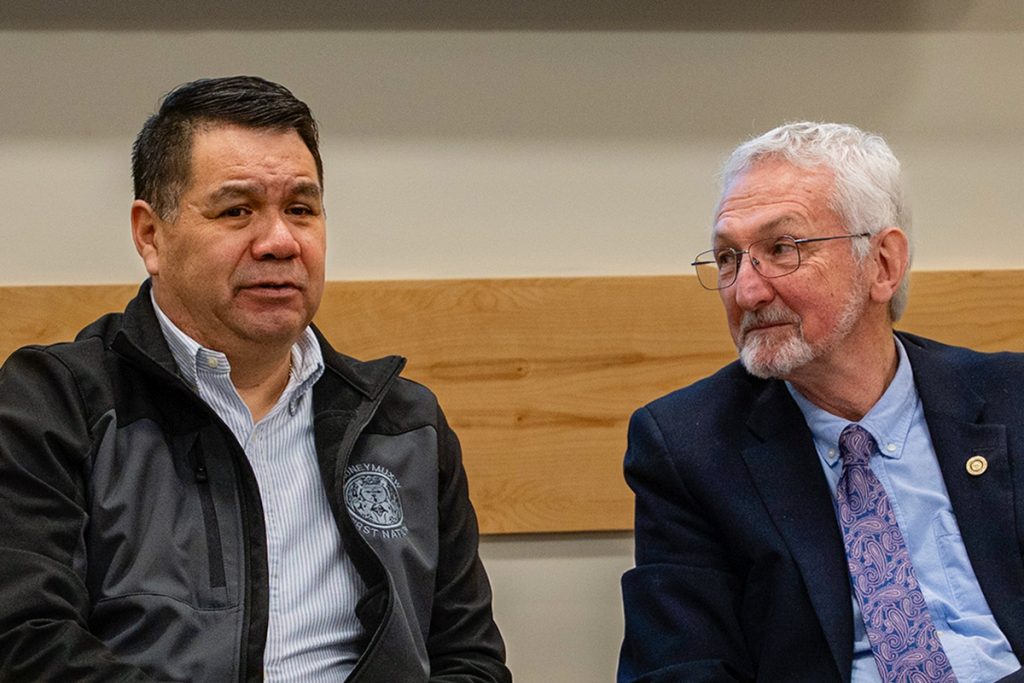
Last week, Snuneymuxw Chief Xumtilum Michael Wyse and Nanaimo Mayor Leonard Krog announced a boundary change proposal to reporters at a press conference held at the city’s service and resource centre.
The proposed changes to the city’s boundaries would include federal reserve lands, taking steps towards repairing some of the historic harms that have excluded people living on Snuneymuxw Reserve lands from voting in civic elections and referendums in Nanaimo.
If the boundary changes are approved, roughly 800 Snuneymuxw members living on the included reserve lands will be able to vote in the upcoming City of Nanaimo elections this fall.
“Today is a historic day,” Wyse said to reporters. “Our people are moving forward and are going to be part of [electing] who we would like to see representing the City of Nanaimo and working alongside Snuneymuxw Chief and council.”
Currently, residents of the Snuneymuxw reserve lands are only allowed to vote for school district and regional district representatives.
“Snuneymuxw is Nanaimo and Nanaimo is Snuneymuxw,” Wyse said at the press conference.
“However, when boundary lines were arbitrarily drawn on a piece of paper, Snuneymuxw was purposely left out of the municipal boundaries, and only a tiny portion was included in the RDN boundary,” Wyse said. “This history created an unfair and unjust disparity among those residing on Snuneymuxw reserves and those who do not.”
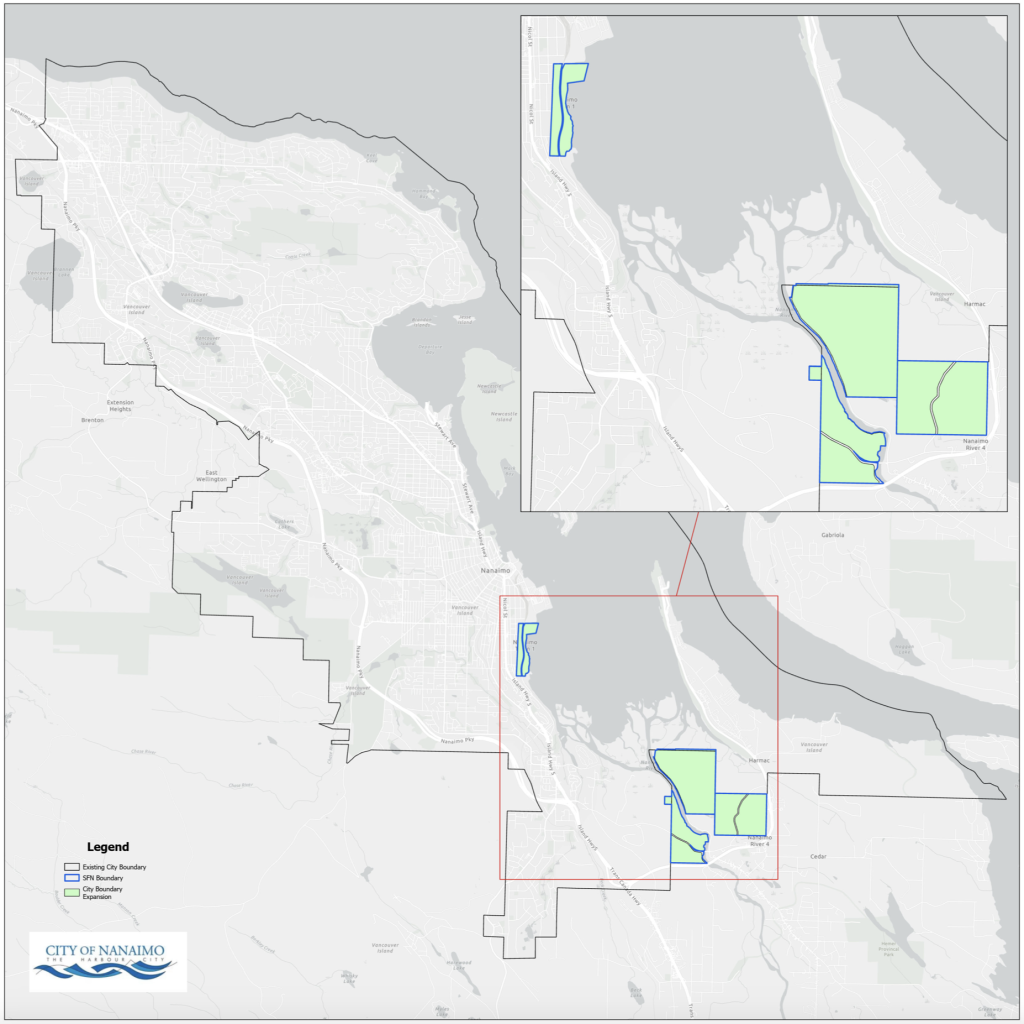
The change of boundaries will include the reserve near downtown Nanaimo as well as the reserve lands by the Nanaimo River, which were excluded from the city boundary during amalgamation in 1975.
“Snuneymuxw members living off reserve have been able to vote in municipal elections and one block over, you can’t,” Krog said, specifically referring to residents of the reserve near downtown Nanaimo.
The boundary change will not affect the ongoing ability of people living on reserve to run in city elections, as one does not have to be a resident of Nanaimo to run for city council.
According to Dale Lindsay, chief administrative officer for the City of Nanaimo, there are many examples of urban reserves in B.C. that are within the city boundary.
He said this is a chance to fix Nanaimo’s historical exclusion of reserve land from the city, calling it “the first” time there has been collaboration “between the nation and the municipality to make sure that this is remedied.”
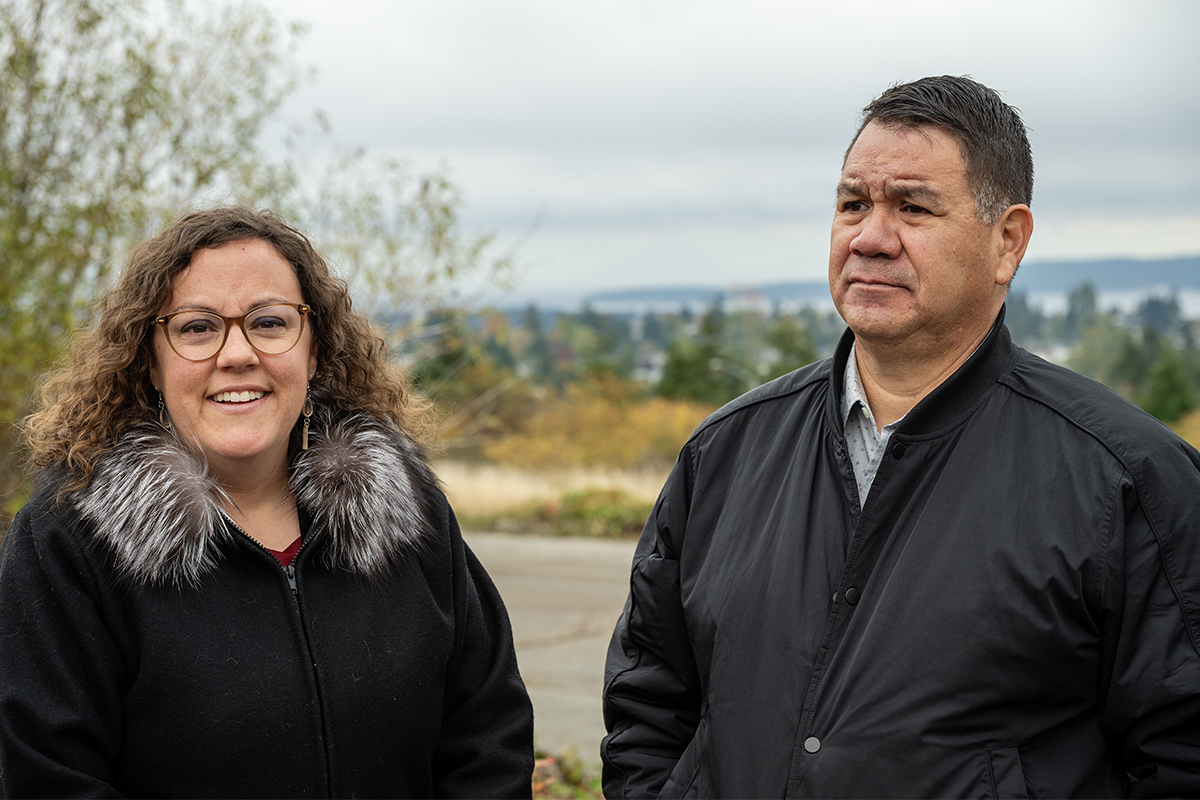
Wyse also said that if housing is developed in the new reserve lands near VIU, those residents will be able to vote in city elections as it falls within the city boundary.
A history of Nanaimo city boundaries
The original boundaries of the City of Nanaimo were set through a Letters Patent signed by Lt. Governor Joseph Trutch in 1875, in response to a petition to create the municipality.
The petition for the municipality included “at least 30 of the male freeholders, householders, free miners, pre-emptors and leaseholders” who had owned property in the area for at least two years and were 21 years of age or older.
The exclusion of reserve lands from the city’s boundary was baked into that first letters patent.
The original boundary for the city started “at the North East corner of the Indian Reserve at the Nanaimo Harbour” and finished by skirting the reserve boundary’s western border and finishing where it started, the letter patent states.
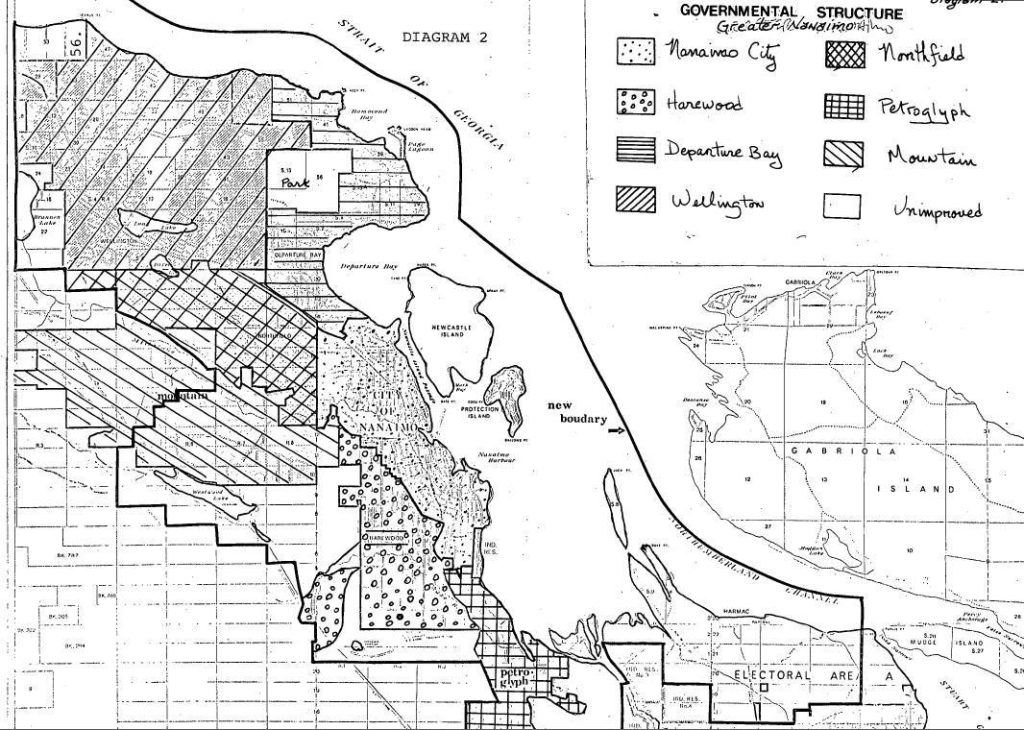
In 1975, the City of Nanaimo amalgamated with the unorganized communities of Wellington, Harewood, Chase River, Northfield, Departure Bay and Protection Island. Those areas became part of the city with a slim 52 per cent majority in a referendum, but the reserve lands remained excluded.
The city boundary was extended five more times since 1975, most recently in 2003.
A history of disenfranchisement
B.C. has a long history of disenfranchisement and discrimination against Indigenous people.
The Qualification and Registration of Voters Act, 1871 barred “Chinese or Indians” from voting in the province. In 1885, the Public Schools Amendment Act barred “Chinese and Indians” from voting in school board elections.
In 1876, the Indian Act gave First Nations people the right to vote but only if they give up their membership in their nation and become British subjects in the eyes of the law. Known as “enfranchisement” this was part of an assimilationist strategy to destroy distinct First Nations.
In 1949, the Provincial Elections Act was amended giving Japanese and First Nations people the right to vote in provincial elections.
It wasn’t until 1960 that First Nations people won the right to vote federally without giving up their status.
“Settler colonialism has only reluctantly allowed Indigenous people a political voice, and only in very circumscribed situations,” Sean Carleton, a historian at the University of Manitoba told The Discourse. “So all of that history needs to be taken into consideration when you know different decisions are made about including Indigenous people in political decisions.”
Boundary change will go to Alternative Approval Process
In order to push the boundary change through, Nanaimo council had the option of holding a referendum or an Alternative Approval Process, which is when electors can submit a response form opposing the change instead of everyone having to vote for or against the proposal.
At its meeting on Monday, Nanaimo city council unanimously chose to proceed with the Alternative Approval Process.
At the press conference last week, Krog said he thinks the Alternative Approval Process is the most appropriate for this question because if residents support the boundary change, no action is required.
“The Alternate Approval Process is designed to save money on issues which I think are obvious or important for the city,” Krog said last week. “So for what it’s worth, I’m prepared to state today, quite simply, that I will support the Alternative Approval Process.”
Krog also said the city will engage in public consultations about the change.
“There will be some elements in our community, sadly, as there are in every community in this country, who have attitudes that are, frankly, not Canadian,” Krog said. “But I am also satisfied that the vast majority of the citizens of Nanaimo will see this as a sensible step to correct an historic anomaly.”
The Alternative Approval Process will open on March 11 and close at 4:30 p.m. on April 13. If 10 per cent of the city’s 79,569 electors sign and submit an elector response form opposed to the boundary change by that deadline, council will have to hold a referendum on the question.
People who live on the reserves will not be able to participate in the Alternative Approval Process as they currently live outside the city boundaries, according to Sheila Gurrie, the city’s director of legislative services.
If the proposed changes gain elector assent, it will go to the province for approval, something Krog hopes will happen before the local elections in the fall.
Property taxes and city services
The boundary changes will not impact the city’s inability to tax federal reserve land.
The city has provided water and sewer services to the reserve lands for years through existing service agreements with Snuneymuxw and the nation operates its on-reserve water and sewer systems. The province provides road maintenance and plowing services.
For water, the city bills Snuneymuxw “based on the metered water rate by other users of the City Distribution System.” A series of bulk meters records the amount of city-supplied water used by the reserves.
“In all cases, the nation pays for water and sewer at a metered bulk water rate, which is about 20 per cent higher than commercial, industrial [and] institutional properties,” Bill Sims, the city’s general manager of engineering and public works told The Discourse in an email.
Sims said the city received more than $110,000 from Snuneymuxw for sewer and water services between November 2024 and November 2025, and has done so “for many years.”
The proposed boundary changes will not allow the City of Nanaimo to regulate land use, zoning or building permits on reserve land within city boundaries.
“There will be absolutely no changes when it comes to land use,” Lindsay told reporters. “The nation will continue to govern their own lands.”
Voting eligibility in B.C.
In B.C., there are two classes of voters who can vote in local elections: resident electors and non-resident property owners.
For resident electors, you must be 18 years or older, be a citizen, have lived in B.C. for six months, be a resident of the municipality or electoral area and not be disqualified under the Local Government Act or any other law.
Non-resident property owners must also be 18 and a citizen but also be the registered property owner of where they intend to vote for at least 30 days and not be disqualified.
Paying property taxes is not a requirement for voter eligibility in local elections.
Students who are studying away from home can choose to vote either where they are going to school or where they usually live.
Both Indigenous and non-Indigenous people living on reserves can vote, but where they can vote depends on if the reserve overlaps with or is adjacent to a regional district boundary.
For Snuneymuxw reserves, this means that people living on reserves could vote for Regional District of Nanaimo area representatives and school board trustees.
Nanaimo city councillor Paul Manly said people on reserve would have to travel to Cedar to be able to vote for a regional director when there was a city polling station just blocks away from where they lived.
“It doesn’t make any sense,” he said.
What did you think of this story?
Your feedback after we publish a story helps ensure we're always improving our reporting to better serve you
Author

Related Articles
Nanaimo Blues Festival brings international headliners and local talent to Maffeo Sutton Park
‘Blues is for everyone,’ says Nanaimo Blues Society president
What to do and where to go during extreme heat events in Nanaimo, the Comox Valley and the Cowichan Valley
A guide to prepare for extreme heat events on Vancouver Island
Snuneymuxw Days shares culture with Nanaimo community
Health and wellness event features sport, traditional games and a feast.