
What is the City of Nanaimo doing to preserve trees?
Urban forests are critical city infrastructure, not just ‘tree hugger stuff,’ say city staff.
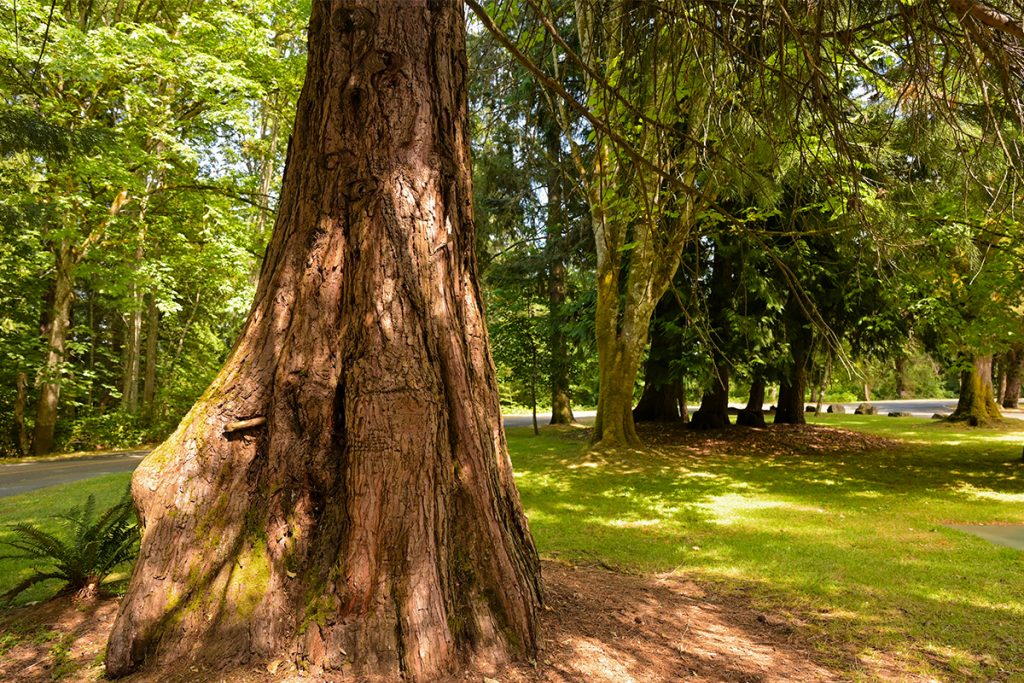
The City of Nanaimo is looking to update its Urban Forestry Management Strategy, while residents and experts are underlining the importance of having trees in the city to help combat climate change and extreme weather such as heatwaves and flooding.
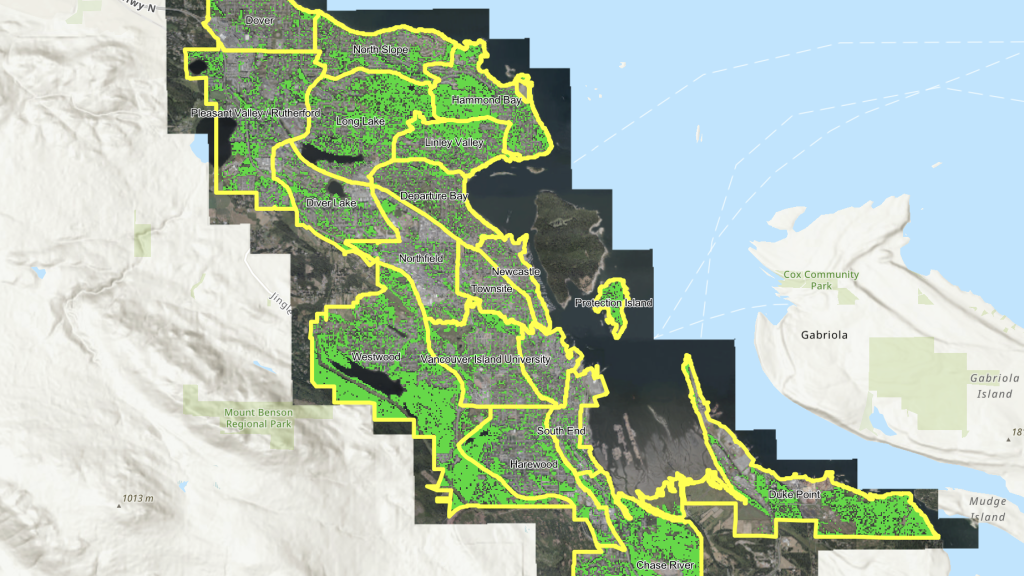
The City of Nanaimo’s current Urban Forestry Management Strategy dates back to 2010 and aims for 30 per cent tree canopy cover in every neighbourhood.
As of 2024, 42 per cent of 19 tree canopy monitoring areas in the city met that target, which has not changed since 2016, even though it forms part of the city’s Climate Change Resilience Strategy.
Charlotte Davis, the City of Nanaimo’s deputy director of parks and natural areas, told The Discourse that two staff reports on updates to the urban forest strategy will be presented at city council’s governance and priorities committee meeting on July 13.
“Trees help cool neighbourhoods on hot days, they can help us store carbon, they provide habitat for animals, it contributes to making our community as a whole much more livable,” she said. “It’s much more than tree hugger stuff, it’s actually important for everyone.”
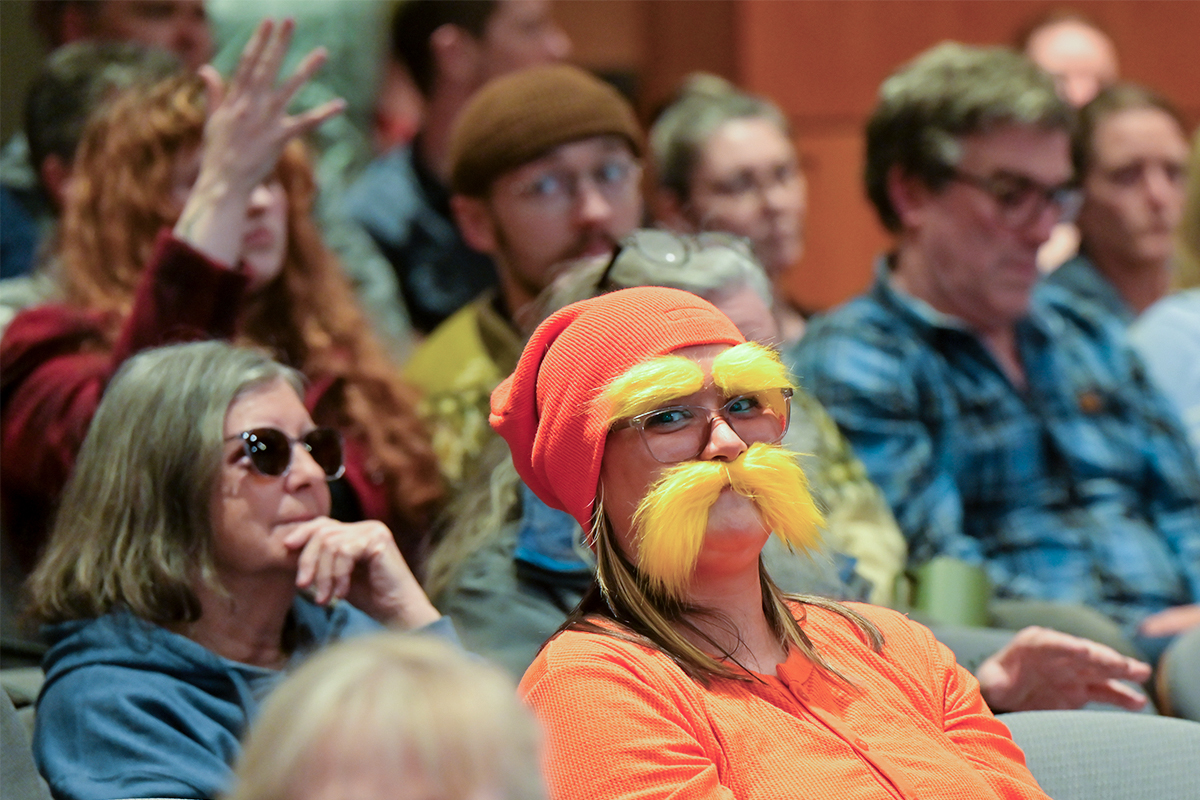
Strong Towns Nanaimo, an organization that advocates for a city “built around people, not automobiles” recently held a panel discussion on the topic at the Nanaimo Harbourfront library bringing together city staff, climate action researchers, community leaders and city staff.
“Trees are crucial public infrastructure for climate adaptation,” said Deraek Menard, environmental coordinator for Strong Towns Nanaimo.
Menard said that the two biggest things that trees do for a city are help cool it down with shade as well as help with storm water management.
Davis said that trees in Nanaimo intercept 277 million litres of storm water annually, helping the city save money that would have to be spent on building culverts and other storm sewer infrastructure.
Deanna Fourt, a climate action researcher with Nanaimo Climate Action Hub, said that trees not only provide shade but evapotranspiration — where trees draw water from the ground and release it into the air — which also provides a cooling effect.
Fourt points to what is known as the 3-30-300 Rule, developed by UBC forest professor Cecil Konijnendijk, which says you should be able to see three trees from your window, your neighbourhood should have 30 per cent coverage with trees and the nearest public green space should be no more than 300 metres from your door.
One example of a high-quality green space in Nanaimo is Bowen Park, where Fourt regularly walks herself.
“I’ll walk down the street and it’s very hot, and then you step 10 metres into the forest and it’s so cool in there,” she said. “We should have a decent sized forest in every neighbourhood.”
Fourt would like to see the city prioritize planting and preserving trees in neighbourhoods where people are less likely have air conditioning, such as older apartment buildings. She also points to school properties as potential sites for more trees.
“If there’s any place where we would want to have the benefits of trees, it would be a school,” she said. “Schools are in most neighbourhoods so that would give a cooling area for all the neighbourhoods too.”

City working to increase tree cover
The city has a tree protection bylaw that has been on the books since 2013 regulating tree removal on private property.
But Menard says the rules are too permissive and allow large trees to be cut with no repercussions.
The bylaw defines significant trees based on their diameter at breast height of 1.3 metres. Large trees, such as Douglas fir, Red cedar and Sitka spruce are only categorized as significant if they are greater than 80 cm in diameter. Trees such as Garry oak, and Western dogwood are considered significant once they reach 10 cm in diameter.
“Get yourself a tape measure out and measure 80 centimeters across, that’s a colossal tree,” Menard said.
A permit is required to remove significant trees or more than four non-significant trees from a private property. But Menard said that if a property owner had four trees of that type that were just under the 80 cm threshold, they could cut them down without asking for permission.
“That’s such a colossal amount of cooling that is being lost in that area because of that,” he said.
There are exemptions to the bylaw for hazardous trees that are endangering other trees or are allowed under development and building permits.
Menard said that Nanaimo needs more housing, but argued that infill developments could both increase density as well as help preserve tree canopy at risk from urban sprawl compared to new single family home subdivisions.
He said that the current bylaw only requires developers to preserve trees on lots that are greater than 0.5 hectares, which exempts most single family homes and smaller duplex or triplex buildings. A single tree is all that is required to be planted on those types of properties.
“It is immensely cheaper and easier to just conserve mature trees than it is to replant them,” he said.
Davis told The Discourse that the city has guidelines for projects in designated development permit areas that provide greater protection for trees in environmentally sensitive areas, such as being near a waterway or wetland.
Breaking Nanaimo’s tree protection bylaw could lead to a fine of up to $10,000.
The City of Nanaimo also offers vouchers for people to buy trees at a discount that they can plant on their own property.
Making neighbourhoods more livable
One of the new city initiatives is to plant trees along city-owned boulevards, which is already happening along streets in the Old City neighbourhood.
Davis said that residents can ask for trees to be planted on their boulevard and groups of residents can approach the city’s parks department with a request for more trees on their street.
About 11 per cent of city-owned land in Nanaimo is suitable for planting trees, Davis said, and the city is using an equity lens to its urban forest strategy to determine areas that take socio-economic factors such as people who live in older apartment buildings and houses having less access to air conditioning.
“We can make more improvements to people’s lives by improving the environment around them and making it more livable, improving wellness in those areas,” she said.
Davis said she wants to help more people in Nanaimo get behind the idea of planting more trees that “can live out their whole natural lives and become the big beautiful trees we want them to become.”
One of the new city initiatives is to plant trees along city-owned boulevards, which is already happening along streets in the Old City neighbourhood.
Davis said that residents can ask for trees to be planted on their boulevard and groups of residents can approach the city’s parks department with a request for more trees on their street.
About 11 per cent of city-owned land in Nanaimo is suitable for planting trees, Davis said, and the city is using an equity lens to its urban forest strategy to determine areas that take socio-economic factors such as people who live in older apartment buildings and houses having less access to air conditioning.
“We can make more improvements to people’s lives by improving the environment around them and making it more livable, improving wellness in those areas,” she said.
Davis said she wants to help more people in Nanaimo get behind the idea of planting more trees that “can live out their whole natural lives and become the big beautiful trees we want them to become.”
What did you think of this story?
Your feedback after we publish a story helps ensure we're always improving our reporting to better serve you
Author

Related Articles

Nanaimo Jazz Festival celebrates 10 years with more than a dozen shows in September
Local and international artists to perform on multiple stages in the city at this year’s Nanaimo Jazz Festival.
Snuneymuxw Elder C’tasi:a shares traditional plant knowledge in new book
‘Plant Teachings from my Auntie’ by Snuneymuxw Elder C’tasi:a and ethnobotanist Nancy Turner delves into traditional plants and plant medicine.
How is The Discourse’s journalism funded?
And what does it cost to produce The Discourse’s in-depth, independent journalism?