
Why Nanaimo postal workers are striking
Canada Post workers say they want to protect their benefits but the company says it needs financial sustainability.
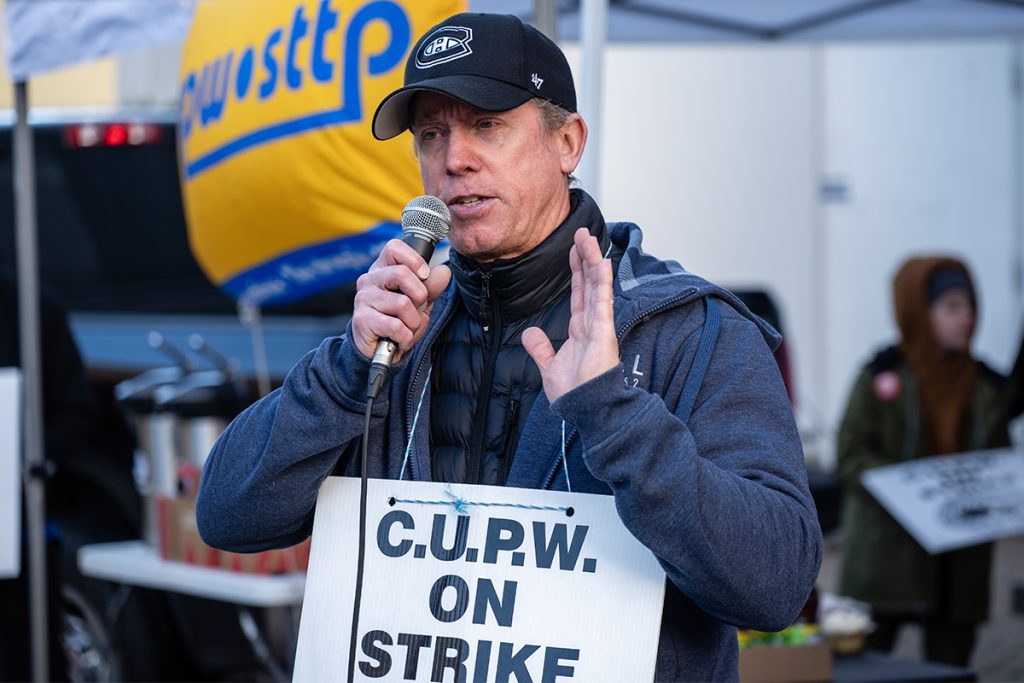
Unionized workers at Canada Post have been on strike since Nov. 15, shutting down mail and parcel delivery across the country.
Last weekend, postal workers held a rally in downtown Nanaimo to address what they say are myths about what the issues are in the strike.
Shane Lorenz, president of Canadian Union of Postal Workers (CUPW) Local 786, told The Discourse that he thinks Canada Post is “holding out” for Prime Minister Justin Trudeau to pass back-to-work legislation.
“I’d like to see the corporation, on their own, come forward with a reasonable offer,” he said. “But if nothing else, I would hope that the minister would put pressure on them to do so, because no one’s winning from this.”
The union’s demands are for wage increases, a cost of living allowance, 10 days of medical leave in addition to seven personal days, an increase of short-term disability payments to 80 per cent of regular wages and improved rights for temporary workers.
One of the main sticking points for Canada Post is the financial sustainability of the crown corporation. In a news release sent on Wednesday, the company said the latest offer from the union “would cost more than $3 billion over four years, at a time when the postal service is already recording large financial losses” and that the company has lost over $3 billion since 2018.
Lorenz isn’t buying that argument.
“The financial crisis that’s being painted in the media by Canada Post is merely fictitious, he said. “They’re spending money that they don’t have on things that they don’t need. It’s just that simple, without going into a lot of details. They’re creating this financial crisis to make it look like the workers are overpaid and don’t deserve what we’re asking for.”
Local president says electric Canada Post vehicles a waste of money
A CUPW fact sheet distributed at the rally claims that “billions of dollars” have been spent on “unnecessary infrastructure upgrades that provide no benefit to the customer or the workers” and have “eliminated many jobs and created unsafe working conditions.”
Locally, Lorenz points to the replacement of gas-powered vehicles with electric vehicles as an unnecessary expense.
“They’re rear-wheel drive and in the rain they’re terrible because there’s so many steep driveways in Nanaimo,” Lornez said. “They’re not really suited for the hilly terrain that we have here on the Island.”
While Canada Post has stopped delivery, other private parcel companies are at capacity but according to Lorenz, they don’t operate in harder to get to communities such as on Protection Island.
When a parcel is shipped to Protection or Gabriola Island on a private courier, Canada Post actually delivers it the final distance.
Lorenz said there are more than 1,200 communities in Canada that no large courier company delivers to.
On Wednesday morning, postal workers briefly picketed Purolator’s distribution hub in Nanaimo. The company, which Canada Post holds a 91 per cent ownership stake in, has taken on additional parcel deliveries that the union says is the work of their members.
Another issue at the bargaining table is the issue of parcel delivery on weekends. The union says that provisions for seven-day delivery already existed in the collective agreement but Canada Post “wants to scrap the current language and hire lower wage workers that have no set schedule and no set hours.”
Lorenz said that currently the contract has full-time workers picking up weekend shifts on overtime.
“I get that that’s not the most feasible way, and we’re willing to negotiate something different, but not what they’re offering,” he said.
North Nanaimo mail carrier cut off short term disability
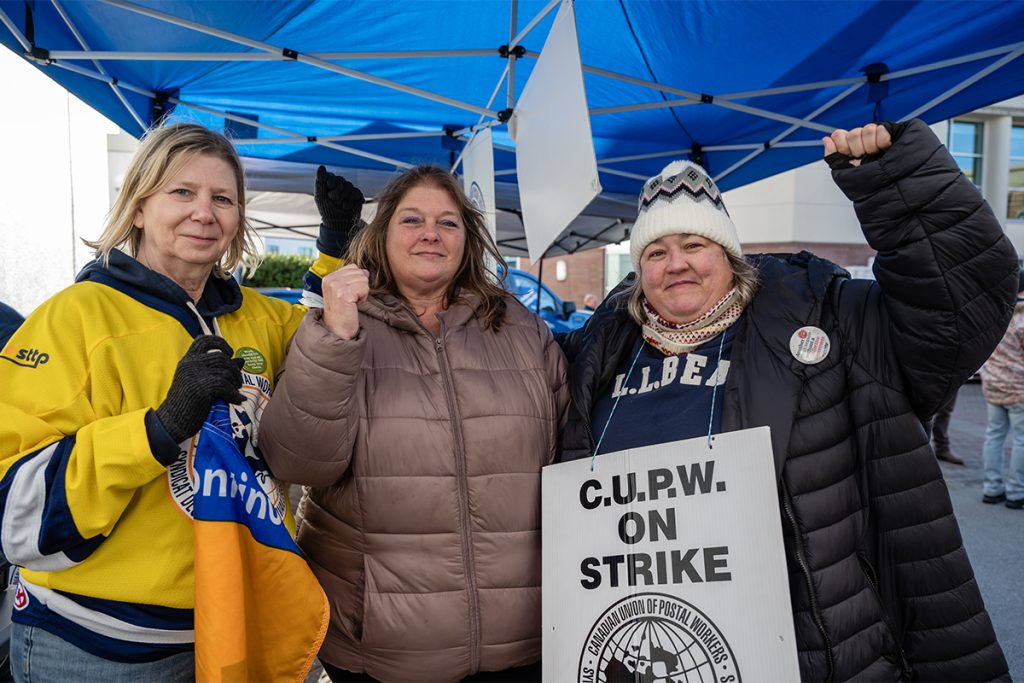
When postal workers went on strike, Canada Post took the unprecedented step of cutting off health insurance benefits for all workers, and ending short-term and long-term disability for injured and sick workers.
Lisa Walker is a rural and suburban mail carrier whose route is in North Nanaimo. She broke her leg in May after being knocked over by her dog and has been doing physiotherapy so she can get healthy and return to work.
“I am now doing physio twice a week with no income and no benefits,” she said. “It makes it a little tough for people to get going.”
Her physio sessions now cost her $90 for a half-hour session which she does twice a week.
She says that the uncertainty is affecting her mental wellbeing.
“It’s depressing, it’s scary. We don’t know if we’re going back to our jobs,” Walker said.
On Wednesday, the union announced it had reached a mediated settlement with Canada Post — with the help of the Canadian Industrial Relations Board — that reinstated 328 striking postal workers who had been temporarily laid off during the strike. Canada Post has also agreed to issue any layoff notices for the duration of the strike, per the union.
Walker said she misses delivering to seniors on her route.
“Not only do they like the mail, but they actually look forward to seeing us because that’s their outdoor people coming in,” she said. “So many of them are just excited to see you.”
Walker has also had to scale back on the holiday festivities this year due to the strike and being cut off disability, which pays 70 per cent of her normal wages.
“Christmas is huge to my family,” she said. “This year we’re not buying my kids things. They are older, they understand, but if they were younger that would be pretty devastating.”
Canada Post workers in Nanaimo still responding to letters to Santa
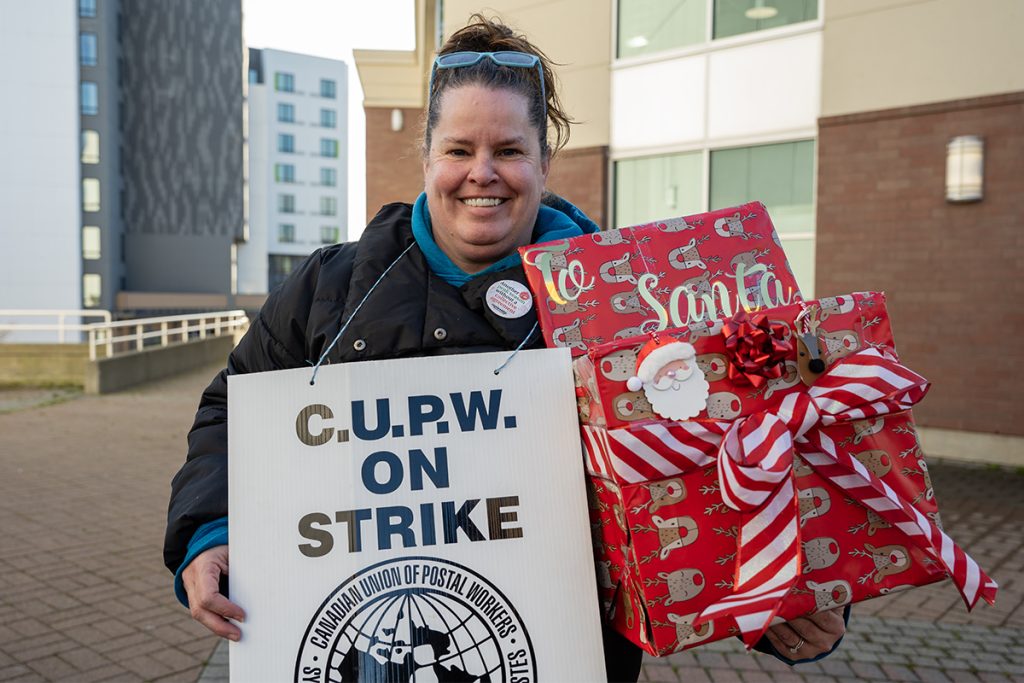
Becki Sergeant has worked for Canada Post for more than 20 years, mostly as a letter carrier, but was working as an inside assistant handing out trays of mail and flyers in the mornings before the strike.
She has also volunteered with the Letters to Santa program where postal workers answer letters children send to Santa on their own time. She’s working on keeping the program running during the strike and says children or their parents can drop off letters to Santa on the picket lines at 140 Terminal Ave. and 1847 East Wellington Rd.
Sergeant said postal workers in Nanaimo usually answer 1,000 to 2,000 letters to Santa each year, and have answered 90 letters so far this year.
“It’s so much fun, and it’s nice to see the kids’ responses to these letters when they get them,” she said. “We see a lot of heartfelt letters as well. We do our best to just respond with some positivity, no promise of any gifts, but just positive words.”
Sergeant said that ideally, letters to Santa could be dropped off on the picket line before Dec. 16, but that postal workers will accept them “right up to the last minute” and if the strike is still ongoing they will “deliver to your house in a personal vehicle so that every kid gets a letter back.”
Nanaimo teachers show solidarity
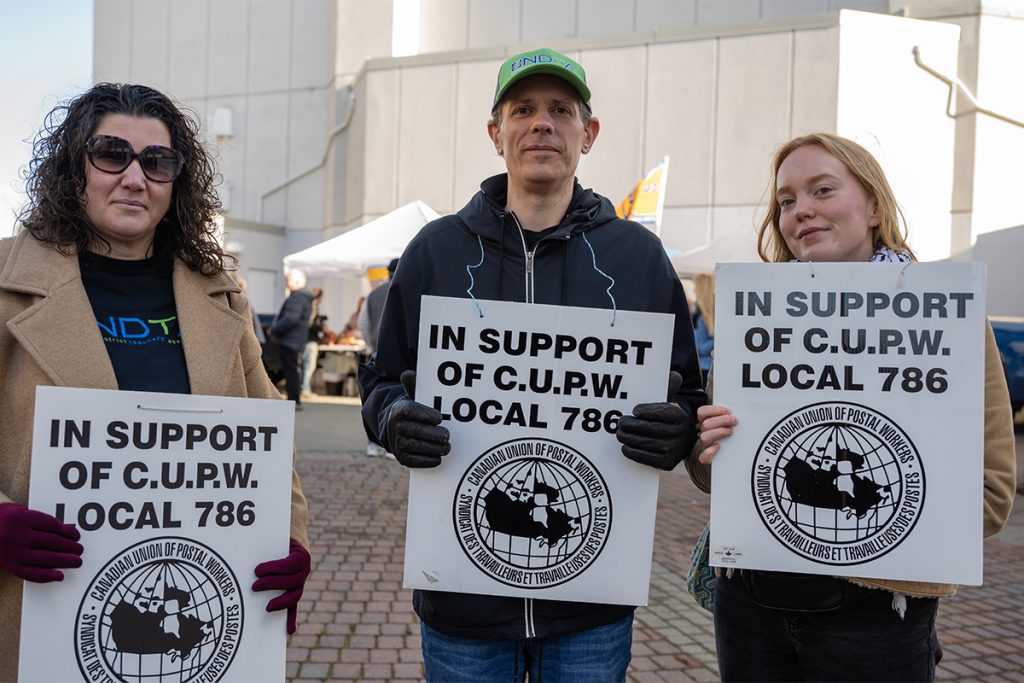
Jo Cornthwaite, president of the Nanaimio District Teachers Association, was at the rally to donate $1,000 to the local postal workers’ strike fund.
“That support reminds you that there’s a community there to support you, that you’re not alone, and that we’re stronger together,” Cornthwaite said.

Stephan Gale has been a letter carrier for 25 years and his first route in Nanaimo was 25 kilometers or more a day “and that’s carrying mail up hills, up steep driveways, like it’s, it’s a long haul out there,” he said.
Gale, who now works for the union as a regional grievance officer, has seen the impact that the job has on people first hand and says that postal workers have the highest injury rate in the federal sector.
“I’ve had dog bites, I’ve had knee injuries, I’ve had muscle pulls, back injuries. It’s all from just carrying the mail,” he said.
Ensuring there are “decent, healthy working conditions” is a key demand of the strike, Gale said.
“We don’t want to be on strike. We want to go back. We want a good, decent, collective agreement. We want to get back to work and do what we do, which is provide a service to Canadians.”
Disclosure: Mick Sweetman has a brother who is a letter carrier in Toronto.
What did you think of this story?
Your feedback after we publish a story helps ensure we're always improving our reporting to better serve you
Author

Related Articles
DRIPA debated in B.C. election on Vancouver Island
The Conservative party of B.C. is promising to repeal the Declaration on the Rights of Indigenous Peoples Act (DRIPA), while other parties argue that would set back relations with First Nations and create economic uncertainty.

Where Nanaimo’s MLA candidates stand on addictions care, family doctors and Island rail
Candidates in Nanaimo-Gabriola and Nanaimo-Lantzville answered three questions from Discourse readers ahead of the Oct. 24 B.C. election.
Nanaimo’s guide to the 2026 B.C. election
What riding am I in? Who are the candidates? When do I vote? B.C. election basics for Nanaimo voters.