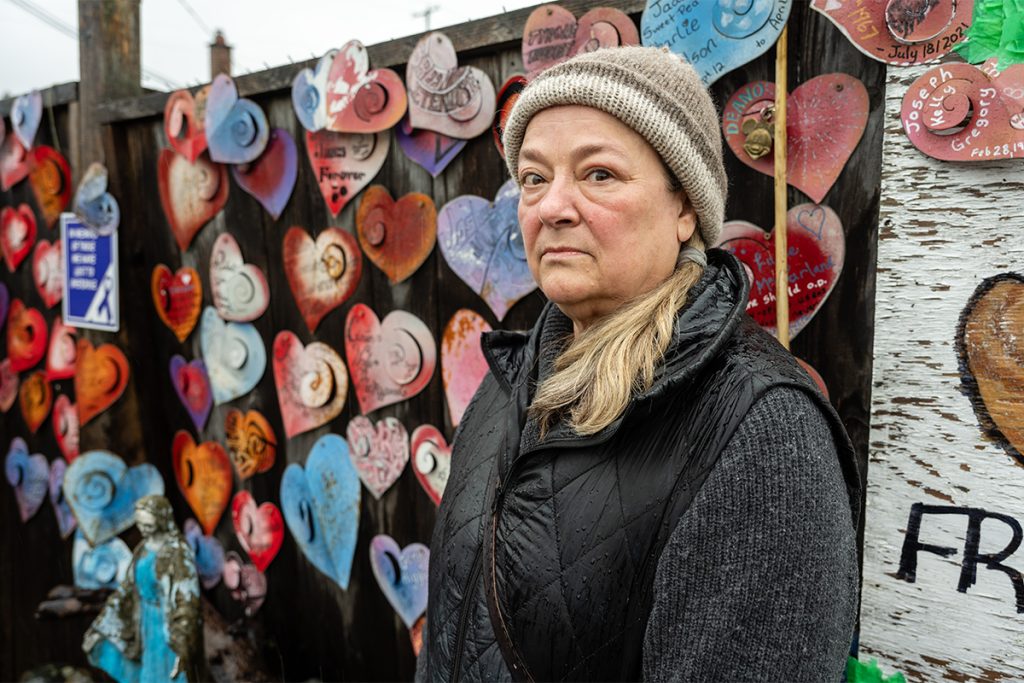
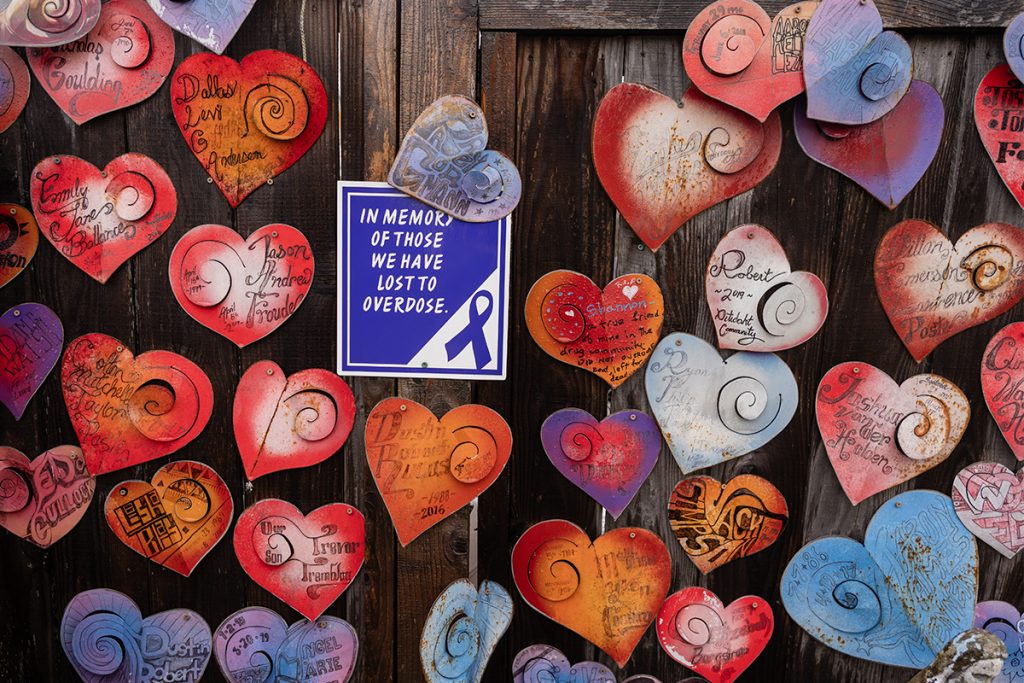
On a small side street just off the Old Island Highway, a modest memorial to residents of Nanaimo who have died from unregulated toxic drugs occupies a fence next to the Wisteria Community Association.
The fence has dozens of metal hearts affixed to it, each bearing the name of someone who has lost their life to an ongoing public health emergency that has killed 564 people in Nanaimo since 2014, part of more than 17,000 people who have died from unregulated drugs across B.C.
Tanis Dagert, a volunteer with Wisteria Community Association and a former coordinator of the Community Action Team in Nanaimo, has known some of the people whose names are on those hearts.
During the COVID-19 pandemic, when people were not allowed to gather together to mourn the loss of loved ones who died from unregulated drugs, Dagert and a friend of hers collected people’s names and made the metal hearts for the memorial. She estimates there are more than 60 names on hearts already and she has a list of dozens more community members who have died from toxic drugs.
“A lot of the names we knew personally from people, especially in the downtown core. But at this point, everybody knows somebody who has either died, or their child has died, or their brother, or their uncle,” she said.
Her brother Gerald Dagert survived an overdose 25 years ago but suffered an anoxic brain injury that has meant he has been in and out of various care facilities, group homes and psychiatric hospitals since that day.
Data shows that both fatalities and calls to Nanaimo Fire Rescue and the BC Emergency Health Services (BCEHS) were down in 2024, but remained at the second-highest levels since 2014.
According to the BC Coroners Service, a total of 94 people died from unregulated drugs in Nanaimo in 2024, a drop from 114 in 2023. That is a 17.5 per cent decrease.
Meanwhile, data shows that medical calls for overdoses decreased from 2,136 calls in 2023 to 1,525 calls in 2024 for BCEHS, a 29 per cent decrease.
For Nanaimo Fire Rescue, calls went from 1,827 in 2023 to 1,150 in 2024, a 37 per cent decrease.
“It's really important to remember that the decline we're seeing is still a fraction of the increase that we have seen over the last five years,” said Island Health’s chief medical health officer Dr. Réka Gustafson.
“While we really celebrate the slight decline and that we're going in the right direction, it's really important for people to know that we aren’t where we were at the beginning of the pandemic, and certainly not when we declared the emergency in 2016.”
Dee R., who asked that we not use her full name, is a volunteer doing outreach and helping run pop-up overdose prevention sites with the Nanaimo Area Network of Drug Users (NANDU).
“I have lost a lot of people last year, especially in the last year, due to homelessness,” she told The Discourse. “There are people who are not drug addicts until they become homeless, and that is how they deal with staying warm, because the drugs give you that feeling of being warm.”

Dee also says that the type of drugs that fentanyl is cut with in street drugs has changed since the COVID-19 pandemic started in 2020.
“There's more benzodiazepine and tranquilizers that are similar to the krokodil that they have in the United Kingdom,” she said. “It's scary, and people are dying.”
One thing that Dee says is needed is more access to drug testing. Samples of drugs can be dropped off at the overdose prevention site on Albert Street until the service closes at 9 p.m. and tests are completed when a technician is available.
Nanaimo Fire Rescue chief Time Doyle says the large increase in overdose calls in 2023 followed by a significant drop in 2024 was unusual.
“We don't normally see those types of swings upwards or downwards, the groupings from year to year are a little bit closer together,” he told The Discourse.
Doyle said that Nanaimo Fire Rescue responded to 11,688 calls for service in 2024, about 10 per cent of which were overdoses.
He said that the service has been upgrading medical training for firefighters and adding capacity with more firefighters as Nanaimo grows and becomes more densely populated with multi-unit buildings and high-rises.
Nanaimo Fire Rescue has added 40 full-time firefighters in the past years and more hiring could be on the horizon in the master plan that is under consideration.
Doyle said that responding to emergencies can take a personal toll on his members.
“When someone's having their worst day ever, whether that's an overdose or heart attack or a fire, or someone's been in a really significant car accident,” he said. “They're all complex situations and no one ever likes to see other people suffering and does leave a mark on any first responder.”
Generally, Nanaimo Fire Rescue prioritizes responding to high-acuity emergencies and critical calls. “We go to the calls that would require more people potentially to work on the patient and require more critical interventions,” Doyle said, while the BC Emergency Health Services also responds to less severe calls.
Doyle said that people who use drugs should try and use them with other people and have naloxone, which can reverse the effects of an overdose.
Nanaimo Fire Rescue is one of the few fire departments in the province that runs a take-home naloxone program through the BC Centre of Disease Control where firefighters give naloxone kits to people during medical calls or people can pick a kit up at the fire hall.
Visits to the Nanaimo Regional General Hospital’s emergency department for substance misuse — which includes patients who were both coded as “overdose ingestion” or “substance misuse or intoxication” and includes both legal and illegal drugs — were also down to 977 in 2024 after spiking in 2023 to a high of 1,352.
This is part of a broader trend across the province that saw fatalities fall by 13 per cent in 2024 according to the BC Coroners Service and data from the Public Health Agency of Canada also show fatalities falling in the first six months of 2024.
The agency writes that the number of apparent opioid toxicity deaths “may continue to decrease through to June 2025, but not to levels seen before 2020.”
Fatal overdoses also fell in the United States by 10.6 per cent as of September 2024.
Experts are not sure why there has been a decrease across many jurisdictions over the last year, or if the drop is part of a larger more sustained downward trend, the Vancouver Sun reports.
“In all substance use-related harm, there's a gradient from South to North Island, by and large,” Gustafson said, pointing to the increase in overdose deaths in the Cowichan Valley and the decrease in Nanaimo. “But the very local factors, especially in smaller communities, are harder to really assess as to what's contributing to them.”
Dagert said would like to see a more public memorial established to help people remember and give them a space to grieve.
“It's the number one cause of death for young men and that issue alone has left so many children fatherless.”