
Vancouver Island’s ‘hidden epidemic’ and those fighting to understand it
How Nanaimo became ground zero in the fight for toxic drug crisis survivors who are left with brain injuries.

This story won gold for Best Local Community News in the 2024 Canadian Online Publishing Awards.
It was sometime in 2003 when Tanis Dagert realized she hadn’t seen her younger brother Gerald Dagert in about a month. In his then-mid-30s, he had frequented Vancouver’s notorious Downtown Eastside since he was a teen, hanging out on the streets, selling weed and sometimes getting into trouble. As he got older, he moved onto heavier drugs like cocaine.
“He would go away for a while, and then come home all bedraggled. That’s what I remember a lot of,” she recalls. “One time a guy came to our house when I was there and tried to beat him up. I got involved and ended up with a torn ligament to my leg because the guy pushed me down the hill. There was that kind of impact on the family. The marginalization. So much shame. We were like, a suburban family in Coquitlam.”
By this point, Gerald was using heroin, and would typically show up to reconnect when he received his monthly income assistance cheque. However, this time he hadn’t. Tanis’s mother Annette Dagert, who was staying with her, was also worried.
Tanis used to see Gerald around from time to time on Hastings Street when she worked at Simon Fraser University’s downtown campus, but the last she heard he had been seen in Surrey.
“So I called up Surrey General [Hospital] and said, ‘By any chance do you have a Gerald Dagert there?’ And they were like, ‘Yeah, he’s been here for a month,’” she says.
The family rushed to the hospital and found an emaciated Gerald in a hospital bed, uncommunicative and on life support.
What the family managed to piece together was that Gerald had overdosed, likely on heroin, and had been found unconscious on the floor of a “traphouse” or a place where people gather to do drugs. In a coma for ten days, he had likely suffered a stroke.
At some point, Gerald had pulled out his feeding tube, and Tanis remembers the doctor advising the family that if he did it again, to “just let him go.”
The family refused, and after praying around his bed, Tanis and Gerald’s parents decided to set up at the George Point Inn next to the hospital for the following six months so Annette could look after Gerald.
“She wouldn’t give up on me,” says Gerald, who quickly regained consciousness but ended up with impaired cognitive functioning, memory loss and paralysis down the right side of his body.
“I had to learn how to speak, write, walk, swallow, everything,” he says.
Housed with other patients who had brain injuries, Gerald found recovery in the hospital difficult, as it was disorienting and noisy. “That’s the thing in the hospital, you have to deal with a million people, back and forth,” he says.
He now lives in Nanaimo’s Crescent House, a residential supportive living facility run by Coastal Support Services, which operates with funding from Vancouver Island Health Authority.
“My guess is he choked off his airway — which is how anoxic brain injury happens — and cut off the oxygen to [his] brain,” says Tanis.
An opioid overdose can slow or stop someone from breathing entirely, and this lack of oxygen can cause brain injuries within minutes, even if the person survives.
Overdose calls in Nanaimo: ‘Everyone there was in shock’
A relationship brought Tanis to Nanaimo from Vancouver in 1999, where she continues to care for her brother and work as a coordinator with the Nanaimo Area Network of Drug Users (NANDU) and formerly as the facilitator for the Nanaimo Community Action Team’s (CAT).
The expertise she has gained as an advocate has taken her to the front lines of an opioid crisis that has claimed the lives of more than 13,000 people in B.C. since it was declared a public health emergency in 2016.
Despite grassroots efforts like that of NANDU to lower the risk of death and harm from an unpredictable and toxic drug supply, more and more people are dying. The Coroners Service recently warned of an increase in deaths — an average of seven deaths per day, province-wide.

On Vancouver Island, Nanaimo occupies an especially central position within the crisis.
During a presentation on Dec. 11, interim Public Health Officer Shannon Waters showed Nanaimo City Council a graph that demonstrated how the numbers and rates of illicit drug poisonings or overdoses attended by B.C. Emergency Health Services (BCEHS) in Nanaimo are more than double the rate of the rest of Island Health.
“Having been the medical health officer for the Cowichan Valley region, when I took on being interim for this area and saw this data, it affected me really deeply,” said Waters. “It’s very different and more extensive than the data I present within the Cowichan Valley.”
BCEHS told The Discourse it has responded to 1,978 calls for overdose poisoning events in Nanaimo as of Dec. 14, a dramatic increase compared to 1,059 last year.

The number of overdose deaths in the Nanaimo area follows a similar pattern: In 2022, 85 residents died from illicit drug toxicity. In the first ten months of 2023, 99 more people have died.
Again, when charted per 100,000 people, Nanaimo’s death rate is more than double the rest of Island Health.

These statistics were also presented by Waters at the SPARK conference last month, a collaborative event aimed at promoting support and care for those who use substances. Though many in attendance were front-line workers and had inside knowledge of the crisis, the numbers still hit hard, recalls Tanis.
“Everyone there was in shock,” she says.
However, hidden within these facts is another issue that has only started to be discussed in earnest within the last few years, and which experts say is key to understanding this crisis: many of those who suffer from overdoses and survive — like Tanis’s brother Gerald — are left with life-long acquired brain injuries.
This both contributes to, and is entangled within, the opioid crisis and constitutes a “hidden epidemic,” says Nanaimo Brain Injury Society’s (NBIS) executive director Kix Citton.
“When someone has a brain injury… they’re not able to use the executive functions of problem-solving [or] maintaining relationships, housing and employment. And if there aren’t resources and supports — which there are not for brain injury, they’re few and far between — [the] cascade of events where someone can end up precariously housed or unhoused is a pretty clear path,” she says.
“Then on the other side of it, being homeless or precariously housed can then put somebody at greater risk of brain injury.”
The problem of brain injuries is also far more widespread than people might think, especially among people who are unhoused.
According to preliminary numbers from Nanaimo’s 2023 point-in-time homeless count, 28 per cent of respondents said they had an acquired brain injury, up from 23 per cent in 2020, which was the first year this question was included in the survey.
In surrounding areas like Parksville-Qualicum, that number is as high as 43 per cent.
Brain injuries the missing piece
One of the hurdles in understanding the issue of brain injury among unhoused residents was figuring out what the actual statistics were, says Citton.
The toxic drug crisis hit Nanaimo several years earlier than the rest of the province, and an increase in overdoses was noticed as early as October of 2013, says Dr. Paul Hasselback, the former Island Health chief medical officer for central Vancouver Island who retired in 2020.
This led to the adoption of interventions like the creation of the Nanaimo CAT in 2015, which Hasselback initially developed with his then-graduate student Griffin Russell.
The innovative local initiative brought together local health care workers, bylaw officers, RCMP and drug users.
The type of services CAT offers is peer outreach on the street level, running a medical van to provide primary care in parks and shelters, distributing harm reduction supplies and bag meals, hosting community dialogues and distributing micro-grants to other initiatives.
“That initial working group informed the whole provincial response to overdose, and in many ways, spearheaded what CATs across the province would become,” Tanis said in an interview when she was the facilitator. There are now approximately 35 CATs operating in B.C.
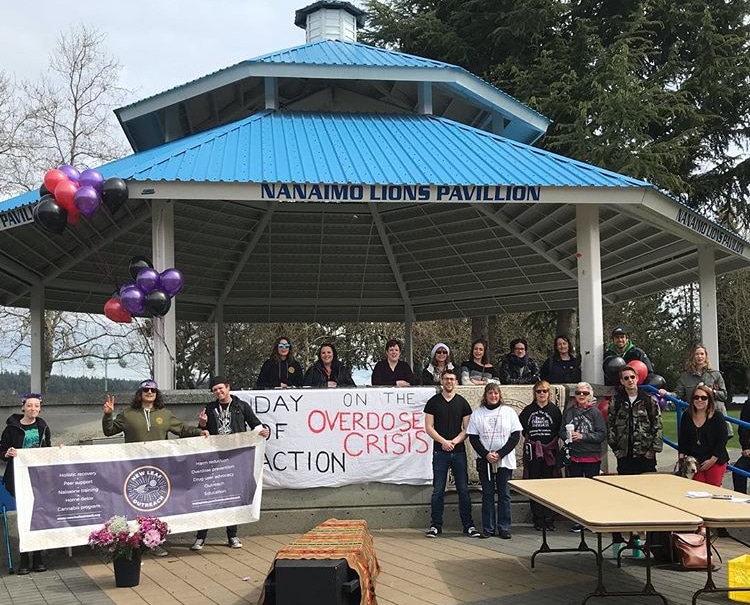
They also supported the early uptake in the use of naloxone, a medication used to reverse an opioid overdose.
“One of the first initiatives taken by the province back in 2016, was to ramp up the availability of naloxone,” says Hasselback. “It has proven over and over again, in various different studies, to be one of the most effective ways of preventing deaths from overdoses.”
However, for every overdose death, it is estimated there are 20 to 30 non-fatal overdoses, according to Dr. Elizabeth Plant, a Cowichan Valley-based family physician who specializes in addiction treatment.
Crucially, these non-fatal overdoses — and the related brain injuries — are not tracked or counted in any statistical analysis, according to Plant.
“The impact of the toxic drug crisis is often tracked through numbers of deaths, and yet there’s many more people who are surviving multiple overdoses and experiencing the related brain injury, but we’re not tracking those numbers. And yet those numbers are having a huge impact,” says Citton. “There’s this missing piece.”
Of those people who do experience drug toxicity events, new research shows they are 15 times more likely to have a brain injury than those who do not.
After Citton joined the Nanaimo Homelessness Coalition as a representative of NBIS in 2019, she successfully pushed for the following year’s provincial and federal point-in-time count survey to begin to track these numbers by including a question about acquired brain injury.
In 2018, NBIS partnered with Island Health to host a symposium that investigated the intersection of brain injury, substance abuse and mental health. The symposium included several organizations like the Cridge Centre for the Family, a nonprofit society that offers a variety of services including brain injury support.
The following year, with funding from Nanaimo CAT, NBIS held a follow-up community dialogue which focused on the impact of the toxic drug crisis and overdose.
“Nanaimo really has been, I think, at the forefront of bringing this to people’s attention,” says Tanis.
Advocacy and support is key for brain injuries
Though some attention has focused on the effect that an overdose, or cumulative overdoses, can directly have on the brain, there are two other aspects not often discussed, says Hasselback.
One is that when people are left with a traumatic brain injury as a result of a car crash or sporting incident, “the functionality and changing functionality that occurs after an injury is sometimes treated through self medication, which is an easy way of saying using street-related drugs.”
Self-medicating in this way may put them at risk for having another drug-related brain injury, even if the initial one was unrelated.
The second piece to this is that people who have acquired a brain injury are often vulnerable and may end up being unhoused, which exposes them to an increased risk of violence and again contributes to the development of further brain injuries.
It’s an issue that Tanis has seen firsthand: approximately seven years after his initial overdose in 2003, Gerald was hit by a car and sustained a head injury while crossing the road in his wheelchair.
“That set you back quite a lot,” Tanis says, looking at Gerald.
“I’m still recovering,” he replies.

The supports Gerald has received, though at times a struggle to access, have been key to his recovery, they both say.
Without the advocacy of his sister and the various assisted living facilities he’s lived in, Gerald is convinced he’d be “dead or locked up in a mental institution.”
This unfortunately is the reality for many, says Citton.
“What somebody needs with a brain injury is calm, regular support, because being able to manage when there’s a lot of variables… is very taxing on the brain. Fatigue is a huge thing for folks with brain injuries,” she says.
“Just being able to get through the day even when you have housing, and when you have things in place — people might just be able to go to a grocery store and do their shopping, and then not do anything for the next couple of days.
“All these things that we rely on the brain to do when the brain is injured… is really difficult to manage at the best of times. And then you have a high percentage of people with brain injury as part of the homeless population, and we’re not talking about it. We’re not addressing it. We’re not recognizing what needs to be done.”
When a person experiences an overdose, a typical scenario might be that first responders arrive and provide care, and then that person may or may not go to the hospital for a variety of reasons, but that’s essentially it, says Citton.
“There’s no follow-up care for that person,” she says. “You get discharged to the doors of the hospital and either told to follow up with your GP — if you have one — or you’re just let loose in the community to sort it out on your own, often not understanding what you’re experiencing.”
Though there aren’t many supports that exist currently, NBIS is in the midst of a three-year research project aimed at reaching a provincial consensus on how to best serve people living with these types of brain injuries, a project funded through the Ministry of Mental Health and Addictions and the Vancouver Foundation.
In May, the province also announced new programs aimed at substance use-related brain injuries, as well as an investment of $4.5 million over three years toward the B.C. Brain Injury Alliance, founded in 2014, and $345,000 towards ongoing research and “[to] propose evidence-based solutions and services.”
A new private members bill introduced by Cowichan-Malahat-Langford MP Alistair MacGregor also seeks to raise awareness and funding for the hidden epidemic of brain injury.
Citton says these conversations, research and investments give her hope. But when it comes to the toxic drug crisis, it’s not enough to prevent people from dying.
“We need to address brain injury as a critical piece of this complex health crisis we’re in. And if we’re not going to look at that in terms of safer supply, we need to understand that whatever intervention we’re [doing] needs to include brain injury.
“We can’t just throw money at recovery beds and not include it as part of the consideration of what is needed for treatment,” she says.
What did you think of this story?
Your feedback after we publish a story helps ensure we're always improving our reporting to better serve you
Author

Related Articles
How is The Discourse’s journalism funded?
And what does it cost to produce The Discourse’s in-depth, independent journalism?
Nanaimo Blues Festival brings international headliners and local talent to Maffeo Sutton Park
‘Blues is for everyone,’ says Nanaimo Blues Society president

What to do and where to go during extreme heat events in Nanaimo, the Comox Valley and the Cowichan Valley
A guide to prepare for extreme heat events on Vancouver Island