
How do Comox Valley governments and public organizations use AI?
The Discourse reached out to Comox Valley governments and organizations to find out how they are handling the use of AI.
The use of artificial intelligence (AI) tools by local governments is a growing topic of discussion as high profile elected officials in other regions of B.C. have drawn criticism about their use of AI tools in their work.
The Discourse reached out to local governments and public organizations in the Comox Valley to understand what policies governing AI are already in place, if those policies are under development and how staff and elected officials are currently using artificial intelligence.
Some local governments are actively in the process of developing policies that regulate the use of AI internally, while others already have policies in place for employees.
For example, the Comox Valley Regional District adopted an Artificial Intelligence Governance Policy on May 1, 2026 and staff are actively using the bylaw for daily tasks. Meanwhile Comox Valley Schools is examining how AI might be implemented into schools in the future.
The Discourse reached out to the Town of Comox multiple times to learn about its AI policies but did not hear back in time for publication. This story will be updated if a response is received.
What is generative AI and how does the provincial government use it?
Generative AI refers to a specific subset of machine learning where information technology is trained on large data sets of information to generate text, images, video, audio or code when prompted by a user. The technology “performs tasks that would ordinarily require biological brainpower to accomplish, such as making sense of spoken language, learning behaviours or solving problems,” according to the Government of Canada.
This technology includes a growing number of “chat bots” or large language models such as ChatGPT, Microsoft Copilot, Gemini and Claude.
Based on its training data, these systems generate content that is statistically likely to come next, like predicting the next word in a sentence.
The province of B.C. has six drafted guiding principles for how its employees can use generative AI.
A publicly available provincial policy says employees may put confidential information into generative AI tools that are available through the BC Public Service’s agreement with Microsoft, such as Copilot, an AI assistant that is integrated into Microsoft 365 apps and browsers including Word, Excel and Teams. However, employees cannot put any confidential information into publicly available AI tools like ChatGPT.
The policy also directs employees to review all outputs from AI tools to ensure they are factually accurate, complete and up to date. They must also edit any output text to ensure the language is inclusive and aligns with government writing standards and style guides.
Risks of AI use by governments
A 2023 report from the Office of the Information and Privacy Commissioner for British Columbia outlined nine principles for the responsible and trustworthy use of generative AI technologies.
The report highlights that privacy of personal data is a primary concern for organizations using generative AI. It suggests that organizations should only use “generative AI tools that respect privacy laws and best practices,” to protect personal information.
Organizations should also, according to the report, “consider whether the use of a generative AI system is necessary and proportionate,” especially when it may have a significant impact on individuals or groups.
One group the report found most vulnerable to the negative impacts of generative AI is children.
“They may be less able than adults to identify or challenge biased or inaccurate information, or be more prone to having their agency limited by an AI that generates information based on a restricted world view,” the report reads.
Another principle highlighted by the report is openness. It says organizations should be transparent when a generative AI tool will be used as part of a decision-making process
Regional District adopts AI policy
The Comox Valley Regional District recently adopted a policy to guide employees on responsible, appropriate and secure use of generative AI applications and to provide protocols that maximize the benefits of using generative AI applications while managing potential risks and concerns.
Manager of corporate services Jake Martens told The Discourse employees of the regional district are actively using AI tools to assist them with things such as writing communications, research and drafting bylaws.
According to the policy, staff are only allowed to use GovAI while other applications such as ChatGTP, Claude, Meta AI and DeepSeek are prohibited.
Any contracted services and hardware that use AI other than GovAI cannot be purchased or used by staff. Staff are also required to review a guide on the responsible use of generative AI and are encouraged to take part in professional development and continuing education related to generative AI as appropriate.
According to the policy, approved uses of AI include:
- Creating drafts of communications and reports before they are reviewed and revised
- Reviewing and suggesting improvements to writing
- Providing ideas or avenues of research or thinking
- Summarizing documents or reports
- Interacting with an approved AI Agent
Shortcomings of generative AI are also listed in the policy and include AI hallucinations, implicit bias in responses, a dehumanizing tone, inaccuracies and outdated reference materials.
A privacy impact assessment is required if authorized generative AI is used “in conjunction with processes that routinely collect, use or disclose sensitive personal information.”
The policy only applies to staff but Martens said they are planning to review the policy’s application to CVRD leaders in the future.
City of Courtenay developing AI policy
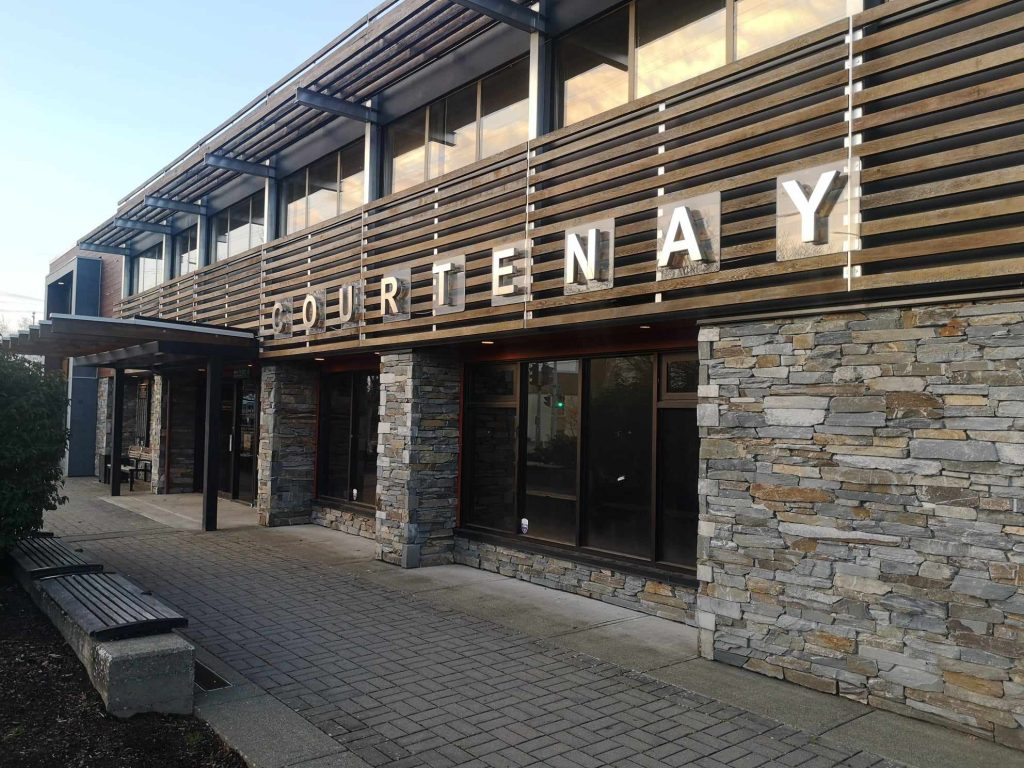
In a statement to The Discourse, the City of Courtenay said it is currently developing how it will use AI but does not have a policy in place yet. Work on the policy is expected to begin later this year and when finalized, the city said it will include “how AI can be used responsibly, with appropriate governance, security, accountability and public oversight.”
The city has also completed an AI Impact Assessment in relation to its recently announced Intelligent Intersections project. The pilot project, located at the intersection of Cliffe Avenue and 5th Street, uses the AI-based traffic analytics system Miovision. The technology has been implemented since January 2026, according to a news release. It gives staff the ability to better understand intersection functions ahead of major renewal projects, such as improvements at the Cliffe Avenue and 5th Street intersection.
Miovision “continuously analyzes transportation activity at the intersection,” a news release from the city reads, allowing “staff to better monitor vehicle queues, pedestrian movements, cyclist activity, transit operations and safety-related interactions throughout the day.”
The technology is compliant with the Freedom of Information and Protection of Privacy Act and the city said its impact assessment “confirmed that the cameras do not collect personal information and helped evaluate any risks associated with the use of AI, ensuring appropriate safeguards were considered.”
As the city continues to work on its AI policy, it will review best practices and lessons learned from elsewhere, the statement to The Discourse said.
Internally, the city is “exploring AI productivity tools within a secure environment” and has implemented the use of Microsoft 365. Staff are still accountable for all work produced and final decisions.
Contractors for the city are not currently required to disclose their use of AI but are still held to contractual obligations which include “confidentiality, information security, restrictions on data use and responsibility for the accuracy, quality and intellectual property compliance of their work,” the city said.
In future, there may be more specific AI-related provisions for contractors.
As for councillors, the city said guidance on the use of AI “will be considered as part of the city’s broader AI policy development and brought forward for consideration by the newly-elected council in the fall.”
“Accountability and maintaining public trust will remain key considerations,” the city said.
Comox Valley school district examining the role of AI
Comox Valley Schools is in the early stages of exploring and consulting how AI might be used in the school district and is examining the role of AI in schools and the district, according to a statement sent to The Discourse from Comox Valley Schools.
It has existing technology and privacy policies, including its Acceptable Use of Technology Procedures and Privacy Management Program that applies to all technology tools including AI. But the school district does not have a specific policy for AI.
The district said it is following provincial guidance.
“As AI continues to evolve, the district will continue to assess best practices and consider what additional guidance may be appropriate,” the statement said.
Vancouver Island Regional Library explores impacts of AI
Currently, the Vancouver Island Regional Library does not have a formal policy for AI according to Natasha Bartlett, assistant director of marketing and development.
“Like many libraries and public organizations, we are monitoring developments in this area and considering future approaches,” Bartlett said.
Use by staff is limited by department and depends on the needs of staff, she added.
Sea & Cedar magazine, which is published by the regional library, does not accept submissions containing AI-generated writing or art.
Contributors whose work is selected for publication are asked to confirm that submissions are original and human-generated.
Bartlet said VIRL, like many libraries across the country, is exploring the impacts of AI on information access, digital literacy and creative work.
What did you think of this story?
Your feedback after we publish a story helps ensure we're always improving our reporting to better serve you
Authors

Related Articles

Courtenay mayoral candidates on water conservation strategies amid worsening drought conditions
For the second time this year, Courtenay residents see Level 3 water restrictions, days before the Oct. 17 municipal election.

Comox Valley local candidates on housing affordability
Candidates in Courtenay, Comox and Cumberland share how they’d support housing affordability and increase the supply of affordable housing.

Comox Valley candidates on supportive housing, second-stage housing and warming centres
Candidates in Courtenay, Comox and Cumberland share how they’d support adding supportive housing beds, second-stage housing and warming centres.