
Behind the backlash to the Cowichan Valley’s comprehensive zoning bylaw
The campaign against Bylaw 4710 was fuelled, in part, by misinformation and an organized group of advocates. What could this mean for the future of local politics?
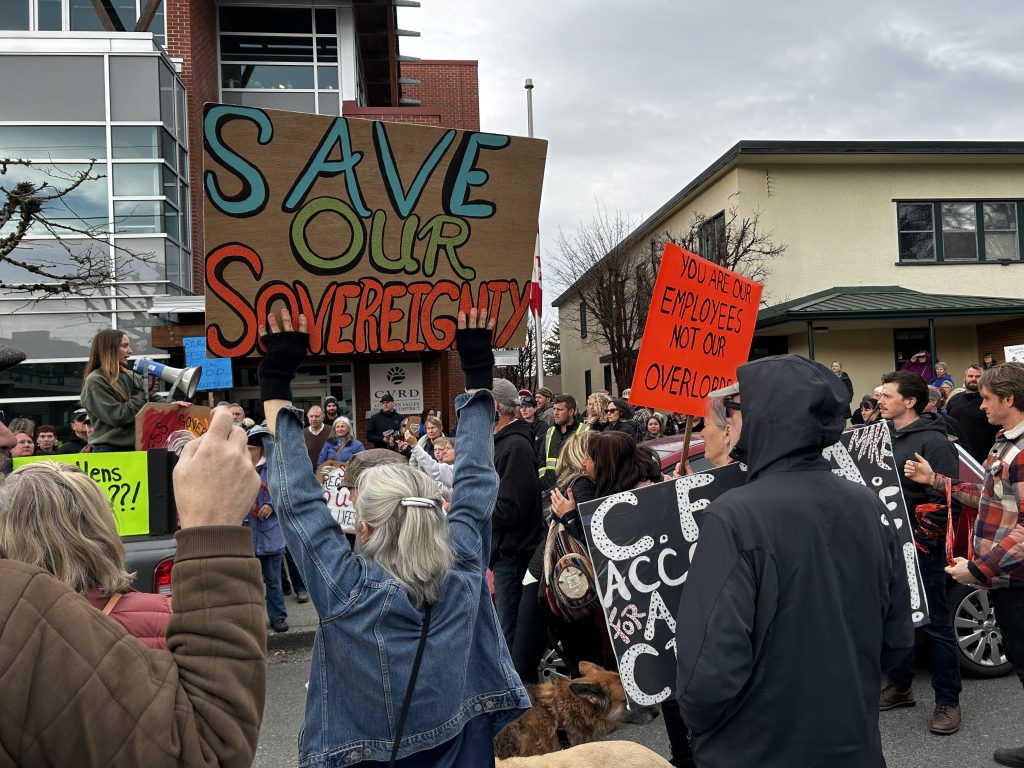
Standing on the back of a truck and holding a megaphone, a community member directs people to the website Take Back Cowichan, filled with resources on how to organize against the Cowichan Valley Regional District’s proposed comprehensive zoning bylaw.
The March 31 protest outside the CVRD’s offices has drawn a crowd of over 100 people who are spilling out onto the street and blocking traffic. Many in the crowd hold signs with phrases like, “CVRD you work for us” and “Less Government, More Freedom.”
Attendees are also handed a pamphlet that outlines three issues with the comprehensive zoning bylaw, known as Bylaw 4710, that have been echoed in Facebook groups: not allowing the use of RVs as permanent housing, a change from a complaints-based enforcement system and the regulation of the number of chickens allowed on a property.
The speaker tells the crowd she wasn’t the organizer of the gathering but “just happened to have a microphone in her truck.”
Many of the attendees were upset at what they claimed was a lack of consultation with the public by the regional district. They said the bylaw was being framed as a simple update but actually introduced new restrictions on what rural residents could do with their properties.
While it was true that the 322-page bylaw document did include these rules, they were not all new. Reporting by The Discourse showed that the use of RVs as permanent housing, $50,000 fines and the regulations of roosters on properties that alarmed protesters already existed in the CVRD’s individual area bylaws.
The draft Bylaw 4710 was a multi-year project mainly meant to combine nine of those individual area bylaws into one document covering the whole regional district to improve efficiency in processing land-use applications, according to the CVRD’s website.
Less than two months later, the CVRD board would vote to pause work on Bylaw 4710 until after the October 2026 General Local Elections.
Leading voices in the campaign presented the board’s decision as a grassroots “community win.”
But The Discourse has found that many of the out-of-context claims about the bylaw and calls to action were spread, in part, by an organized group of advocates with ties to a previous election campaign and other populist advocacy groups.
Through a series of websites, Facebook groups, email campaigns and in-person events, misinformed claims about the bylaw circulated faster than local news outlets could fact check them.
As Cowichan Valley residents prepare to vote for new regional district directors and council members on Oct. 17, one longtime observer worries what this heated and divisive climate could mean for the future of local politics.
How did the campaign grow?
The Discourse reviewed posts on 14 Cowichan Valley Facebook groups from March 24 to April 24. While most of the regional Facebook groups contained posts with typical community news or events, two appeared to be created as a space for residents to organize against Bylaw 4710.
Residents were largely called to protest in the Facebook group “Neighbours Against new CVRD Bylaws.” The group was renamed to “Neighbours and our CVRD” on July 14.
Created March 27, this Facebook group grew from a handful of members to more than 10,000 within weeks, becoming a gathering place to organize protests, coordinate attendance at CVRD board meetings and plan mass email campaigns to directors.
A second group, “Cowichan Residents for Fair Land Use,” formed the same day and drew similar traffic. It was renamed to “Cowichan Valley Residents Coalition” on May 27. Members of both groups discussed crowdfunding money for legal action and organizing to vote out sitting directors in the Oct. 17 local elections.
Members raised real questions about how the bylaw would affect food trucks and small farms, and complained, fairly, that the document itself is long and complicated for the average person to parse.
But run alongside those legitimate concerns were claims the CVRD disputes directly.
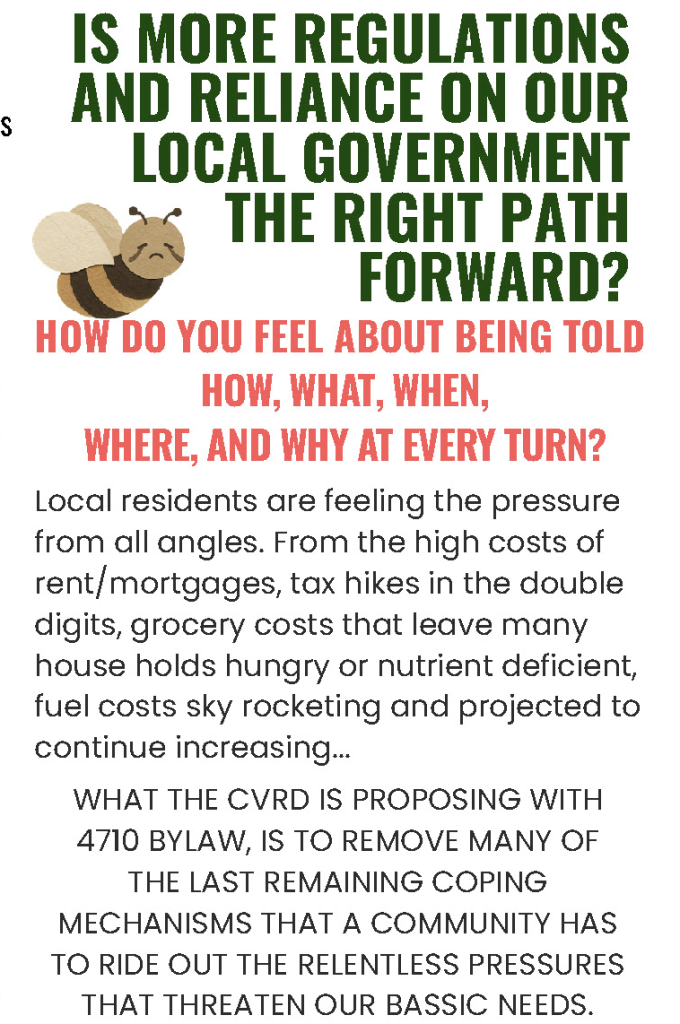

Takebackcowichan.ca, the website promoted at the protest, describes itself as a page that brings together local groups and coverage of the bylaw. An archived version of the website from April 1, 2026 hosted links to the “Neighbours Against CVRD Bylaws” Facebook group and a similar group, “Cowichan Residents for Fair Land Use,” along with Substack pages critical of the bylaw.
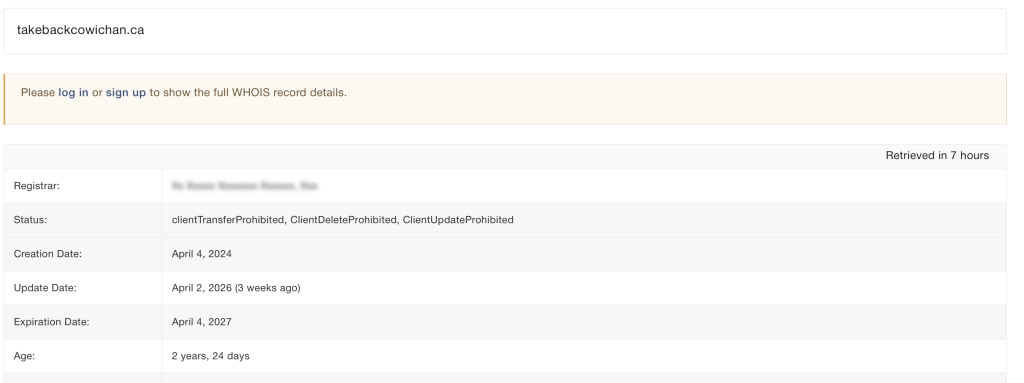
There are no listed owners of the Take Back Cowichan website. The Discourse found its domain was registered in 2024 but didn’t appear to host any original content until April 1, 2026, according to Internet Archive, which records image captures of webpages over time.
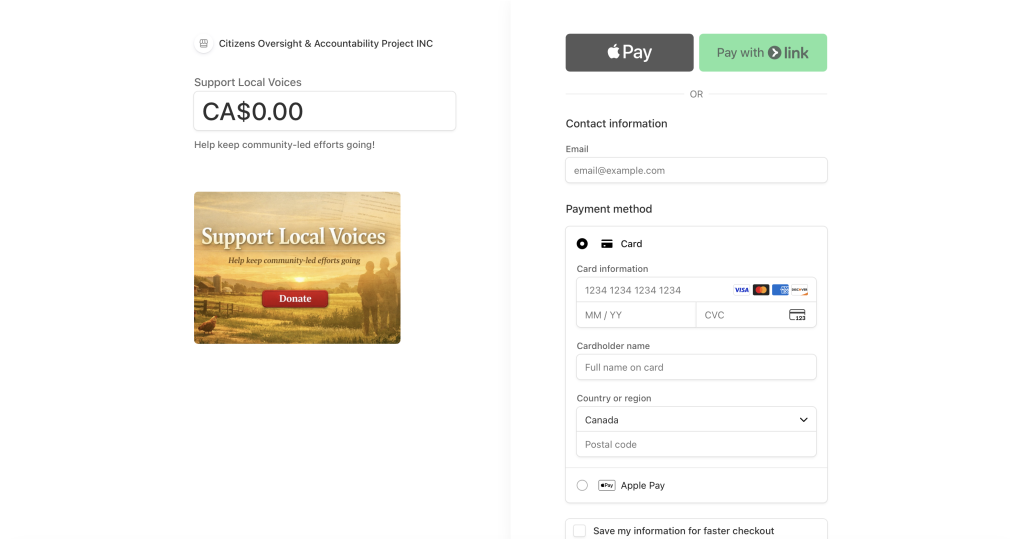
As of publication, a banner at the bottom of the website solicits donations to “support local voices.” Clicking it opens a payment page labeled Citizens Oversight and Accountability Project Inc., also known as COAP.

Much of the language landing in the anti-CVRD bylaw Facebook groups can be traced back to COAP, a Substack page published under the byline “Team COAP.”
At a meeting hosted by advocacy group BC Rising on April 29, 2026, COAP co-founder Adrienne Richards said her group first noticed frustration about the bylaw on Facebook.
“No one really knew about this going on in the background, and then in mid March, all of a sudden, and I can’t say who originally put [the bylaw] out, but as soon as it came out, it went like wildfire across Facebook pages,” she said. “We downloaded it, and I figured the only thing we could do to help was pick it apart piece by piece.”
COAP would go on to write a nine-part series of posts about Bylaw 4710 on its Substack page.
Substack is a U.S.-based online publishing platform founded in 2017 that allows independent writers, journalists, podcasters and creators to host articles, distribute newsletters and collect payments from subscribers.
Wes Regan, a University of British Columbia researcher who studies public distrust of local government, said the backlash against the bylaw in the Cowichan Valley isn’t unusual.
He noted similar campaigns in other cities were fuelled by misinformation and, in some instances, conspiracy theories about an urban planning concept called “15-minute cities.”
People share this kind of material, he said, “because we want to be helpful,” often without noticing it confirms a bias they already hold.
Read more: What is a 15 minute city and why are some Kamloopsians concerned?
Local governments are an easy target right now, he added. “There is this sort of roiling, ongoing simmering anxiety and distrust of government since the pandemic, and trust is one of those things where it takes a lot to build it up and takes very little to lose it.”
Jessica Barker, a local educator who grew up around local politics while her father served as a CVRD director, said she found the situation “incredibly insane” and distinct from past local disputes because of the spread of misinformation involved.
“In the past we didn’t have the misinformation part because there was no internet,” she said.
Barker started her own Substack page in 2024 where she posts articles about politics that often cover the same local issues as COAP.
To help “cut through the noise” and create a space to unpack the claims that were being made about Bylaw 4710 online, Barker created a Facebook group called “Cowichan Clarified” where community members could ask questions and share information about it.
Much of what COAP publishes isn’t factually wrong, she said, but is stripped of context and delivered in language that is built to provoke.
“They might not be lying, but they’re speaking in a way that’s extremely influential, that’s actually an opinion, and people don’t have the literacy skills to parse that out,” she said.
The Canadian Association of Journalists defines misinformation as information that is false but not created with the intention of causing harm.
According to the association, misinformation can be further divided into seven types including false context, which outlines a situation in which genuine information is shared with false contextual information.
It’s that last category which Barker believes much of the misinformation around the bylaw falls into.
What kind of misinformation was shared?
One of the earliest Substack articles COAP wrote on Bylaw 4710 in March 2026 called into question the legitimacy of the bylaw, particularly noting the lack of public hearing about it.
“It is being introduced across the region, without a public hearing, under a system that assumes very different communities can all be governed the same way,” the article states under the byline Team COAP.
The Discourse spoke with CVRD board chair Kate Segall in previous reporting where she clarified that a public engagement process was planned to begin May 2026 and confirmed that a public hearing for Bylaw 4710 would follow. A quirk of the legislative process set out by the Local Government Act dictates that once the district holds a public hearing, they legally cannot accept more public feedback, she said.
The demand for a high-stakes public hearing rather than a “fulsome public engagement process” is telling, according to Regan. He notes that modern public hearings have become highly polarized, frequently “descending into chaos” or being “hijacked” by organized groups.
In a digital age, Regan said local officials are understandably cautious about meetings being turned into a “performance venue with members of different groups livestreaming themselves ripping into the directors.”
Another COAP claim was that the bylaw’s language would move the CVRD from complaint-based enforcement to proactive enforcement, meaning officers would go looking for violations, like fences that are too high, too many chickens, or people living permanently in RVs, instead of waiting on a complaint.
In the Substack article titled “The Missing Middle Is Being Zoned Out,” COAP says it has “been at this [issue] for a minute,” and shares quotes and links to previous reporting including to the Westward Independent — a self-proclaimed news outlet that published articles until 2025 and was also co-founded by Adrienne Richards, according to her bio on the site.
One of the quotes shared in the Substack article comes from a 2024 Westward Independent article reporting that the CVRD had announced “a new approach to the enforcement of non-permitted short-term rentals in electoral areas.” As that article put it, “In short, Bylaw will now seek out violations instead of being complaint-driven.”

However, the Westward Independent article does not cite any CVRD legislation which directs bylaw staff to take a more proactive form of enforcement. Rather, it cites the Short-Term Rental Accommodations Act, passed by the province in 2023, as potentially a way for the regional district to crack down on short-term rentals.
The Westward Independent article references “a recent board meeting” but does not specify which meeting it is quoting from and the quotes only centre on the enforcement of short-term rentals.
Another COAP Substack article from March 2026 titled “RV living” also makes the claim that Bylaw 4710 “replaces a system where many everyday uses were tolerated or complaint-driven with one where only explicitly permitted uses are allowed.”
When asked by The Discourse if the CVRD would be changing how it handles bylaw enforcement, Segall confirmed the regional district will “remain a complaint based system” and the board has directed officers to “prioritize voluntary compliance.”
Another point of contention for COAP was the mention of fines for violating bylaws that could cost residents up to $50,000 a day.
“By including it in the Bylaw, it is effectively saying that violating zoning rules is serious enough to escalate beyond local tickets and could become a provincial offence,” COAP writes.
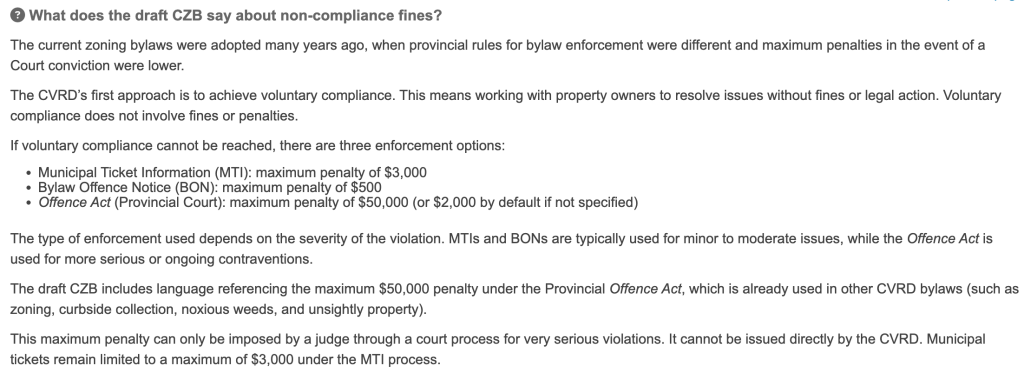
The bylaw does contain wording that says fines could reach a maximum of $50,000, but only under the provincial Offence Act in extreme violations and the fines can only be issued by a judge.
The maximum amount that the CVRD can fine someone is $3,000.
Reporting by the Discourse found that much like the enforcement strategy, the fine structure for the new comprehensive bylaw is unchanged from the current bylaws.
COAP declined an interview with The Discourse and replied to a list of questions about their writing on bylaw compliance and the CVRD’s alleged lack of engagement around Bylaw 4710 with an emailed statement.
“We will not participate in a broad personal and organizational fishing expedition,” the email reads. “We are transparent about our views, and readers are encouraged to examine the underlying sources themselves.
“We believe strongly that engaged citizens — whether writing, attending meetings, or simply paying attention — are the backbone of healthy local democracy. Hobbyists and independent voices have every right to participate without being treated as targets for institutional scrutiny.”
COAP did not respond to questions about its ties to the Westward Independent or how it fact checks and corrects information.
Who is COAP?
The Citizens Oversight Accountability Project describes itself as a citizen’s advocacy group that aims to hold local governments “accountable for their governing, and spending, of our tax dollars.”
COAP told the Discourse it publishes “local commentary and research drawn primarily from public records, bylaws, meeting agendas, minutes, government documents and FOI inquiries.”
The group was founded by Adrienne Richards and Joseph Enslow after an unsuccessful run by both for North Cowichan council in 2022 under the name United Independents, according to an archived campaign page.
During her council run, Richards said in a 2022 Cowichan Valley Citizen article that she would support an emphasis on “less governing and red tape” if elected. Richards, Enslow and a third member Chris Shaw also suggested in an all-candidates meeting that the North Cowichan Official Community Plan was influenced by the World Economic Forum, referencing a conspiracy-based claim that spread through the Freedom Convoy movement. This misinformation is echoed in COAP’s blog posts, like “North Cowichan – NGO’s, WEF, UN.”
COAP also has a history of working with the Land Keepers Society, a nonprofit that formed quickly in 2023 in an attempt to stop a restoration project in the Cowichan Estuary. According to COAP’s website, the two groups collaborated on a town hall about the project, which involved ending a farm tenancy in order to take on environmental restoration work that would protect the estuary environment in the face of sea-level rise and climate change.
COAP has also been featured on multiple livestreams hosted by BC Rising as recently as April 29 and sponsored a BC Rising-affiliated town hall in 2024.
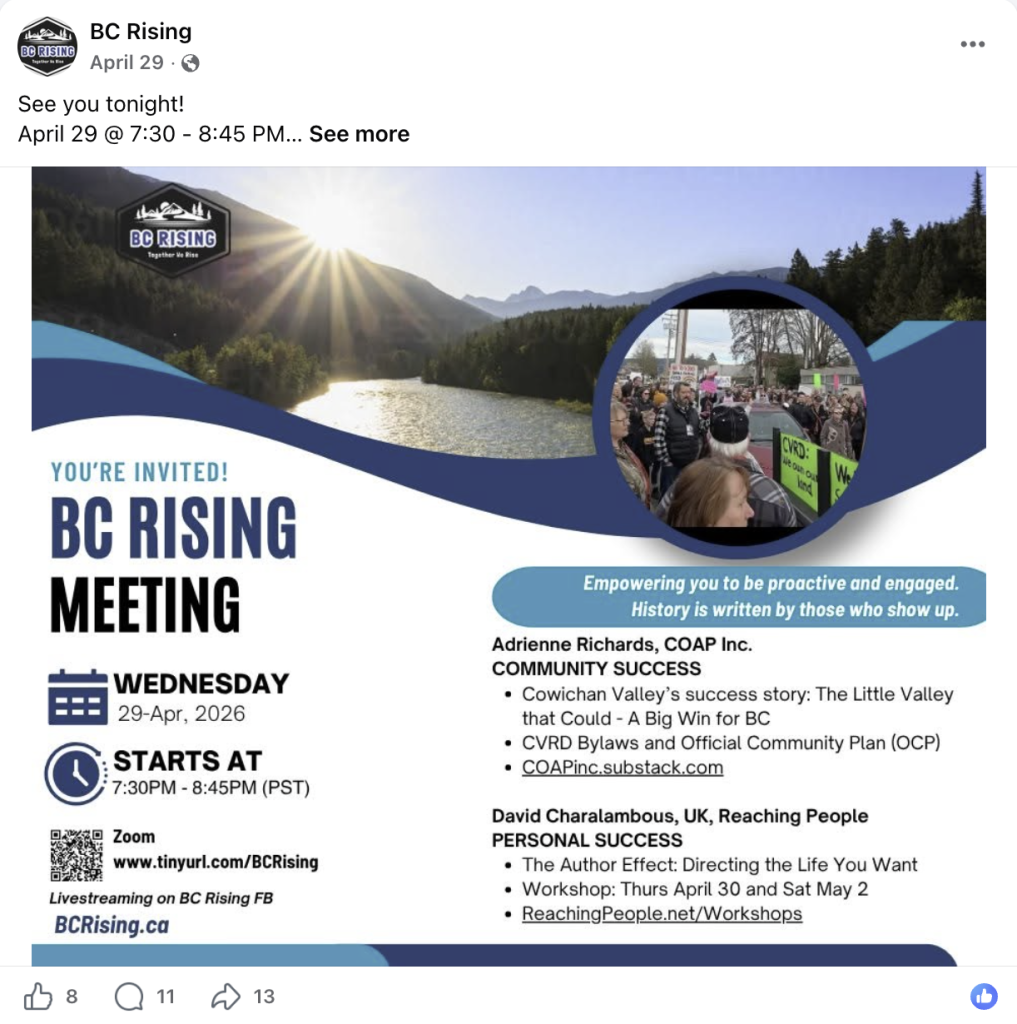
BC Rising emerged from the Freedom Convoy movement and was founded in 2023 by British Columbians who were concerned about COVID-19 restrictions and government overreach.
The group organizes around globalist conspiracy theories, anti-COVID-19 measures, conspiracy theories around UNDRIP (the U.N. Declaration on the Rights of Indigenous Peoples) and support for people involved in the Coutts blockade in Alberta, according to reporting by The Breach.
According to Richards’ biography section on COAP’s website, she had a previous career in “film, media and contract research.”
An archived page of the Cowichan Valley Voice shows that Richards was the main contact for advertising at the publication in 2020. The outlet confirmed that Richards did work for the publication prior to 2020 but is no longer working for them.
Enslow’s biography says he handles the group’s social media, website and livestreams.
Richards is also the administrator for the Facebook groups “Cowichan Valley Residents Coalition” and “Cowichan Valley Political Forum.” Combined, these groups have more than 4,000 members.
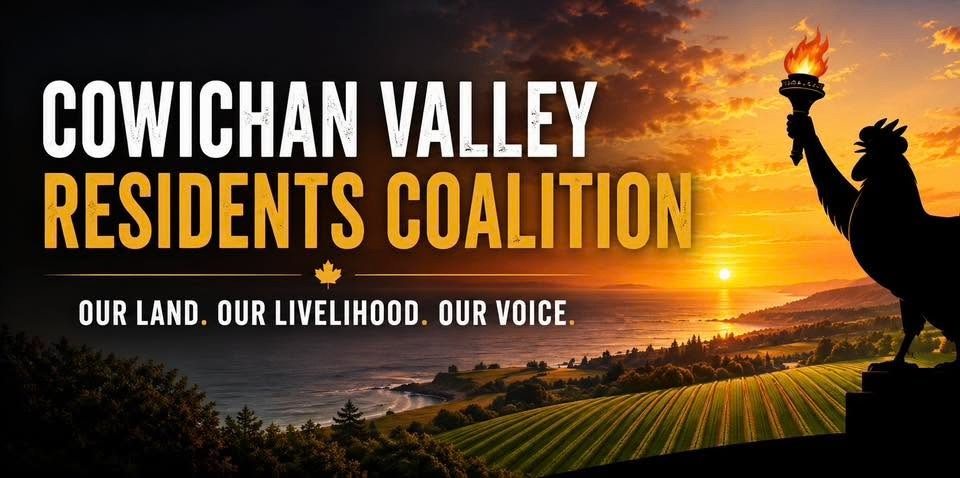
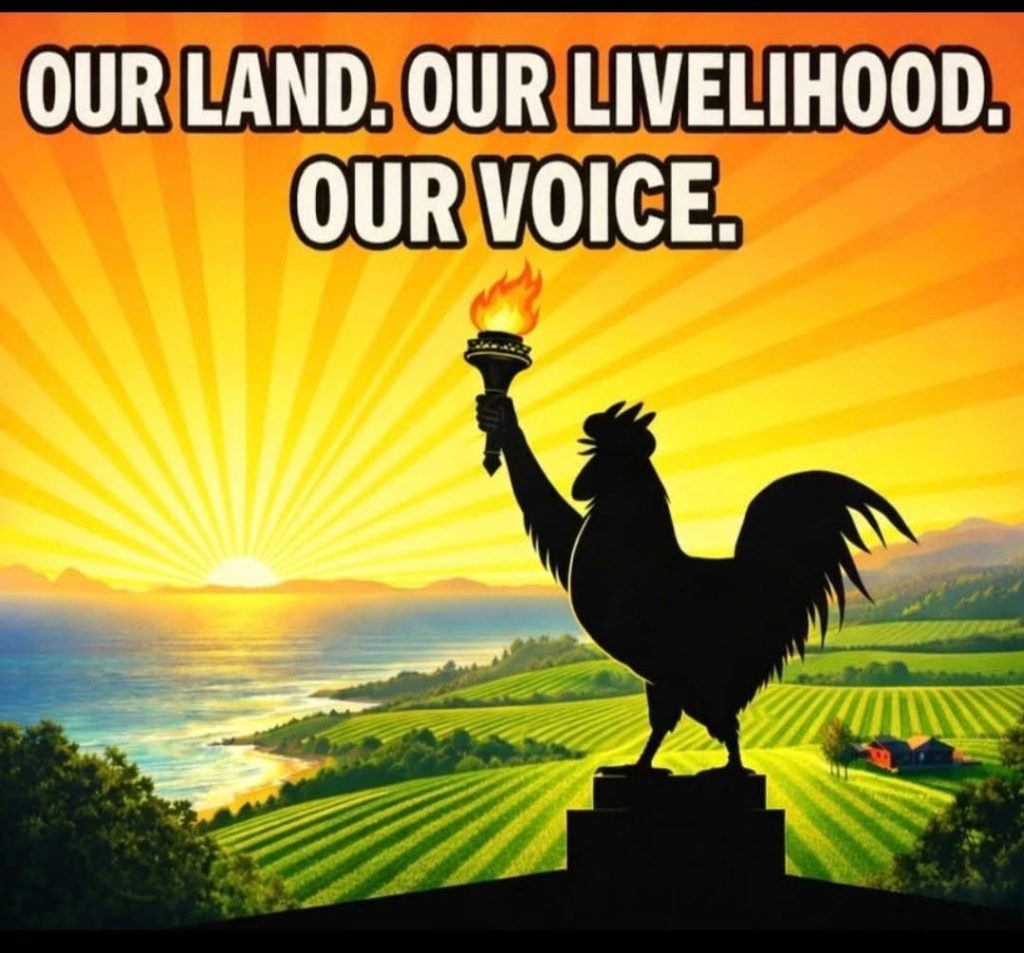
Within those Facebook groups and 17 others, Richards’ posting — both under her personal account and the Westward Independent — actively shared links to COAP’s Substack articles that called the legitimacy of the CVRD bylaw into question.
COAP declined to respond to The Discourse’s questions about its ties to the Westward Independent, Take Back Cowichan, BC Rising and the Facebook groups.
COAP’s Substack posts often cite real bylaw documents and figures, but pair that content with charged language and phrases like “ACTUALLY F YOU,” “Threaten to Kill Cowichan Valley Tourism” and “Let the Gaslighting Begin” and encourage readers to “call bullshit” on officials.
COAP also “translates” official CVRD communications, at one point rewriting a CVRD statement responding to community backlash paragraph by paragraph into what COAP called “plain English.”
Most of its posts end with a call to action urging readers to email directors or show up at meetings, and don’t include the CVRD’s response or note any attempt to get one.
Barker acknowledged she also uses emotional language in her own writing and advocates for a clear political position, and said that isn’t inherently wrong. In her view, it’s sometimes a legitimate way to bring people into a cause, as long as it’s “rooted in truth and evidence.”
The risk, she said, is when factual material gets “nefariously seeded with persuasive vocabulary” in a way that stirs emotion and drives people to act on something closer to disinformation.
Regan said language choices matter here too: articles written with words like “tyranny” and “despotic” can sow division and pollute public discourse. The questions worth asking of any such article are whether it’s clearly built to evoke anger or outrage, and whether it casts other people in the community or the government in “some diabolical way,” he added.
When asked what can be done about the spread of misinformation, Regan said local governments need to be proactive about communications and debunk claims as they see them, though he acknowledged that local governments typically don’t have a lot of resources for communication and engagement.
The CVRD did add more clarifications to its frequently asked bylaw questions page on its website over the course of 2026, according to Internet Archive.
But with the increasingly complex ways in which people receive information, the person sharing the message also matters, Regan explained. Someone distrusting of local government may be more likely to believe a farmer, for example.
“Finding effective ways to communicate to and engage with local communities needs to be resourced better because of these challenges,” Regan said.
Who won, in the end?
On April 22, after the protests and a series of tense committee meetings, the CVRD board voted to pause Bylaw 4710 until after the October elections.
Representing COAP at a BC Rising meeting on April 29 that was attended by The Discourse, Richards said the success of the campaign to reverse the bylaw was not just a result of COAP’s efforts.
“This isn’t my win. It’s not COAP’s win at all. We just played a little tiny part. It was a community win, so this is not at all about us,” she said at the April 29 public meeting. “This was absolutely 100 per cent community.”
The community was direct in expressing its frustrations to the board. In a letter to the editor of the Cowichan Valley Citizen, one attendee recalled a resident who threatened to “use his excavator to bury any CVRD employee who entered his property to enforce the bylaw” at an April public meeting about the proposed bylaw changes. According to the letter, subsequent speakers said the directors brought the hostility from the community upon themselves.
One portion of the meeting recording posted to YouTube was removed and The Discourse could not confirm the threat, but a representative from the CVRD said the livestream was edited because the speaker used inappropriate language and profanity.
Research cited in a report from the Public Policy Forum after the 2025 Canadian federal election found that a decline in local news coverage can lead communities to be less trusting of one another and more polarized. As the first federal election since Meta’s ban of Canadian news on Facebook and Instagram, the report describes it as “likely the most poorly covered election in modern Canadian history.”
The vacuum left by local media is often filled with national news, which tends to be more divisive, and social media, “where truth and falsehood compete on equal terms,” the report adds.
That division, in turn, is fueling real world consequences for elected officials. A recent survey by Canadian Municipal Barometer found that 63 per cent of elected officials reported they had experienced some form of harassment during their term or campaign.
In 2024, the Federation of Canadian Municipalities declared harassment a serious problem for elected officials especially for “women, Black and racialized, and 2SLGBTQIA+ representatives.”
Duncan city councillor Jenni Capps echoed that sentiment in a recent series of Instagram posts where she spoke about harassment she has seen and experienced locally.
While she said it’s important for people to be free to criticize governments, that criticism should not be directed at individual elected officials and feedback should be given through proper channels rather than in Facebook groups.
Kate Graham, a political scientist and instructor of local governance at Western University and Huron University, has researched harassment in local politics. She spent a decade working for the City of London, Ont. and ran twice as a candidate for the Ontario Liberal Party in London North Centre.
Globally, she said research shows that polarization and divisive discourse online has transformed the tone and experience of local politics. “At the local level, politics can become quite heated. It can become quite personal. It can be, at times, quite uncivil as an experience for the people who step forward to lead.”
Though more research is needed and the impacts are hard to measure, “there is a discouraging effect of a hyperpolarized political environment on particularly the sort of more reasonable middle ground consensus-oriented people who would like to contribute but just aren’t interested in that kind of an environment,” Graham said. Evidence suggests this is especially true for underrepresented groups.
More than a thousand communities across Canada are heading into an election this year, Graham added, and local government and elections officials are not yet well equipped to respond quickly to division, misinformation and harassment — though growing public discussion is starting to change that. More conversations are needed, and it can help to come back to why people engage in local politics in the first place.
“There is a shared interest in communities and in making good decisions for communities,” Graham said. “I think we need to start prioritizing and recognizing how important the way we engage in politics is to the practice and the effectiveness of politics. So, holding yourself to account, holding the people around
you to account, and expecting better from one another on how we treat other people is a democratic contribution, in my opinion.”
In July, the CVRD announced it was the first regional board in B.C. to join the Elect Respect pledge, an initiative launched by Mayor Marianne Meed Ward of Burlington, Ont. that urges elected officials, candidates and the public to “pledge to foster respect, inclusivity and safety in public life.”
COAP did not answer The Discourse’s question about concerns that its anti-bylaw campaigning may have stoked division and harassment of local officials.
In an emailed response, COAP stated many of The Discourse’s questions “appear to repeat allegations and framing already circulating among openly hostile local political commentators.”
For Barker, her biggest concern is how the backlash will impact the upcoming municipal elections this fall. She’s worried that politicians will be voted in “based on untruths” and then be influenced by public demand for them to vote “on issues in a way that is not representative of facts.”
“Council members or people who are running for election will run on these platforms and the people are being miseducated about what’s going on,” she added.
Editor’s Note, Aug. 19, 2026: The Discourse incorrectly reported that the CVRD board voted to pause Bylaw 4710 on April 10. The vote to pause the bylaw process until after the October election actually took place on April 22.
The Discourse also incorrectly reported that the board voted to scrap the bylaw all together on May 27. The May 27 vote was actually to start the process to repeal Bylaw 4373, the Cowichan Valley Regional District Official Community Plan. Bylaw 4710 has not been scrapped but work on it, including staff and consultant activities related to it, have ceased until after the October 2026 General Local Elections and the adoption of a new board-directed corporate strategic plan. This story has been updated to reflect these changes. The Discourse apologizes for these errors.
What did you think of this story?
Your feedback after we publish a story helps ensure we're always improving our reporting to better serve you
Related Articles

Voting in the 2026 Cowichan Valley local elections? Here’s what you need to know
Where, when and how to cast your ballot in North Cowichan, Duncan, Ladysmith, Lake Cowichan and the Cowichan Valley Regional District for the 2026 local elections.

Cowichan Valley candidates on protecting the community from climate change
Candidates in Duncan, North Cowichan, Ladysmith and Lake Cowichan share the steps they’d take to protect the community from the impacts of climate change.
Here’s how Cowichan Valley’s municipal candidates will respond to the homelessness and mental health crises
Cowichan Valley’s 2026 candidates share how they’d respond to issues related to homelessness, mental health and addiction.