
What’s in the Cowichan Valley Regional District’s draft comprehensive zoning bylaw?
The Discourse takes a deep dive into the 322-page document that combines nine existing zoning bylaws into one.
Editor’s note April 13, 2026: On April 10, 2026, the Cowichan Valley Regional District said it will postpone all open house sessions on the comprehensive zoning bylaw as it updates its timeline for public engagement. The article has been updated to reflect this.
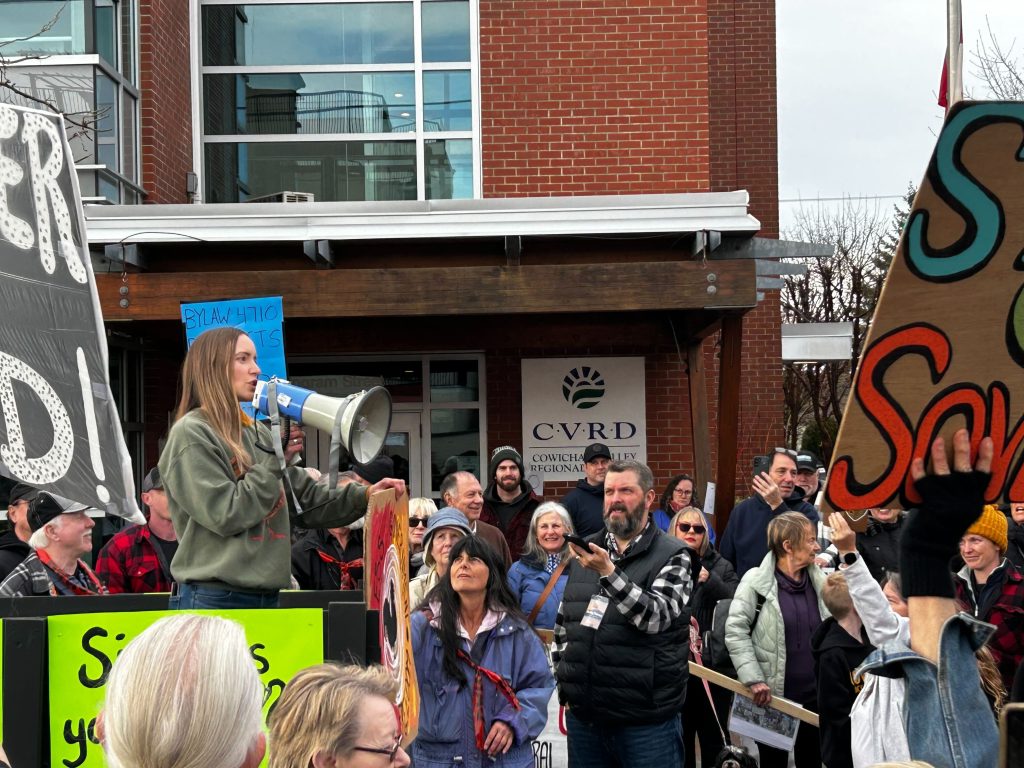
A draft Cowichan Valley Regional District (CVRD) bylaw has become a topic of debate in the community, drawing protestors to the district’s head offices and sparking backlash online. At its latest special electoral area services meeting on April 1, the district received more than 265 emails from residents commenting on the new bylaw.
The Comprehensive Zoning Bylaw consolidates nine electoral area-specific bylaws into one 322-page document. It standardizes zoning designations, puts a cap on the size of accessory suites, introduces new setback rules for agricultural land and adds new regulations for things such as food trucks and beekeeping.
But some of the most contentious parts of the proposed bylaw — including the use of recreational vehicles and tents as permanent dwellings, the keeping of roosters, fence heights, the ability to grow food on residential properties and the bylaw’s fine structure — have largely remained unchanged from the area-specific bylaws.
A Facebook group named Neighbours against new CVRD Bylaws was created in response to the proposed consolidation of bylaws and has grown to have nearly 7,000 members since March 27. Meanwhile, another smaller group on Facebook called Cowichan Clarified includes members who are seeking clarification around what’s being shared about the bylaw, with members pointing out misinformation that is being widely shared online.
Local resident and educator Jessica Barker said she created Cowichan Clarified as a space for residents to come together to analyze local media and political issues with the goal of strengthening civic education in the Cowichan Valley.
“I hope we can get to know each other through having authentic conversations as we go through the material, and this includes working through items we disagree on,” she said in an email statement to The Discourse.
According to the CVRD, consolidating all nine existing bylaws will simplify zoning regulations, making them easier for residents to understand and more cost-effective to administer.
Some concerned residents took their grievances to the regional district offices on Tuesday, March 31, partially blocking Ingram Street in protest against the draft bylaw. Demonstrators carried signs reading “CVRD you work for us,” “Bylaw 4710 does not reflect rural life,” and, “No to 4710.”
Elsewhere in the region, a local food truck owner fears the new bylaw will put her out of business. Reana Borthwick has operated Drifters Creamery, a soft serve ice cream truck in Cobble Hill for four years. She told The Discourse the bylaw’s new restrictive rules around food trucks will force her to leave the regional district.
“I feel like it’s creating a problem when there isn’t one and it’s affecting the livelihood of my business,” she said.
The bylaw is still under review by the CVRD and the community will have an opportunity to give feedback on it at future public engagement sessions.
In a news release on April 10, the CVRD said that based on the level of community feedback, it was postponing previously-scheduled open houses that were to begin in May. Future dates for public engagement will be decided after an electoral area services committee on April 15 and a regular board meeting on April 22.
“We want residents to know we’re listening and that we care about getting this right,” CVRD board chair Kate Segall said in a press release.
But some residents say they worry their voices won’t be heard or taken into account by elected representatives.
“They need to know that we are not happy about what is going on and that we actually don’t trust them,” said resident Savannah Wright at the protest.
The Discourse dug into the new proposed bylaw and spoke with community members and CVRD board members to address community concerns and bring clarity to some of the proposed changes — as well as some of the things that are staying the same. Click through the drop-down items below to learn more.
We may add to this document as more information and questions come up, so please check back! We’ll do our best to communicate any changes and updates in our Cowichan Valley newsletters. If you have any questions or concerns about the proposed bylaw that you’d like to see us address, send an email to cowichan@thediscourse.ca.
Changes Impacting small business
Food trucks are not covered under their own section in the current area-specific bylaws except for a small exception for the Malahat Skywalk in Area A, but the new proposed comprehensive bylaw introduces specific rules for mobile food vendors.
The biggest concern for Borthwick are the strict conditions food trucks must follow according to the new proposed bylaw. It limits food trucks to eight hours of operation per day and requires them to pack up and move after closing.
For Borthwick, neither rule works for her business. Setting up takes her a day-and-a-half, and her ice cream machines are too powerful for a generator, requiring a permanent electrical connection. She also feels it’s unfair to restrict her hours just because Drifters operates out of a food truck.
“I just don’t have the capacity. It’s not viable to move the truck every day so it would force me out of the CVRD,” she said.
The bylaw would also restrict where Borthwick can operate. Food trucks would be prohibited on any parcel of land that already has a restaurant and the trucks could not open in a location that takes away parking spaces.
In addition, the bylaw would restrict the creation of a permanent “food truck village,” similar to the Food Garden outdoor food court on Salt Spring Island, Borthwick said.
“There are so many areas on Vancouver Island and other places in this country that have food truck villages, and people just love going to those because it creates a sense of community,” she said.
Borthwick said she hopes the regional district will use the public feedback process to rework the bylaw into something that is more food-truck friendly. She pointed out that the City of Duncan requires food trucks to get written permission from restaurant owners if they want to operate near them, something that could be implemented in the CVRD as well.
“I just think that there could be a good compromise with how the bylaws are written so it works both for food trucks and for them [the CVRD] to enforce the rules,” Borthwick said.
Lack of public engagement
Protestors at the CVRD offices on March 31 said they were concerned about what they perceived as a lack of public engagement and public consultation on the proposed bylaw. They pointed to a staff recommendation that the CVRD not hold a public hearing for bylaw 4710 as an example of this.
Board chair Kate Segall told The Discourse the recommendation from staff to not hold a public hearing only referred to marine zones, which are not part of the comprehensive zoning bylaw.
She confirmed that there will be a public hearing for bylaw 4710 after the public engagement process is complete. The timing of the hearing is important because once the district holds one, they legally cannot accept more public feedback, according to Segall.
“We actually want to make sure that we create enough space to effectively gather the right input before we get to that stage,” she said.
Segall said all of the feedback gathered from the open houses in May will be compiled into a report which will then be presented to directors for incorporation into the finalized bylaw.
“We do really care and we want to get this right,” she said.
Recreational Vehicles
Across the nine original bylaws and the new draft comprehensive bylaw, the rules pertaining to living in recreational vehicles (RVs) on a property you own have not changed.
The original bylaws prohibited the use of a tent, trailer or RV as a permanent or temporary residence unless the person living in it is in the process of constructing a permanent dwelling.
The new bylaw similarly states that a “tent, trailer, recreational vehicle, park model unit, bus, or other motor vehicle shall not be used as a residence” except as a temporary dwelling.
Residents are still permitted to live in an RV on a temporary basis if they have a building permit for a permanent residence to be built on the same parcel of land and if they occupy the RV for less than 12 months. As soon as the permanent dwelling is occupied, the residents must stop living in the RV.
Enforcement of the draft bylaw
Residents are concerned that the new bylaw will change how the regulations are enforced, giving bylaw officers the power to enter a property at any time without the owner’s consent.
Currently, bylaw officers operate on a complaints-based system, meaning that they will investigate non-compliance based on complaints received about a specific property.
This will not change under the consolidated bylaw, according to Segall. She also added that they have directed CVRD bylaw officers to prioritize “voluntary compliance,” which does not involve any fines.
The regulations governing when bylaw officers can enter a property are also staying the same.
Officers can only enter properties at “reasonable times” and do not require the property owner’s consent to do so. It remains an offence to prevent or obstruct a bylaw officer from entering a property.
Fines for non-compliance
The fine structure for the new comprehensive bylaw does not differ from the current area bylaws.
There are three ways the regional district can fine a property owner for non-compliance:
Municipal Ticket Information which carries a maximum fine of up to $3,000.
Bylaw Offence Notice carrying a fine of up to $500 formal charge in the provincial courts under the Offence Act to a maximum of $50,000. However, that fine can only be ordered by a B.C. Supreme Court Judge.
Contrary to posts being circulated online, the CVRD cannot fine an individual $50,000. The legal maximum is $3,000. The formal charge in the provincial courts is reserved for serious zoning bylaw violations, whereas the Municipal Ticket Information and Bylaw Offence Notice is used for minor to medium offences.
Accessory dwelling units
While the regulations around accessory dwelling units have largely stayed the same, there have been a few notable changes to the maximum size of units and setbacks to natural waterways.
Under the current bylaws, attached units are capped at 95 square metres of gross floor area on non-Agricultural Land Reserve properties. The new proposed bylaw has increased this to 111.5 square metres. Attached units on properties zoned A-1, A-2 or those that are within the Agricultural Land Reserve and less than 40 hectares in area are capped at 90 square metres of gross floor area under the new bylaw.
The draft bylaw states that detached suites cannot be located within 60 metres of a natural boundary of any watercourse or within 30 metres of the natural boundary of the Koksilah River.
Like the current bylaws, owners are still only allowed one attached suite or one detached suite on a single parcel.
Setback rules
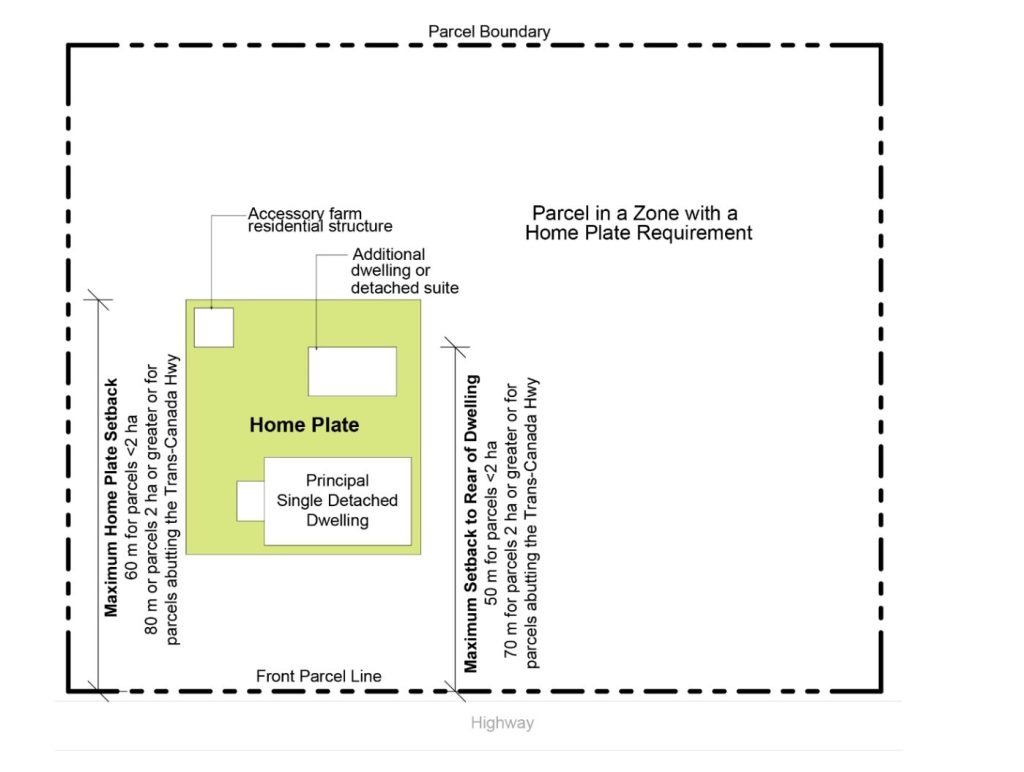
The current bylaws do not require an owner to build their home in a specific spot on the property. In the new proposed bylaw, if a property is in an Agricultural Zone (A-1 or A-2) and is less than two hectares, property owners must cluster the principal dwelling, suites and accessory buildings within either 60 metres of the front or side parcel line, which it calls a “home plate.” For larger properties over two hectares, the maximum distance is 80 metres.
The maximum setback from the front parcel line or exterior side parcel line to the rear of the principal dwelling, additional dwelling or attached suite is 50 metres for parcels under two hectares or 70 metres for parcels two hectares or more, or those abutting the Trans-Canada Highway.
The new bylaw increases the setback distance between a home and a the natural boundary of a major water course — including the Cowichan River, Koksilah River and Chemainus River — or active floodplain to 50 metres, or 30 metres from the top of a ravine bank, depending on which is greater. All other oceans, lakes or streams require 30 metres of distance from the natural boundary or active floodplain, or 10 metres from the top of a ravine bank, whichever is greater.
Zoning designation changes
Under the current bylaws, the name designations of zones such as RR-1 (Rural Residential 1) and RR-2 (Rural Residential 2) mean different things depending on which electoral area you are in.
The new draft bylaw standardizes these names across all areas and as a result, some properties will have zoning designations changed to match the new definitions if the bylaw comes into effect.
The Cowichan Valley Regional District has a map tool that allows residents to find their property and check to see if the zoning designation will change.
One reader asked us to look into what would happen to their ability to conduct agricultural operations on their property if the designation was changed from R-2 (Residential 2) to R-1 (Residential 1). Under the current bylaws, some areas such as Shawnigan Lake and Cowichan Station are more lenient towards farming/agriculture on residential lots.
The draft bylaw does not permit agricultural operations on R-2 or R-1 properties, however, it does still allow for horticulture which is defined in the new bylaw as the “practice of growing fruits, vegetables, flowers, non-invasive plants or ornamental plants.”
Backyard chickens and beekeeping
The Discourse is continuing to look into regulations specifically related to backyard chickens. While some current bylaws do reference chickens in some way (either as hens, poultry or chickens), some do not and instead use the term “agriculture,” which includes the keeping of livestock. This adds confusion to what is currently allowed in some areas and zones. The Discourse has reached out to the CVRD for clarification on what is currently allowed, and what changes are being proposed, but has yet to receive a detailed response to this question.
Depending on where you live under the current bylaws, the amount of hens you can keep in a backyard varies widely based on parcel size, or isn’t currently allowed on some residential lots. Some of the current bylaws make no mention of hens or chickens, but do classify the term “agriculture” as “growing, rearing, producing or harvesting livestock or agricultural crops other than cannabis” and allow agriculture in some areas zoned as residential.
For example, Saltair/Gulf Islands allows up to 12 chickens on a parcel of land 0.4 hectares or larger on R-2 and R-2A zones under “restrictive agriculture,” while Cowichan Bay permits five hens on a property that is more than 700 square metres and less than 0.4 hectares. Properties larger than 0.4 hectares in Cowichan Bay must comply with regulations for limited agriculture instead. Agriculture is allowed on lots zoned as rural residential or suburban residential in Cowichan Station/Sahtlam/Glenora but not on urban residential lots, although chickens or hens aren’t specifically mentioned in the bylaw for this area.
Across the current and draft bylaws, roosters are either not mentioned or are prohibited on residential properties and only allowed in areas designated for agriculture or limited agriculture.
The new draft comprehensive bylaw applies a four-chicken limit to parcels of 0.2 to 0.4 hectares and a six-chicken limit on parcels greater than 0.4 hectares where backyard chicken keeping is permitted.
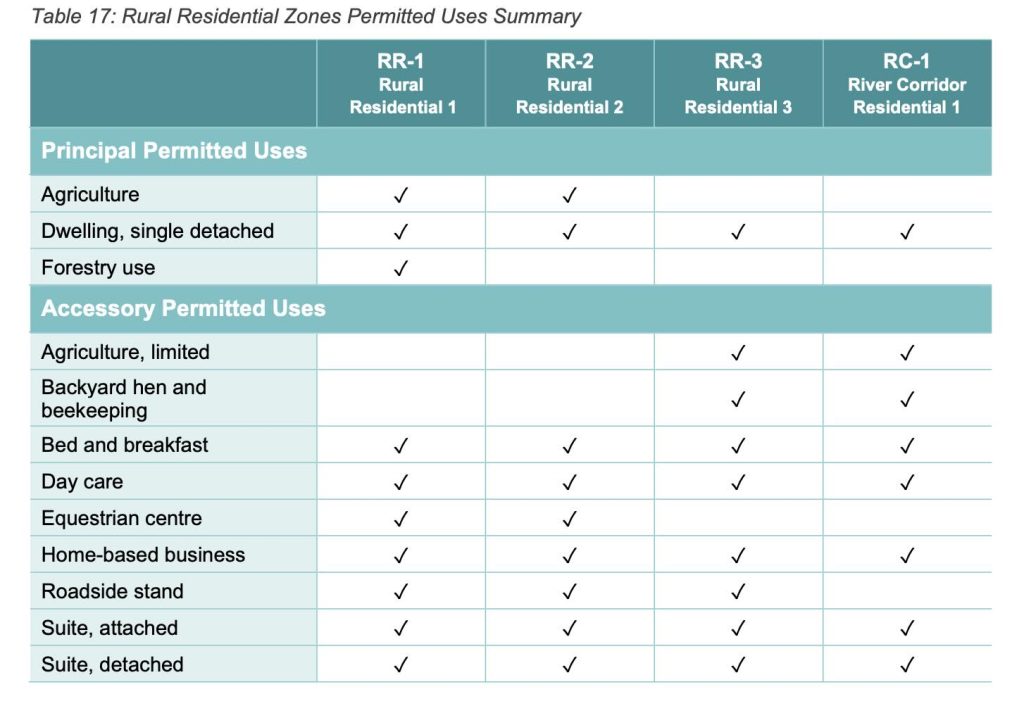
Rural Residential 1 and Rural Residential 2 designated properties would not be permitted to keep hens as an accessory use according to a table in the draft bylaw, although agriculture is an allowed principal use and includes keeping poultry. Meanwhile, the draft bylaw doesn’t allow agriculture as a principal use on properties zoned Rural Residential 3 or River Corridor Residential 1, but does allow backyard hen and beekeeping and limited agriculture as accessory uses.
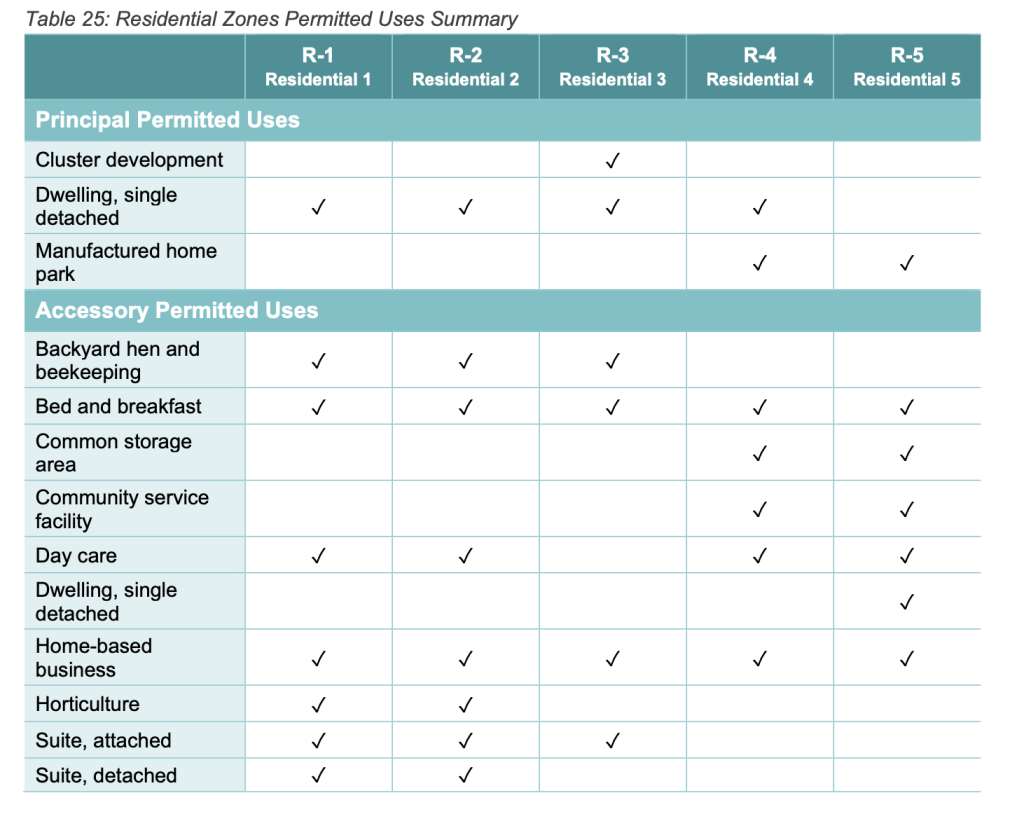
Residential 1, 2 and 3 designated properties are permitted to keep chickens while residential 4 and 5 cannot.
Under the current area-specific bylaws, there are no unified regulations on disposal or slaughtering of dead chickens. Under the new proposed bylaw, slaughtering is not permitted on residential properties and all hens must be disposed of at a livestock disposal facility or by a veterinarian.
The Discourse reached out to the CVRD to ask for clarification on how the rules pertaining to keeping hens in the draft bylaw would impact these various properties and was sent the following response via email:
“As this is a draft bylaw, things can change as we move through this process,” a spokesperson for the CVRD wrote. “The early draft zones will be carefully considered over the months to come and it will be resolved when a bylaw is presented to the board for first reading.”
There are no specific regulations on beekeeping under the current bylaws, although some of the current bylaws classify “intensive agriculture” as the “commercial use of land” for purposes such as beekeeping, rearing and processing livestock and poultry, and more.
The new draft bylaw introduces limits of two beehives on parcels of land between 601 and 929 square metres and four beehives for parcels 930 square metres or larger. Parcels that are 600 square metres or less are not permitted to keep bees.
Beehives must also be located in the backyard or on the roof and must be a minimum of 7.5 metres from any parcel line, among other regulations that determine beehive placement and infrastructure.
Equestrian rules
Similar to rules on chickens, under the current bylaws equestrian regulations are also fragmented and varied depending on what area you live in. Equestrian buildings, such as stables and riding arenas, are broadly treated as typical agricultural buildings.
The new bylaw states that an equestrian centre cannot be operated on a parcel of land unless it is larger than four hectares.
Food truck regulations
Originally, only the Area A and C bylaws mention food trucks and that is specifically in relation to the Malahat Skywalk.
The draft bylaw formally defines what a food truck is and sets restrictions on when and where they can operate.
Food trucks are prohibited from operating on the same parcel of land as an existing restaurant in the new bylaw.
They are also only allowed to operate for eight hours a day and must move after they close. Operators cannot build any permanent structures related to the food truck or take up any existing parking spaces.
Fence heights
Fence heights have been standardized across all areas in the draft of the new comprehensive bylaw.
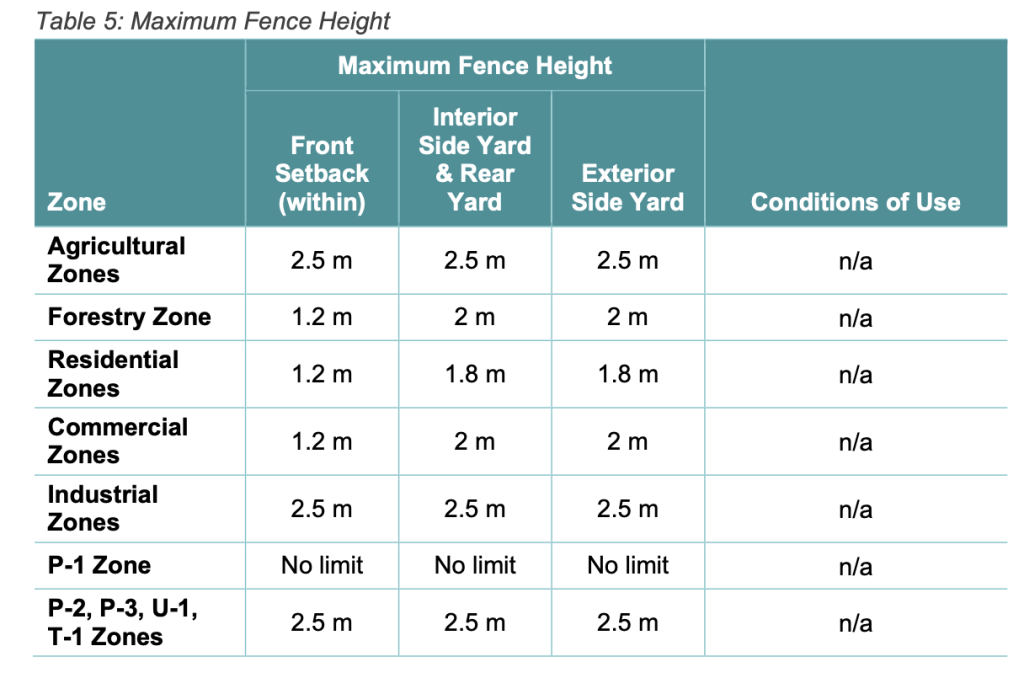
In the new proposed bylaw, residential properties still have a fence height limit of 1.2 metres along the front setbacks while the maximum fence height in agricultural and industrial areas remains 2.5 metres, except for Area H and B which did not have a maximum height for fences on agricultural properties.
Some areas under the current bylaws allow for two-metre-high backyard and side fences for residential zones, but the new proposed bylaw caps the height of backyard fences in all areas at 1.8 metres.
Commercial properties under the new bylaw are restricted to fences of 1.2 metres in height in the front and two metres in the side and rear of the property. Under previous bylaws, some commercial parcels could have fences up to 2.5 metres tall.
Definitions from the draft bylaw
Setback: The minimum required horizontal distance between a building or structure and a specified parcel line or other described feature.
Parcel: A lot, block or other area of land in which land is held or into which land is subdivided whether under the Land Title Act or Bare Land Strata Regulations under the Strata Property Act.
Home plate: The area of residential footprint on a parcel within an Agricultural Zone, which comprises the portion of a parcel that includes a principal dwelling, accessory dwellings, and accessory farm residential facilities.
Agriculture: the use of land, buildings, or structures for the growing, rearing, producing, or harvesting of livestock or agricultural crops, and includes the processing on a parcel of the primary agricultural products harvested, reared, or produced on that parcel and the use and storage of associated farm machinery, implements, and agricultural supplies.
Accessory: a use, building, or structure which is incidental to, subordinate to, and exclusively devoted to a principal use, building, or structure that is located on the same parcel or that is located on common property within the same strata plan as the principal use, building, or structure.
Backyard hen and bee keeping: the keeping of domesticated hens/chickens and/or bees on a parcel as an accessory use to a principal residential dwelling.
Food truck: means a truck or trailer from which a vendor sells goods, food, or food products and which is capable of being moved on its own wheels and is fully self-contained with no service connection required.
AI disclosure: NotebookLM was used to compare 10 different bylaw documents (from nine electoral areas and the new proposed bylaw) to find differences between them and to aid with the research process for this story. Everything has been independently fact-checked against the original documents by humans — the reporter and editor of this story. Use of this tool allowed us to quickly and accurately respond to community questions regarding a developing issue.
What did you think of this story?
Your feedback after we publish a story helps ensure we're always improving our reporting to better serve you
Author

Related Articles

Voting in the 2026 Cowichan Valley local elections? Here’s what you need to know
Where, when and how to cast your ballot in North Cowichan, Duncan, Ladysmith, Lake Cowichan and the Cowichan Valley Regional District for the 2026 local elections.

Cowichan Valley candidates on protecting the community from climate change
Candidates in Duncan, North Cowichan, Ladysmith and Lake Cowichan share the steps they’d take to protect the community from the impacts of climate change.
Here’s how Cowichan Valley’s municipal candidates will respond to the homelessness and mental health crises
Cowichan Valley’s 2026 candidates share how they’d respond to issues related to homelessness, mental health and addiction.