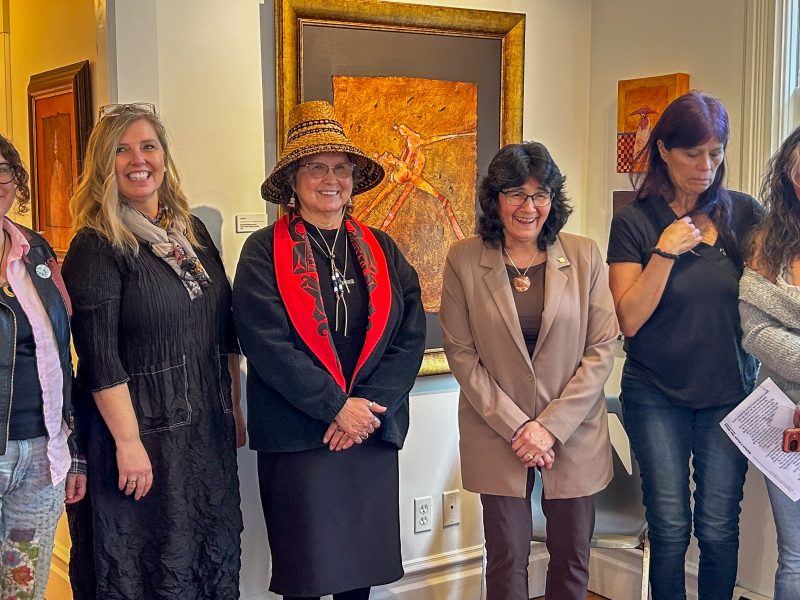

Community members gathered at the Cowichan Estuary Nature Centre on Saturday, May 31 to celebrate the Quw’utsun (Cowichan) and Xwulqw’selu (Koksilah) Estuary and witness the gifting of a hand-carved wooden salmon rattle by Kwakwa̱ka̱’wakw Elder Tlithl’Kawi (Rupert Scow). It is an offering that honours both the salmon and the shared history of the Kwakwa̱ka̱’wakw and Quw’utsun Peoples.
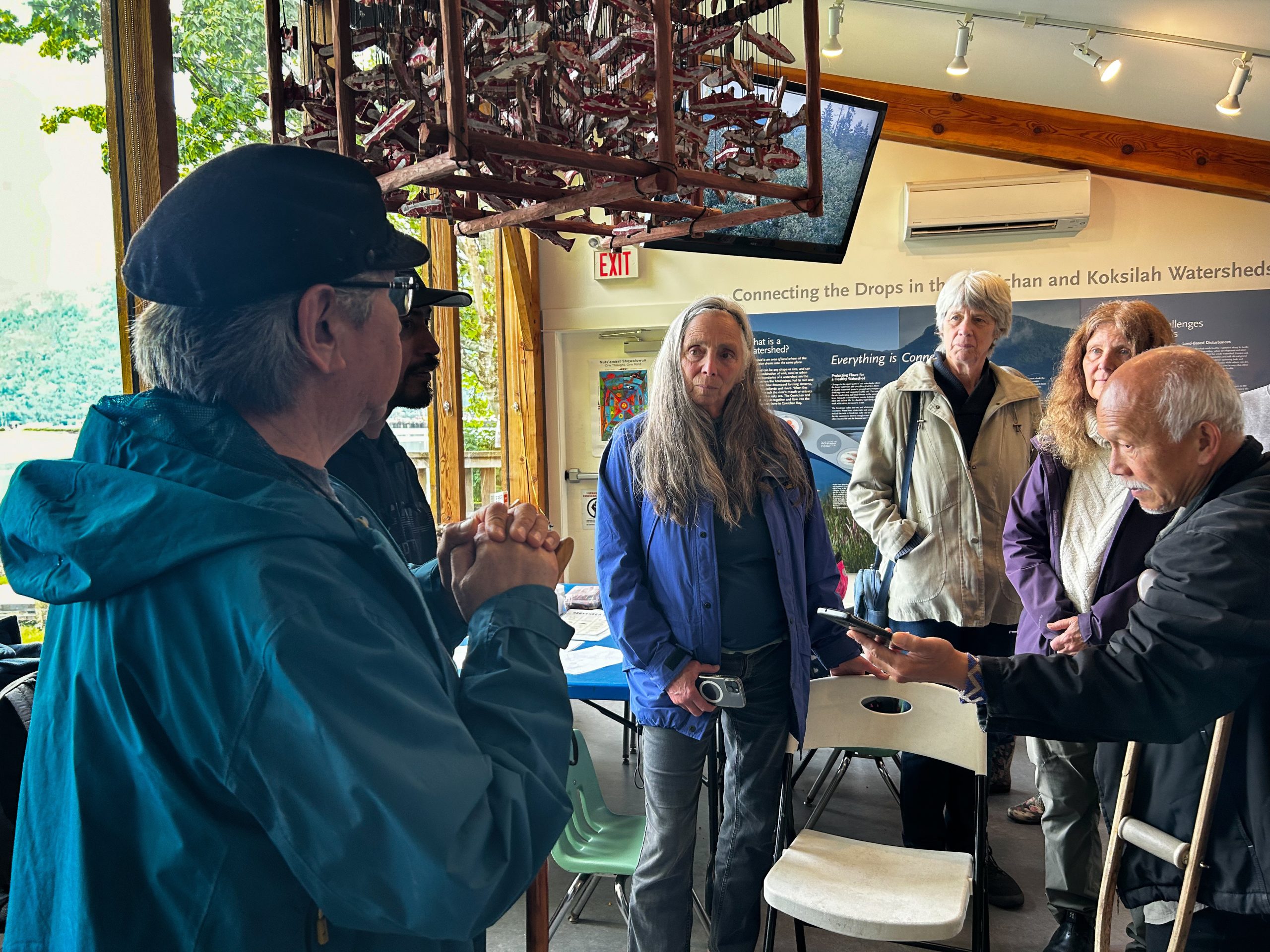
The rattle hangs directly next to the door as visitors walk into the nature centre. Light from the massive floor to ceiling windows catches the hundreds of red and silver salmon contained within the wooden box frame of the rattle.
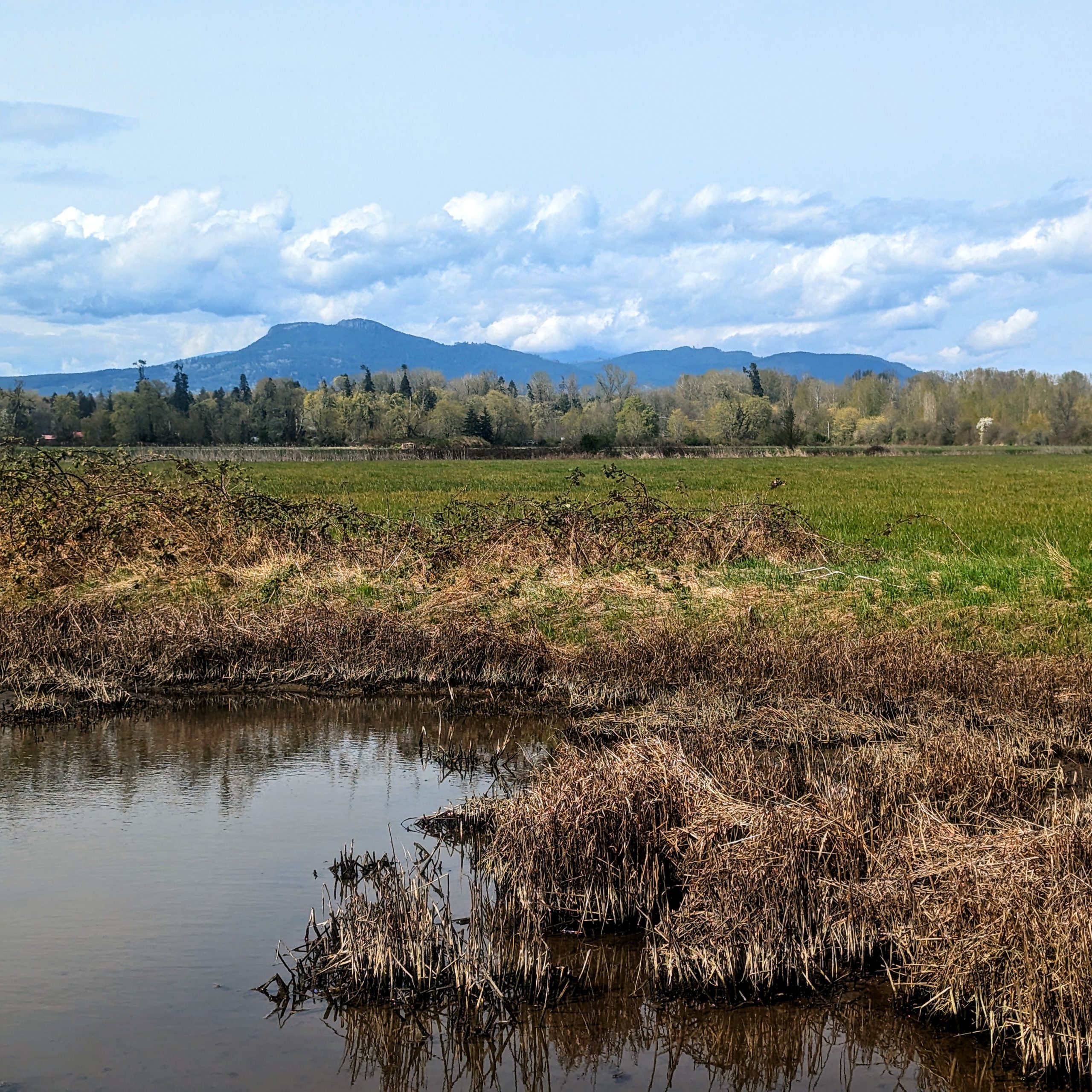
The nature centre is situated along the Cowichan Estuary, a 400-hectare ecosystem where the rivers meet the ocean. It is home to fish and other marine life as well as migratory and resident birds, seals and sea lions. Juvenile salmon from the Quw’utsun and Xwulqw’selu Sta’lo take shelter amongst the eelgrass beds in the estuary before making their way out into the ocean. It is also where the salmon return every year before swimming up river to spawn. The estuary is one of the most important in B.C. when considering its ecology and for millennia, Quw’utsun People have sustainably harvested food, such as salmon and shellfish, from the estuary.
When Tlithl’Kawi met with the centre to discuss hosting the artwork, he immediately knew it was the right place for the rattle.
“I saw everything here,” he said as he motioned to the various displays and activity stations around the centre after the celebration. “It just fits in.”
Sierra Harvey, executive director of the Cowichan Estuary Nature Centre, said incorporating more Indigenous perspectives is a priority for the centre, and she hopes this is the first of many steps toward making it not just a hub for learning, but also a hub for culture.
“We’re really trying to bring in the intersection of the social and cultural, both pieces that nature education in the past has never really acknowledged … I think that is a deep part that’s missing in nature education,” she said. “It’s a symbol of what we want to honour moving forward.”
A salmon rattle with history
Tlithl’Kawi is Kwikwasut’inuxw (the People of the Bear) — part of the larger Kwakwa̱ka̱’wakw tribal grouping — from Gwa’yasdams village on Gilford Island near Alert Bay. He comes from a line of carvers who are renowned for their totem poles and articulated masks, including his great grandfathers, Chief John Scow on his mother’s side and the acclaimed master carver Chief Mungo Martin.
Standing next to the rattle, Tlithl’Kawi addressed the crowd of 30 attendees to open the celebration.
“In our culture a smaller rattle was used to honor the salmon returning for the year,” he said.
Traditionally, a smaller version of the rattle would be used in a Kwakwa̱ka̱’wakw ceremony where a woman would dance with the rattle under her cloak, he said. At each corner of the Bighouse she turned counter clockwise to reveal the rattle, then shook the rattle to end the ceremony.
Tlithl’Kawi told the Discourse that the idea to create a large salmon rattle got its start when he was working as a carver in Vancouver with his brother. They had “absolutely no wood,” he recalled, and to make ends meet they used the leftover wood and scraps to make a small rattle containing sixteen fish.
“We brought it to a gallery and sold the piece, so we were able to buy more wood and we were back in business,” he said.
This version of the rattle, which has 200 individually carved salmon in it, is much larger than the first version but still follows the same pattern. The frame is made of dyed cedar sticks arranged in a grid and the salmon are tied to the sticks with string. A woven cedar handle is attached to the top of the rattle.
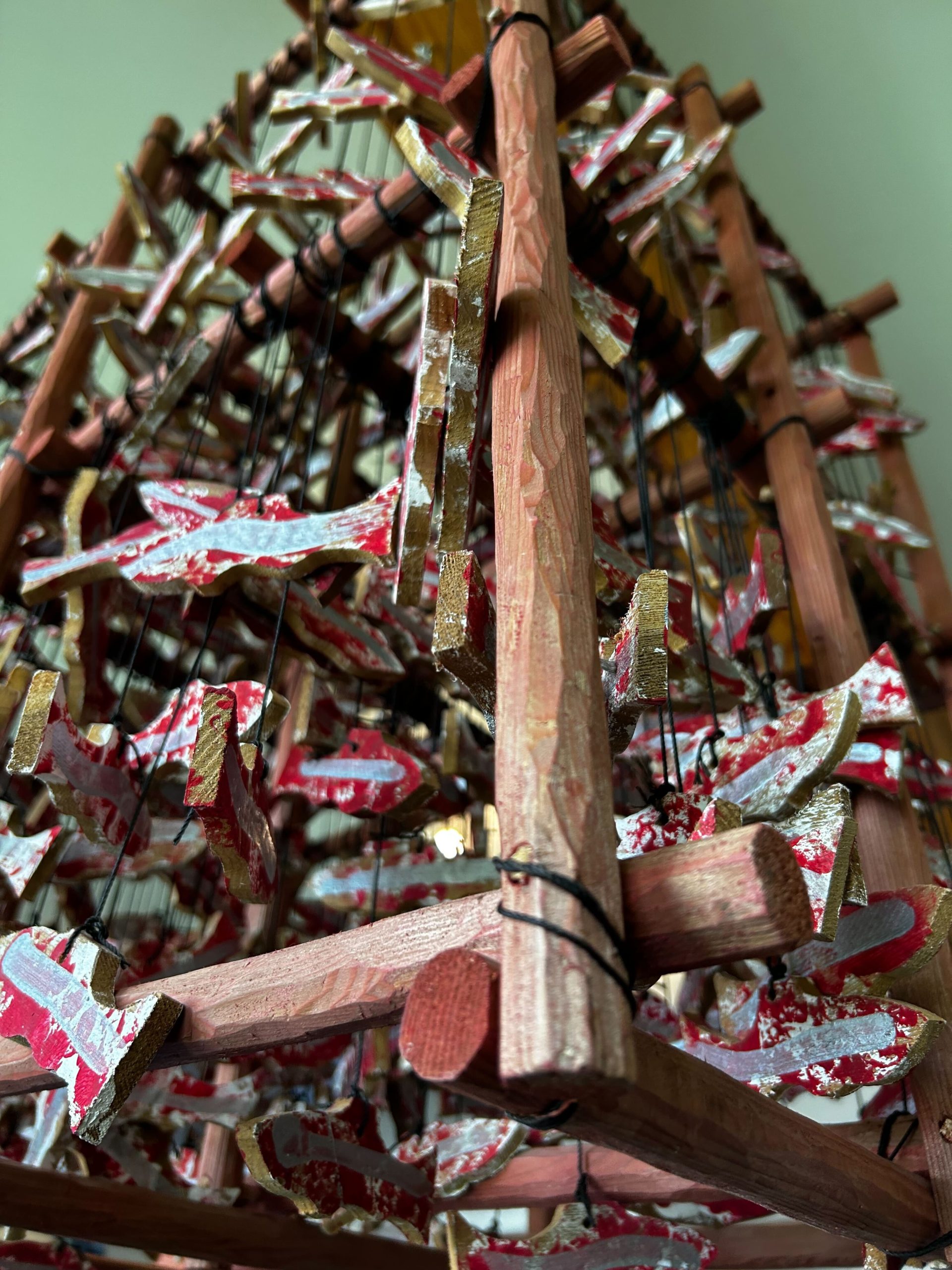
The salmon also vary in size with small ones representing males and the larger ones representing the females. “There’s always a male and a female,” he said. “Even in ourselves, there’s parts that are male and female.”
Tlithl’Kawi was grateful for the opportunity to tell the story of the rattle, where it came from and why it was so important to his culture. By dancing with the rattle, the Kwikwasut’inuxw would celebrate the first fish caught in the salmon run. It meant that salmon were returning and that a healthy salmon return meant “you’ll eat tomorrow.”
“It’s very respectful, the way they gave me a chance to tell the story of the rattle. That’s always important. To say, ‘Oh, that’s only a rattle,’ well what does that mean?”
Tlithl’Kawi compared the gifting of the rattle to a potlatch — a ceremony that not only celebrates events such as marriages, the passing on of chieftainship or the naming of a child, but also serves as a way to verbally record these proceedings, preserving them for future generations and embedding them in the community’s collective consciousness.
Harvey told The Discourse that eventually, the salmon rattle could be incorporated into an already existing section of centre that displays the salmon life cycle, a tank of baby coho salmon and map of salmon runs in the area. This would weave together the science of the fish and their place in Indigenous culture.
Harvey sees the future of the Nature Centre as a place to not only educate visitors from all over the world, but also lift up Indigenous voices and artists.
“I think some of these spaces haven’t been for everyone. In the past, they’ve been just very science focused but arts and culture are so much a part of that. We don’t need to separate the two in such distinct ways,” she said.
Medicine for the present
Quw’utsun artist Shawn Johnny was also present for the celebration and thanked Tlithl’Kawi for asking permission to leave the work of art on his territory.
Johnny remarked that not long ago, his nation and Tlithl’Kawi’s Kwakwa̱ka̱ʼwakw and Quw’utsun people were at war.
“Can we get along?” he laughed, “you know our nations were at each other’s necks up and down this coast, war after war, battle after battle. So when he approached me about it [the rattle], I said, ‘don’t worry it’s a new day we can start off fresh.’”
Tlithl’Kawi said what happened between both groups is in the past.
“It’s my feeling that no matter what it is, we have to work together so that we can walk in a good way and find a solution, regardless of what happens,” Tlithl’Kawi told The Discourse.
Johnny said he and Tlithl’Kawi have become close friends and hope they can serve as an example of how to reconcile their shared history.
“Bringing our nations together, it brings us together and we can be the medicine. That’s really important medicine just being with one another, it’s something everyone needs right now,” Johnny said.
Harvey said coming together peacefully for nature is “huge medicine,” especially in a world where individualism is put first.
“When it comes to restoration work or gatherings like this or even nature walks, it can remind us of our relationship with nature and that we aren’t separate from it,” Harvey said.