
Cowichan society keeps searching, advocating for missing and murdered people
The Cowichan Missing and Murdered Women, Men and Children Society is planning a gala and conference — and needs more sponsors and support.
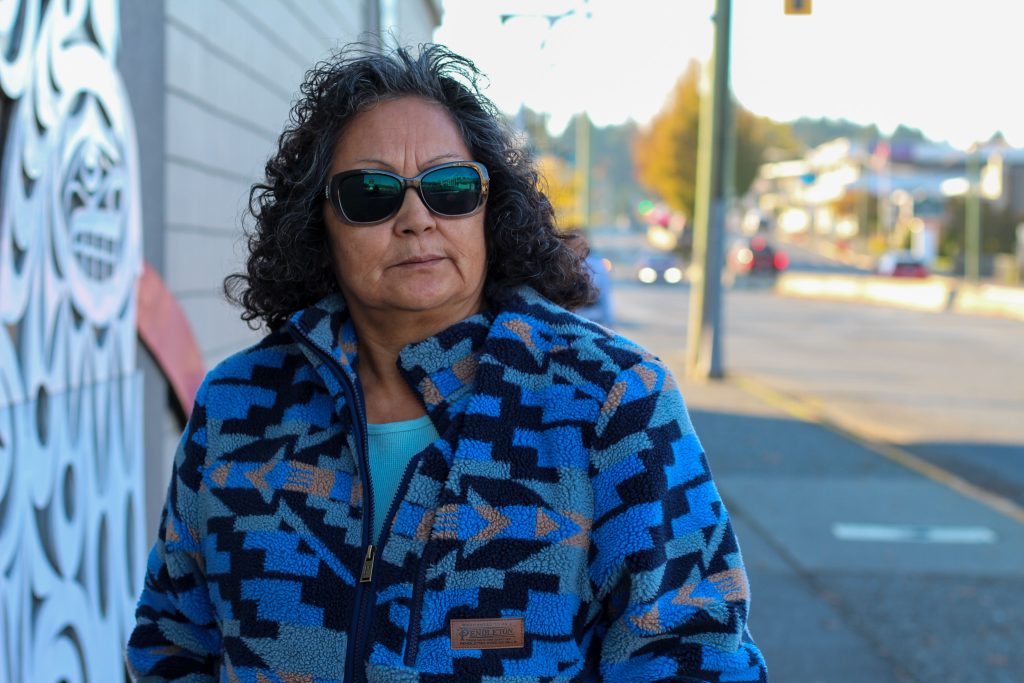
When Monica Patsy Jones receives a call about a missing Indigenous person in the community, she gets to work. With the support of five other women, Jones begins searching, starting with the last known location of the person and their regular hangouts in the Cowichan Valley. There’s no time to waste, she says.
And it’s not just when people call. Every day, Jones searches for Indigenous community members that have gone missing — no matter how long they’ve been missing for.
“We’ll get up and walk out there and meet up, and we’ll go look for this person until we find them and support the family in any way we can,” Jones says. “Whoever needs help, we’re there to help them.”
Jones has been doing this work since 1977, when her 27-year-old sister, Catherine Theresa Joe, went missing and was found, murdered, in Duncan. The murderer was never caught, but Jones hasn’t stopped looking for answers. Since then, she has founded the Cowichan Missing and Murdered Women, Men and Children Society and serves as its executive director to continue this work with the support of local volunteers.
The society also aims to raise awareness about the issue of missing and murdered Indigenous people, and advocate for solutions to a crisis that has been ongoing for decades.
“When it comes to us — Indigenous people — we don’t get any help. We don’t get any shining light on us and have the media [reporting] over and over again that our people are missing,” Jones says. “That’s why we recruit ourselves.”

Jones has organized multiple walks in the Cowichan Valley to raise awareness about the issue and support families of missing and murdered Indigenous people. She has also travelled to Ottawa to speak about the issue at the federal government level. Testimony from her family was included in the final report on Missing and Murdered Indigenous Women and Girls, and she has travelled throughout the Island and B.C. to share her personal experiences and what she witnesses as she seeks answers for herself and others.
Now, Jones is preparing for her largest event yet.
On Nov. 18, the Cowichan Missing and Murdered Women, Men and Children Society will host a gala at Mellor Hall. First Nations chiefs and other community leaders have been invited to learn and share about the issue of missing and murdered Indigenous people. But Jones isn’t stopping there.
Funds from the gala will go towards a conference, to be held in the near future, that will invite people from across the country to the Cowichan Valley to raise awareness and surface solutions for an issue that continues to impact Indigenous communities throughout Canada. It’ll be the first time a conference like this is held in the Cowichan Valley, Jones says, and an opportunity to push leaders to act.
“It’s having leadership under one roof … they’re all there. So what can they do to help us and how do we want them to voice themselves … at the federal and provincial level where they can speak in house?” Jones says.
While planning for the upcoming gala is in the works, Jones says she still requires more funding and support to make it happen, and is asking community members and organizers to step up to support this cause.
‘We’re still here, and we want answers’
Jones, a member of Cowichan Tribes, recalls one of her late aunts speaking about a relation that went missing in the 1950s and was never found. While growing up, Jones says she heard from Elders who spoke of missing and murdered cases that never went resolved. And she says the unsolved cases of missing and murdered Indigenous people continue to pile up.
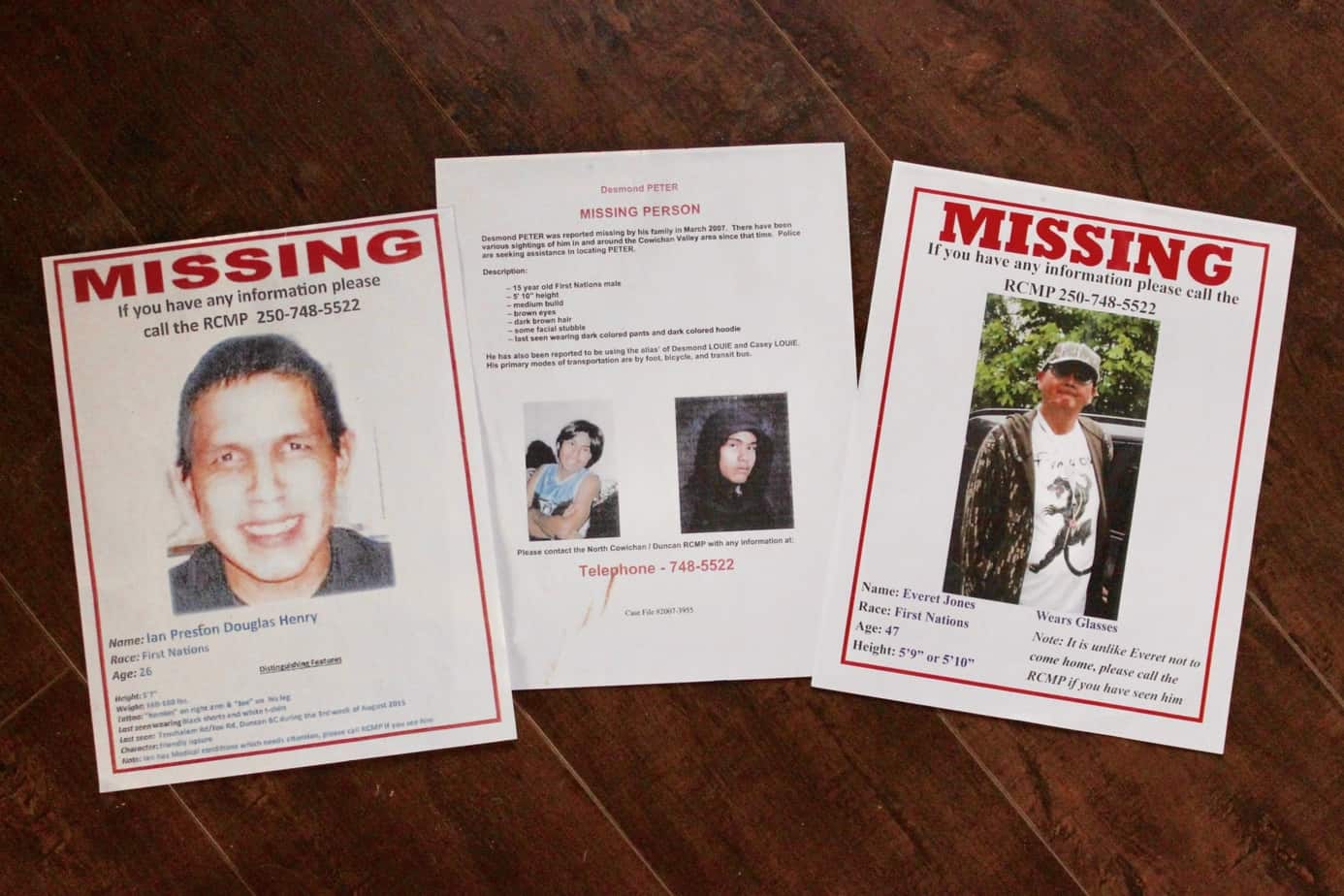
Since 2007, three Quw’utsun men have gone missing and have not been found. In 2007, 14-year-old Desmond Peter went missing. Eight years later, Ian Henry was last seen at the age of 26. And around six months later, 47-year-old Everett Jones went missing.
And there are more. In 2011, Tyeshia Jones was murdered at the age of 18. In May 2023, the community rallied in solidarity for Carsyn Mackenzie Seaweed and her family after Carsyn was found by police in a “semi-conscious state under suspicious circumstances.” She died shortly after she was found.
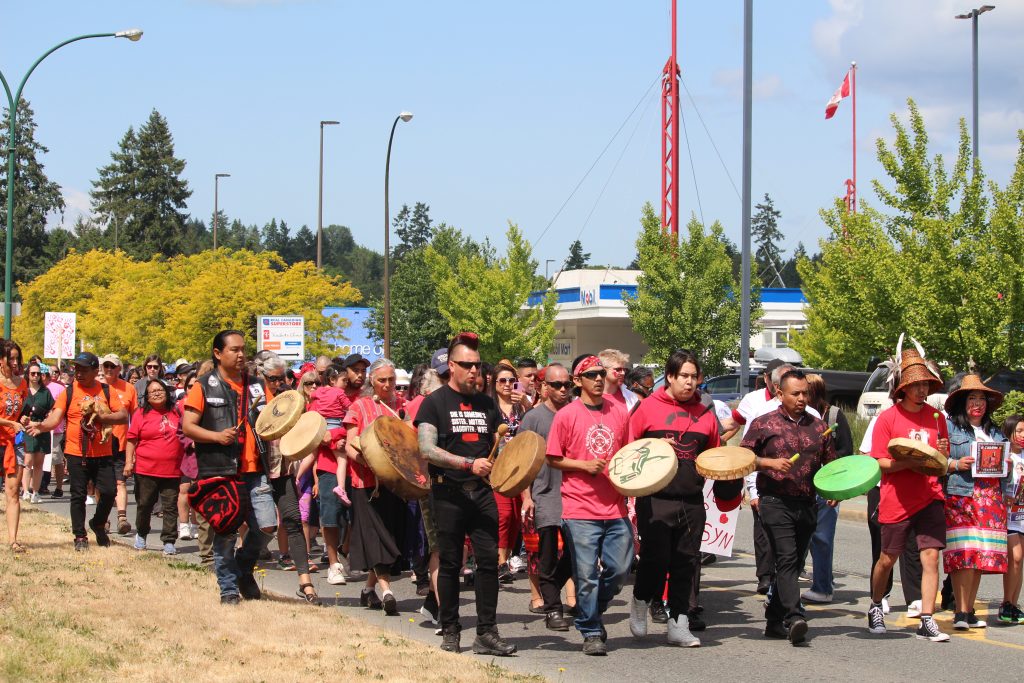
“We want to let them know that we’re still here, and we want answers. We want action,” Jones says. “That’s the only way we’re going to get action in this area — if we keep pushing through and keep being a voice for ourselves.”

The National Inquiry into Missing and Murdered Indigenous Women and Girls website says “First Nations, Inuit, and Métis women, girls, and 2SLGBTQQIA people live with an almost constant threat to their physical, emotional, economic, social, and cultural security.”
The final report from the inquiry documents testimony from survivors of violence and family members and adds context to the issue of missing and murdered Indigenous people. It notes that factors such as intergenerational trauma, marginalization, housing insecurity, employment and health care barriers, lack of cultural support and colonial and patriarchal policies all contribute to the issue and leave Indigenous people to be vulnerable to violence.
A 2022 report from Statistics Canada says that factors such as those listed above, as well as systemic racism lead to Indigenous people experiencing higher rates of criminal victimization. The report says that from 2015 to 2020, the average homicide rate for Indigenous victims was six times higher than the homicide rate for non-Indigenous victims. Indigenous people in Canada were also twice more likely to have little or no confidence in their police service compared to non-Indigenous people.
Volunteers with the Cowichan Missing and Murdered Women, Men and Children Society are able to act right away, and Jones says they can — and do — share what they learn with police when they’re ready. But she says there’s a lack of communication between RCMP and the community, and that she wishes they’d provide regular updates about the investigations. Even when a case is being investigated by police, Jones and other volunteers continue to search themselves, too.
“We can just put their picture in our phone and start searching until we find them,” Jones says. “We don’t have to do all the paperwork the way [police] do, so that’s a big difference. I’m sure they do their job, it’s just we can get out there right away.”

Funding required to further support searches
Jones says she switched her organization over to a non-profit model so she could apply for various types of funding to help with searches and to raise awareness about the issue. But accessing that funding has proven to be difficult, especially when applications take up a lot of time — time that is being volunteered.
“It’s supposed to be easier if you have a non-profit society and a number attached but it creates all this paperwork,” Jones says. “I have a volunteer to help us do this but I’m out there talking, and I have to follow up until I get responses about whether it’s yes or no and it just makes it difficult and a lot of work.”
That’s part of the reason why she’s planning the upcoming gala and aims to hold a national conference. If Jones is able to get political leaders under one roof to hear people out and understand that more funding is needed to assist with these searches, she thinks they’ll be able to relay what they learn to higher levels of government.
Jones says the society needs an office to work out of, where they can store files and information. Families who are searching for loved ones also require funding support to pay for things like ads, time spent searching and even a private detective if necessary.
“All of us are volunteers, none of us get paid,” Jones says. “We did it for the love of our heart because we want answers. We want to find our missing loved ones.”

Support for gala needed
As the date of the Lifting Spirits, Honouring Lives Gala approaches, Jones says she’s still searching for sponsorship or funding to cover the cost of food as well as silent auction donations and ticket purchases. The Municipality of North Cowichan and Cowichan Tribes have already approved funding to pay for the hall and other local organizations and businesses have provided monetary donations and items for the silent auction.
Jones says 500 tickets — priced at $100 each — are available for the gala. The food is estimated to cost around $25,000 and the total cost of the gala is approximately $40,000. Jones says the hope is that an extra $10,000 to $20,000 is raised to support the future conference.
“This is one of the biggest events we could do.” Jones says. “That’s where I’m wandering around with these letters and pestering everyone looking for assistance, partnerships, sponsorship, whatever they can give.”
Jones hopes someone will step up to support with food donations or the cost of food and is also spreading the word about ticket sales as the event nears. She says the event is important because it will bring people together to share and learn as well as support families who are facing obstacles — both financial and systemic — as they search for their loved ones.
“You know the phrase: it takes a community to raise a child?” Jones says. “Well it takes a community to find these ones.”
Gala details
The Lifting Spirits, Honouring Lives Gala will take place on Saturday, Nov. 18 at Cowichan Exhibition Park’s Mellor Hall. Tickets can be purchased on Eventbrite or in-person by calling 250-815-5321.
Those looking to support the event can reach out at the number listed above or by emailing Jones at comiakenqueen1@gmail.com.
What did you think of this story?
Your feedback after we publish a story helps ensure we're always improving our reporting to better serve you
Author

Related Articles
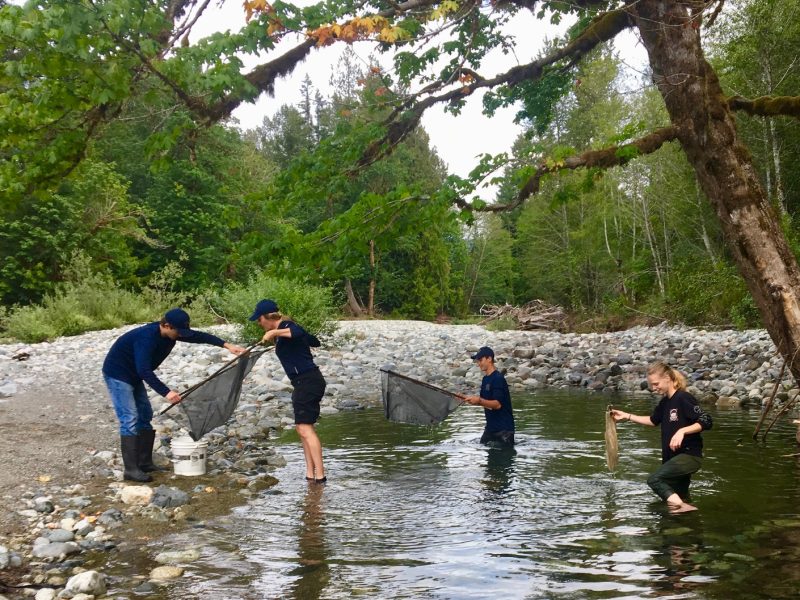
What to do and who to call when juvenile salmon are in danger
Officials say Cowichan Valley residents should call experts to move salmon in isolated pools because of risks associated with relocation.
How is The Discourse’s journalism funded?
And what does it cost to produce The Discourse’s in-depth, independent journalism?
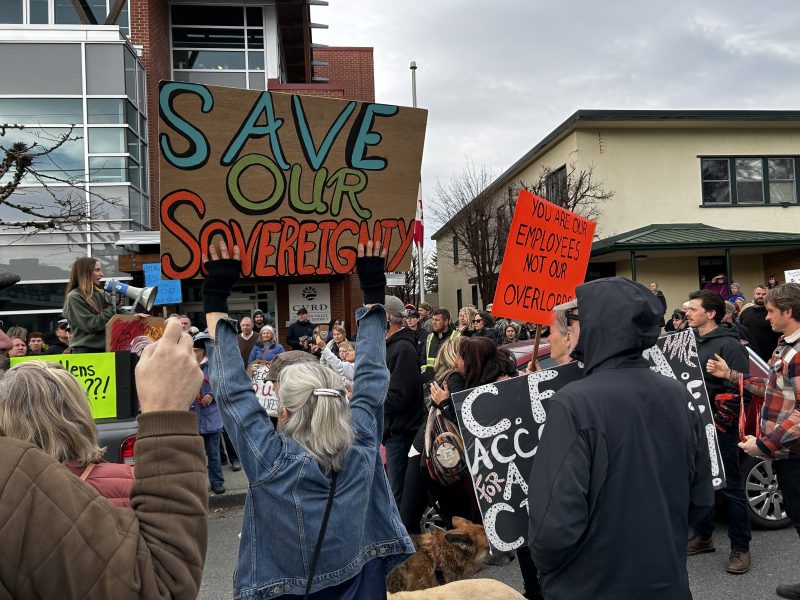
Behind the backlash to the Cowichan Valley’s comprehensive zoning bylaw
The campaign against Bylaw 4710 was fuelled, in part, by misinformation and an organized group of advocates. What could this mean for the future of local politics?