
Tariffs, health care and housing top of mind for voters at Chemainus all-candidates meeting
Three of the four Cowichan—Malahat—Langford candidates heard from voters at the Royal Canadian Legion in Chemainus.
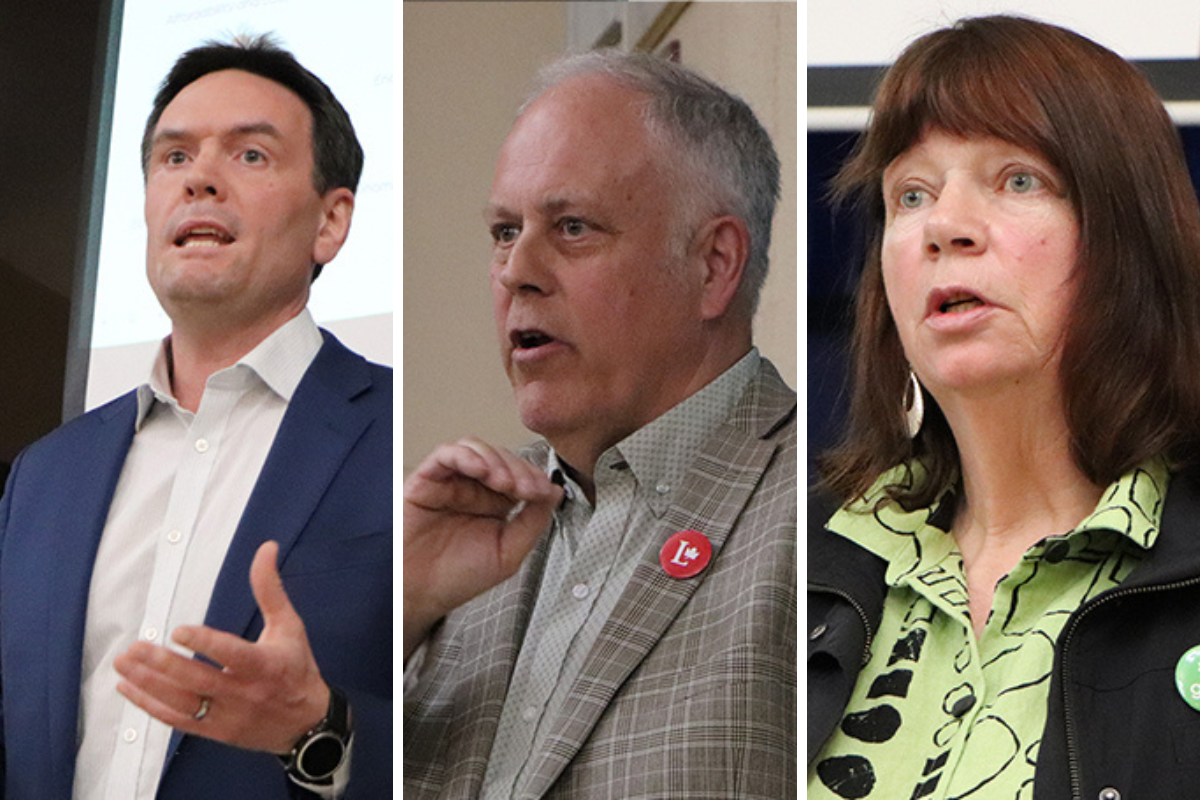
With the April 28 federal election imminent, three out of the four candidates vying to represent the Cowichan Valley in the House of Commons met with voters for an all-candidates meeting hosted by the Chemainus Residents Association.
Last week, nominees for the Liberals, New Democrats and Greens hoping to become Members of Parliament took questions on the top issues for local voters — while the Conservative candidate opted not to attend.
Close to 70 people attended the event at the Royal Canadian Legion #199 branch.
Organizers posted video from the event on Facebook.
The event was an opportunity for candidates to answer questions directly from the community ahead of the federal election — and final voting day — on April 28.
Liberal candidate Blair Herbert, NDP candidate and incumbent Alistair MacGregor, and Green Party candidate Kathleen Code attended and sat in a row of chairs at a table in front of the audience.
Organizers placed an empty chair between Herbert and MacGregor with a blank name card in front of it. The seat was in the place of Conservative candidate Jeff Kibble, who did not attend the meeting and received criticism for the decision from voters.
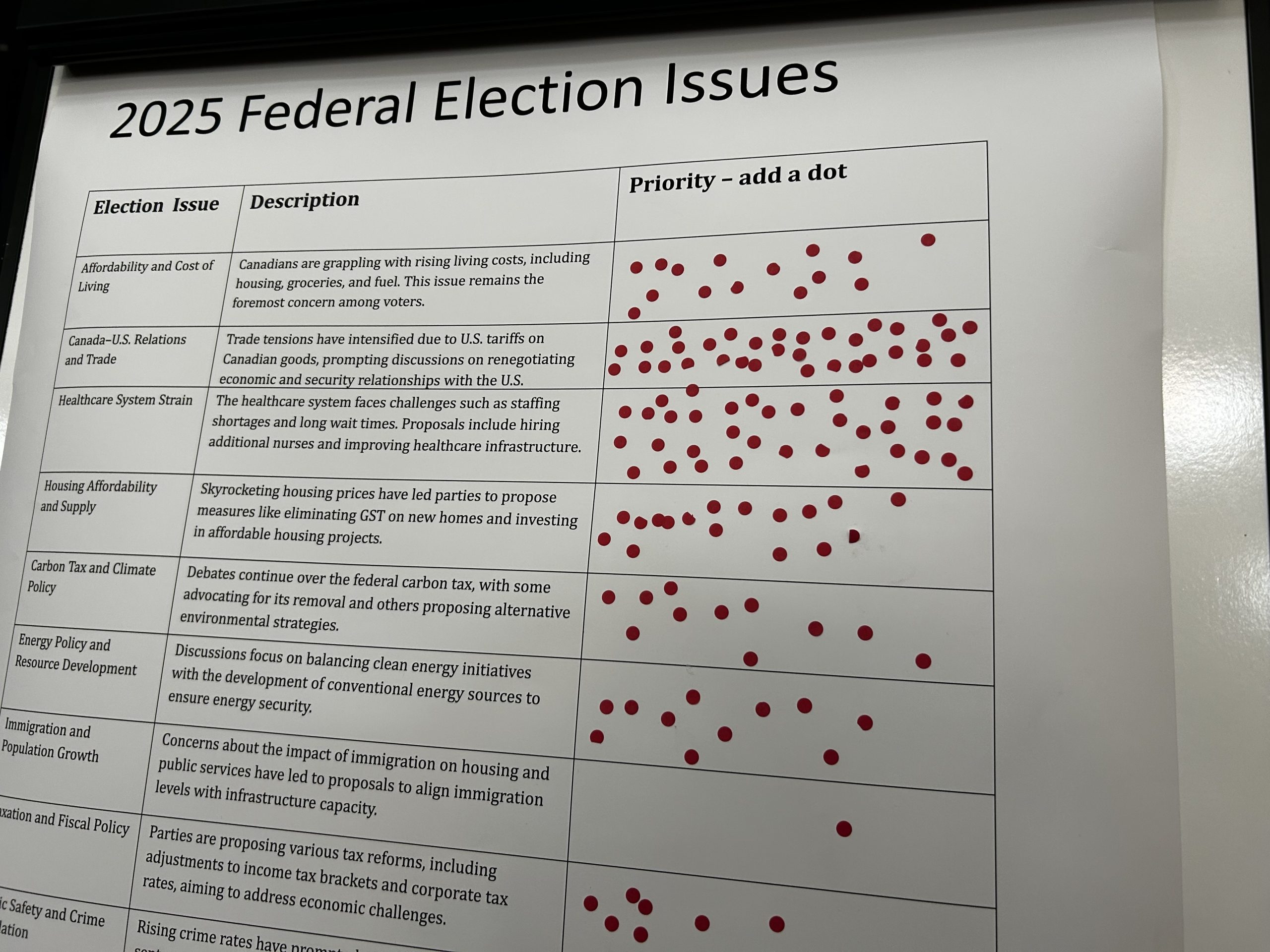
At the door, attendees were handed three red dot stickers and were directed to a large sheet of paper that had a list of issues — ranging from U.S.-Canada relations to crime and housing affordability — which they could mark with the sticker to show what three issues were most important to them.
Candidates in attendance delivered opening remarks and answered pre-written questions from the Chemainus Residents Association on various issues such as reconciliation and affordability. Audience members were also allowed to ask their own questions, and two student volunteers from Chemainus Secondary asked questions as well.
Audience members were particularly interested in topics such as health care, U.S.-Canada relations, housing, affordability and the environment, which candidates spoke on throughout the meeting.
Conservative candidate a no-show, but still leading according to polls
Chemainus Residents Association president Mark Saunders told the audience all Cowichan—Malahat—Langford candidates were invited to the meeting before they were formally recognized by the parties. Kibble declined to attend and told Saunders he was “presently otherwise engaged,” a statement which garnered some scattered laughter from the audience.
Saunders said he asked if Kibble could send a spokesperson to address the audience and explain why he wasn’t attending, or give a written opening statement that could be read before the meeting began.
“I did not hear back from him, so unfortunately we do not have the fourth candidate,” Saunders said.
Kibble also chose to skip another all-candidates meeting scheduled the following day in Lake Cowichan.

Kibble isn’t the only Conservative candidate choosing to pass on all-candidates meetings.
Kris McNichol the Conservative candidate running in Courtenay—Alberni didn’t attend a meeting in Port Alberni and a citizen group in the Abbotsford—South Langley riding created a petition to demand Conservative candidate Sukhman Gill participate in an all-candidates meeting. It’s a similar story in other ridings in B.C., Alberta and Ontario.
Projections from polling aggregator 338 Canada suggest the Conservatives in the lead, with NDP trailing behind by roughly five per cent at the time of writing, followed by the Liberals and Greens.
A recent poll by Research Co., a Vancouver based research firm, surveyed 401 eligible voters who live in the Cowichan—Malahat—Langford riding and found the Conservatives are ahead. According to the survey, if the election was held today 36 per cent of respondents said they would vote for Kibble, 29 per cent said they would vote for MacGregor, 19 per cent would vote for Herbert and five per cent would vote for Code. Eleven per cent of voters said they were still undecided.
U.S.-Canada relations top of mind for attendees
By far, the most pressing issue for attendees at the meeting — aside from health care — was U.S.-Canada relations and trade. One attendee asked how Canada’s relationship with the United States should go forward.
“I believe we have to stand up to the United States,” Code replied. “We support tariffs for tariffs but at the same time we need to be aware of the workers that will be affected.” She said the Greens would support industries impacted by tariffs by creating a federal strategic reserve for goods — such as lumber, steel and potash — to buy up those goods and use them to build infrastructure and houses for Canadians.
MacGregor said the NDP believes that workers have a strong part to play in any tariff response to the U.S. by Canada. “I don’t think you’re going to find any disagreement amongst the parties about standing up to the United States,” he said.
Herbert described the trade war as instilling a feeling of whiplash in Canadians. He argued that Mark Carney is the most qualified person for the position of Prime Minister and can go “against the guy down south who knows nothing about economics.” He said the Liberals plan to make dropping inter-provincal trade barriers a top priority by July 1.
How will parties meet the demand for health care providers?
On the topic of health care, candidates were asked how they would meet the growing demand on our healthcare system and lack of access to a healthcare provider or doctor.
MacGregor said he’s a strong believer in the federal leadership when it comes to health care delivery and pointed to the NDP’s record of passing national dental care legislation and setting up the framework for national pharmacare. He said the next big health care “frontier” would be bringing the funding for mental healthcare up to parity with physical healthcare, especially for youth.
Herbert said he was interested in creating more programs that would see a town or municipality establish a medical clinic and hire on family doctors, such as the Colwood Clinic in Colwood. He also believes that there should be more investment in young people from the Cowichan Valley who want to pursue careers in health care and suggests sponsoring their education so they come back to practice locally.
Code commended MacGregor on the national dental care plan but said her local dental office still hasn’t signed on. She said the Green Party would like to see the creation of wraparound services for people struggling with mental health and addictions.
How will parties balance the economy and environment?
One participant asked candidates how “you and your party can grow our economy without sacrificing our ecology.” In The Discourse’s reader election survey, the environment was the second-most important issue to respondents, right behind U.S.-Canada relations / tariffs.
Code criticized “status quo parties,” and alleged that they have never put together a serious plan to combat the climate crisis. She said the Greens would advocate for the creation of a nationwide green electrical grid powered by renewable energy sources, such as geothermal and wind power.
Herbert said he believes countries around the world are looking for solutions to combat climate change and Canada is in a unique position to build those solutions here and export them.
“I think we need to look at it like an economic opportunity,” he said.
Motioning to the empty chair beside him, Herbert said the Conservatives are hanging on to “industries of the 1950’s,” such as oil and gas, and are ignoring green solutions for energy.
Macgregor proposed that building an east-west smart energy grid that uses renewable energy — such as hydroelectricity in B.C. and solar or wind power in the prairies — would provide jobs for workers and cut reliance on fossil fuels.
“I can tell you one thing I’m not going to be hopping on the diluted bitumen pipeline building that the Liberals and the Conservatives seem to be on,” he said.
Fact Check
Reporting from The Narwhal shows that since their rise to power in 2015, the Liberals passed multiple climate-related laws, such as the Net Zero Emissions Accountability Act, and established the carbon pricing system.
All major parties have released their platforms — and the NDP and Liberal Party both put forward specific commitments related to climate action.
The Conservative Party does not have any specific plans for climate action listed in its platform but does touch on creating a national “energy corridor,” removing the carbon tax and “unlocking the Ring of Fire” in Ontario to harvest minerals.
Want to learn more? Read The Narwhal’s reporting on where parties stand on key environmental issues.
Social supports and equity for all
Another attendee asked how the parties would support equal opportunities for everyone, citing the example of implementing a universal basic income.
“I’m not really sure what to say about this,” Herbert said. “My children can’t get their heads around this either. They have a very good work ethic and they don’t understand why someone should get paid for doing absolutely nothing.”
Meanwhile, Code said the Greens have been advocates for universal basic income for a long time. She said her experience working in social services gave her a first-hand understanding of just how little money there is in the system to actually help the people who need it.
“We are a rich country, we should not allow people to fall behind,” she said.
MacGregor responded to Herbert’s comment, said he doesn’t see universal basic income “as someone receiving money for doing nothing.”
“I see it as lifting people up and helping them afford the basic necessities of life,” MacGregor said. “This is an idea I would champion as your MP.” He noted that the NDP have put forward a bill for universal basic income in the past.
How does each party plan to solve the housing crisis?
Housing was the final topic of the night and attendees wanted to know what the parties would do to address housing supply and affordability.
Code said the Greens are proposing a nationwide house building program using the materials procured through the earlier mentioned strategic resource reserve. She said they would also ensure that all public housing is protected by covenants and “kept out of the hands of predatory investors.”
Herbert said the federal government needs to make housing affordable for all types of people, from nurses to retail workers, and the Liberals plan to do that by building homes and bringing back multi-unit residential buildings to attract investors into the housing market.
MacGregor said the Conservatives and Liberals can’t be trusted to fix the housing crisis alone and, if elected, he would continue to hold them and corporate landlords accountable. When it comes to building homes in mass supply, MacGregor said, “We don’t need to reinvent the wheel. We just need the political will to do it.”
To hear more from Cowichan—Malahat—Langford candidates, read their responses to questions from our readers.
Final voting day is Monday, April 28. To learn more about how and where to vote in the Cowichan Valley, read our 2025 voter guide.
What did you think of this story?
Your feedback after we publish a story helps ensure we're always improving our reporting to better serve you
Author
Related Articles
Voting in the 2026 Cowichan Valley local elections? Here’s what you need to know
Where, when and how to cast your ballot in North Cowichan, Duncan, Ladysmith, Lake Cowichan and the Cowichan Valley Regional District for the 2026 local elections.

Cowichan Valley candidates on protecting the community from climate change
Candidates in Duncan, North Cowichan, Ladysmith and Lake Cowichan share the steps they’d take to protect the community from the impacts of climate change.
Here’s how Cowichan Valley’s municipal candidates will respond to the homelessness and mental health crises
Cowichan Valley’s 2026 candidates share how they’d respond to issues related to homelessness, mental health and addiction.