
Reporter’s Notebook: How a salmon puppet is helping save the Quw’utsun Sta’lo
A community of Indigenous youth and elders came together to build a puppet for the Quw’utsun Sta’lo. They ended up healing so much more.
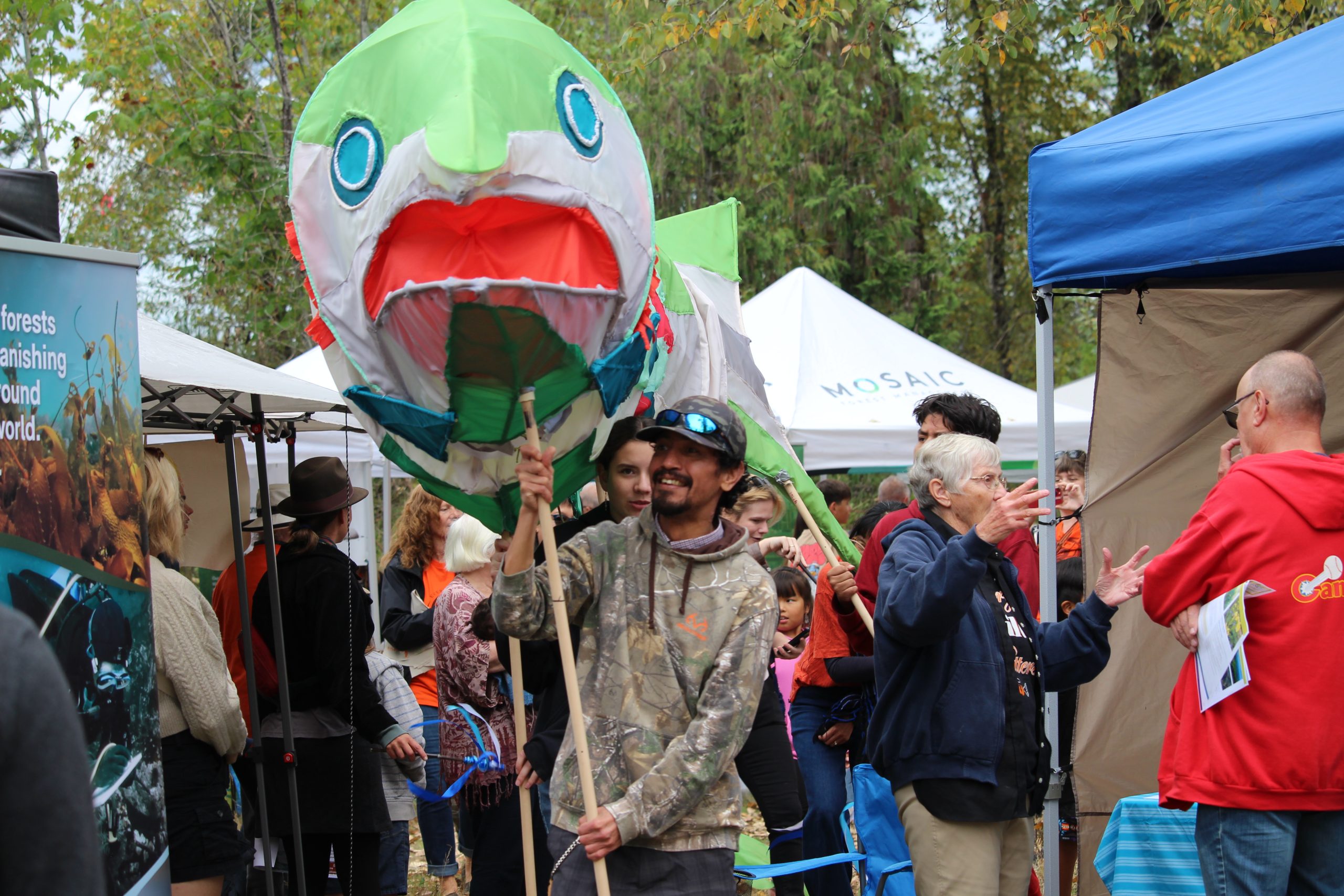
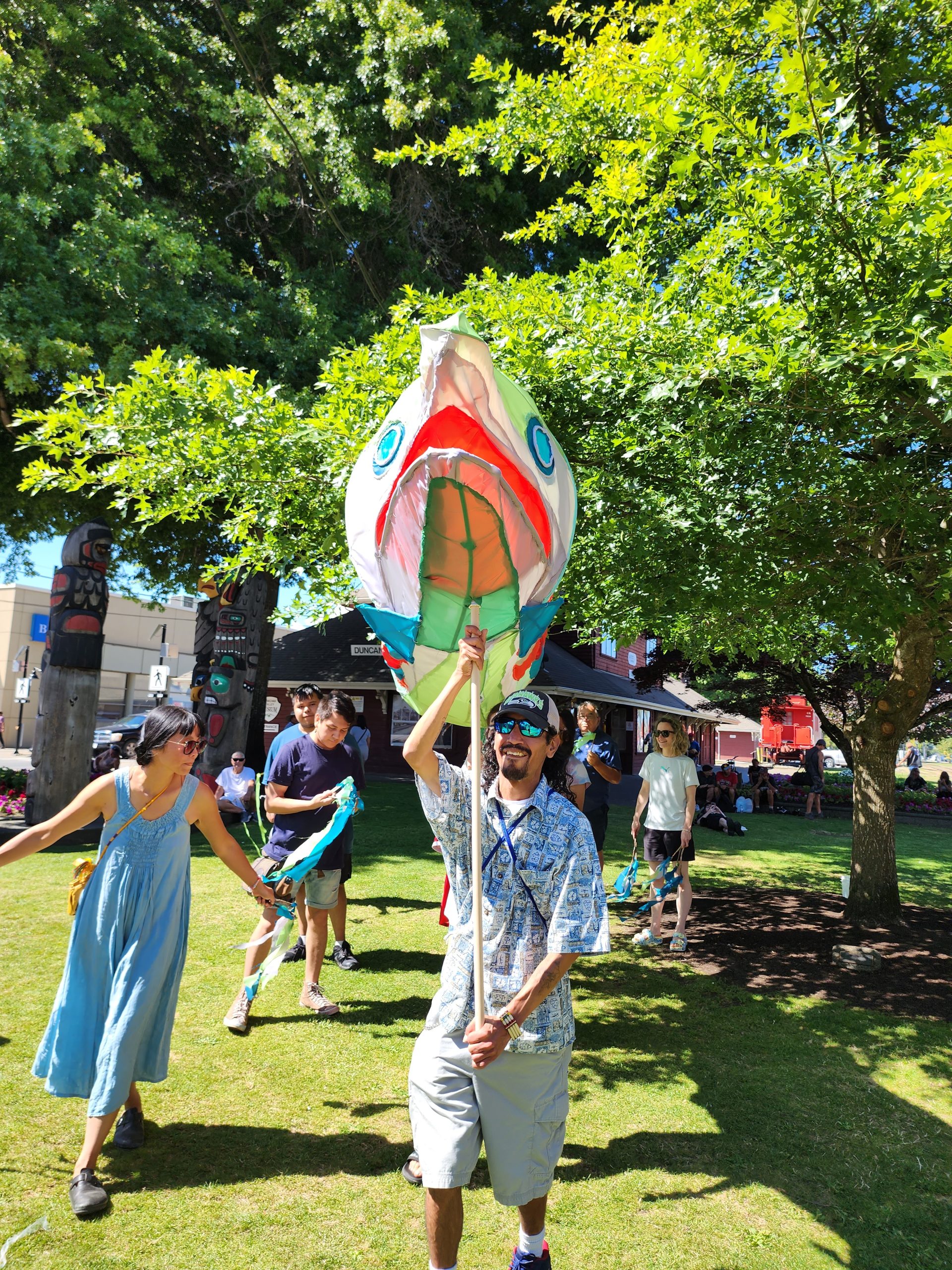
I happened to be returning books to the library on Jan. 20 when I noticed a sign inviting passersby to celebrate a new home for the “Quw’utsun Salmon” beside a hallway adorned with photos of what I could only describe as a massive salmon being carried by four people on sticks.
Intrigued, I poked my head into the Koksilah Room to see it lined with chairs. A slideshow playing at the front of the room showed video and photos of the people-powered Quw’utsun Salmon puppet in motion.
I was greeted by Tin Yan Tsang and Robin Gale, facilitators of the Healthy Relationships Program at Cowichan Women Against Violence Society, who were surprised to find out I was with The Discourse and that I even knew about the event.
They said I was more than welcome to stay, so I joined the other attendees and took a seat near the front.
What followed was a look into an incredible project between Cowichan Women Against Violence (CWAV) and Quw’utsun Knowledge Keepers from Hiiye’yu Lelum (The House of Friendship).
Tsang said the project began as an idea between her and a friend, Bernadette Trench-Thiedeman, an Australian artist who creates large puppets for live performances.
Trench-Thiedeman was visiting the Cowichan Valley in 2023 and presented the idea of making a puppet for CWAV’s Healthy Relationships program to community members from the Quw’utsun Nation, including Knowledge Keepers William “Chip” Seymour, Rose Grey, Fred Wilson and staff from Hiiye’yu Lelum (The House of Friendship).
Discussions ensued about what form the puppet would take, and it was decided that it would be a salmon to raise awareness about its plight amid deteriorating conditions in the Quw’utsun Sta’lo (Cowichan River) and educate the community about the abundance of salmon that used to return to the river.
Tsang said a group of Indigenous and non-Indigenous youth led by Quw’utsun artists Shawn Johnny and Ryan George worked on the puppet over the course of a few days in August 2023 in the Si’em Lelum Gymnasium, hand sewing it in a “mad dash” to get it ready for the first performance at 39 Days on Aug. 4.
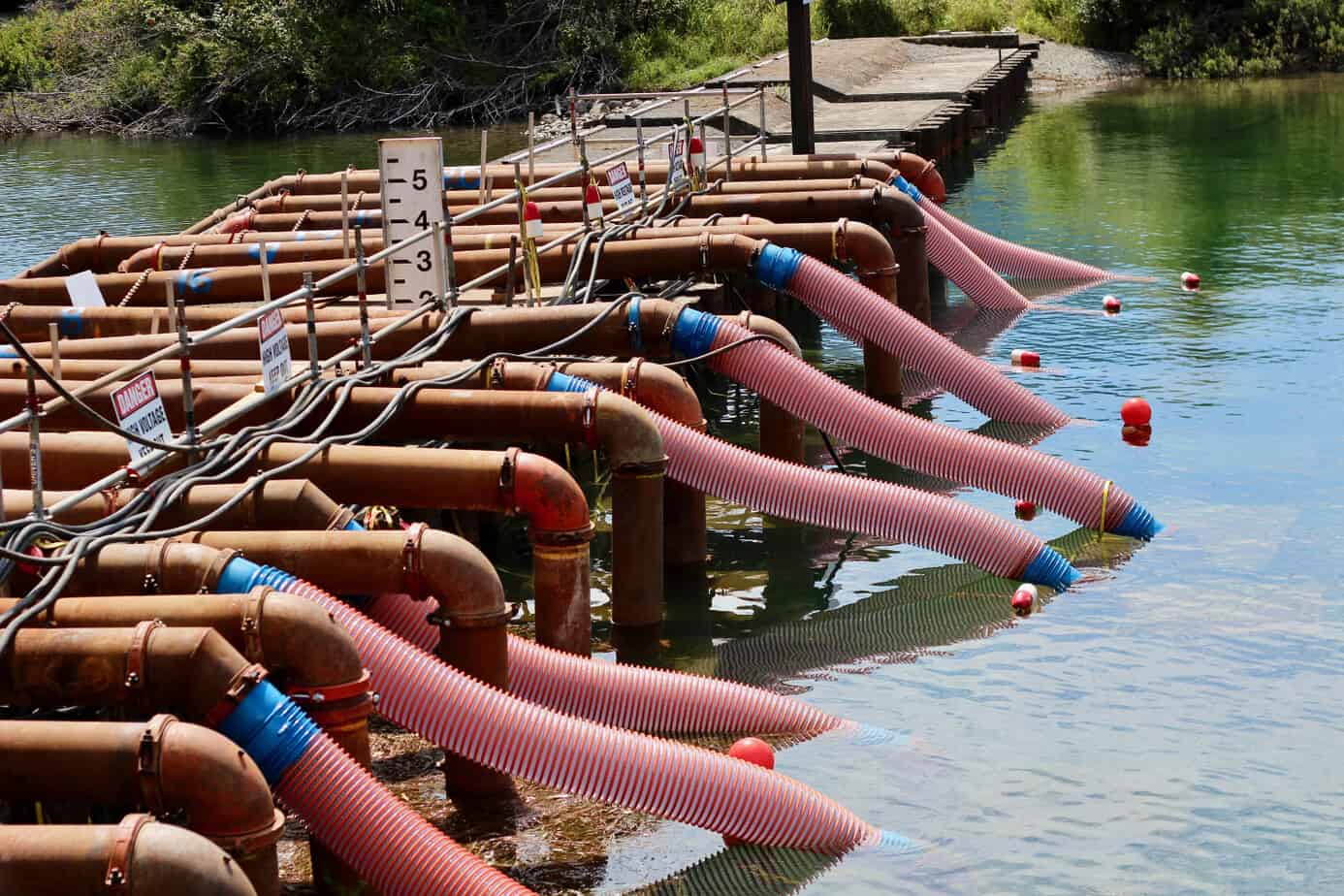
The puppet is made out of nylon fabric skin and cane —a hollow jointed stem of bamboo palm or sugar cane — dipped in the Quw’utsun Sta’lo before being shaped.
Tsang said dipping the cane in the water was an important moment for the project, as it advocated for restoring the river and enhancing salmon returns.
I talked to Johnny after the celebration about the almost poetic statement of dipping the cane in the river. I asked him how the process made him feel, and he described the day as magical.
“Those little fibres that we carry on the land now had started from our own traditional waterways. We’re trying to save the river, and it started at the river, and it came from the river, for the river,” he said.
Unfortunately, the first iteration of “Salmy” (the salmon puppet’s name) would not last long. Following its first performance in 2023, the outer skin layer went missing during transport.
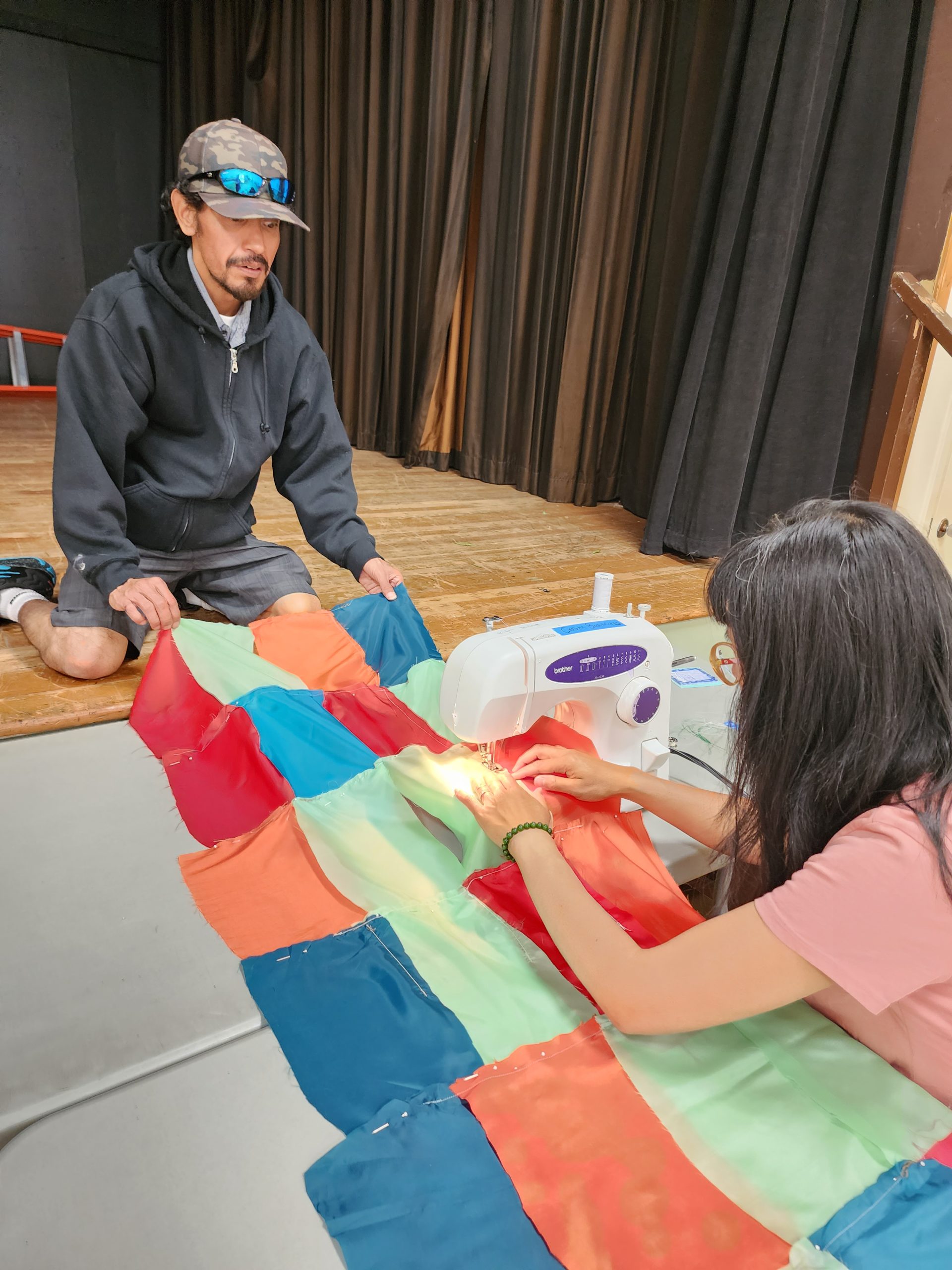
But the puppet team didn’t lose hope. Using reference photos of the first skin, Johnny and another group of Quw’utsun youth recreated it at the Duncan United Church before it performed again at 39 Days of July, Cowichan River Day, and the Little Raven Powwow.
The phrase “second coming of the fish” was thrown around jokingly at the celebration, but the monumental effort to make the second skin was no joke.
“It was quite an undertaking. We had five sewing machines, and all of the youth and Shawn and Ryan, our artists were there, and a bunch of volunteers to help with the cutting and to help teach how to sew and how to create this extra skin in a week,” Gale said.
As the presentation came to a close, I couldn’t help but feel overwhelmed by the emotions in the room with me. I had somehow accidentally stumbled upon a years-long saga of this puppet and was surrounded by the team who had spent so many hours working to bring it to life. It was a powerful sight to see.
By the community, for the community
Johnny believes the puppet belongs to the community and the youth who created it.
“There are so many possibilities with this puppet, I believe it’s a good starting point in truth and reconciliation and everything about our people and us as human beings,” he said.
Johnny’s grandfather, the late William “Chip” Seymour, advised the team on the first version of the puppet. It was his vision that the project be made by the community, for the community. He compared the puppet to cedar masks made by Quw’utsun carvers and said performers wearing the masks allow the carvers’ souls to live on.
While colonial institutions like museums and residential “schools” have harmed Quw’utsun culture, Salmy was something they couldn’t take from the community, Seymour told the puppet team.
One thing that kept coming up in my conversations with folks was how much Seymour impacted the project. It was Seymour’s vision that the project act as a bridge between all people — an ethos he strove for during his time as chief of Cowichan Tribes, Johnny told me.
“Didn’t matter what communities we come from, he would always try to pull us together as one and work together, as a community, as a whole, for one another. And I think that’s what he really enjoyed about this project, before we lost him,” he said.
Johnny described how his grandfather would sit and watch work on the salmon. “I would look over at him, and he would be sitting there, just smiling and watching,” he said. “I think my perspective of observing him, observing us, was that his overall vision for our community was set in motion by all of us working together.”
Quw’utsun salmon puppet helps youth ‘find their place’
The healthy relationships program focuses on youth violence prevention by helping participants develop skills, attitudes and knowledge to help them navigate current and future relationships.
The program teaches skills for all relationships, friendships, romantic relationships, relationships to the community and to the land, Gale said in an interview after the celebration. It was clear to me that over the two summers, the youth formed close friendships and learned to work as a team and learn more about the communities they inhabit.
By the end of the second summer, Gale noticed that the kids participating in the program had grown more confident and had even stepped into leadership roles.
“It was really cool to see the youth kind of find their place, and then be able to have a very genuine sense of pride and perform with it,” she said.
After the formal part of the presentation wrapped up, the group walked over to see Salmy in its new home hanging inside the library’s main area for the public to enjoy.
The youth attending the celebration ceremony were beaming with pride as they posed in front of Salmy, which was a big change from when they first started on the project.
In the beginning, the youth were quite shy, Johnny told me. But as the project developed, they started to open up, talking and smiling more. “I think that was the biggest reward of it all,” he said.
What’s next for the Quw’utsun salmon puppet?
For now, the puppet will stay hanging in the library, where Gale said it’s getting a lot of attention from the public. There’s a QR code by the puppet that will take library-goers to a webpage that explains some of the frequently asked questions about Salmy and links to the videos by the Cowichan Watershed Board on the importance of salmon to the Quw’utsun Sta’lo.
Some attendees at the celebration event asked if there were plans to use the puppet in other productions and right now, there aren’t any. I had to know as well, would I ever get to see the salmon in motion?
Tsang said it requires funding that CWAV just doesn’t have at the moment. From just looking at how intricately constructed the puppet is, it’s clear that it would require lots of maintenance and upkeep. One way around this is supporting the project through a donation page that’s open to the public and goes directly to the Quw’utsun Stseelhtun Friendship Project.
Letting the youth determine the future of the puppet they had worked so hard on was important for Gale and the other project facilitators. The consensus was they’d like to see the creation of more puppets or other large art projects that bring the community together and that Salmy be passed on to new guardians.
“Something that we really wanted to make sure people understood is, it’s not our puppet. We’re just sort of the guardians of it,” Gale said.
While plans to build more puppets may be on hold for the time being, I for one would love to see Salmy at more events. Johnny agreed and said that it could be used to bring focus to causes like Every Child Matters or MMIWG2S+. The possibilities for the puppet are endless.
What did you think of this story?
Your feedback after we publish a story helps ensure we're always improving our reporting to better serve you
Author
Related Articles
What to do and who to call when juvenile salmon are in danger
Officials say Cowichan Valley residents should call experts to move salmon in isolated pools because of risks associated with relocation.
How is The Discourse’s journalism funded?
And what does it cost to produce The Discourse’s in-depth, independent journalism?
Behind the backlash to the Cowichan Valley’s comprehensive zoning bylaw
The campaign against Bylaw 4710 was fuelled, in part, by misinformation and an organized group of advocates. What could this mean for the future of local politics?