
Broombusters celebrates 20 years of removing Scotch broom on Vancouver Island
This volunteer organization is removing invasive species to reduce wildfire risk and protect biodiversity.
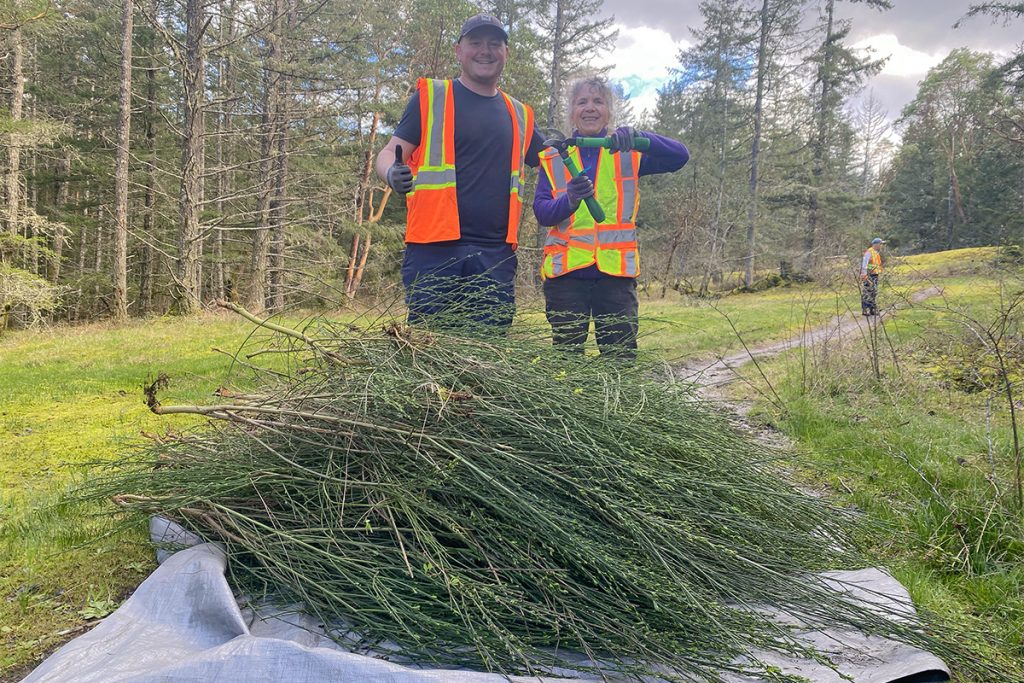
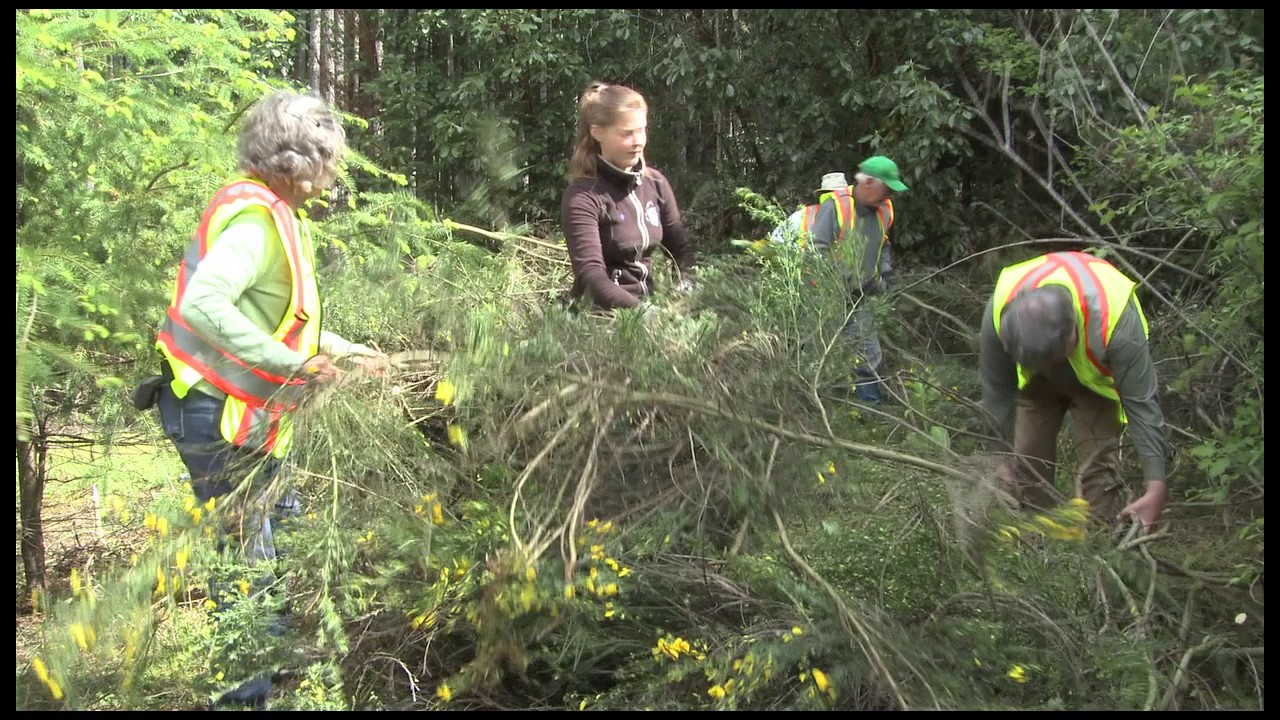
It’s an overcast Thursday afternoon and about a dozen volunteers wearing reflective vests are slogging through the mud in Nanaimo’s Lotus Pinnatus Park, just beside Highway 19, as they work to remove invasive Scotch broom.
Julie Devereux is on her knees, digging in the wet soil to get at the stem of a Scotch broom plant in the park so she can cut it with a pair of garden shears.
“This is such a lovely area, there’s so many wildflowers and broom produces so many seeds, they will just cover all of this area,” she said. “We just want the wildflowers to proliferate and get rid of the invasives.”
For the past 20 years, Broombusters — an organization that was founded near Qualicum Beach —- has removed invasive Scotch broom across Vancouver Island. What started as a small effort to protect local biodiversity has now turned into a crucial part of reducing wildfire risk in the critical urban-wildfire interface, with the City of Nanaimo partnering with the organization to remove the invasive species from city parks.
Also in the park that day is Hunter Jarratt, known as Invasive Species Guy on social media.
“Scotch broom is one of the worst invasive species we have on Vancouver Island,” Jarratt tells The Discourse. “It changes soil chemistry, spreads rapidly and catches fire easily.”
Broom, as a large dry bush, is what’s known as a ladder fuel that helps connect surface fuels on the ground and higher fuels in trees. It also contains flammable oils that add to its fire risk.
While Jarratt said the broom looks “luscious and green” right now in the wet spring weather, it will dry out fast and the oils in the plant make it a perfect fuel for wildfires.
Broombusters executive director Joanne Sales told The Discourse over a phone call that the low snowpack on Vancouver Island and incoming hot summer weather is cause for concern, especially with highly flammable Scotch broom lining roads, power lines and properties.
But she also said efforts to remove broom are working.
“[In] the places where people are cutting broom, it really is disappearing. That doesn’t mean that you never have to go out and cut some plants, but you can get it under control.”
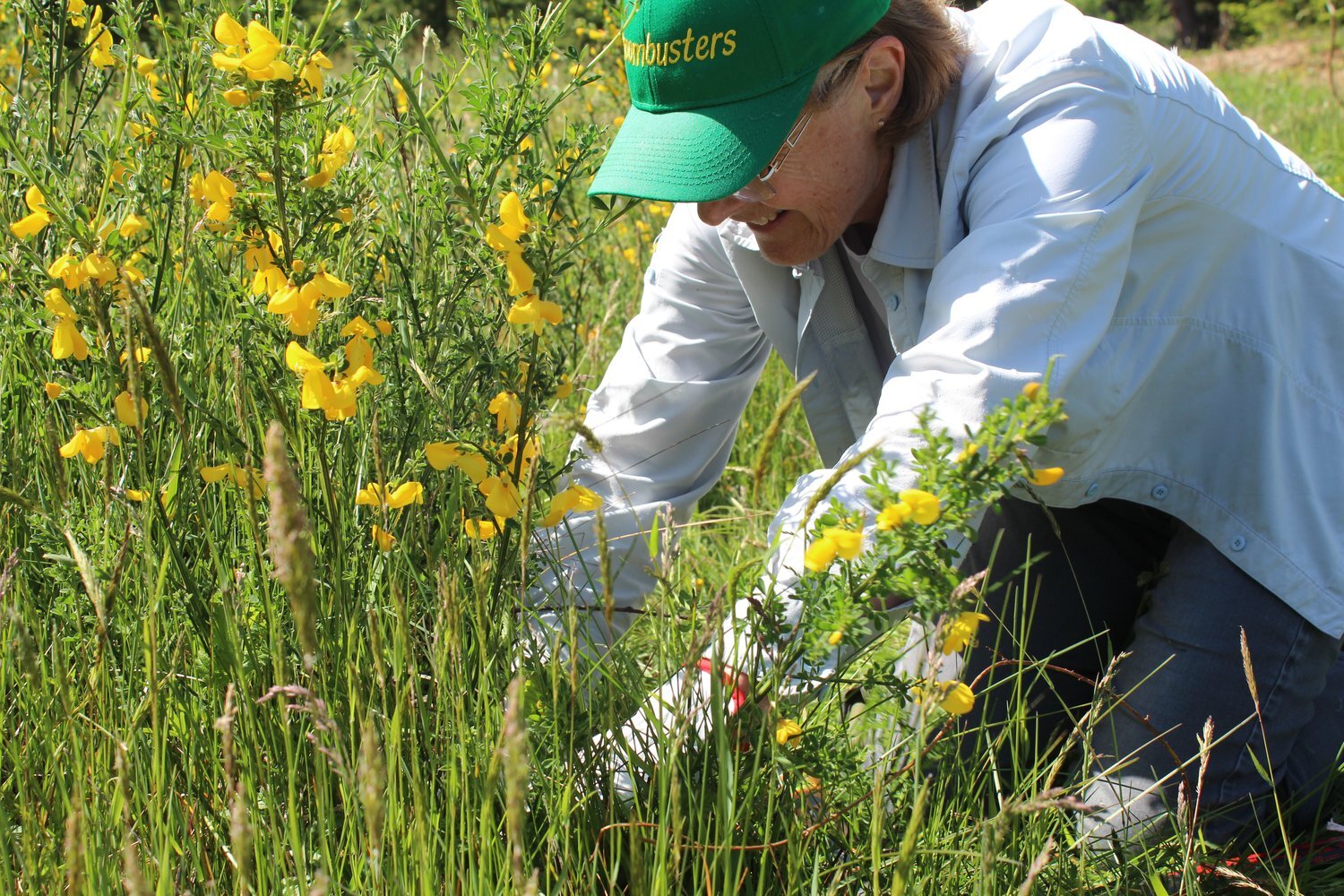
Broombusters marks 20 years of cutting broom in bloom
Sales first began helping to control Scotch broom in 2006 when she was concerned about the broom growing in fields beside her blueberry farm in Coombs. After asking local government officials why the broom wasn’t being cut, she was told that they didn’t have the manpower.
So Sales asked, if she cut the broom, would the local government remove it?
The answer was yes and now Qualicum Beach, which Sales said had “huge broom lining the roads” has “hardly anything.”
The broombusting idea took off and soon people were contacting her for Scotch broom removal in other communities, with the Nanaimo branch starting in 2010.
Today, the City of Nanaimo partners with the organization providing large bins that volunteers fill with cut broom.
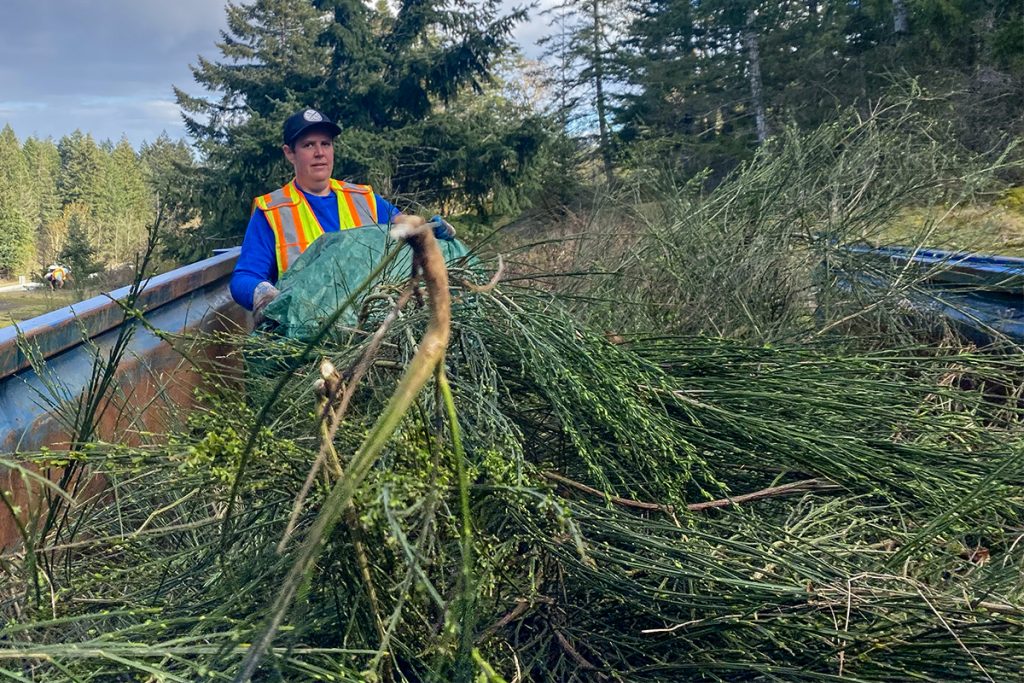
How Scotch broom can fuel wildfires
Jarratt previously explained to The Discourse how invasive species can fuel fires by changing the natural fire cycle of an ecosystem. This is referred to as the invasive plant/fire cycle.
These new invaders, he explained, will add fuel to the ecosystem so more intense and severe fires will occur. After the fire, because those species were already present in that ecosystem, they will be the first to colonize and repopulate those sites.
Jarratt said the invasive plants push out native species that can’t adapt quickly, taking advantage of sunlight and nutrients. The increase in invasive species makes the ecosystem less resilient, creating a monoculture and setting the stage for another fire.
This is all amplified by climate change and increasingly common drought conditions, he added.
“It’s leading to a pretty rapid instability of an ecosystem. It’s invade, burn, repeat over and over again. So it’s quite concerning.”
Sales said her son-in-law was caught in the massive wildfires in Santa Rosa California in 2017 that destroyed thousands of homes and killed 22 people.
“The firefighter came and knocked on his door shouting ‘you have minutes!,’” she said. “He grabbed his phone and computer, got in his truck and rode away in his pajamas.”
He got out safely and came to Vancouver Island where he learned how flammable the Scotch broom surrounding the farm where he was living in California was.
“No wonder it went up so fast,” Sales said her son-in-law remarked.
City bylaws to control broom and other invasive plants
Following the fires, the city of Santa Rosa passed a Vegetation Management Ordinance that requires property owners “to maintain defensible space throughout the entire Wildland Urban Interface Area” and remove specific hazardous vegetation within 30 feet of structures.
Sales said the response for similar bylaws on Vancouver Island have been called unfeasible due to the cost.
“One of the councillors even said that something terrible has to happen and then they will pass an ordinance,” Sales said.
After a presentation by Sales to the Qualicum Beach town council on March 4, Coun. Scott Harrison said that he hates to be pessimistic but worries that higher levels of government will only act after a serious incident happens.
“Hopefully we will see reason and get some of those fire breaks in before we have a fire that spreads,” he said.
Having given dozens of presentations to local government officials over the past 20 years, Sales said they are generally supportive and that it has never felt like she was being brushed off or that officials thought this was unimportant.
“They just don’t know what they can do about it,” Sales said.
The City of Nanaimo’s Property Maintenance and Standards Bylaw includes Scotch broom in its definition of a noxious weed, and requires that property owners remove them. Like all bylaws, the city uses a complaint-based system for enforcement and, according to Sales, residents who live nearby can complain to the city if they see a property with an infestation of broom. Failure to follow the bylaw could face a fine of up to $50,000, with each day it goes un-resolved counting as a separate offense.
A city staff report notes that this is not meant to limit the spread of invasive plants on private or public lands. The city’s Invasive Plant Management Strategy is concentrated on preventing new invasive species from establishing themselves in city parks and controlling ones that present a health concern for the public.
The City of Nanaimo is also organizing a series of work parties across the city this month to help remove invasive species from city parks.
There is also a free workshop on invasive species removal, taught by Jarratt and Sales and hosted by the City of Nanaimo, in Bowen Park on April 15.
Last year, May was declared Invasive Species Removal Month by the city, which aligns with Invasive Species Action Month in B.C. The city also sponsored four drop zones to encourage residents to safely dispose of removed invasive species at no cost.
In July, Nanaimo City Council voted to direct staff to “begin a phased process to draft a bylaw that prohibits the sale and distribution of specific species on the Invasive Plant Council of BC lists within city limits.”
In the staff report on the possibility of banning sales of invasive plants, the banning of sales of invasive species was identified as “one tool in a box of many” that could help “provide an effective method to halt the introduction of new invasive plants.”
Council voted for the option that will see the city partner with local garden retailers and community organizations for a public awareness campaign and update the city’s Invasive Plant Management Strategy, which means that the development of a new bylaw “will take time.”
Scotch broom in hydro line corridors poses a fire hazard advocates say
Hydro line corridors are often a sea of yellow during the summer months as Scotch broom proliferates in open sunny areas.
The hydro corridors run up and down Vancouver Island and Sales said it poses a wildfire hazard.
Last week, Sales said she noticed broom being removed from power lines in Qualicum Beach, in the direction of Parksville, for the first time.
Sales said she expects the broom will come back from new seeds but is happy that the removal was done.
“We don’t want to have six- and nine-foot tall flammable broom candles,” she told The Discourse.
Ted Olynyk, manager of community relations for BC Hydro, told The Discourse he wasn’t able to give specifics about the removal of broom on Vancouver Island as people were off work for the long weekend, but in general the company will work with all of the owners of the surrounding land that the hydro lines run through.
He said BC Hydro participates in broom removal when all property owners in an area are involved with it as the seeds will travel in the wind from one area to the next.
“It’s like the old notion of having a smoking section in a restaurant,” he said. “Somehow the smoke will magically stop in one area.”
BC Hydro will also remove vegetation if it becomes a problem in accessing its power lines.
With files from Madeline Dunnett.
What did you think of this story?
Your feedback after we publish a story helps ensure we're always improving our reporting to better serve you
Author

Related Articles

What are Nanaimo election candidates saying about the climate emergency?
All-candidates forum puts climate questions to Nanaimo election candidates.
Comox Valley, Nanaimo land trusts raising funds to support Deep Bay land conservation purchase
In a partnership with the Comox Valley and Nanaimo Area land trusts, BC Parks Foundation is fundraising to protect 50 hectares of pristine shoreline in Deep Bay and make it accessible to the public.

Nanaimo Jazz Festival celebrates 10 years with more than a dozen shows in September
Local and international artists to perform on multiple stages in the city at this year’s Nanaimo Jazz Festival.