
City of Nanaimo funds ‘stopgap’ warming centre, but more services still needed
With so little funding available, ‘there is no other service provider that’s willing to do this work,’ says Risebridge executive director Jovonne Johnson.

There were sighs of relief and some tears as Nanaimo city council voted unanimously to allocate $230,000 to fund local warming centre services at a special council meeting on Wednesday.
The funds will be utilized under a service agreement with Risebridge Society for seven-day-a-week services that run from Nov. 14 to March 31.
They were sourced from a surplus in the city’s Asset Retirement Obligation project, which estimates the cost of doing remediation work to city buildings when they are retired from use.
The city’s estimated cost projections went down from $2.3 to $1.8 million once fully calculated, according to finance director Laura Mercer, and the total amount of surplus is about $400,000.
Coun. Paul Manly added an amendment to the motion, which also passed, that the city issue a call for other organizations with the capacity to run warming centres to step forward so Risebridge isn’t the only one in operation, as recommended by the Nanaimo Systems Planning Organization. In this case, additional funds would be identified.
At present there is no indication that the provincial government intends to step in with funding, said Dale Lindsay, the city’s chief administrative officer. Historically the province tends to fund overnight and emergency shelters, while municipalities are responsible for providing daytime warming shelters, sometimes with funding from provincial grants like the one they received last year.
Extreme weather shelters provide basic shelter for people living on the streets to prevent “cold-related illnesses, injuries, and even fatalities,” according to the city.

Though some shelters offer bunks and steel frame beds, at the emergency weather response shelters it’s “really rudimentary,” says Coun. Manly, who is the executive director of the Nanaimo Unitarian Shelter. “It’s basically giving people a yoga mat on a dry floor. It’s pretty sad, actually.”
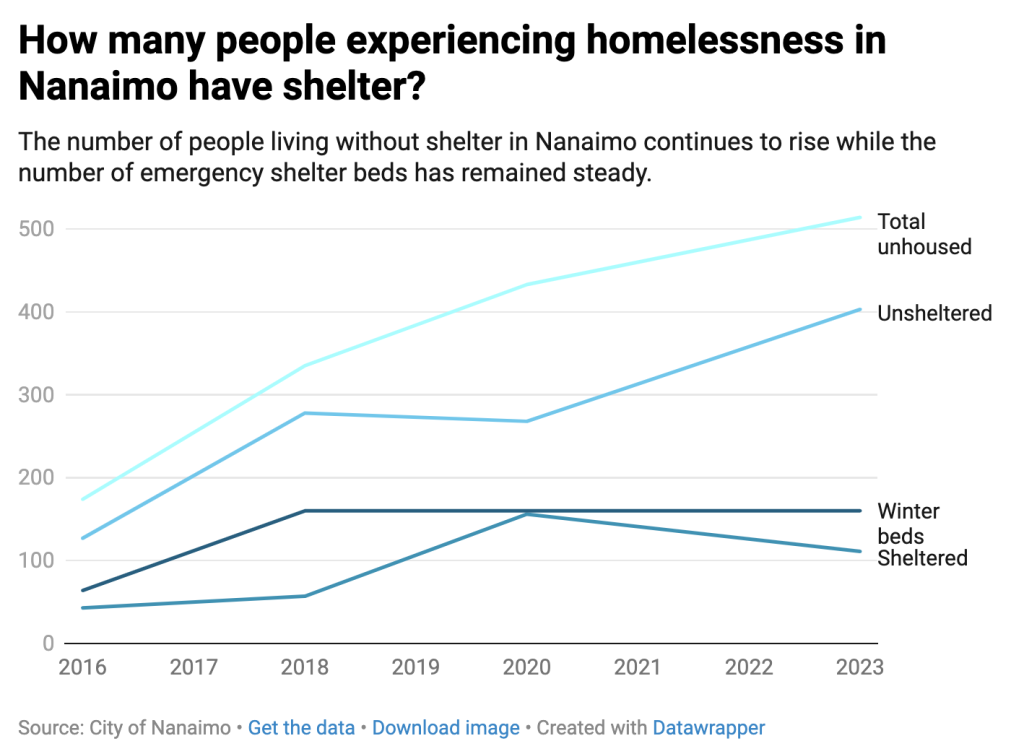
But with the number of people experiencing homelessness up 20 per cent from last count in 2020, the city continues to scramble to meet the need. “Of the 514 counted as living on the streets, we have 78.4 per cent of those who don’t have anywhere to go at night,” said Coun. Hemmens.
“The problem is not what it was a decade ago [or] five years ago,” said Coun. Tyler Brown, during the meeting. “I think provinces are going to have to step into spaces that they normally haven’t been. Unfortunately, they haven’t yet. And at the same time, there’s a real need to fill that gap. I don’t think [$230,000] is going to cover it all. Not by any means. But it’s something.”
Coun. Geselbracht added that it was necessary for the city to “intervene as a stopgap measure, because if we don’t have something in place this year to fill that capacity during the day for warming — that need to be warm, to use bathroom facilities — it gets pushed onto private businesses in the downtown area. It’s just causing further frustration. And perpetuating a hard situation for the folks living on the streets.”
He also called for a more coordinated and consistent approach, led by the province, because the needs of the unhoused in Nanaimo has far outgrown the intermittent funding for services taken on by church groups and non-profit organizations like Risebridge.
“It makes me happy, but it’s still very bare-bones funding,” said Risebridge executive director Jovonne Johnson, who estimates that their organization serves approximately 300 to 500 people a week. “Obviously that’s not every unhoused person, and that’s not for the entire time, but the fact that we can offer something: somewhere for someone to go, seven days a week to have their basic needs met the best we can — work with Island Health, do basic wound care and first aid — is huge.”
While she agrees with Manly to keep an option open for more spaces, finding other organizations to do the work is challenging.
“There is no other service provider that’s willing to do this work. Because it is really hard work. So it’s not just about the funding, it’s also about mental health and addictions training. There also has to be a level of peer lived experience or compassion and understanding to want to work with this population right now,” says Johnson.
Beyond the funding, this winter Risebridge is also seeking city support for the work they do and better collaboration on providing services, says Johnson.
The city’s move to fund Risebridge aligns with the research and recommendations presented by the Nanaimo Systems Planning Organization (SPO) at an Oct. 23 governance and priorities meeting, which estimated approximately $265,000 was needed, per location, to adequately fund and staff warming centres throughout the city for 18 weeks.
The SPO’s warming centre recommendations report states that multiple warming centres are needed to lower the impact on surrounding communities and offer better outcomes for unhoused community members.
“Risebridge has a capacity of just under 50… and there’s already a number of people [leaving shelters] and camping in the parks and sleeping rough in the downtown, it’s not going to leave a lot of available space. I know that [Risebridge] would end up being somewhat of a magnet for people who are trying to get warm, and I think we actually need more than one in the community,” said Coun. Manly.
Approximately 514 people in the community are currently unhoused, according to the latest point in time count, an increase of about 20 per cent from 2020. Point-in-time figures represent a “significant undercount” with real numbers between 800 to 1000 people, according to SPO researcher Andrew Thornton, who organized the count along with the Canadian Mental Health Association.
Of those residents, 403 are unsheltered, which means they are sleeping in places unfit for human habitation such as doorways, alleyways, parks or abandoned buildings. The remaining 111 are in various forms of shelter which includes places like emergency and extreme shelters, transitional housing or temporary motel accommodation.
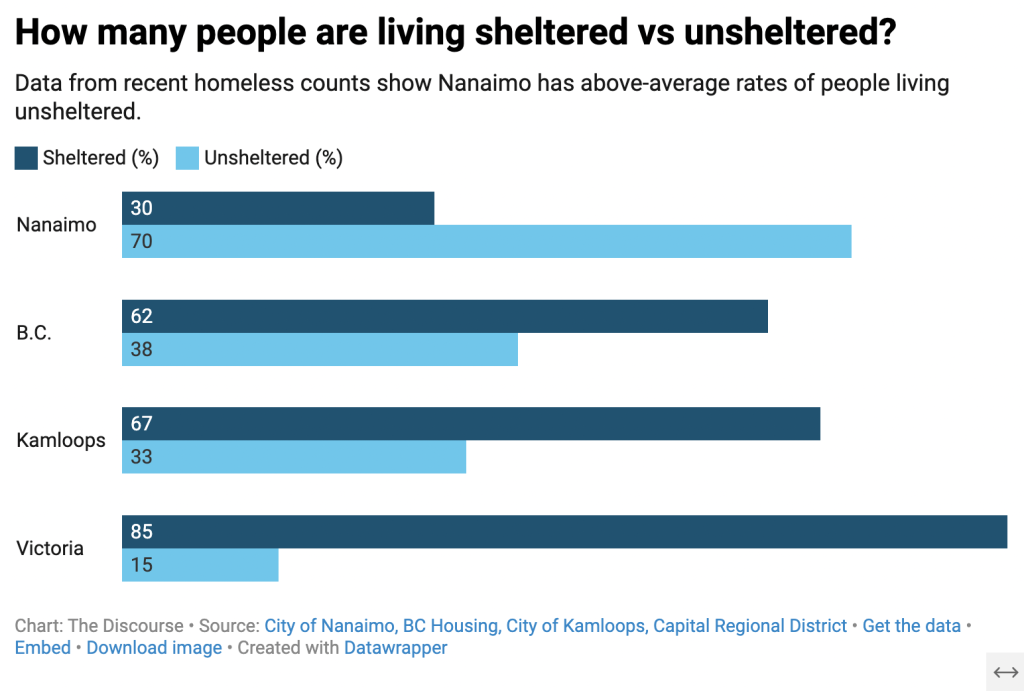
The City of Nanaimo has a comparatively high percentage of unhoused residents living unsheltered compared to the provincial average.
In Nanaimo, 30 per cent of people experiencing homelessness were sheltered in 2023. Data from BC Housing shows that at most recent count across B.C., 62 per cent of people experiencing homelessness were sheltered.
Contrasting the number of people living unsheltered with the number of emergency shelter beds in the city, it’s clear there’s a widening gap between what is available and what is needed, says Thornton.
“Counting emergency shelter beds is notoriously difficult for a number of reasons, but the number in Nanaimo has been fairly static since 2018 as far as I know,” Thornton stated, via email. “There are approximately 120 emergency shelter beds in the non-winter months, and the only variation is that there is usually an additional 30 to 40 beds for the winter period.”
At the end of the meeting, Coun. Brown proposed a final amendment to the motion that correspondence be sent to B.C. Premier David Eby that “outlin[es] the continued and severe health needs of unsheltered populations in Nanaimo and the community-wide need for provincial funding that matches the scale of the crisis for programs and shelter space for the unsheltered populations in Nanaimo,” which was unanimously approved.
What did you think of this story?
Your feedback after we publish a story helps ensure we're always improving our reporting to better serve you
Author

Related Articles
Nanaimo mayoral candidates address the homelessness crisis
Homelessness is a key election issue but what can the City of Nanaimo do about it?
How Nanaimo candidates would pay for rising infrastructure costs
City of Nanaimo’s 2026 candidates share how they’d manage the budget to cover rising infrastructure and repair costs without overburdening taxpayers.

Nanaimo candidates on how the city can cut emissions
City of Nanaimo’s 2026 candidates share two actions within city jurisdiction they’d prioritize to reduce emissions, and how they’d know if they were working.