
Son de Metal creates ‘a music of working people’
Traditional Mexican son-rock fusion band will play Mansfield Park in Nanaimo on Wednesday, July 9.
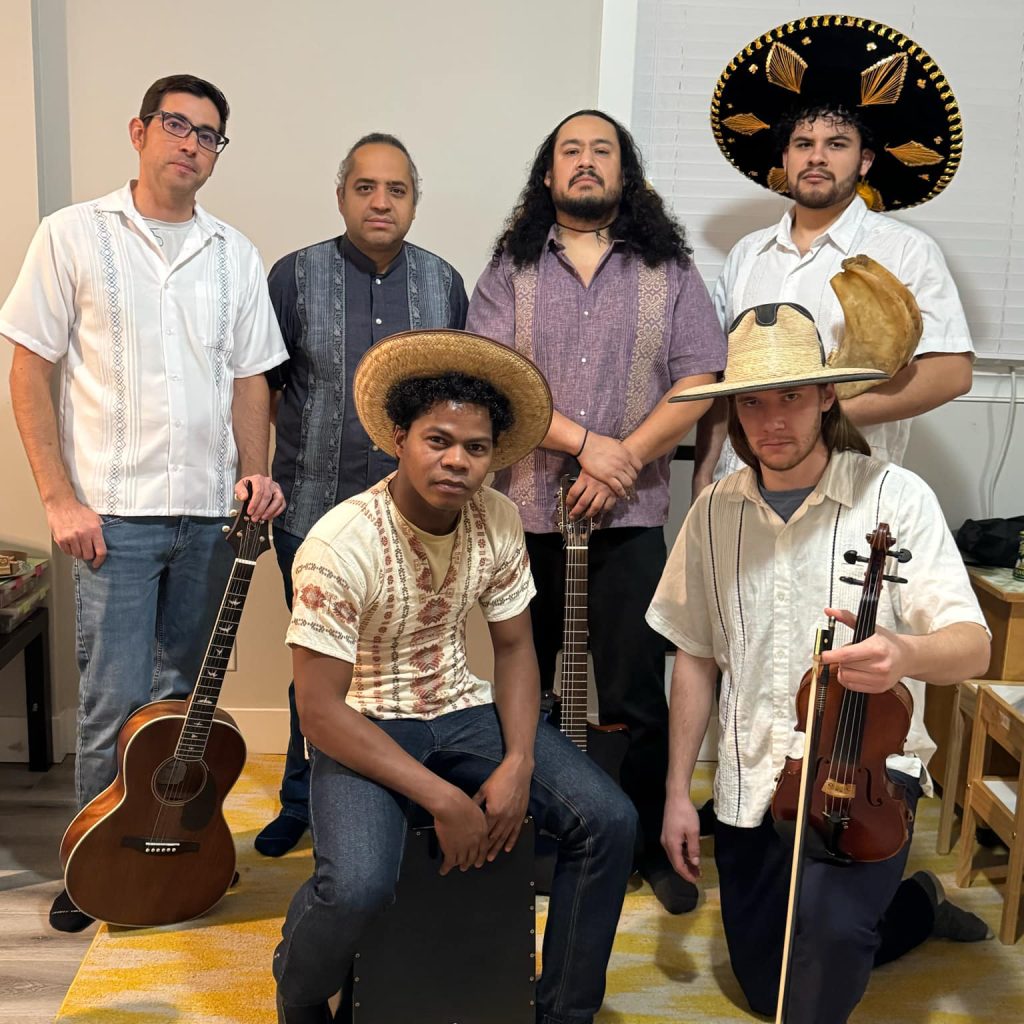
A new subgenre of traditional Mexican folk music, created on Vancouver Island and mixed with rock elements, will echo through Nanaimo’s Mansfield Park this Wednesday evening.
Son de Metal will be performing a free concert with Vancouver’s Colectivo Yollotl as part of the City of Nanaimo’s Concerts in the Park series.
Reporter Mick Sweetman spoke with Rodrigo Moreno Villamar, who plays the jarana in Son de Metal, about how people are responding to its unique style of music.
The Discourse: My first question is simply, what does “Son de Metal” mean?
Rodrigo Moreno Villamar: It’s a play on words from a type of music in Mexico called son. You might have heard about son Cubano, right? It’s a type of son in Cuba. But just like there’s son Cubano, we have something else called son in Mexico, and there’s eight traditional main varieties of it. So what we’re doing here is an experiment where we take that traditional music — some songs are 300 to 400 years old — and mix it with symphonic rock elements like double bass, violin, distorted electric bass, distorted guitar, etc. Son de Metal is a play on words of son, the genre and metal meaning the fusion with rock.
How long have you been playing together?
We’re relatively new. We started about two years ago and we’ve been having presentations since about a year ago, and the reception has been great. We have played in several places across the Island, once in Vancouver and this summer, we’re slated to play at the Victoria Latin festival. We played Filberg Festival last year. We are also going to play the 39 days of July Festival this year in Duncan on Sunday. And we’re also going to play in the Comox Valley on July 22 with some bands from Montreal that are coming.
This music couldn’t have come from AI, it’s very organic. It couldn’t have come from Warner Brothers Studios. It couldn’t come from Sony or the big conglomerates, because it’s a music of working people. The only reason why I started this band is because I don’t consider myself a real musician, even though some of my bandmates are. It comes from my own story of having lived in Mexico and immigrated to the United States, having lived in Oregon for over a decade, and then coming to Canada. So all those chapters of my life form my experience, my feelings — good and bad — and that’s expressed in this music.
What has the response to your band been like?
I was surprised, because it’s a very new type of sound. Usually the older traditional groups have mostly wooden instruments, all acoustic and it’s only one voice. In this case, we’ve incorporated vocal harmony. We’ve incorporated bottom-end instruments and the electric bass with distortion gives it a very characteristic flavor. But also the double bass below that. So it can be a very bassy, very ominous, type of a feeling you get.
But it’s also paired with an African drummer from Madagascar, Mr. Beni Rene, who makes everything very dynamic, not to mention the dancers, which add a compound, including six-eight [Mexican hat dance timing] and sometimes sonnets.
That creates this crazy feeling. I can only describe it by inviting you to come to the show. It tugs at your heart strings with the violin. It drives you through the beat with the dancers stomping on the tarima — a platform for stomp and tap dancing — and it’s very strong with it. So it really drives you. The rhythm instruments on the higher end, such as the jarana, which is a type of Mexican eight-string guitar, gives it a different sense that is usually not experienced by people in Canada or Mexico or anywhere else really, because it’s a new thing.
We have people from everywhere, but the essence of the music is still from Mexico based on traditional genres and we mix those other elements together.
I think it was actually on your YouTube page, you wrote that your music helps keep Mexican cultural roots alive through the modern dystopia. What do you mean by that?
Basically, what we’re saying is that a lot of this music was very, very joyful from the beginning, and because it was created a long time ago, that makes sense in that southern Mexican context.
In 2025, I see that that music has a lot more layers than I once thought about. So we’re highlighting some of the darker aspects, or minor scale aspects of it, and what we get by keeping the same dynamism in the tempo and the beat.
We’re able to still keep it true enough that you are able to experience the joy of it, but it is like a sound check for the zeitgeist with everything that’s going on in the world.
I hope that the Canadian public can identify a little bit of their struggle and their pain through this music, because the original music also is a music of pain and struggle. It’s music of the people that were marginalized centuries ago in Mexico when there was a colonial structure that had 17 different castes. It was a very developed caste system based on skin color and the people on the lowest rungs created this music.
Living in Nanaimo, Canada, there are a lot of local Nanaimoites, Canadians and Islanders that struggle day-to-day, and they don’t necessarily have a music of their creation that is of this day. There’s a lot of commercial music — you see people trying to fit into certain genres or identities that these corporations create. We want to do something organic, and I think that we’re succeeding in doing so by incorporating these more modern elements.
In our band, yes, the basis is set when it comes to arrangements and melody lines, etc. — we really do try to incorporate everybody’s input. And of course, a lot of the input is from people from the Island, from Canada. We’re very proud to have Mr. Paul Sadlemyer on violin, who’s a graduate from the VIU jazz program, as well as Mr. Drake Shoemaker from Campbell River. Even when we’re practicing, people stop by and just want to have a chat or sit and listen, because somehow it speaks to them.
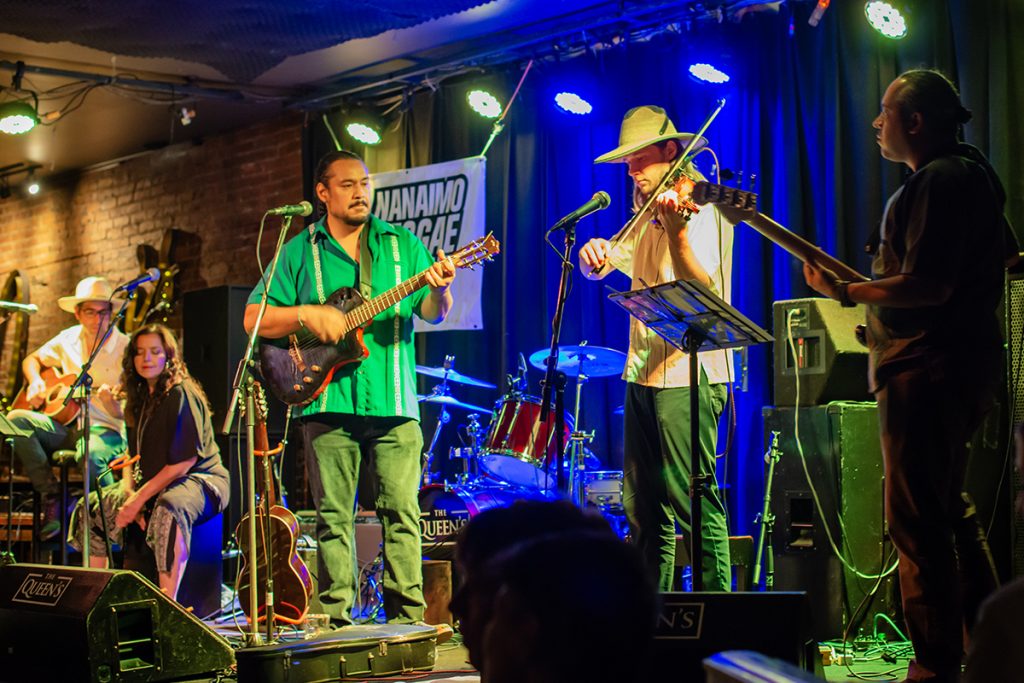
Are you finding that your music is resonating with the Mexican community here?
I would say yes, but also because some of the songs have resonated here. We played at the opening of Mary’s Mexican store last year, where the actual Mexican Consulate came from Vancouver to Nanaimo, which is a first — they had never come to Nanaimo, so that was cool. The Consul General herself told me that she loved it, and other people really like it too. However, my objective is not to tell Mexican-Canadians “this is your music, this is how we see it.” It’s more to be a hybrid where everybody sees a piece of themselves represented or in the music, or the feelings the music creates.
So it’s bridging different cultures through music.
Exactly. My drummer is from Madagascar, my dancers are from Guatemala, our bass player is half Mexican and half Dominican. It’s a reflection of modern-day Canada. I have my Mexican heritage, which is the driving force of this project, but I can’t pretend that I am in 16th century Mexico. I’m in 2025 and that means carrying around a lot of other musical and cultural baggage. I grew up listening to rock, hip-hop, jazz, blues and so did everybody else in the band.
What has your most memorable experience with the band been?
I think the reception, because nobody can expect this music because it’s a new genre, so to speak. It’s not that we were trying to create a new genre, it just organically came about to be this way. So there’s something really strange, if you come to the show, there’s going to be something really, really strange about it, really foreign about it, but there’s something oddly familiar to it as well.
[This is] especially if you’re somebody who grew up in the 1990s, 2000s or 1980s where bass lines were that of [Black] Sabbath or Tool. Our bass player is a huge Sabbath and Tool head. Iron Maiden — he likes that kind of stuff. It’s like when you go to a party and you’re loving the song but you don’t know what it is and then when the beat drops, you realize it’s a mash up of two songs you really like combined together.
The reception we’ve gotten is usually one of surprise and after that, a lack of emotional containment. Like, people don’t necessarily know what to do with their feelings, but at some point the beat kicks in and is a driving guide that channels that energy.
One of the big memories for us was playing the Filberg Festival last year. It was a beautiful festival, a packed crowd and just the most idyllic setting I could think of in Filberg Park in Comox and seeing all the people and families having great time and vibing together to music that is not only played by a Mexican guy, but also their local prodigal sons from the VIU jazz program.
It’s a very cool thing that’s happening. It’s hard for me to describe it in words, but if you come and feel the vibe and hear the music, you’ll see that there’s something afoot, and I can’t really pinpoint it, but I just know we’ve got to keep doing it so that it flourishes even more.
What does it mean to be selected to play a free concert in the park by the City of Nanaimo?
It’s an honour. It’s a pleasure and we are so elated, not just for having been chosen but just to have live free music at the parks. I mean, a lot of us have children and I think it’s the right of every kid to be able to go to the park and every once in a while have free live music where you can dance with your brothers, sisters, mom or dad. We’re super excited to see the push that the city has given this event in terms of publicity, and we’re extremely thankful for it. Hopefully the people of Nanaimo and the neighbours come out and we all have a great time.
What can you tell me about Colectivo Yollotl?
For Wednesday, we are not just Son de Metal. I’m bringing a band from Vancouver that plays the traditional son as they always have been played in the Fandango. The Fandango is the traditional party in Veracruz, a state in Mexico, where people dance, sing and play all night. In the dancing and in the singing, there’s a lot of improvisational elements and those elements allow for people to air their grievances. So we’re going to have, in a way, a double show where we showcase the more fusion aspect of the music and then we’re going to have the traditional band for son Jarocho, where everybody sings, everybody plays, everybody dances.
What did you think of this story?
Your feedback after we publish a story helps ensure we're always improving our reporting to better serve you
Author

Related Articles
Nanaimo mayoral candidates address the homelessness crisis
Homelessness is a key election issue but what can the City of Nanaimo do about it?
How Nanaimo candidates would pay for rising infrastructure costs
City of Nanaimo’s 2026 candidates share how they’d manage the budget to cover rising infrastructure and repair costs without overburdening taxpayers.

Nanaimo candidates on how the city can cut emissions
City of Nanaimo’s 2026 candidates share two actions within city jurisdiction they’d prioritize to reduce emissions, and how they’d know if they were working.