
Sun Over Swamp explores the abstract aesthetics of ‘vast and complex lifeworlds’
Nanaimo Art Gallery’s Sun Over Swamp group show features abstract works from Takao Tanabe, Rebecca Brewer, Azadeh Elmizadeh, Rita Letendre and Gailan Ngan.
It has been almost exactly 10 years since I interviewed Canadian artistic giant Takao Tanabe when I was a reporter at the now-shuttered Nanaimo Daily News.
Back then, Tanabe was being acknowledged by an honorary doctorate from Vancouver Island University which celebrated his decades of work to become one of Canada’s most accomplished artists.
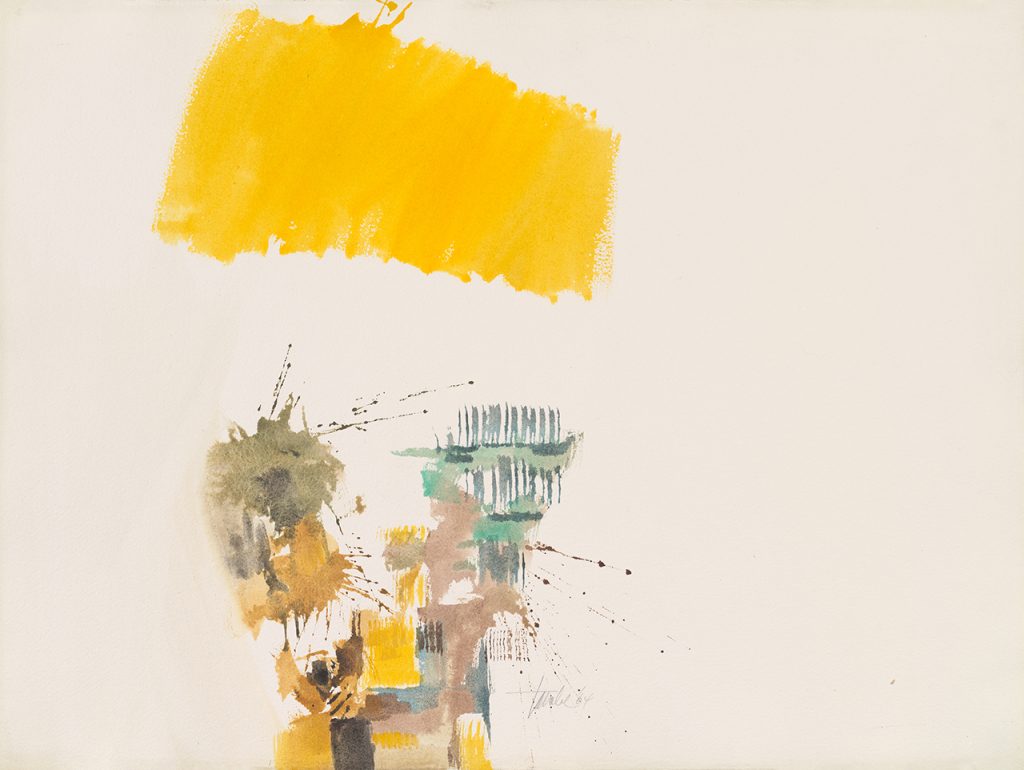
This month, Tanabe is in the local spotlight again with his 1964 painting Sun Over Swamp, which forms the title piece of a group exhibit at the Nanaimo Art Gallery (NAG) that opens on Friday, April 26 at 7 p.m.
In addition to Tanabe, the group exhibit’s artists Rebecca Brewer, Azadeh Elmizadeh, Rita Letendre and Gailan Ngan, “reflect on our fragile yet globally interconnected biomes,” writes NAG curator Jesse Birch.
“From tracing the environmental footprint of their materials to employing storytelling, mythology, artificial intelligence, and embodied learning in their processes, [the artists] consider unknowably vast and complex lifeworlds through the practice of abstract painting.”
At 97 years old, Tanabe is not inviting many reporters over, but when I visited his Vancouver Island studio 10 years ago — with the promise that I would not reveal to anyone exactly where it was — I was surprised to hear that art was not a part of young Tanabe’s life.
“I come from a very poor family,” he told me then, as we sat at an industrial-sized table in his sunny studio. “I wouldn’t say we were deprived. .. but there was no such thing as art, for goodness sakes.”
Raised outside of Prince Rupert in a village called Seal Cove, Tanabe’s father was a commercial fisherman, and by the age of 11, Tanabe was helping out at the local cannery during the summer. By the time his family had moved to Vancouver in 1937, he continued to attend school and found weekend work in a bowling alley where his job was to re-set pins.
After this his family were forcibly incarcerated in internment camps, first in Hastings Park and later in the Kootenays, because they were of Japanese ancestry.
Near the end of the war, they moved to Winnipeg where Tanabe worked as a labourer, and with an idea that he could escape that life, he wondered if he could get into sign painting.
Though the internment meant he didn’t finish high school, Tanabe managed to talk his way into the Winnipeg School of Art.
The higher artistic aspirations didn’t come until later, he told me. At that time the art school was poor and lacked basic supplies, so much of what he learned about art had to be described to him, he said.
From his start as an abstract expressionist to the metres-long landscapes of ocean vistas and prairie expanses, he has now painted for decades; the breadth of Tanabe’s work is astonishing. And it still resonates.

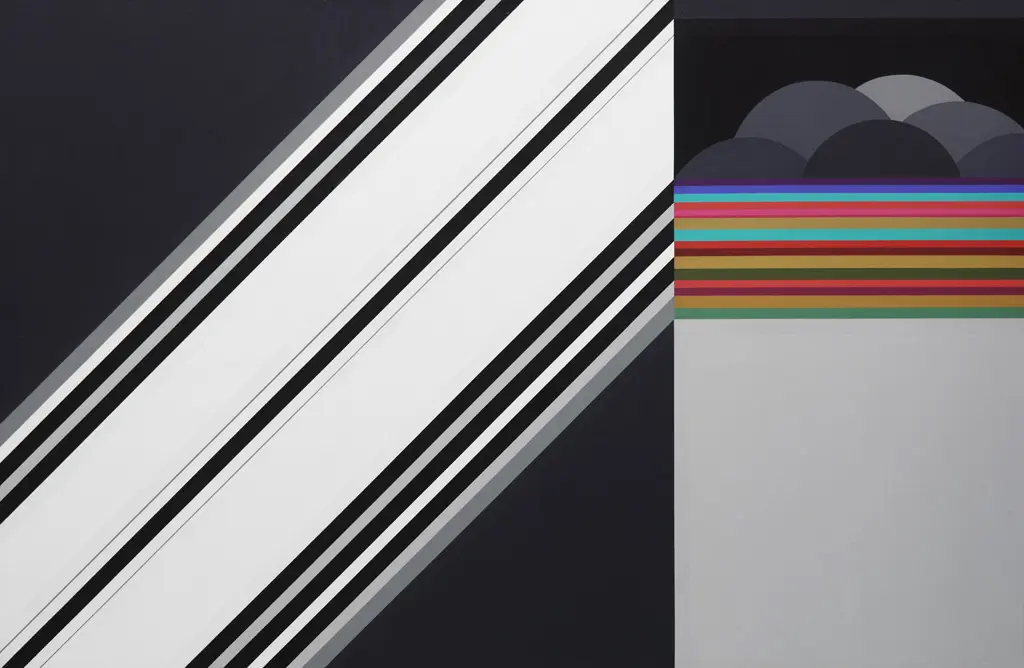
Last spring, I checked out Hard-Edge, a modernist abstract exhibit at the Vancouver Art Gallery that specifically featured what are known as hard-edge abstract paintings. They reference an aesthetic movement that emerged globally in the post-war period characterized by geometric “compositions of flat areas of colour, separated by crisply defined transitions,” according to the gallery.
I rounded the corner and was struck by one of Tanabe’s early works — Untitled (Passing Rainbow), from 1968. Somehow I instantly recognized his style, though everything I’d seen in his studio were massive nature landscapes. I must have Googled his older works and somehow committed them to the filing cabinet of memory.
Curious about whether the move from abstract expressionism to landscapes was abrupt or happened slowly over time, I asked Tanabe’s wife Anona Thorne if he would answer a few questions about the current exhibit over email.
“Tak doesn’t prefer landscapes. In fact, even while painting landscapes, he has periodically done some abstracts on paper for his own satisfaction,” responded Thorne. “Various writers have commented that he has always painted landscapes, even while painting abstractions… and the fact that some of the abstractions have references to landscape in their title is notable. The ‘shift’ from abstract to landscapes was a gradual evolution, not an abrupt change at all.”
When I enquired about how his work manages to stand the test of time, Tanabe’s answer is simple: “I’m lucky,” he writes.
An ‘algorithmically filtered collective unconscious’
The relationship between the work of the artists in the show is one of abstraction, says Vancouver-based artist Rebecca Brewer.
“That’s not just purely because my work delves into moments of formal abstraction, there’s recognizable features sometimes, but a lot of it is quite abstract, ultimately,” they say. “Abstraction is so much more than formal abstraction. Something becomes abstracted through a process sometimes.”
This process can take many forms, but one Brewer has recently utilized is taking descriptions of their own art and feeding it through artificial intelligence or AI programs to create new works.
“That was another curiosity I had. Could it — based on the things that I was thinking about when I was working on my paintings, which are sort of emergent and very intuitive, those things that I privately think in the studio — would that translate at all when put into this AI? It was very uncanny,” says Brewer. “It felt a little bit like a surrealist gesture to use the automatic to explore other images that could arise from a description of my own work.”
This creation of new images “generated from an algorithmically filtered collective unconscious,” is part of a swamp aesthetics, writes Birch, that in Brewer’s case is also informed by inspiration sourced in 17th-century Dutch sottobosco painters.
“It’s a kind of Dutch still life-adjacent tradition that literally means ‘undergrowth,’ where everything is focused around creatures that live really close to the ground, and it’s a slightly different point of view,” says Brewer.

Artist Azadeh Elmizadeh’s work also rises up from the undergrowth to find a focus on water, “specifically in arid areas such as the Iranian plateau, [that] have given birth to certain myths and fables that center around the significance of water,” she writes, via email.
With three new works created specifically for the Sun Over Swamp show, the Toronto-based artist says that a recurring motif in some of these fables “is a mythological hybrid being that exists in a liminal world that is part human, part animal and can morph into the landscape if the plot necessitates it,” with attributes of a fish, a bird and a serpent.
As the show’s theme inspects different aspects of ecology, the interconnectedness of ecosystems and “the porousness of our bodies concerning the environment,” mythology is a particularly useful way to understand those connections, says Elmizadeh.
The opening reception of Sun Over Swamp is on Friday, April 26 at 7 p.m. On Saturday, join Nanaimo Art Gallery curator Jesse Birch, and learning and engagement coordinator Yvonne Vander Kooi for an in-depth conversation with exhibiting artists Rebecca Brewer, Azadeh Elmizadeh and Gailan Ngan. The show runs until June 24.
Editor’s note, April 24, 2024: The article has been changed to reflect a clearer timeline of Tanabe’s early life and photo captions have been updated. Tanabe’s age was also incorrectly listed as 98, but he is currently 97.
What did you think of this story?
Your feedback after we publish a story helps ensure we're always improving our reporting to better serve you
Author

Related Articles
DRIPA debated in B.C. election on Vancouver Island
The Conservative party of B.C. is promising to repeal the Declaration on the Rights of Indigenous Peoples Act (DRIPA), while other parties argue that would set back relations with First Nations and create economic uncertainty.
Where Nanaimo’s MLA candidates stand on addictions care, family doctors and Island rail
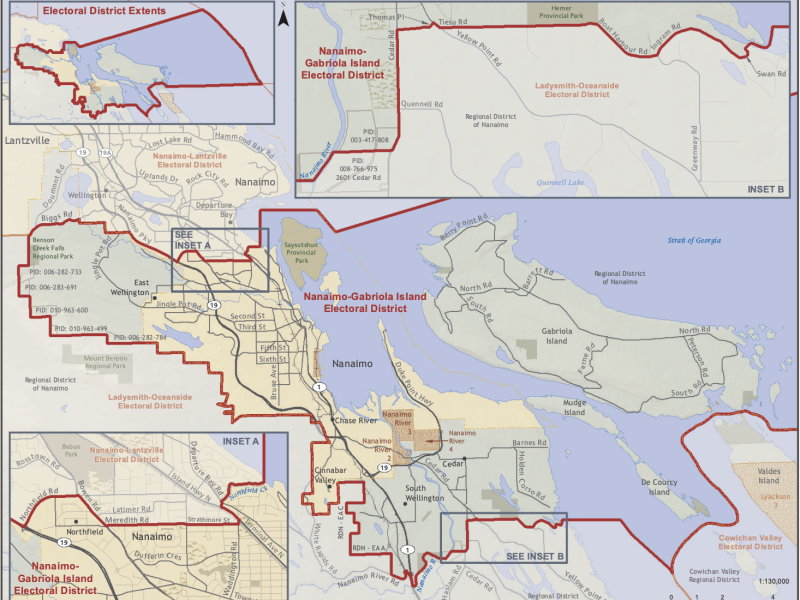
Candidates in Nanaimo-Gabriola and Nanaimo-Lantzville answered three questions from Discourse readers ahead of the Oct. 24 B.C. election.
Nanaimo’s guide to the 2026 B.C. election
What riding am I in? Who are the candidates? When do I vote? B.C. election basics for Nanaimo voters.