
The role of animals in Vancouver Island’s early logging and mining history
Animals were key to resource extraction operations on Vancouver Island throughout the late nineteenth and early twentieth centuries.
Kelly Black is a researcher, writer, historian and collector of books and has taught B.C. and Canadian history at Vancouver Island University. What questions do you have about Cowichan Valley history? Send us an email and we’ll do our best to tackle them.
Many museums and heritage sites on Vancouver Island feature displays about workers and the technology that aided resource extraction. There are so many engines, trains and coal cars featured at these places that we may forget that there was a time when horses, mules and oxen were worked by people to haul logs and coal.
Animals laboured above and below the ground throughout the late nineteenth and early twentieth centuries. Eventually, innovations in power generation and extraction methods replaced the need for animals and forced workers to adapt their knowledge and skills, relegating animal labour to old-timer reminiscences and history books.
Getting the logs out
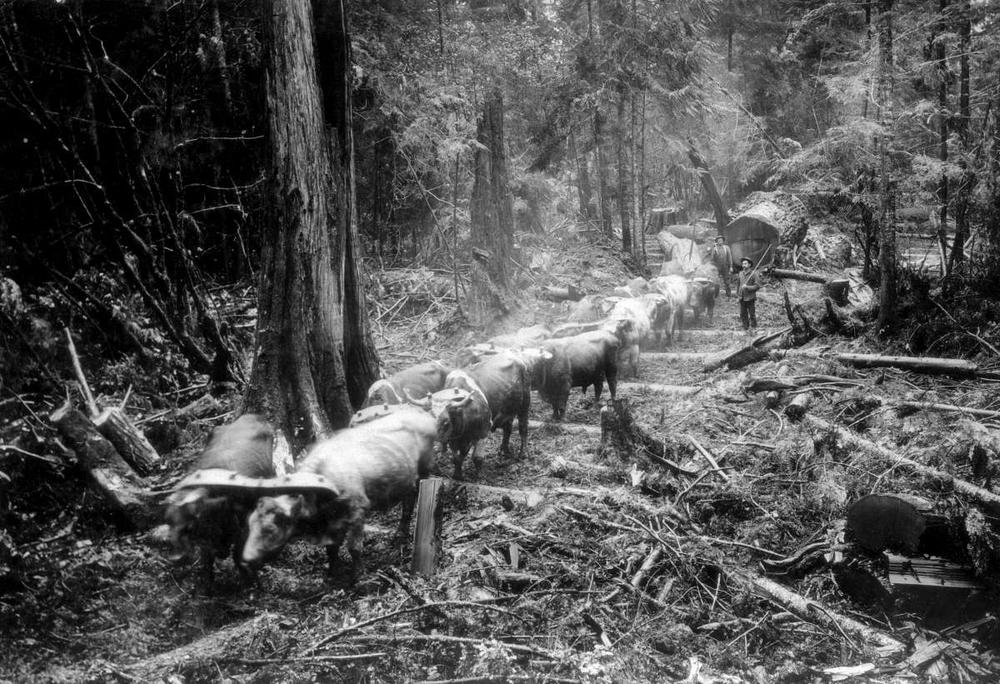
In the nineteenth century, logging by settlers on Vancouver Island took place close to the ocean or other water courses. If trees could not be dropped right into the water, a team of horses or oxen were necessary to bring logs out of the forest. To prepare the way, workers cleared a road through the forest and set out logs (or skids) to create a skidroad and prevent the log from getting stuck as it was pulled.
People took on important roles to support the teams of animals that were hauling logs. The “greaser” put lubricant on the skids while the “teamster” manoeuvred the animal team; the “hooktender” attached a series of ropes and pulleys from the log to other trees and stumps. Every effort was made to decrease hang ups and increase the power of the animals.
“Drawing the logs from the bush to the skid-road called for the greatest exertion of ox-power, and a teamster who could command the unified action of 10 or 12 oxen was an animal psychologist of the first rank,” writes Nathan Dougan in his book Cowichan, My Valley, about the complex systems and special skills required for horse and oxen logging.
“Such a one [sic] was Jim McLurg. Having feared goad-stick in the air and calling some of the oxen by name, old Jim stamped heavily on the ground, as he gave the command. He seemed to electrify the cattle into action with his own exuberant energy, as every ox trained to the bow, and the great log ploughed along.”

According to Dougan, horses and oxen were well-treated — after all, the success of a logging operation depended upon both human and animal labour. However, the title “bull-puncher” was also used to describe a teamster, an indication of the intense prodding used to get the oxen moving.
Donkey power
By the 1890s, a new machine had arrived on Vancouver Island: the steam donkey. Named for the animal power that it replaced, the donkey used cables attached to a spool or drum and pulled the logs in — a process known as yarding. Animal teams continued to be used by small operators, but the steam donkey shifted the dynamics of logging.
The engine operator became known as the donkey puncher and the vital role of the teamster was eliminated. Several workers were still required to operate the engine effectively, but equipment manufacturers and timber companies saw a new way to increase production and profit.
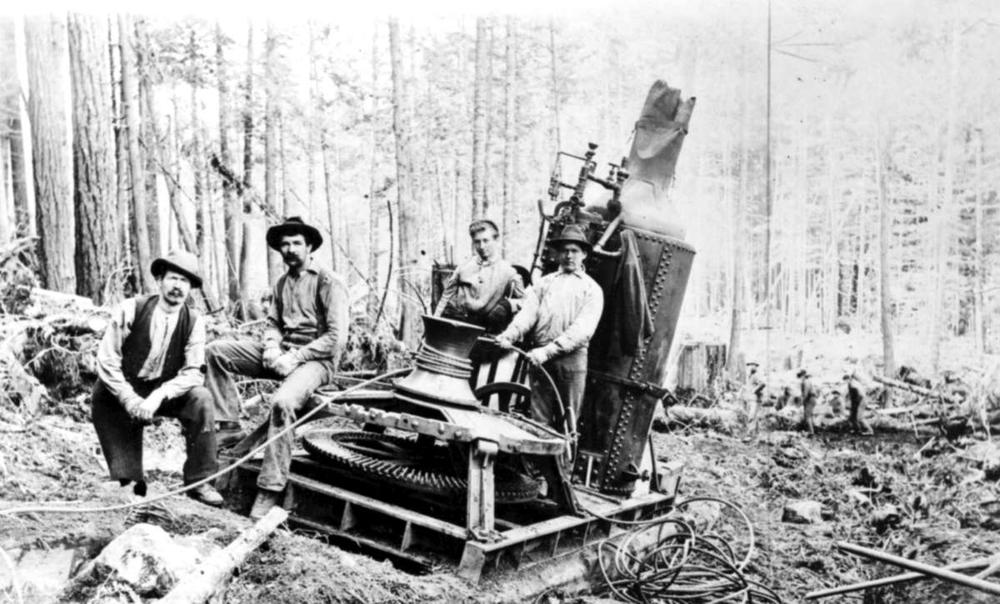
“The steam donkey possessed several advantages over animal power,” explains forestry historian Richard Rajala in his book The Legacy and the Challenge: A Century of the Forest Industry at Cowichan Lake. “They offered greater power and higher yarding speeds, required no training and did not have to be fed when idle.”
In just a few decades, animal team logging became a piece of nostalgia, written down in settler reminiscences and forgotten by most.
Getting the coal out
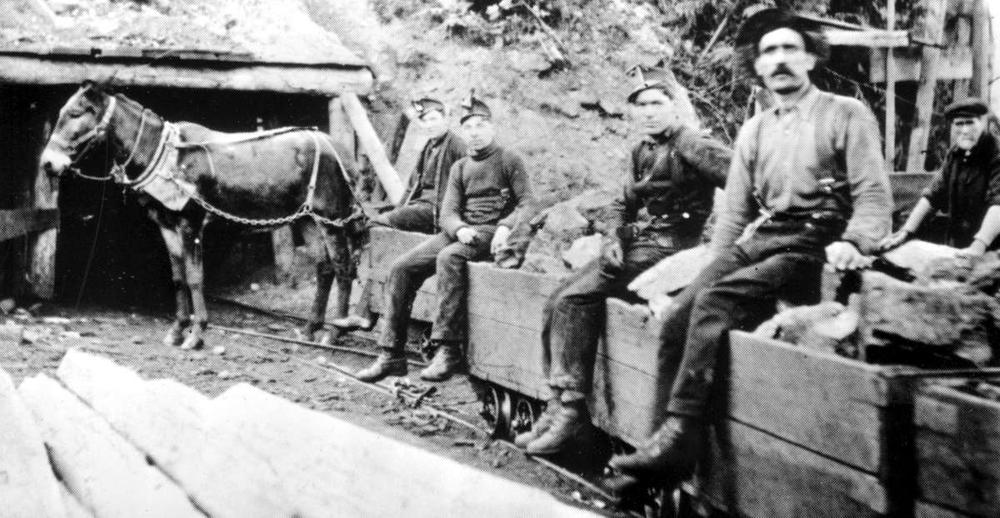
Animal power was also an essential part of coal mining in the Ladysmith, Nanaimo and Comox Valley regions. Mules and ponies were used to haul cars of coal from the stalls where men worked to the entrance of the mine. Their strength and small size allowed them to access the cramped spaces where miners worked.
The success of a day’s wages relied upon the amount of coal mined and therefore the speed of the mule or pony and its driver, a position also titled “mule skinner.” A lack of cars, notes historian John Hinde in his book When Coal Was King, “meant lack of wages, and disputes about shortages of cars or delays were common.”
Mules and ponies were stabled both above and below ground. At the Extension mines 20 kilometres north of Ladysmith, the stables were located near the entrance to the mine. At Cumberland and in Nanaimo, the animals lived in stalls at the base of the shaft, hundreds of feet underground.
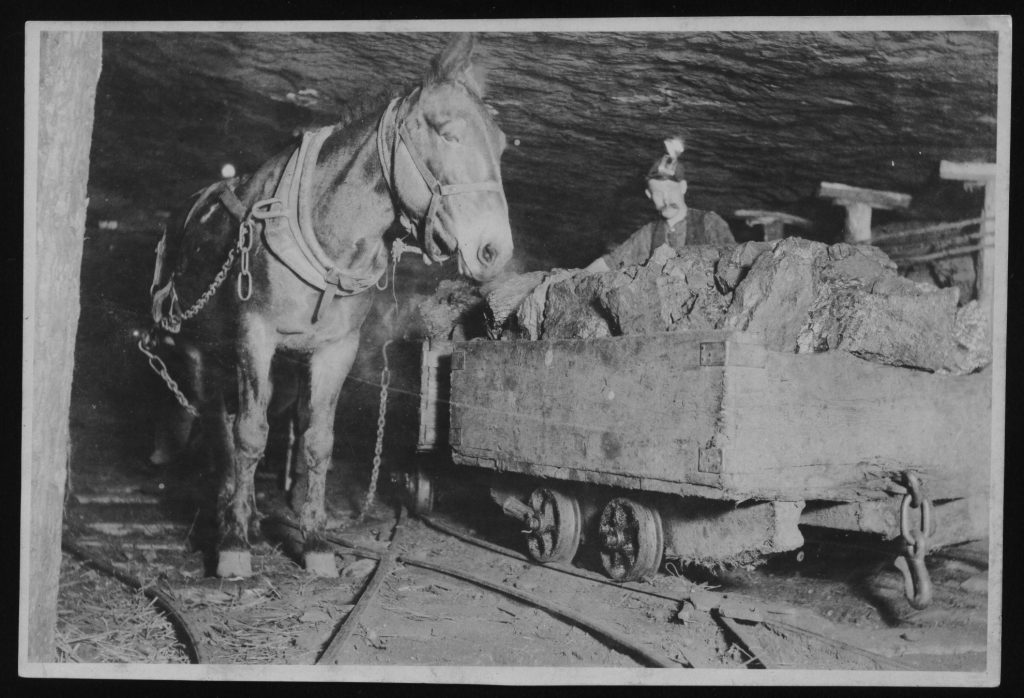
In 1978, the Coal Tyee Society began an oral history project to capture stories about coal mining on Vancouver Island. Working with these oral histories, Vancouver Island historian Lynne Bowen wrote Boss Whistle: The Coal Miners of Vancouver Island Remember. Bowen’s book and the Coal Tyee interviews (now digitized and available online through Vancouver Island University), feature many stories about animals. In one interview, miner Wilf Broderick remembered the intelligence and temperament of the animal workers:
“But there was some real good mules, there were some real good ones, real good ponies, they were really highly intelligent. If you had a good mule it made the work twice as easy or as good [as a] pony or horse. They got to work everything more or less on a system and they knew exactly where you were going this time and know where you were going the next time.”
The animals were given names like “Black Jim”, “Queenie” and “Fox.” Not all drivers treated the animals kindly, and frustrations ran high when an animal refused to cooperate. Mules were often forced down onto their knees and into tight spaces which stripped the fur and skin off their backs.
Some workers believed that the company valued an animal’s life more than theirs. “If a horse or mule got killed down there,” recalled one miner quoted in Boss Whistle, “somebody got fired for it. They were more important than the men because they cost more. They could get men for nothing.”
It was not until the 1940s that the use of animals in coal mines ended — a relatively late date, and one of the reasons their role in the mines was able to be documented by the Coal Tyee project.
Remembering animal labour
There is no shortage of places to see steam donkey relics, including Quarry Nature Park in Cobble Hill, the Forest Discovery Centre in Duncan and Transfer Beach in Ladysmith. The Museum at Campbell River even has a restored and working steam donkey from 1916. Visitors to Piper Park in Nanaimo, No. 6 Mine Heritage Park in Cumberland or Extension Miners Community Park can see steam engines and coal cars from the days when mining was the main industry.
For the animals that laboured alongside people in the forests and mines, there are fewer examples. Though Comox Valley musician Gordon Carter sings about their plight in his song Pit Pony’s Tale, in Nanaimo or Cumberland there are no monuments to the hundreds of mules and ponies who once lived underneath. Animals had an essential role in the exploitation of resources on Vancouver Island and their stories are there, if you know where to look.
What did you think of this story?
Your feedback after we publish a story helps ensure we're always improving our reporting to better serve you
Related Articles
What are Nanaimo election candidates saying about the climate emergency?
All-candidates forum puts climate questions to Nanaimo election candidates.
Comox Valley, Nanaimo land trusts raising funds to support Deep Bay land conservation purchase
In a partnership with the Comox Valley and Nanaimo Area land trusts, BC Parks Foundation is fundraising to protect 50 hectares of pristine shoreline in Deep Bay and make it accessible to the public.

Nanaimo Jazz Festival celebrates 10 years with more than a dozen shows in September
Local and international artists to perform on multiple stages in the city at this year’s Nanaimo Jazz Festival.