
With a recent point-in-time count showing that homelessness in Nanaimo increased by 20 per cent last year, there is broad support for more affordable and supportive housing in the city for people who are unhoused.
Supportive housing is defined by the City of Nanaimo as affordable housing with staff who are on site 24-7 to support tenants who have significant barriers to maintaining market housing such as mental illness, substance use disorders, a history of trauma or diminished capacity.
Recently, two new supportive housing locations opened in the Chase River neighbourhood and 100 people are in the process of moving into them. Meanwhile, in the Old City neighbourhood, a supportive housing project that has been in operation for over a year is also going smoothly according to the local neighbourhood association.
But neighbourhood organizations and city officials are questioning why much of the new supportive housing is concentrated in central and south Nanaimo.
At a city council meeting on May 5, 2025, Coun. Erin Hemmens said she was hearing “deep concerns” from residents of the South End neighbourhood regarding the concentration of services in that community. In response, Hemmens made a motion to add language to the official city plan that states staff should try to encourage supportive housing to be built throughout the city.
“Of course, it’s going to be up to the people sitting at this table to say yea or nay to any kind of property proposals, but I think it provides a little bit of support and assurance to the South End in particular that we will do our best to to not concentrate these services,” she said at the meeting.
The Discourse met with community members to learn more about their thoughts on current and planned supportive housing developments in their neighbourhoods, as well as city staff to understand how the locations of these developments are selected.
Where is supportive housing in Nanaimo located?
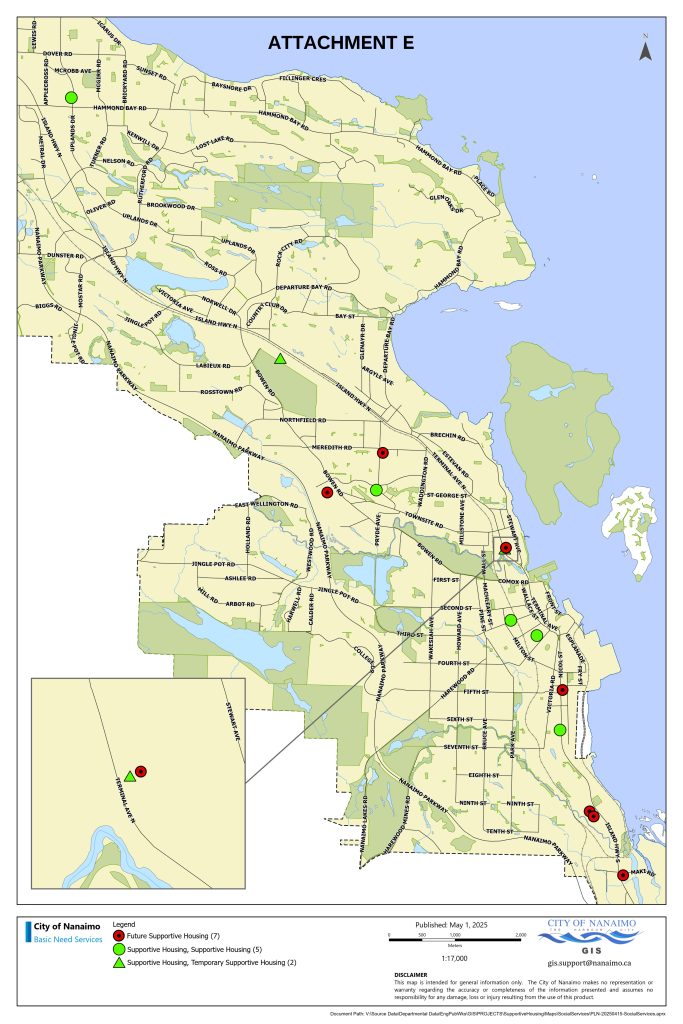
There are currently nine supportive housing locations in the city, with another five planned for development. The majority of them are located in the Newcastle, Old City, South End and Chase River neighbourhoods, and only two are located north of Townsite Road.
The reasons for these locations are complex, according to senior city staff who gave an extensive interview to The Discourse.
Staff say there are not a lot of empty lots available in Nanaimo and the city’s real estate team works with BC Housing to secure sites for supportive housing.
Lisa Brinkman, manager of community planning at the City of Nanaimo, said BC Housing has a list of criteria it is looking for in potential sites, such as being walking distance to grocery stores, medical services and public transportation so people can meet their daily needs.
Brinkman said BC Housing is trying hard to find sites in the city that meet the criteria but it is difficult. When they do find those sites, sometimes the landowner isn’t willing to make a deal “so then they move on to the next option,” she said.
Hemmens said the way the city is responding to the homelessness and housing crisis has evolved over time.
“Five years ago, we were talking about the dire need for housing, which is real,” she said. “Now we talk more about how that housing is landing in communities, and I think the community is responsive to that conversation.”
How people access supportive housing
BC Housing uses what it calls a coordinated access and assessment process to offer people units in supportive housing buildings.
The agency works with other local agencies that are part of a placement committee and prioritizes people who are chronically homeless and sleeping in shelters or on the street, people who have been homeless in Nanaimo for at least one year, Indigenous people who are experiencing homelessness and people who have mental health or substance use issues.
For example, the residents at the Cornerstone supportive housing building on Prideaux Street came primarily from a temporary housing site in the Newcastle neighbourhood that has been temporarily housing people since 2018. The residents at the new site at 1300 Island Hwy. are placed there from the shelter system.
“We’re looking at folks that are a fit, who will be working on goals and skills in order to fulfill what they’re looking for on their path,” said Anne-Marie Tosh, who is the senior program manager for Connective, formerly the John Howard Society, that operates both of the Cornerstone and 1300 Island Hwy. supportive housing buildings.
Chase River supportive housing opens with minimal issues
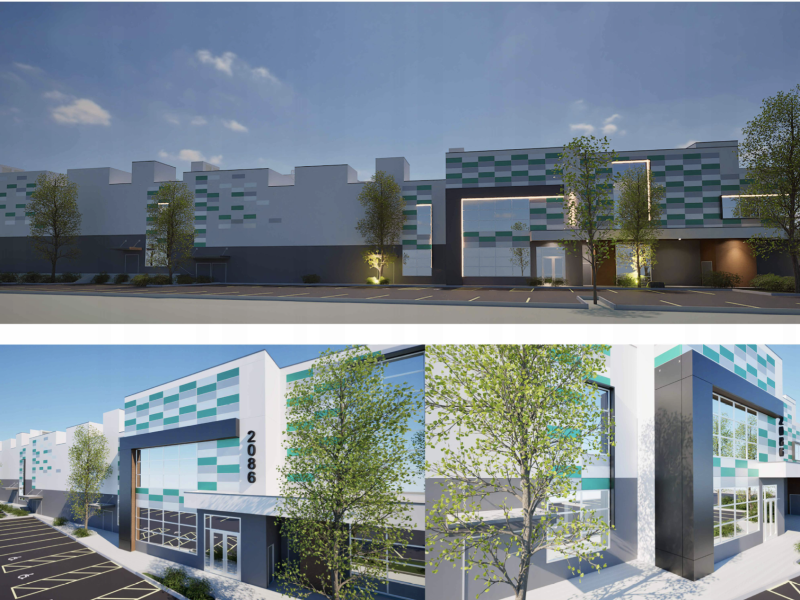
The new temporary housing site at 1300 Island Hwy. in Chase River opened in July, well behind its original estimate of fall 2024. Brinkman said the city was trying not to concentrate supportive housing in the south side of the city but BC Housing was keen to go ahead with the project.
“We were going to lose the funding if we didn’t pick a site,” Brinkman said. “It was getting to that point.”
Ultimately, BC Housing decided to proceed with the city’s support.
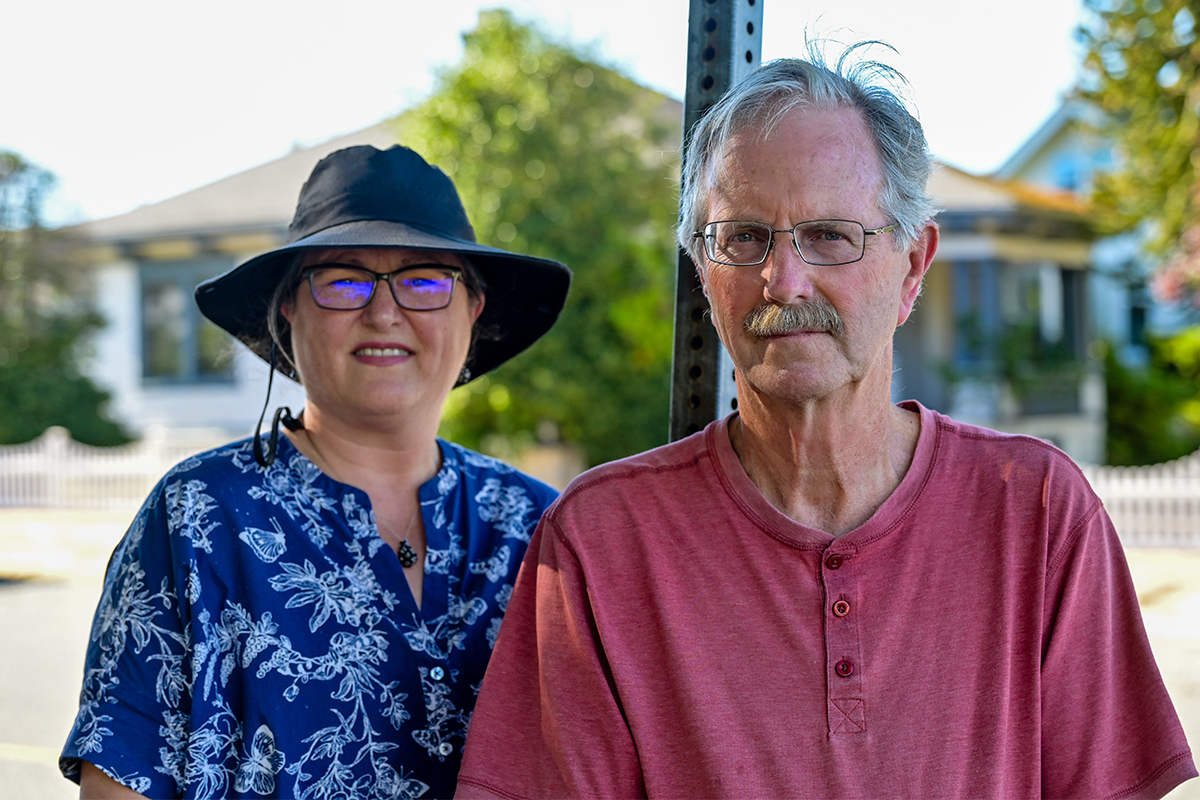
Mike Parker has been living in Chase River for more than 30 years and is currently the chairperson for the Chase River Community Association. Since the two locations opened in July, Parker said he has not seen a single complaint made about either site.
When BC Housing and the city made the announcement for the 1300 Island Hwy. temporary housing, he said he reached out to invite the agency to a community meeting with local residents.
At the meeting, Parker said residents asked about how things like staffing ratios, training and meals would work at the sites.
“But there’s been people in our community who have embraced it and are willing to help them with beautification projects, and that’s cool,” he said.
Before the site opened, Connective reached out to invite community members for a tour of the area and Tosh gave them her phone number in case they had any concerns when residents started moving in.
So far, the only thing that she’s had to deal with is a request to turn the music down when a group of residents was socializing around some picnic tables.
“The residents were more than happy to do that,” Tosh said. “They had no idea that other people could hear it.”
Although the reception of the two temporary housing locations have gone well, Parker said he would like future supportive housing to be located in other areas of the city so “it’s not all downtown. Downtown’s tired of that.”
“The people of Chase River have stepped up and done our part, so now it’s [time for] every other community in Nanaimo to do their part,” he said.
More types of housing needed
Parker, a retired civil servant with the BC government, said the Chase River community wants the temporary supportive housing in the neighbourhood, but also wants more affordable rental housing for seniors and youth.
“When you’re looking at condos $400,000 and $500,000 for 800 square feet, it’s insane,” he told The Discourse.
“The government’s going to have to subsidize things or get less than market driven housing so young people can at least get into the market.”
Parker said the Chase River neighbourhood has a high percentage of residents who are seniors who live in trailers and the community needs more affordable housing so people who are moving out of their homes to downsize can afford a smaller apartment.
“There’s no reason for seniors to be in temporary housing but they can’t afford to pay $2,000 a month because they don’t make that kind of money,” Parker said. “So they’re in nowhere land.”
READ MORE: How can we make rent more affordable?
Municipal versus provincial roles
The City of Nanaimo and BC Housing signed a memorandum of understanding in 2019 to build six new housing sites in the city that were a mix of supportive and affordable rental housing for a total of 608 units, 188 of which would be supportive housing.
Brinkman said half of the sites were to be supplied by the city and half by the province.
“We aren’t land rich. Some municipalities own much more land and Nanaimo actually doesn’t,” Brinkman said. “We’ll occasionally purchase a parcel or carve off a parcel that we may have.”
A recent City of Nanaimo staff report shows that the province also has a number of supportive housing buildings in Nanaimo that have been built or are being built as part of its HEART and HEARTH programs that are supported by the city. Those four properties have a total of 237 units of supportive housing.
BC Housing is also partnering with Island Health to develop 20 units of housing for people with complex care needs on Boxwood Road.
BC Housing spokesperson Henry Glazebrook told The Discourse via email that the province “works to secure suitable land and buildings for housing and shelter in line with municipal requirements, including official community plans.
When selecting locations for supportive housing, the province considers factors such as land cost, proximity to schools and daycares and access to services and transit, Glazebrook said.
BC Housing works with RCMP and bylaw officers, who Glazebrook said “are best placed to support neighbourhood and street safety, and establish communication channels with neighbours to help address concerns.”
Hemmens said “a mandate of building housing in the province is amazing, and we can all get behind that, but that housing does come with impacts in communities that need to be discussed openly and mitigated if at all possible and that can’t just be left with the city.”
In a mandate letter to BC Housing, the former Minister of Housing charged the organization to work with municipalities to “build housing for middle-income families, individuals and seniors” as well as “maintain and densify” social housing properties.
South End resident Joanne Swain, treasurer for the South End Community Association, said she knows services for people experiencing homelessness are needed but is concerned with an “overconcentration” of them in one neighbourhood.
“What we need is a more balanced, city-wide approach — one that spreads out services in a way that supports integration and dignity, rather than isolation or frustration,” she told The Discourse via email. “I know it’s possible to do this with care and collaboration. What we’ve received is lip-service.”
Old City Neighbourhood Association welcomes new residents
The Downtown and Old City neighbourhoods are home to supportive housing buildings on Prideaux Street and Wesley Street.
Joy Adams Bauer, president of the Old City Neighbourhood Association, told The Discourse her group has a great relationship with Connective, the operator of the Cornerstone supportive housing building on Prideaux Street.
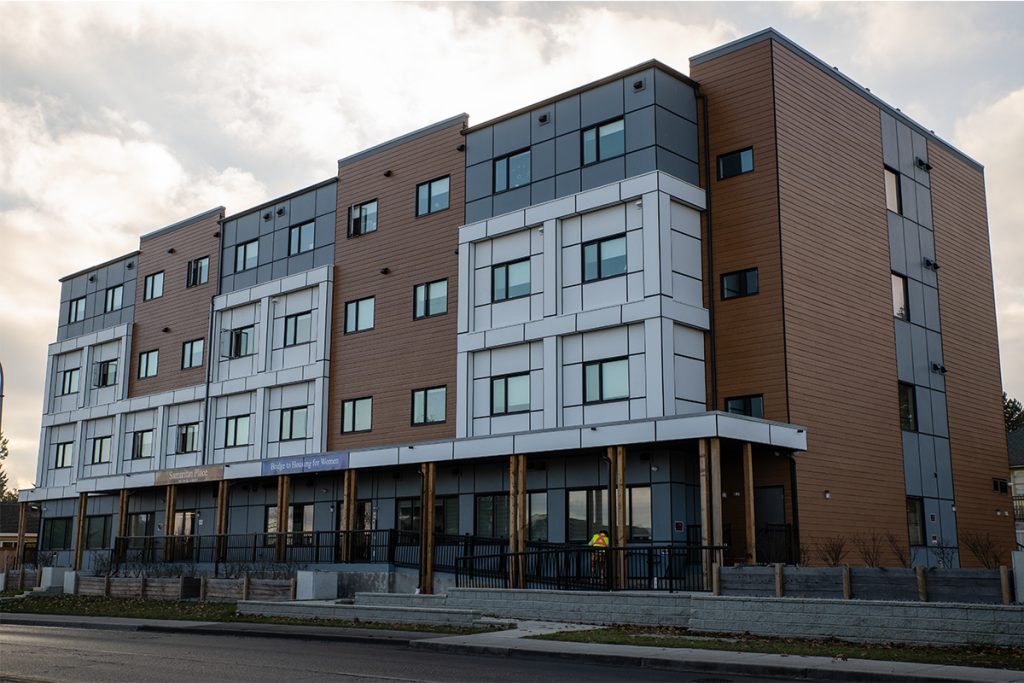
Before the supportive housing building was constructed, the location was a city-owned community services building where the 7-10 Club ran a meal program. During the COVID-19 pandemic, it was converted into a shelter for older people experiencing homelessness who were at a heightened risk from the coronavirus. BC Housing then built a 51-unit supportive housing building on the site.
“We were all extremely pleased, and certainly our members were very happy to welcome those folks into our neighbourhood,” Adams Bauer said.
When the building opened, Adams Bauer said the association was part of a monthly Community Advisory Committee meeting where neighbourhood residents meet with city officials, police and the housing operator to discuss any issues. However, after it had been open for a while, the group decided the meetings were unnecessary, “as everything was going so smoothly.”
“The consultation has been top-notch, from Connective that’s running it, to BC Housing who’s funding it, to the municipality who was able to provide the land,” Adams Bauer said. “It’s been very good.”
Tosh said she understands that when a supportive housing project is announced there is “a lot of fear.” That’s why the agencies operating the housing projects meet with residents to “listen to their fears.”

“Because that’s one of the big things the community thinks, that we’re not listening to them,” Tosh said.
Adams Bauer lives about a block away from the Cornerstone building and regularly walks past it.
“If I see someone sitting out there I always say hi, and when they first came, welcomed them to the neighbourhood,” she said.
Adams Bauer said she thinks the residents of Cornerstone moving together from the temporary housing at Newcastle Place helped integrate them into the new building.
“They already had two-and-a-half [to] three years living together as a community, so that really helped when they moved to Cornerstone.”
One of the members of the Old City Neighbourhood Association, Sue Creba, even made quilts for all of the residents in the building, according to Adams Bauer.
“I haven’t had any conversations with anybody who has said [they’re] concerned about this facility in our neighborhood,” Adams Bauer said.
Editor’s note, August 23, 2025: This article was changed to better reflect that two of the temporary housing sites — at 1030 Victoria Rd. and 1300 Island Hwy. — have opened since the map of supportive housing locations by the City of Nanaimo was published.