
Overdose Awareness Day brings community together to better understand the toxic drug crisis
Saving lives, understanding overdose and shedding stigma were the goals of the day.

Content warning: This story mentions overdose, substance use, the toxic drug crisis and death. Please read with care. Find a list of local and general resources for support, harm reduction, emergencies and more at the bottom of this newsletter.
A leisurely bike rider was struck by two things when he stopped at Charles Hoey Park last Saturday.
“There’s so much purple. And it seems so happy here,” he said.
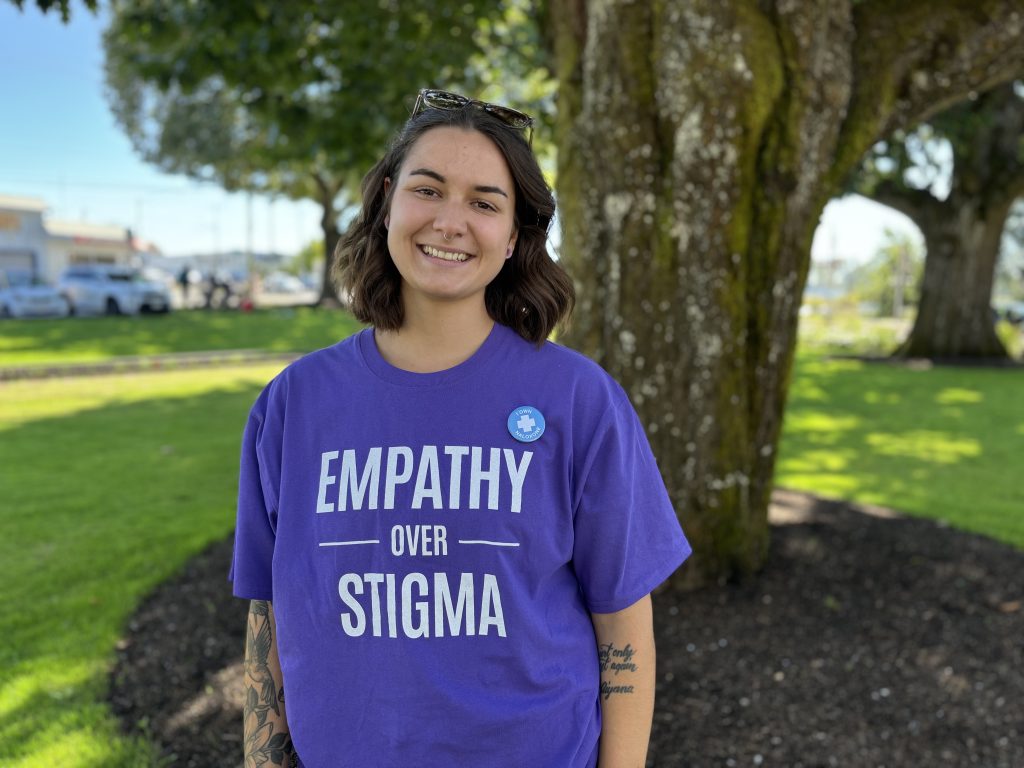
The day was both filled with purple and energy. Saturday, Aug. 31 was International Overdose Awareness Day with vibrant purple being the emblematic colour of the event, featured in ribbons, decorations and t-shirts that read “Empathy Over Stigma.”
The atmosphere was energetic and hopeful, and though the toxic drug crisis is extremely grave, encouraging community awareness required friendly and engaging volunteers and advocates on the ground.
“They want to come out and help keep other people safe, keep them alive. And that’s really amazing to see,” Cailey Foster, peer coordinator with the Cowichan Community Action Team, said.
Overdose Awareness Day event took visitors through past, present and future
The Cowichan Community Action Team and Cowichan Tribes joined together to present “Purple Ribbon Day” in downtown Duncan, in honour of International Overdose Awareness Day .
This year’s theme for International Overdose Awareness Day was “Together We Can,” and Purple Ribbon Day aimed to unite the community around understanding toxic drugs, the crisis and saving lives.
Foster noted that proper awareness around overdose is crucial because there is so much stigma, fear of asking for help, misinformation and politics around toxic drug poisoning.
“Just being here to acknowledge the issue, to show all the supports and remember people who we’ve lost — I think just gets that conversation going,” she said.
There was no lack of conversation at Purple Ribbon Day as hundreds of people filed through the information tents asking questions, taking pins and pamphlets and finding support for substance misuse and grief.
Alexis Cage from Kwun’atsustul Counselling is a treatment coordinator with Cowichan Tribes and coordinated Purple Ribbon Day with the Community Action Team. She pointed out that the positioning of the tents in Charles Hoey Park that day was deliberate.
“We structured it as past, present and future,” Cage said.
Visitors entered through a memorial section with booths to honour lives lost to the toxic drug poisoning crisis and find grief support. The middle area was filled with present day community supports and front line community organizations spreading word that support is available. The last section of the event setup featured a community art project, intended to keep awareness going beyond International Overdose Awareness Day.
Read also: Want to end the drug poisoning crisis? Start by listening to people who use drugs
What exactly is overdose awareness?
Cage explains that the word “overdose” is not about consuming drugs, but the toxic ingredients found in them. A user might take a small amount of drugs, but with unregulated supplies and drugs containing sedative additives like benzodiazepines or fentanyl, that user can be dangerously close to overdosing or worse, dying.
“I think the language is now shifting more to ‘toxic drug poisoning,’ because ‘overdose’ can be interpreted incorrectly,” Cage said. “It almost sounds like it can be intentional, like you are just taking too much, when that is rarely the case.”
Johanne Kemmler, coordinator for Cowichan Community Action Team, said another misconception of overdose is that it only affects the person you see lying in the street.
“It’s actually a neighbour using alone that’s [more likely to] die from an overdose,” Kemmler said. “It’s everyday people that are dying from drug overdoses.”
And the statistics — no matter which numbers you highlight — are staggering.
Since B.C. declared a public health emergency with the drug crisis in 2016, more than 15,000 people in the province died from drug use. Toxic drugs are the leading cause of death for those in the province between the ages of 10 and 59, accounting for more deaths than homicides, suicides, accidents and disease put together.
In 2022, 389 individuals on Vancouver Island died from illicit drug toxicity and in 2023, according to BC Emergency Health Services, the number of overdose/poisoning calls paramedics responded to in Duncan alone was 819.
Nancy James has been a counsellor for Cowichan Tribes for 30 years. On Saturday, she sat at the memorial table, welcoming people to light a candle and post a loved one’s name on the memorial board.
“Right now, my mandate is to work with children who have lost parents to overdose,” James said as people approached to add a name to the board.
In the middle of our talk, three more people came up to add a name to the board.

Support is out there
Purple Ribbon Day centers around overdose awareness, but the event is also about how to save lives.
“That’s our goal, because dead people can’t access treatment,” Kemmler said.
Kemmler hopes that campaigns like Purple Ribbon Day help get word out that strong support does exist in Cowichan Valley.
Eager and talkative volunteers were present at the event to show the community the variety of ways someone struggling with substance use disorder can access support.
Island Health shared a number of avenues toward care, including a new toll-free access number (1-833-804-8111) people can call for same-day care.
The local Lookout Housing and Health Society informed people about safe usage, overdose prevention and drug supply testing.
Cowichan Hospice was on site for information on grieving support.
Youth Short Term Assessment and Response shared information about its program geared towards youth in crisis.
The Cowichan Women Against Violence Society was on hand to talk about addiction and support.
The Cowichan Community Action Team handed out materials for a number of treatment options, including the Lifeguard app, which is a way for people to stay connected to emergency help when using drugs alone. They also distributed a hefty document called the Duncan Street Survival Guide, listing the ways someone can access food, shelter, support and more.
“This comes back to talking about it, making sure [people] know the help is there when they want it,” Foster said.

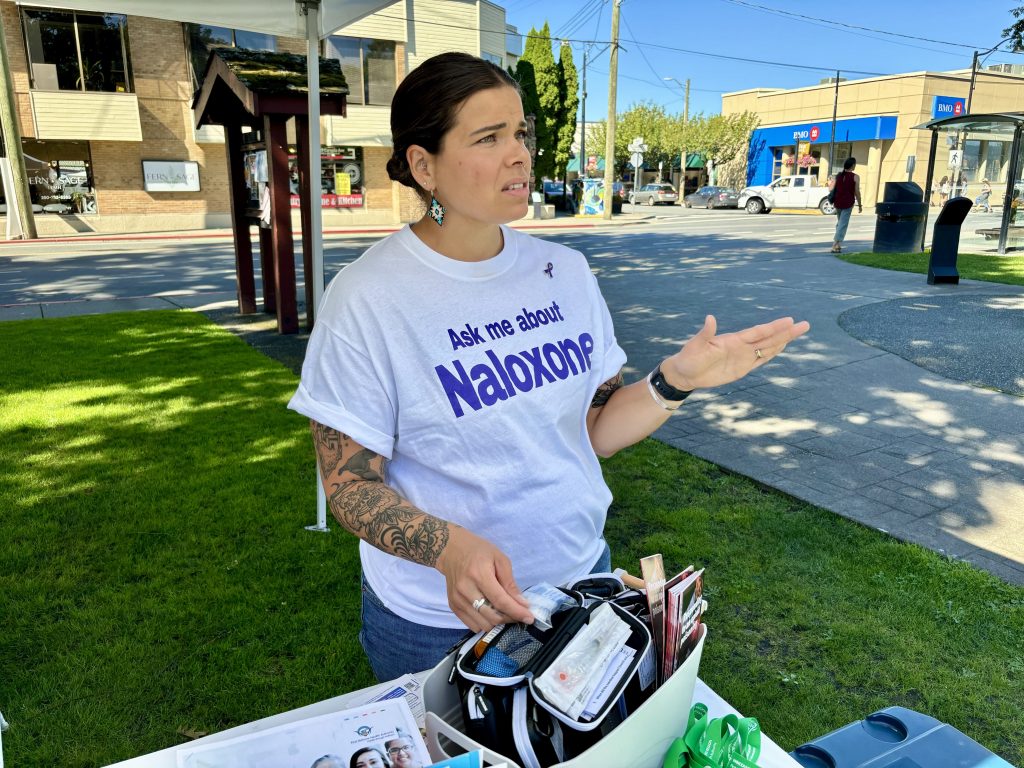
One table provided community members with the tool that directly saves lives. Naloxone kits, if used correctly, temporarily reverse the effects of an opioid overdose and can bring someone back to consciousness. Administering a dose via injection or nasal spray helps get people breathing again and until help arrives.
Danielle Kannegiesser of the First Nations Health Authority assured people that naloxone administration is easy and cannot harm someone or be misdiagnosed. She also said the kits aren’t difficult to find.
“It’s very accessible,” Kannegiesser said. “You can just walk into the pharmacy and ask for them. They’ll do training for you.”
Alexis Cage carries naloxone kits wherever she goes, and hopes that others will do the same to save lives. She wanted people to know that carrying a kit doesn’t carry a stigma, rather it shows you care for others.
“I think that’s our biggest message of the day,” she said. “Even just to show it as a sign of compassion, to hang it on your bag, says, ‘I’m an ally.’”
Peers support overdose awareness and prevention
Volunteers, health workers and community members weren’t the only people on site. Peers who face addiction were in the park as well to talk about what it’s like to actually experience an overdose.
Louis has been using drugs and alcohol since the age of 11. Today, he is 60 and spoke of the “hell” an overdose can be.
“You’re just black,” Dowling said. “You don’t even know that you’ve done it. You just wake up and someone will tell you that you did — if you live.”
Dowling said the toxic additions to the drugs he used were the cause of his overdoses. Today he finds it painful to walk because he said toxic drugs have affected his spine.
“I walk bent over because they put elephant tranquillizer in the dope.”
Animal tranquillizers such as xylazine and other sedatives like benzodiazepines have been traced in local unregulated opioid samples, according to the Vancouver Island Drug Checking Project. These toxic drugs pose a serious health risk because they do not respond to naloxone.

Tracy developed her drug dependence after painkillers helped her recover from a home fall. That contributed to a future of addiction, trauma and homelessness. Today, she is part of the Cowichan Community Action Team, helping people through her own experience.
“Turn it into something good — why not?” Tracy said. “It enables me to do things like this event, because I can help somebody else.”
Tracy said she helps both fellow addicts as well as people suffering from loss.
“There was this one lady, her son just overdosed a couple weeks ago and she was angry with the people who use drugs. And she didn’t know what to do with that. So I helped her through that.”

Both Tracy and Louis want the stigma attached to drug dependence to disappear.
“We’re human beings at the end of the day,” Tracy said. “We want a place that we can lay our head down and feel safe enough to relax, and to fall asleep.”
Empathy over stigma
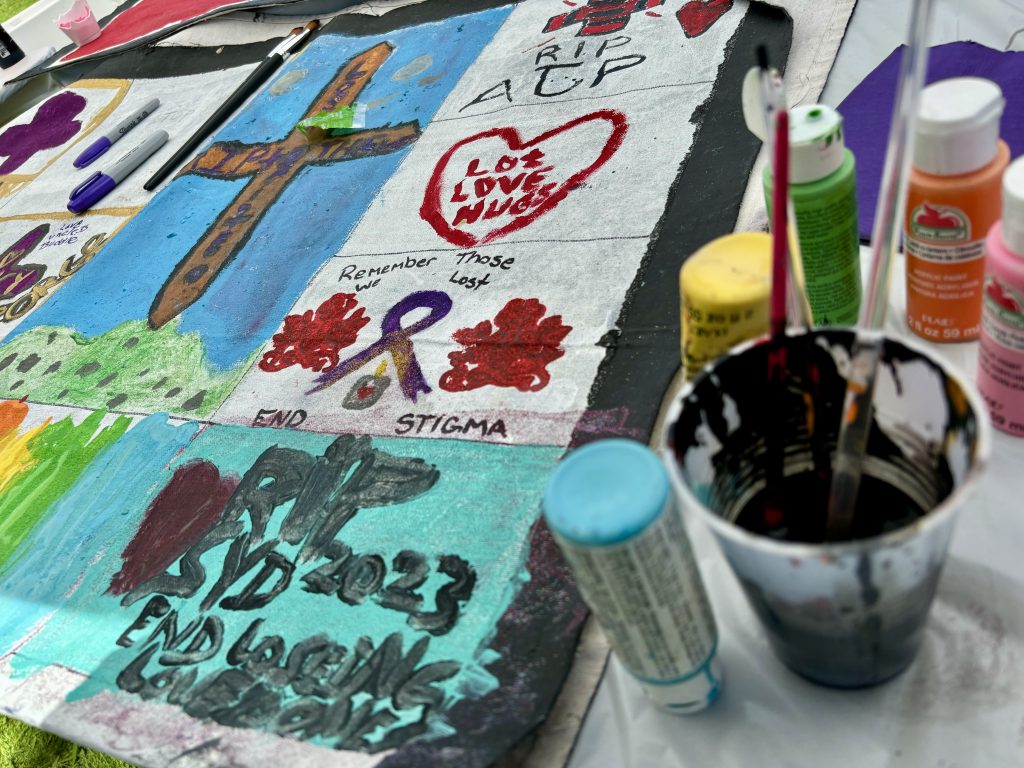
Many people at Purple Ribbon Day agreed that stigma is a massive barrier to the community coming together to battle toxic drug poisoning as evidenced in online community groups where addiction, homelessness and overdose are all very divisive issues.
“I know there’s a lot of people that don’t support the community that we do,” Cage said. “So I think we all need to get on the same page and have a little bit of compassion and understanding that this could be any one of us.”
Cage said there is no one-track answer to solving the accelerating toxic drug crisis. She said the community is navigating a “huge sea of grey,” not a black-and-white issue.
“I guarantee almost everybody here has been affected in some way by toxic drug poisoning deaths,” she said. “So I think we just need to own it and realize that it’s not going away, and that we just need to support it and not fight against it.”
Cage has worked the front lines of the opioid crisis doing outreach, overdose prevention, shelter work and treatment duties. She said she has never had a bad experience or been fearful in her work.
“I know there is a lot of fear around mental health and substance use, but if you’re kind to people, they’re going to show that back.”
Johanne Kemmler of the Cowichan Community Action Team told a story of her own son in the throes of addiction, and the simple things that help him toward recovery and meaning.
“Just a kind word,” Kemmler said. “He says when people smile and say hello, it feels so good.”
What did you think of this story?
Your feedback after we publish a story helps ensure we're always improving our reporting to better serve you
Author

Related Articles

Cowichan Valley local election candidates on natural disaster preparedness
In the summer months, the threat of wildfire is becoming more frequent. In the winter, there’s flooding. What do the candidates suggest doing to prepare?

Voting in the 2026 Cowichan Valley local elections? Here’s what you need to know
Where, when and how to cast your ballot in North Cowichan, Duncan, Ladysmith, Lake Cowichan and the Cowichan Valley Regional District for the 2026 local elections.

Cowichan Valley candidates on protecting the community from climate change
Candidates in Duncan, North Cowichan, Ladysmith and Lake Cowichan share the steps they’d take to protect the community from the impacts of climate change.